
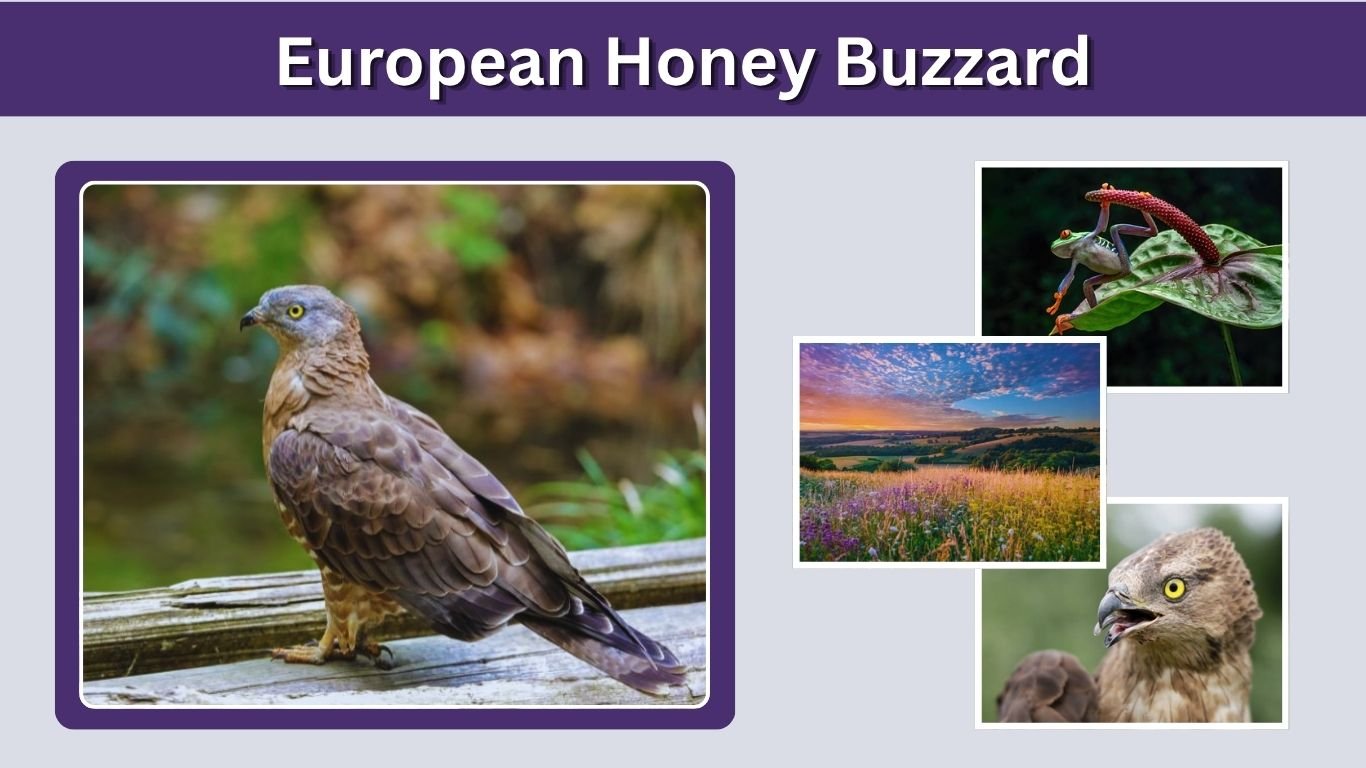
The European honey buzzard (Pernis apivorus) is a large migratory bird of prey known for raiding wasp and bee nests. Despite its name, it does not primarily eat honey and is not a true buzzard of the genus Buteo. It breeds across Europe and western Asia before migrating to tropical Africa for winter. Its small projecting head, long tail, variable plumage, and slow, flexible wingbeats help distinguish it from the common buzzard.
European Honey Buzzard Quick Facts
This secretive raptor belongs to the same broad family as hawks, kites, and eagles. It spends much of the breeding season inside mature woodland, so it may be overlooked even where it is present.
| Feature | Description |
| Scientific name | Pernis apivorus |
| Family | Accipitridae |
| Average weight | About 725 grams |
| Main diet | Wasp and bee larvae |
| Preferred habitat | Mature woodland near open feeding areas |
| Migration | Europe and western Asia to tropical Africa |
| Typical clutch | Two eggs |
| UK status | Scarce summer breeding visitor |
The British Trust for Ornithology lists an average weight of approximately 725 grams and a typical clutch of two eggs. In the UK, the species is rare, localised, and difficult to monitor because of its secretive habits.
What Does a European Honey Buzzard Look Like?
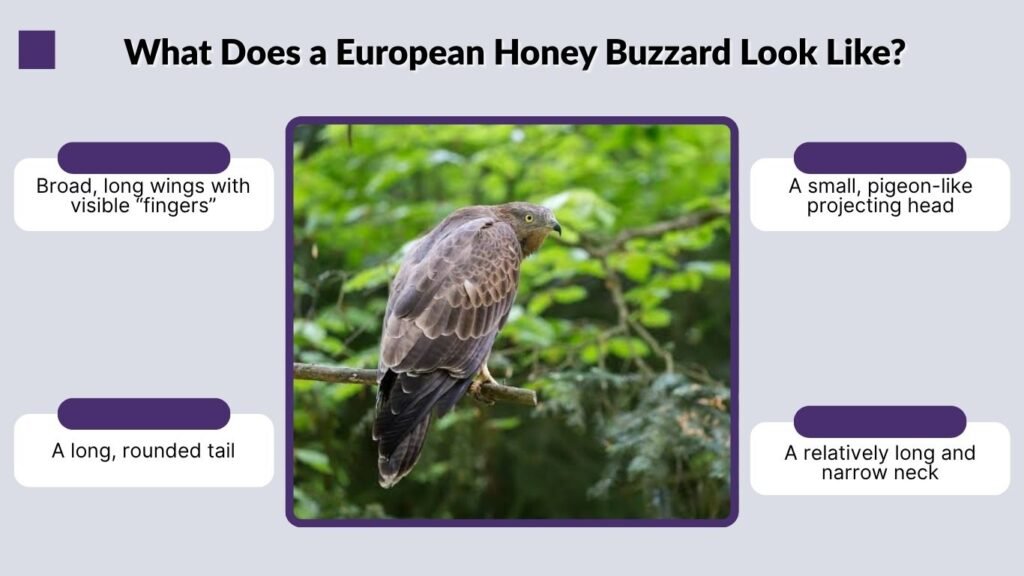
European honey buzzards are approximately the size of common buzzards, but they generally look slimmer and longer. Their plumage is extremely variable, ranging from pale cream or grayish brown to dark chocolate brown. Structural features are therefore more dependable than color alone.
Identification Features
Look for the following characteristics:
- A small, pigeon-like projecting head
- A relatively long and narrow neck
- Broad, long wings with visible “fingers”
- A long, rounded tail
- Dark bands across the tail
- A slender, hooked bill
- Variable brown, gray, cream, or reddish plumage
- Wings held flat while soaring
- Loose and relatively slow wingbeats
The long tail and narrow head create a distinctive silhouette. When gliding, the wings may curve slightly downward, while soaring birds usually hold their wings flatter than common buzzards.
Male vs Female European Honey Buzzard
Adult males commonly have a blue-gray or grayish head, while females generally have a browner head. Females may also appear slightly larger and more heavily patterned below.
However, plumage varies considerably, and some individuals cannot be sexed confidently from a distant view. Tail pattern, wing barring, eye color, and overall structure must be considered together.
Juvenile European Honey Buzzard
Juveniles are especially variable and may resemble common buzzards. They often have a more strongly patterned face, coarse streaking on the breast, and dark patches around the wrists of the wings.
Young birds can also show more evenly spaced tail bars than adults. Their long tail, slim body, protruding head, and broad wings remain valuable identification clues.
European Honey Buzzard in Flight
Flight identification is often easier than identifying a perched bird. European honey buzzards have a light, flexible flight style, with slow wingbeats and long periods of soaring.
Wing and Tail Shape
The wings are broad but appear relatively long, with slightly narrowed bases. The tail is longer than that of a common buzzard and may appear rounded or paddle-shaped when spread.
In a good view, the tail shows a dark terminal band with additional separated bars closer to the base. Plumage and tail markings vary by age and sex, so the bird’s proportions remain important.
Display Flight
During the breeding season, honey buzzards may perform an aerial display in which they rise, briefly hold or clap their wings above the back, and then descend. These displays are most likely to be observed over established breeding woodland.
They otherwise spend considerable time below the canopy and may be surprisingly difficult to detect once nesting begins.
What Do European Honey Buzzards Eat?
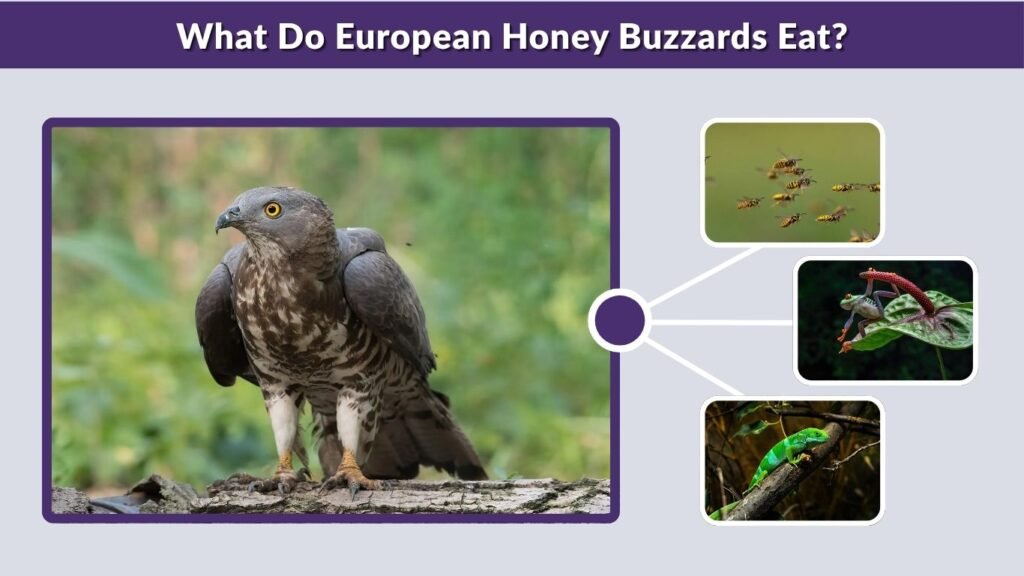
European honey buzzards specialize in feeding on the immature stages of social wasps and bees. They locate nests, dig into the ground or open exposed combs, and consume the larvae and pupae inside.
Main Foods
Their diet includes:
- Wasp larvae and pupae
- Bee larvae and pupae
- Adult wasps and bees
- Other large insects
- Frogs
- Small reptiles
- Nestling birds and small mammals occasionally
Alternative prey becomes more important when social-insect colonies are difficult to find. However, wasp and bee grubs remain the food most strongly associated with this species.
Do European Honey Buzzards Eat Honey?
They may consume small quantities of honey or wax while opening a nest, but honey is not their primary target. The birds are searching mainly for protein-rich larvae and pupae.
The name “honey buzzard” is therefore somewhat misleading. Their scientific name, Pernis apivorus, also refers to bee-eating behavior even though developing insects form the main meal.
How Do They Avoid Stings?
Honey buzzards have dense, scale-like feathers around the face and eyes that offer some protection while they attack insect nests. Their relatively small bill and narrow nostrils also help them work around loose soil, wax, and defensive insects.
They are not necessarily immune to venom. Instead, their physical protection, careful behavior, and ability to dismantle nests reduce their exposure to stings.
European Honey Buzzard Habitat and Distribution
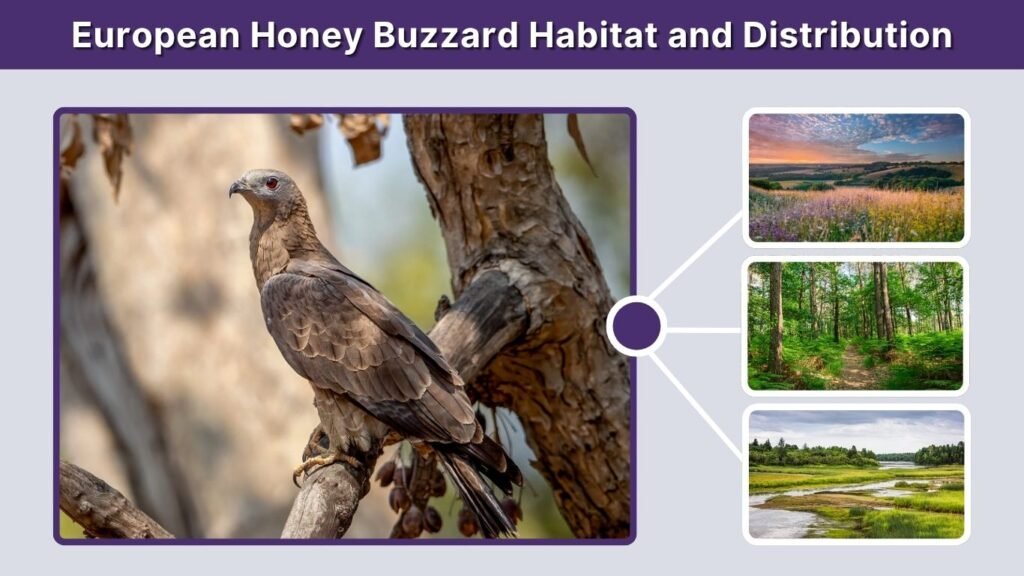
European honey buzzards breed across much of Europe and parts of western Asia. They prefer mature deciduous, mixed, or coniferous woodland near clearings, meadows, farmland, or wetlands where wasp colonies can be found.
European Range
The bird occurs during summer in countries including Germany, France, Spain, Italy, Portugal, Hungary, Finland, Greece, and parts of the United Kingdom. Its exact abundance varies considerably between regions.
In Britain, it is a scarce breeding bird found mainly in secluded mature woodlands. Most individuals begin arriving from May onward, and passage movements may become more noticeable in September.
European Honey Buzzard in the UK
The species is one of the UK’s rarest breeding raptors. Breeding locations are often kept confidential because the birds and their nests require protection.
Honey buzzards may occur in southern England, Wales, northern England, and parts of Scotland, but their quiet woodland behavior means some individuals may remain undetected.
European Honey Buzzard Migration
European honey buzzards are long-distance migrants. After breeding, they travel south across Europe and the Mediterranean before spending winter in tropical and sub-Saharan Africa.
Autumn Migration
Autumn migration can produce large gatherings, particularly near narrow sea crossings and other geographical bottlenecks. The birds use rising air currents to soar and reduce the amount of energy required for the journey.
Large numbers may pass through areas around Gibraltar and other Mediterranean crossing points before continuing into Africa.
Spring Migration
In spring, the birds travel north from Africa to their European breeding grounds. They arrive relatively late compared with some other migratory raptors, with many reaching northern breeding areas during May.
Their late arrival matches the seasonal availability of wasps and other social insects needed to feed adults and growing chicks.
European Honey Buzzard Call
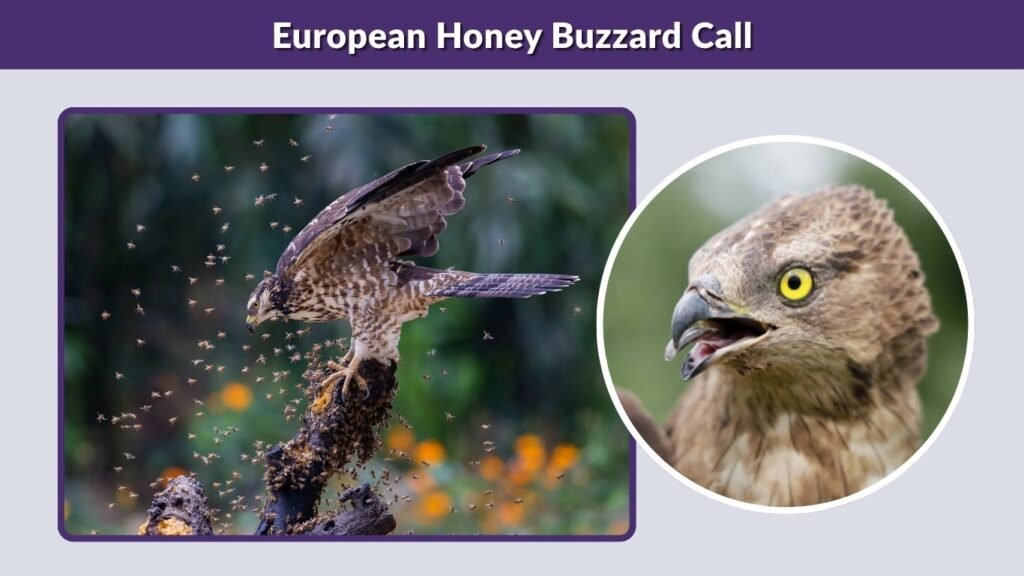
The call is a high, clear, modulated whistle, often given while the bird is flying above woodland. It may rise and fall in pitch and can sound thinner and more drawn out than the familiar mewing call of a common buzzard.
Honey buzzards may call during aerial displays, territorial encounters, and communication between adults and young. They are otherwise relatively quiet and easily missed beneath a forest canopy.
Breeding and Nesting
European honey buzzards usually build or renovate a stick nest high in a mature tree. Fresh green leaves are often added to the nest, helping distinguish an active structure from an abandoned raptor nest.
A typical clutch contains two eggs, and the pair usually raises one brood per year. Both parents participate in caring for the nest and feeding the chicks. Pieces of wasp comb containing larvae may be carried back to the young.
European Honey Buzzard vs Common Buzzard
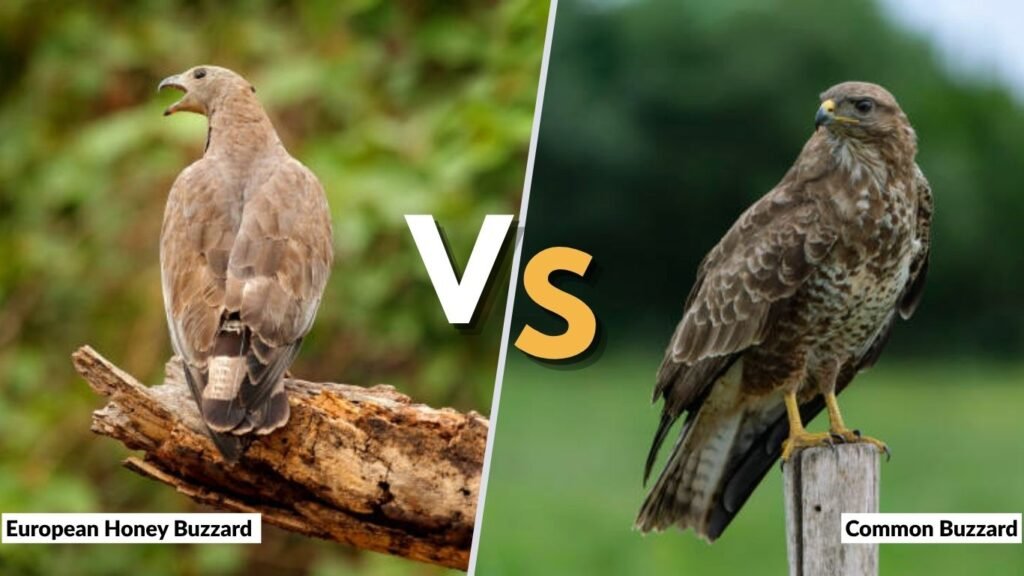
The two species can appear remarkably similar, especially when plumage is viewed from a distance.
| Feature | European Honey Buzzard | Common Buzzard |
| Head | Small and projecting | Broader and rounder |
| Neck | Longer and slimmer | Short and thick |
| Tail | Longer and more rounded | Shorter and broader |
| Body | Slim and elongated | Compact and heavy |
| Soaring wings | Usually held flat | Often slightly raised |
| Flight | Loose, slow wingbeats | Firmer, heavier wingbeats |
| Main diet | Wasp and bee larvae | Mammals, birds, worms, and carrion |
| Seasonal behavior | Long-distance migrant | Often resident |
Because both species have highly variable plumage, silhouette and flight behavior are generally more reliable than color.
FAQs
Is the European honey buzzard a true buzzard?
It is not a true Buteo buzzard like the common buzzard. It belongs to the genus Pernis within the hawk and eagle family. Its resemblance to common buzzards is responsible for its English name.
Are European honey buzzards rare?
They are widespread across continental Europe but can be scarce and difficult to observe in individual countries. In the UK, they are rare breeding visitors that favor secluded mature forests.
Where do European honey buzzards go in winter?
They migrate to tropical and sub-Saharan Africa. Many travel through Mediterranean bottlenecks, where large groups may gather before crossing narrow stretches of sea.
Do European honey buzzards kill bees?
They may eat some adult bees, but they mainly raid colonies for larvae and pupae. They also target wasp nests and use other small animals when their preferred insect food is unavailable.
How can you identify a European honey buzzard in flight?
Look for a small projecting head, long neck, long rounded tail, broad wings, and loose wingbeats. Soaring birds usually hold their wings flat, while gliding birds may curve them slightly downward.
