
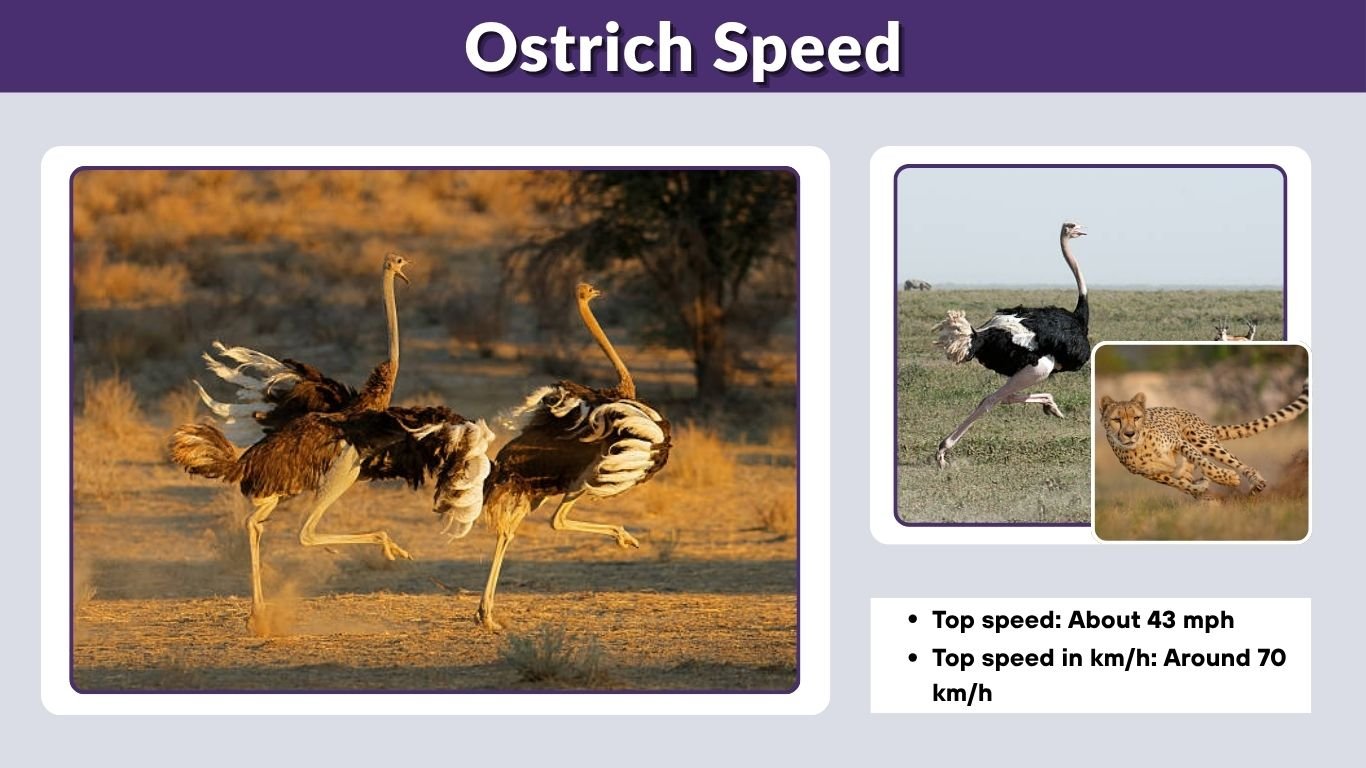
Ostrich speed is one of the most impressive examples of running ability in the bird world. An adult ostrich can reach a top speed of around 43 mph (70 km/h), making it the fastest living bird on land. Its long, powerful legs, two-toed feet, flexible joints, and enormous stride allow it to accelerate quickly and maintain high speeds efficiently. Although a cheetah can sprint faster, an ostrich has impressive endurance and can continue running at considerable speed for much longer distances.
How Fast Can an Ostrich Run?
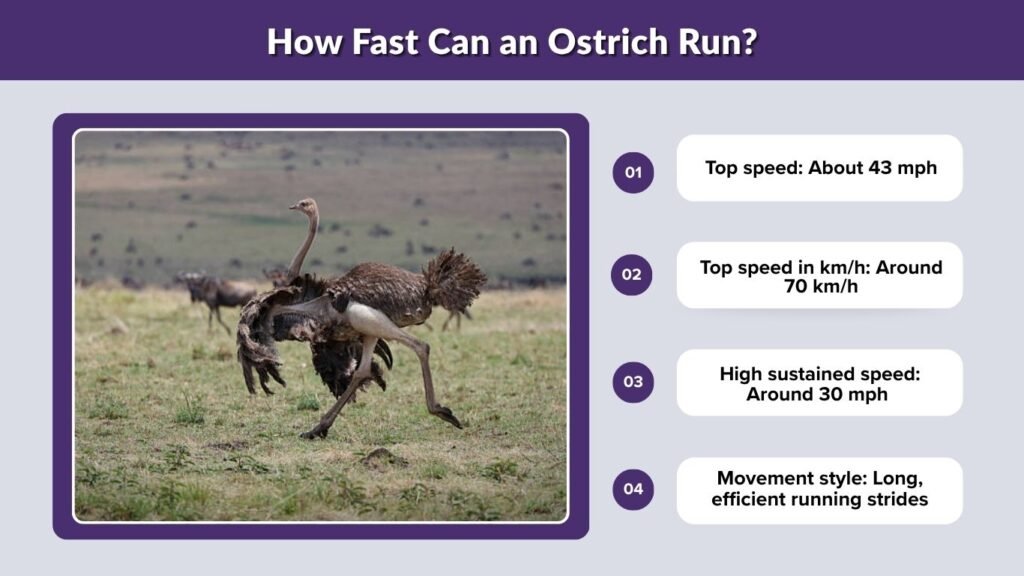
Ostriches cannot fly, but their bodies are exceptionally well adapted for running. Their long legs generate powerful strides, while relatively lightweight lower limbs reduce the energy required to move each leg. This combination enables an ostrich to accelerate quickly across open grasslands and escape many predators without relying on flight.
Ostrich Top Speed
Important ostrich speed figures include:
- Top speed: About 43 mph
- Top speed in km/h: Around 70 km/h
- High sustained speed: Around 30 mph or more for significant distances
- Movement style: Long, efficient running strides
- Fastest land bird: Ostrich
- Primary purpose: Escaping predators and traveling across open habitats
Individual speed can vary according to age, health, terrain, and environmental conditions.
Ostrich Speed in MPH and KM/H
An ostrich running at full speed can reach approximately 43 miles per hour, which equals about 70 kilometers per hour.
At that speed, the bird can cover:
- About 0.72 mile in one minute at an ideal constant 43 mph
- Roughly 1 kilometer in under a minute
- Considerable open ground very quickly when escaping danger
In reality, an ostrich does not remain at maximum sprinting speed continuously, so these figures are mainly useful for understanding how fast its peak performance is.
Why Can Ostriches Run So Fast?
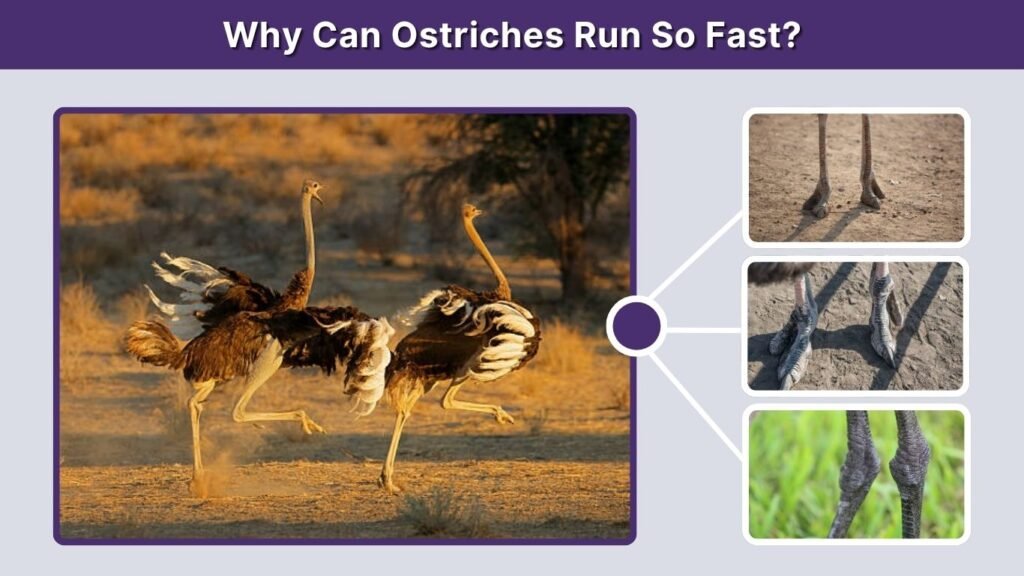
The ostrich’s speed is not produced by muscle strength alone. Its entire lower body is specialized for efficient running. Long bones increase stride length, strong muscles provide propulsion, and elastic tendons store and return energy with each step. Even its unusually shaped feet contribute to rapid movement over open terrain.
Running Adaptations
Several features help an ostrich achieve remarkable speed:
- Extremely long legs
- Powerful upper-leg muscles
- Lightweight lower legs
- Elastic tendons
- Only two toes on each foot
- Large weight-bearing inner toe
- Long running stride
- Flexible joints
- Strong balance
- Wings that assist with maneuvering
Together, these adaptations allow the bird to combine speed with surprisingly efficient energy use.
Two-Toed Feet Improve Running
Ostriches are unique among living birds because each foot has only two toes.
The larger inner toe carries much of the bird’s weight and provides strong contact with the ground. Having fewer toes also reduces weight at the end of the leg, allowing it to swing more efficiently.
This specialized foot structure contributes to both speed and stability during running.
Ostrich Running Speed and Stride
Watching an ostrich run reveals how different its movement is from that of smaller birds. Instead of taking many short steps, an ostrich uses enormous strides. At high speed, each step covers several meters, reducing the number of movements needed to travel a given distance.
How Long Is an Ostrich Stride?
At high running speeds, an ostrich’s stride can reach roughly 10 to 16 feet depending on speed and individual size.
Its long stride provides several advantages:
- Covers more ground with each step
- Reduces unnecessary leg movements
- Helps maintain high speed
- Improves running efficiency
- Allows rapid escape from predators
The bird’s long legs therefore provide both mechanical efficiency and impressive speed.
How Ostriches Turn at High Speed
An ostrich does not always escape predators by running in a perfectly straight line.
Its wings can help with balance and rapid directional changes. During a turn, the bird may spread or move its wings while adjusting its body position.
The legs continue providing most of the propulsion, while the wings function somewhat like balancing surfaces.
How Long Can an Ostrich Run Fast?
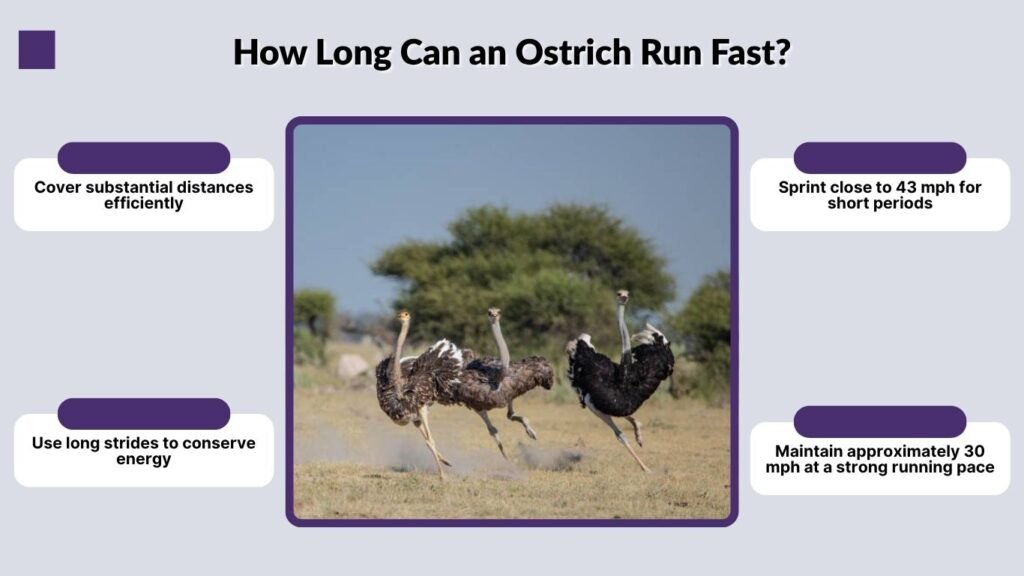
Peak speed and endurance are different abilities. An ostrich cannot maintain its absolute maximum of around 43 mph indefinitely, but it can run at lower high speeds for longer periods. This gives it an important advantage when escaping predators that may be extremely fast over short distances but tire more quickly.
Ostrich Endurance
An ostrich can:
- Sprint close to 43 mph for short periods
- Maintain approximately 30 mph at a strong running pace
- Cover substantial distances efficiently
- Continue moving after many short-distance predators slow down
- Use long strides to conserve energy
This combination of sprinting speed and endurance makes an ostrich particularly well suited to life on open savannas and grasslands.
Ostrich Speed vs. Cheetah
The cheetah is substantially faster than an ostrich over a short sprint. Cheetahs can exceed 60 mph, whereas an ostrich reaches roughly 43 mph. However, maximum speed tells only part of the story because the two animals have very different running strategies.
Cheetah vs. Ostrich Speed
A basic comparison is:
- Cheetah: Roughly 60–70 mph at maximum sprint
- Ostrich: Roughly 43 mph at maximum sprint
- Faster animal: Cheetah
- Greater sustained endurance: Ostrich can maintain high running speeds efficiently
- Ostrich advantage: Long-distance escape and directional changes
If a cheetah attacks an ostrich, the bird relies on early detection, fast acceleration, endurance, and maneuverability rather than simply trying to exceed the predator’s maximum speed.
Ostrich Speed vs. Horse and Emu
Ostriches are often compared with horses and emus because all three can travel quickly across open land. Exact speeds vary by individual and conditions, but ostriches rank among the fastest two-legged animals and can rival the speed of many horses.
Speed Comparison
Approximate maximum speeds include:
- Ostrich: About 43 mph
- Emu: Around 30 mph
- Horse: Many can reach roughly 40–45 mph
- Cheetah: More than 60 mph
- Human: Elite sprinters briefly approach around 27–28 mph
This makes the ostrich considerably faster than an emu and dramatically faster than any human runner.
Ostrich vs. Emu Speed
Both ostriches and emus are large flightless birds adapted for running, but ostriches are faster.
An emu can run approximately 30 mph, while an ostrich can reach around 43 mph.
The ostrich also has longer legs and a more extreme running specialization, including its unique two-toed feet.
Why Do Ostriches Need So Much Speed?
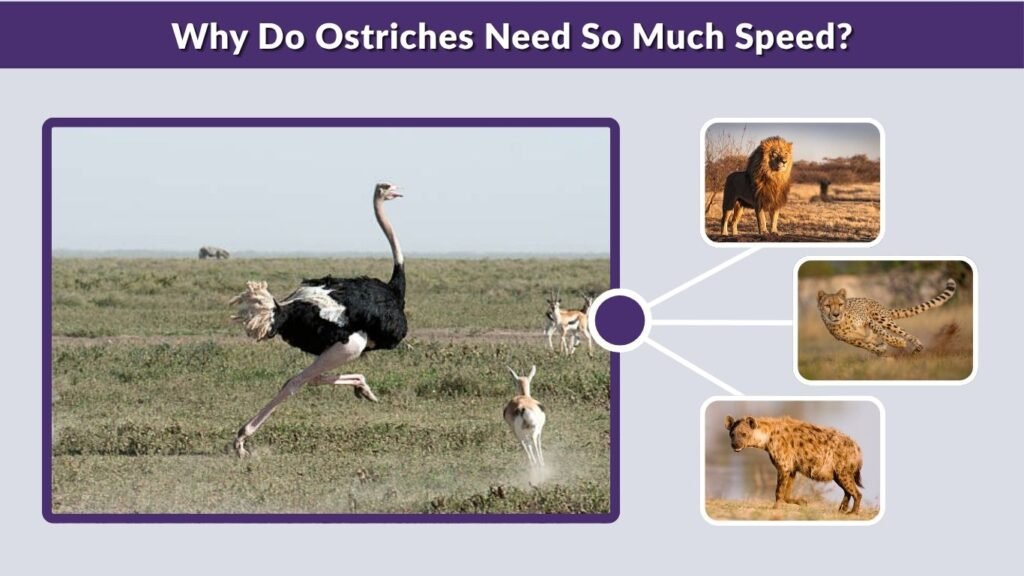
Ostriches evolved in open environments where hiding from predators is difficult. Their height allows them to detect danger from considerable distances, and their speed provides an effective escape mechanism once a threat approaches.
Speed as a Defense
Fast running helps ostriches escape predators such as:
- Lions
- Cheetahs
- Leopards
- Hyenas
- African wild dogs
Speed is usually the bird’s first line of defense.
If cornered, however, an ostrich can use its powerful legs to deliver forceful kicks. This combination of running ability and defensive strength makes an adult ostrich a challenging animal for predators to attack.
Do Male and Female Ostriches Run at Different Speeds?
Males are generally larger than females, but both sexes possess the same basic adaptations for fast running. Individual fitness, body condition, age, terrain, and motivation probably influence running performance more noticeably than sex alone.
Factors Affecting Ostrich Speed
Running ability may be influenced by:
- Age
- Physical condition
- Injury
- Terrain
- Temperature
- Body size
- Motivation
- Predator pressure
Healthy adult ostriches are exceptionally capable runners regardless of sex.
Interesting Ostrich Speed Facts
An ostrich is more than simply a fast bird. Its speed reflects millions of years of adaptation to a ground-based lifestyle. Since flight is unavailable, running has become its primary method of escaping danger and traveling efficiently across large areas.
Quick Ostrich Speed Facts
- Ostriches are the fastest living birds on land.
- Their top speed is around 43 mph.
- That equals approximately 70 km/h.
- Their stride can exceed 10 feet at high speed.
- They have only two toes per foot.
- Long legs provide excellent leverage.
- Wings help with balance and turning.
- Ostriches are faster than emus.
- Cheetahs are faster over short distances.
- Ostriches combine speed with impressive endurance.
FAQs
Ostrich running ability is particularly impressive because the bird combines high maximum speed with long legs, efficient movement, and considerable endurance. These features make it one of the most accomplished runners among living animals.
What is the top speed of an ostrich?
An adult ostrich can reach a top running speed of approximately 43 mph (70 km/h). This makes the ostrich the fastest living bird on land and one of the fastest two-legged animals.
How fast can an ostrich run in mph?
An ostrich can run at approximately 43 miles per hour at maximum speed. It can also maintain lower but still impressive running speeds over longer distances.
How fast is an ostrich in km/h?
The maximum speed of an ostrich is approximately 70 km/h. Exact performance varies among individuals and depends on terrain, health, age, and environmental conditions.
Is an ostrich faster than a cheetah?
No. A cheetah can exceed 60 mph during a short sprint, making it considerably faster than an ostrich’s roughly 43 mph top speed. However, ostriches have excellent endurance and can maintain substantial running speeds for longer distances.
Is an ostrich faster than a horse?
An ostrich’s top speed of roughly 43 mph is comparable to that of many fast horses, although individual horse speeds vary considerably by breed and training. Ostriches are particularly impressive because they achieve this speed while running on only two legs.
