
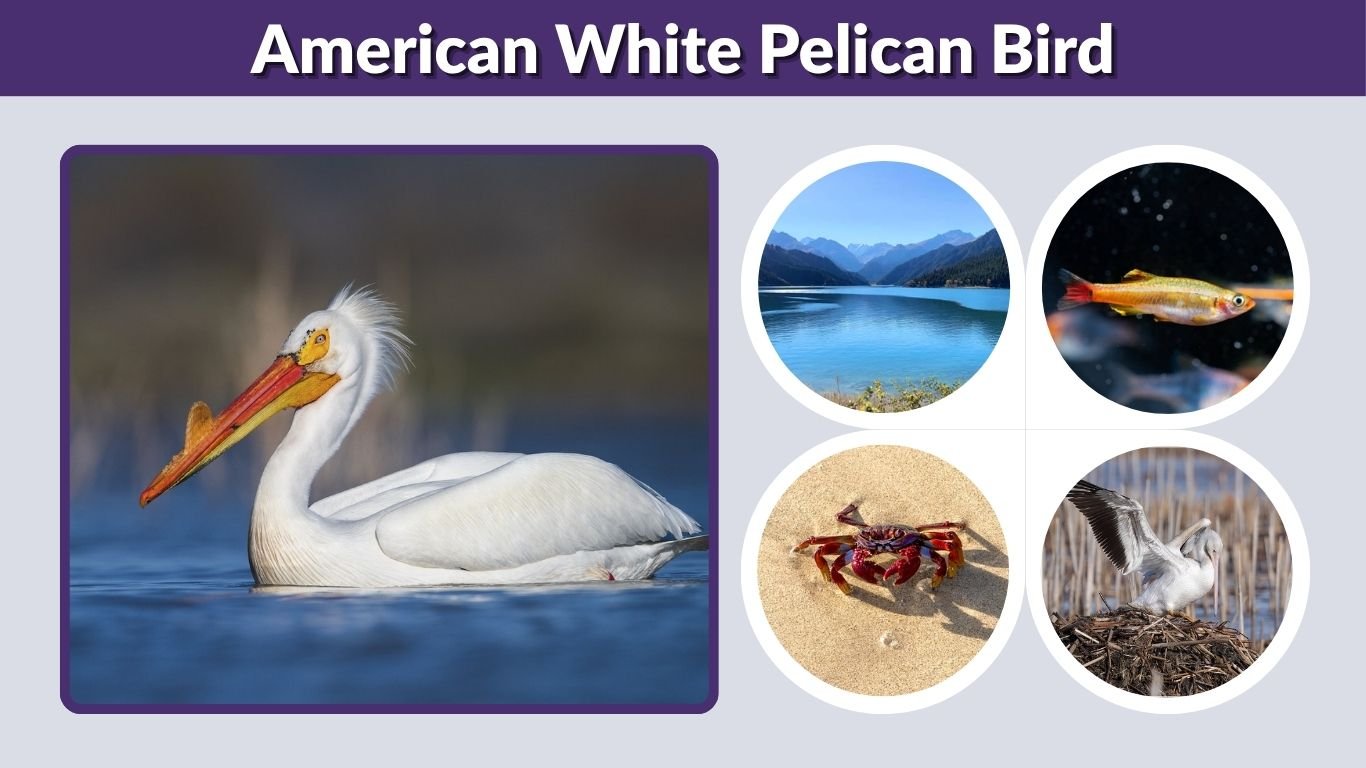
The American white pelican (Pelecanus erythrorhynchos) is one of North America’s largest and most impressive waterbirds. Known for its enormous wingspan, bright white plumage, orange bill, and graceful soaring flight, this pelican is often seen around lakes, rivers, wetlands, and coastal waters. Unlike brown pelicans, American white pelicans usually catch fish while swimming rather than diving from the air. This guide covers their identification, size, habitat, diet, migration, behavior, breeding habits, and other interesting facts about these remarkable North American birds.
American White Pelican Identification
American white pelicans are easy to recognize because of their huge bodies and striking black-and-white wings. At rest, most of the black flight feathers are hidden, making the bird appear almost entirely white. During flight, the black feathers become highly visible and create a sharp contrast with the white body and wings.
Key Identification Features
- Plumage: Mostly bright white on adults
- Bill: Very long and orange-yellow
- Throat pouch: Large, expandable orange pouch
- Legs and feet: Orange to reddish-orange
- Wing feathers: Black primary and secondary flight feathers
- Body shape: Large, heavy body with a long neck
- Flight style: Often soars with wings held broad and steady
During the breeding season, adult birds may develop a noticeable flat horn-like plate on the upper bill. This structure disappears after the breeding season.
American White Pelican Size
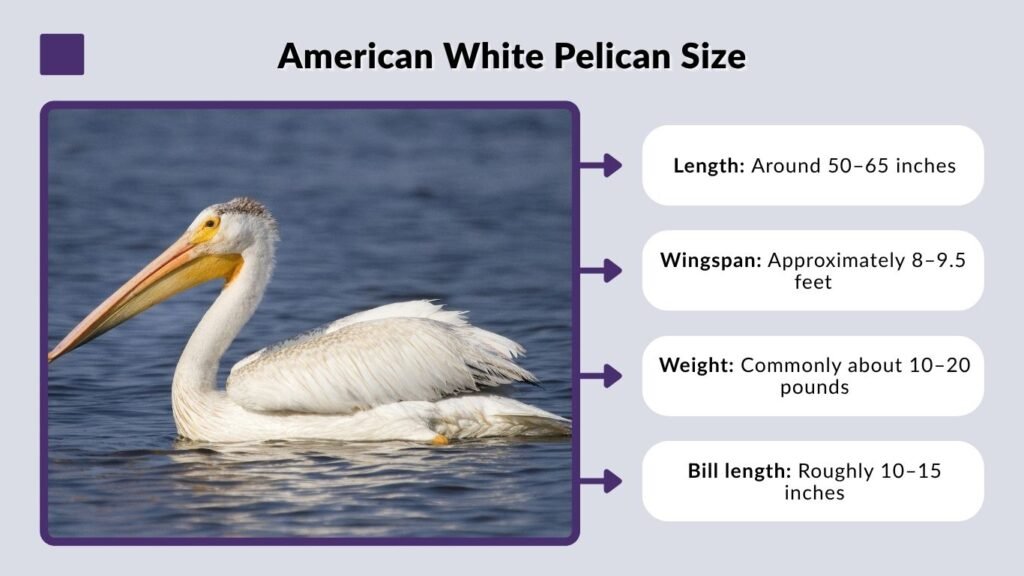
The American white pelican is among the largest flying birds found in North America. Its tremendous wings allow it to soar efficiently for long periods with relatively little flapping. Although its body looks heavy and somewhat awkward on land, the bird becomes surprisingly graceful once airborne.
How Big Is an American White Pelican?
Typical measurements include:
- Length: Around 50–65 inches
- Wingspan: Approximately 8–9.5 feet
- Weight: Commonly about 10–20 pounds
- Bill length: Roughly 10–15 inches
- Overall build: Large-bodied with extremely broad wings
Their wingspan can be wider than the height of many adult humans. Groups of pelicans soaring high above the ground may resemble white-and-black gliders slowly circling on rising air currents.
Where Do American White Pelicans Live?

American white pelicans spend much of their lives around large bodies of shallow water. Their distribution changes significantly throughout the year because many populations migrate between northern breeding areas and warmer wintering grounds farther south.
Habitat and Range
American white pelicans may be found in:
- Freshwater lakes
- Large rivers
- Reservoirs
- Marshes
- Wetlands
- Estuaries
- Coastal lagoons
- Shallow bays
During the breeding season, large colonies occur mainly around inland lakes and wetlands in western and central North America.
In winter, many birds move south toward the Gulf Coast, southern United States, Mexico, and parts of Central America.
American White Pelicans in Florida and Other States
Florida is an important winter destination for American white pelicans. They can often be observed resting or feeding in shallow coastal waters, lagoons, and inland wetlands.
Migrating birds are also seen in states such as Illinois, Wisconsin, Michigan, and Kentucky. Their appearance in these areas may be especially noticeable during spring and fall migration, when large flocks travel between breeding and wintering grounds.
What Do American White Pelicans Eat?

American white pelicans are primarily fish-eating birds, but they are opportunistic feeders. They usually forage in relatively shallow water, where their long bills and expandable throat pouches help them capture prey efficiently.
Common Foods
Their diet may include:
- Small and medium-sized fish
- Minnows
- Carp
- Perch
- Crayfish
- Aquatic insects
- Salamanders
- Other small aquatic animals
American white pelicans do not normally store fish inside their throat pouch for long periods. Instead, the pouch functions mainly like a temporary net. After capturing prey, the bird drains out the water and swallows the food.
How American White Pelicans Catch Fish
Unlike the brown pelican, which famously plunges into the water from the air, the American white pelican generally feeds while swimming. This difference in hunting style is one of the easiest ways to distinguish the behavior of these two familiar North American pelican species.
Cooperative Feeding
American white pelicans frequently work together when hunting. Several birds may form a line or semicircle and swim toward fish, gradually pushing them into shallower water.
Once the fish become concentrated, the pelicans dip their bills underwater and scoop them into their expandable pouches.
Cooperative fishing allows large groups of pelicans to capture prey efficiently. However, individual birds can also forage alone when conditions are favorable.
American White Pelican Migration
Migration is an important part of the American white pelican’s annual life cycle. Many populations travel long distances between inland nesting colonies and warmer southern wintering grounds. Their enormous wings make them well suited for energy-efficient long-distance travel.
Migration Behavior
During migration, American white pelicans:
- Travel in large flocks
- Use rising warm air currents to gain altitude
- Soar for long distances without continuous wingbeats
- Often form loose lines or circular groups
- Stop at lakes, rivers, and wetlands to rest and feed
Their migration routes can bring them through many central and eastern states where they may not remain throughout the entire year.
Watching a large flock circle high in the sky is one of the most distinctive sights associated with this species.
Breeding and Nesting
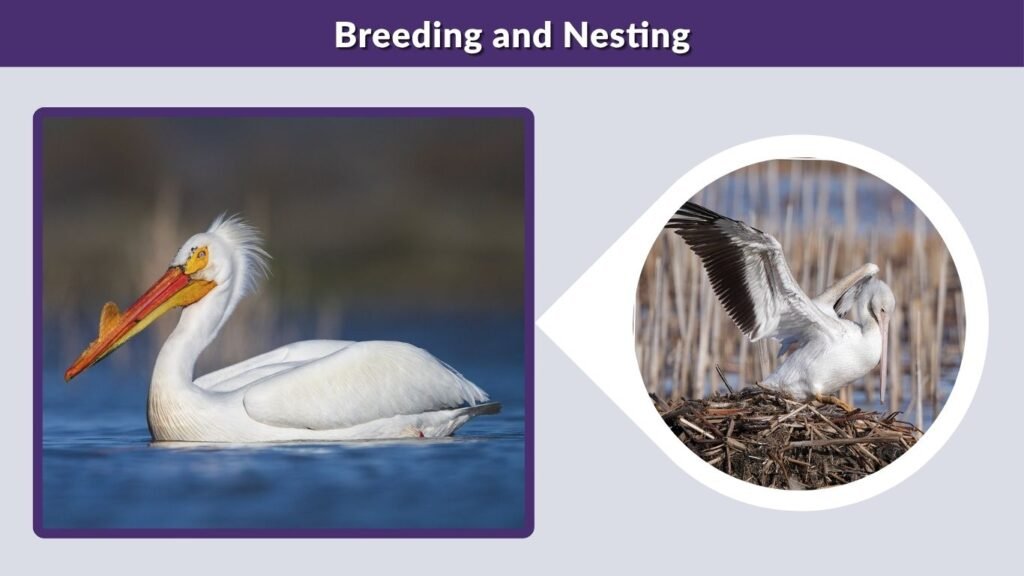
American white pelicans are highly social during the nesting season. Rather than nesting alone, they form colonies that may contain hundreds or even thousands of birds. Nesting sites are usually located on islands or isolated areas near productive feeding waters.
Courtship and Nesting
Breeding adults become especially colorful, developing brighter orange bills, legs, and facial skin. Both sexes may participate in courtship displays before pairs form.
The nest itself is relatively simple. It is usually a shallow depression on the ground surrounded by small amounts of vegetation, soil, or debris.
Females generally lay a small clutch of eggs. Both parents participate in incubation and later provide food for the growing young.
American White Pelican Chicks
Young pelicans hatch nearly helpless and depend completely on their parents.
As the chicks grow, they often gather together with other young birds in large groups sometimes called crèches. Parents recognize and feed their own offspring among the many chicks present in the colony.
Young birds gradually develop feathers, become increasingly independent, and eventually learn to fly and forage.
American White Pelican Behavior
Despite their enormous size, American white pelicans are elegant and efficient fliers. They often use thermals to rise hundreds or thousands of feet before gliding long distances. Their social nature is also apparent during feeding, migration, resting, and breeding.
Interesting Behaviors
- They often rest together in large flocks.
- They can soar for extended periods with little wing flapping.
- Groups sometimes coordinate their movements while fishing.
- They frequently gather on sandbars and shorelines.
- They may travel considerable distances between feeding and resting areas.
- Adults use their large throat pouches primarily for catching prey rather than storing food.
On land, they may appear slow and awkward, but on water and in flight they are remarkably graceful.
American White Pelican vs. Brown Pelican

These two large North American pelicans can be distinguished by appearance, habitat, and feeding behavior. Although both have oversized bills and throat pouches, they use noticeably different strategies for catching food.
Main Differences
- American white pelican: Mostly white with black wing feathers.
- Brown pelican: Mostly gray-brown with darker wings and body.
- American white pelican: Usually catches fish while swimming.
- Brown pelican: Commonly plunge-dives from the air.
- American white pelican: Frequently uses inland freshwater habitats.
- Brown pelican: Strongly associated with marine coastlines.
- American white pelican: Has a much larger wingspan on average.
Both species may occur in some southern coastal areas, making direct comparison possible.
FAQs
American white pelicans often attract attention because of their huge size, dramatic migration flocks, and unusual cooperative feeding behavior. Although frequently associated with coastal environments, they also spend much of their lives around freshwater habitats far from the ocean. The following questions address several common points about these distinctive birds.
1. Is the American White Pelican a Seabird?
Not strictly. American white pelicans use coastal waters during part of the year, but many breed and feed around inland freshwater lakes, rivers, reservoirs, and wetlands.
2. How Big Is an American White Pelican’s Wingspan?
Its wingspan commonly measures approximately 8–9.5 feet, making it one of the largest flying birds in North America.
3. Do American White Pelicans Dive for Fish?
They generally do not plunge-dive like brown pelicans. Instead, they usually catch fish by dipping their large bills into the water while swimming.
4. Are American White Pelicans Found in Florida?
Yes. Florida is an important wintering area where American white pelicans can be seen on coastal waters, wetlands, lakes, and lagoons.
5. Do American White Pelicans Migrate?
Yes. Many populations migrate between northern or inland breeding areas and warmer wintering regions along the southern United States, Gulf Coast, Mexico, and surrounding areas.
