
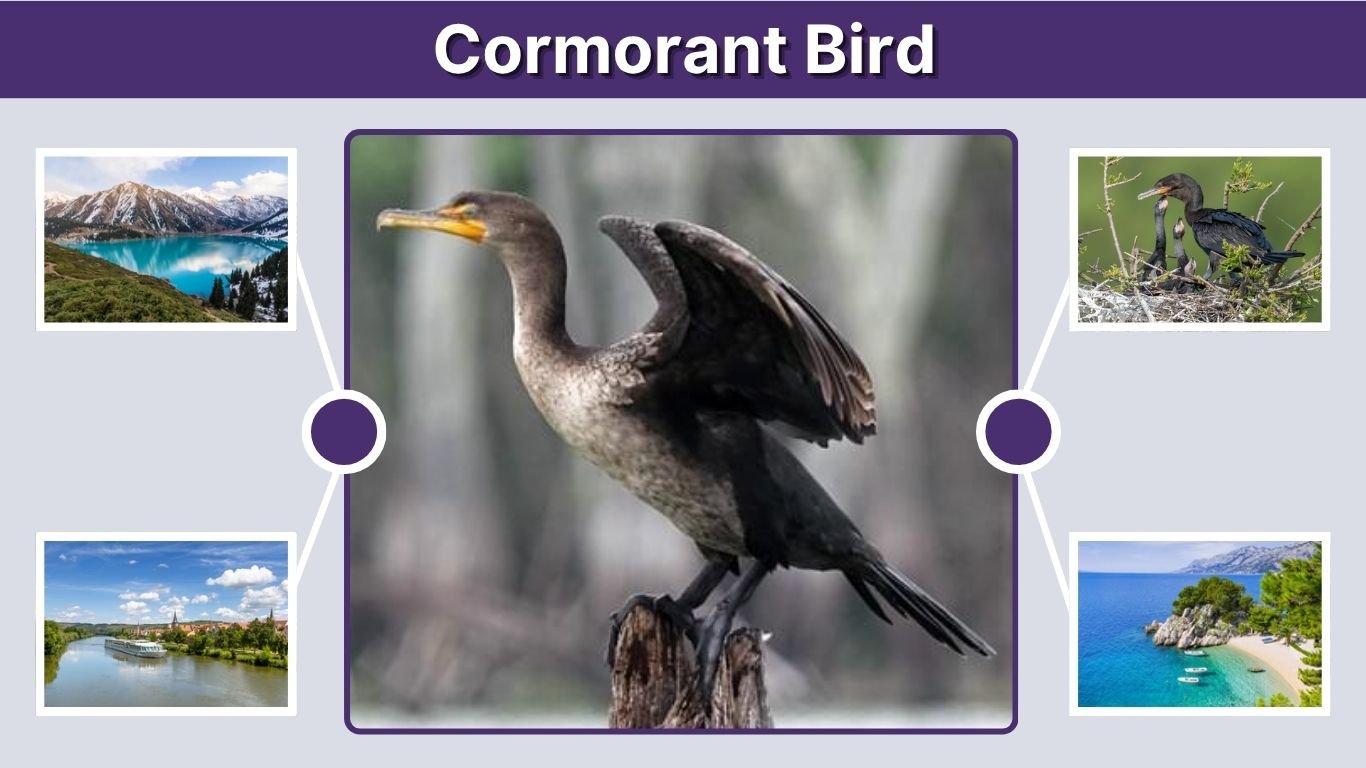
The cormorant is a skilled fish-eating waterbird recognized by its dark plumage, long neck, hooked bill, and remarkable underwater hunting ability. Cormorants occur around lakes, rivers, estuaries, coastlines, and other fish-rich waters across much of the world. They are often seen swimming low in the water, diving after fish, or standing with their wings spread after feeding. From the familiar double-crested cormorant to the unusual flightless cormorant of the Galápagos, these birds have developed impressive adaptations for life around water.
What Is a Cormorant?
Cormorants are aquatic birds belonging to the family Phalacrocoracidae. They are powerful swimmers and specialized fish hunters. Their streamlined bodies, webbed feet, strong legs, and hooked bills make them highly effective at pursuing prey underwater. The family contains numerous species occupying both freshwater and marine habitats around the world.
Cormorant Bird Identification
Typical cormorant characteristics include:
- Long neck and streamlined body
- Dark brown or blackish plumage in many species
- Long bill with a hooked tip
- Fully webbed feet
- Long tail
- Low position when swimming
- Powerful underwater diving ability
- Frequent wing-spreading posture
- Strong, direct flight
Double-crested cormorants, for example, are dark-bodied birds with yellow-orange facial skin and striking turquoise-colored eyes when viewed closely.
Double-Crested Cormorant
The double-crested cormorant (Nannopterum auritum) is one of the best-known cormorants in North America. It occurs around freshwater lakes as well as coastal environments and is often seen perched on rocks, docks, trees, pilings, and channel markers.
How to Identify a Double-Crested Cormorant
Adults are mostly dark with a long neck, hooked bill, and yellow-orange skin around the base of the bill. During the breeding season, adults develop small paired tufts or “crests” on the head, giving the species its name.
Immature birds tend to be browner, with paler coloring on the neck and breast. Double-crested cormorants are particularly widespread in North America and regularly breed around large inland lakes as well as coastal areas.
How Do Cormorants Catch Fish?
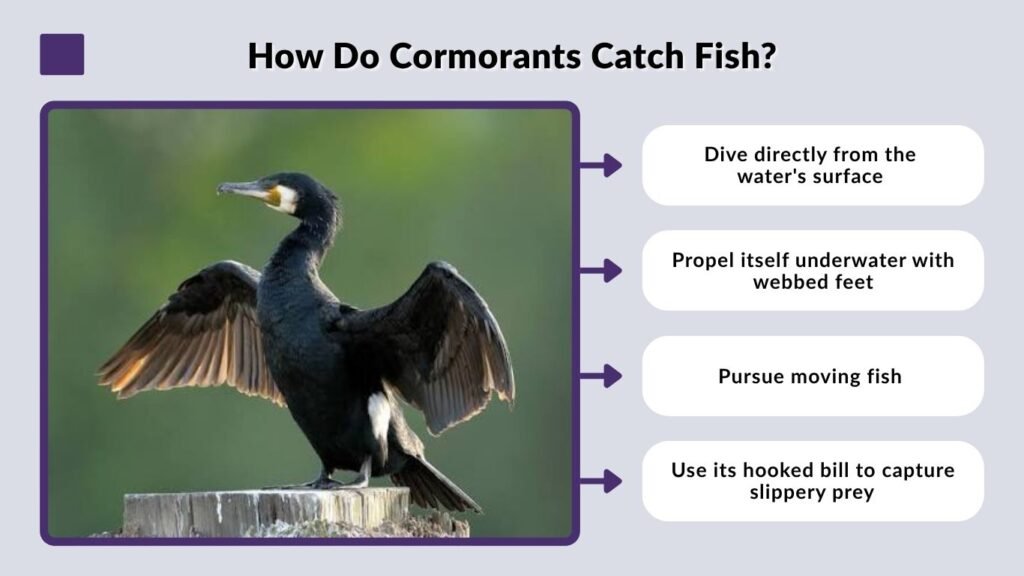
Cormorants are built for underwater pursuit rather than simply grabbing prey from the surface. A bird generally swims until it detects suitable prey, dives beneath the surface, and uses its powerful feet to chase fish.
Cormorant Fishing and Diving Behavior
A fishing cormorant may:
- Dive directly from the water’s surface
- Propel itself underwater with webbed feet
- Pursue moving fish
- Use its hooked bill to capture slippery prey
- Return to the surface before swallowing larger fish
- Toss or reposition prey before swallowing it headfirst
Fish make up most of the double-crested cormorant’s diet, although insects, crustaceans, and amphibians may also occasionally be eaten. More than 250 fish species have been reported in the diet of double-crested cormorants.
Their underwater hunting can be surprisingly energetic. Research on diving cormorants shows that pursuing mobile fish requires substantial effort as birds accelerate and maneuver after their prey.
Why Do Cormorants Spread Their Wings?
One of the most recognizable cormorant behaviors is standing upright with both wings extended. Birds commonly assume this pose on rocks, branches, buoys, docks, or shoreline structures after swimming.
Are Cormorants Drying Their Wings?
Wing spreading is associated with drying after time spent in the water. Cormorants regularly emerge from fishing sessions and remain perched with their wings extended before returning to normal activity.
This behavior can make a perched cormorant easy to recognize even from considerable distance.
Types of Cormorants
Different cormorant species have adapted to environments ranging from tropical rivers to cold northern coastlines. Species can differ considerably in size, coloration, distribution, and behavior.
Well-Known Cormorant Species
Double-crested cormorant: Widespread across North America and common around inland lakes and coastlines.
Great cormorant: A large, widespread species occurring across much of Europe, Asia, Africa, and parts of the North Atlantic region.
Brandt’s cormorant: A marine cormorant strongly associated with the Pacific coast of North America.
Pelagic cormorant: A relatively slender coastal species found around northern Pacific waters.
Neotropic cormorant: Found through much of Central and South America and extending into parts of North America.
Flightless cormorant: A remarkable Galápagos species whose wings are too reduced for flight but whose body is highly adapted for swimming.
Cormorant diversity helps explain why birds identified simply as “black cormorants” can look different depending on location.
Cormorant Habitat and Range
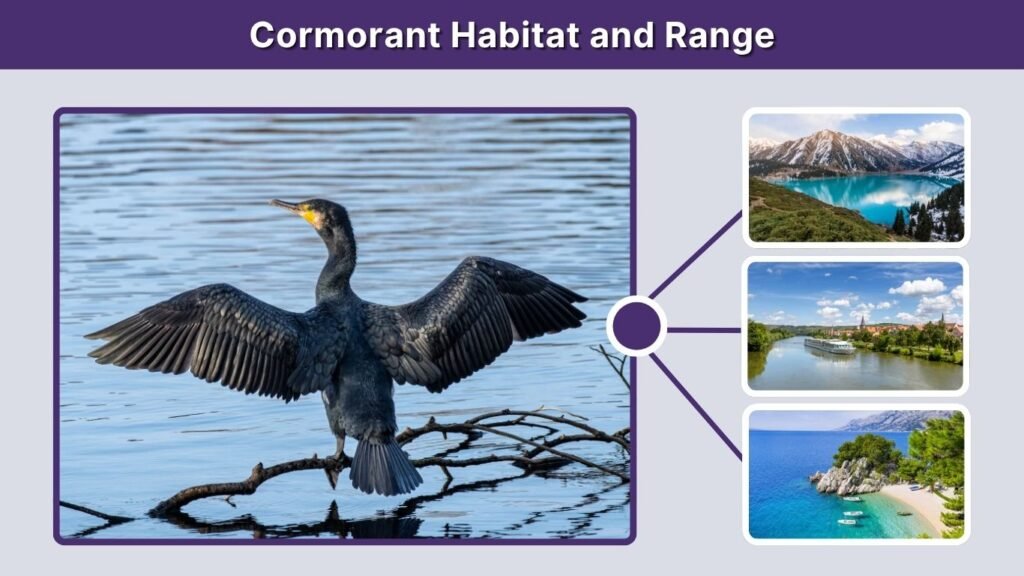
Cormorants need productive bodies of water where fish are readily available. They can occupy both freshwater and saltwater environments and may gather in large numbers where feeding and nesting conditions are favorable.
Where Do Cormorants Live?
Common habitats include:
- Large lakes
- Rivers
- Reservoirs
- Coastal bays
- Estuaries
- Lagoons
- Rocky shorelines
- Islands
- Harbors
- Wetlands
Double-crested cormorants occur widely across North America, so sightings in places such as Minnesota, Michigan, and Florida are not unusual. They may migrate seasonally, while some populations remain in suitable areas year-round.
Colonies can nest on islands, rocky ground, flooded timber, or trees. Double-crested cormorant nests are typically made from sticks, with both members of the pair contributing to nest construction.
Cormorant vs Anhinga
Cormorants and anhingas are frequently confused because both are dark aquatic birds that dive for fish and often sit with their wings spread.
How to Tell an Anhinga From a Cormorant
The easiest distinction is usually the bill.
A cormorant has a thicker bill with a hooked tip, which is well suited to grasping fish. An anhinga has a long, narrow, sharply pointed bill that resembles a spear.
Anhingas also tend to have extremely long, thin, snake-like necks. When swimming, their bodies may be almost entirely submerged, leaving the neck and head above water. Cormorants generally appear heavier and more robust.
Cormorant vs Loon
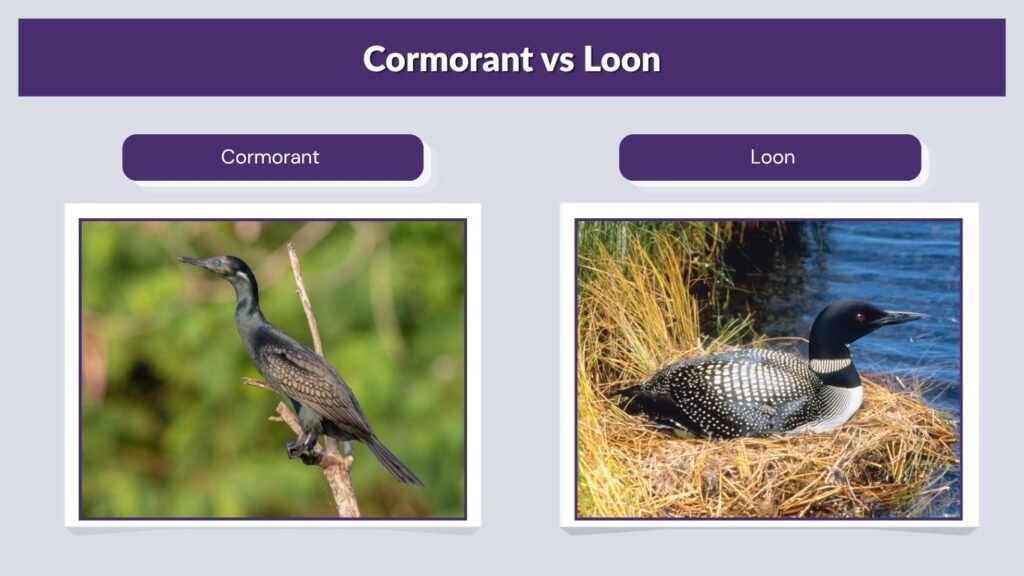
Cormorants and loons can also look similar from a distance because both swim low and dive underwater to catch fish.
Key Differences
A cormorant typically has a:
- Long neck
- Hooked bill
- Long tail
- Dark overall appearance
- Habit of perching with wings spread
A loon generally has a straighter, dagger-like bill and a different body shape. Breeding loons also develop distinctive patterned plumage, whereas many cormorants remain predominantly dark.
Watching the bird after it leaves the water can help: the classic wings-outstretched drying posture strongly suggests a cormorant.
Are Cormorants Ducks?
Cormorants are sometimes called “cormorant ducks” informally because they swim, dive, and have webbed feet, but cormorants are not ducks.
Cormorant Family
Cormorants belong to Phalacrocoracidae in the order Suliformes. Double-crested cormorants are related to other cormorants and, more distantly, to groups such as boobies and frigatebirds rather than true ducks.
Their similarities to ducks mainly reflect adaptations to an aquatic lifestyle.
Cormorant Nesting and Life Cycle
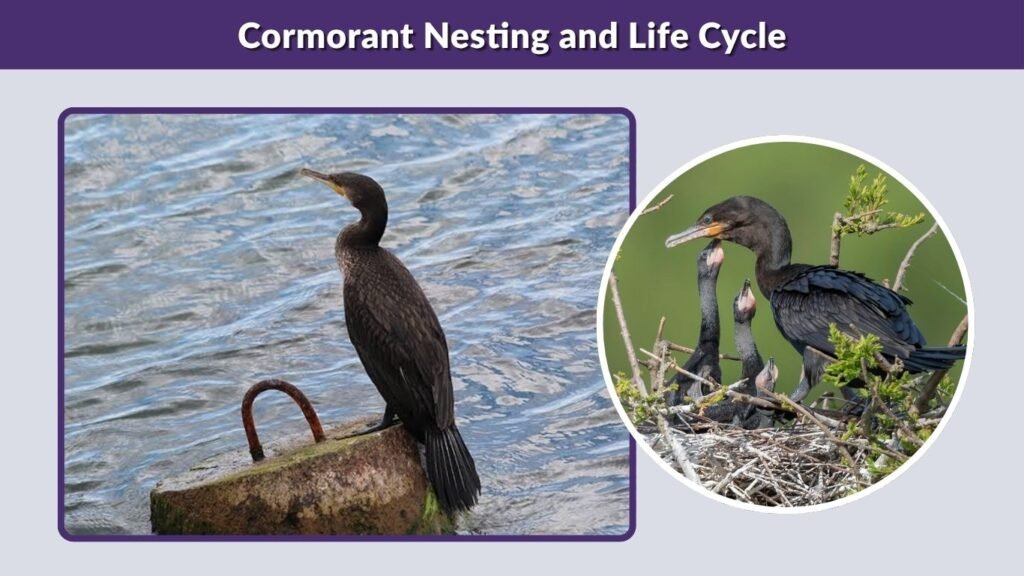
Cormorants are social birds, particularly during breeding. Large colonies may contain many nests crowded together on islands, rocky ledges, trees, or other protected locations.
Double-Crested Cormorant Nesting
Double-crested cormorants may lay 1–7 pale blue eggs, with incubation lasting roughly 25–28 days. Both parents participate in nesting activities and care for young.
Colonies can become highly visible because large numbers of birds may repeatedly use the same nesting area.
Interesting Cormorant Facts
Cormorants are much more than ordinary black waterbirds. Their anatomy and behavior reveal how highly specialized they are for aquatic hunting.
Quick Facts About Cormorants
- Cormorants chase fish underwater.
- Their feet provide strong underwater propulsion.
- Most species are capable flyers.
- The Galápagos flightless cormorant cannot fly.
- Many species form breeding colonies.
- Double-crested cormorants occur in both freshwater and saltwater habitats.
- Cormorants frequently spread their wings after diving.
- Their hooked bills help secure slippery fish.
- They can swallow surprisingly large fish.
- Some traditional fishing cultures have trained cormorants to catch fish.
FAQs
What is a cormorant bird?
A cormorant is a fish-eating aquatic bird in the family Phalacrocoracidae. It is characterized by a long neck, webbed feet, a hooked bill, and excellent underwater swimming ability.
What do cormorants eat?
Cormorants eat primarily fish. Depending on the species and habitat, they may also consume crustaceans, aquatic insects, and amphibians.
Can cormorants fly?
Yes, almost all cormorant species fly. The famous exception is the flightless cormorant of the Galápagos Islands, which has greatly reduced wings.
Why do cormorants sit with their wings open?
They commonly spread their wings after swimming, helping their plumage dry before they resume normal activity.
Is a cormorant the same as an anhinga?
No. They are different birds. Cormorants generally have heavier bodies and hooked bills, while anhingas have very long necks and narrow, pointed bills.
