
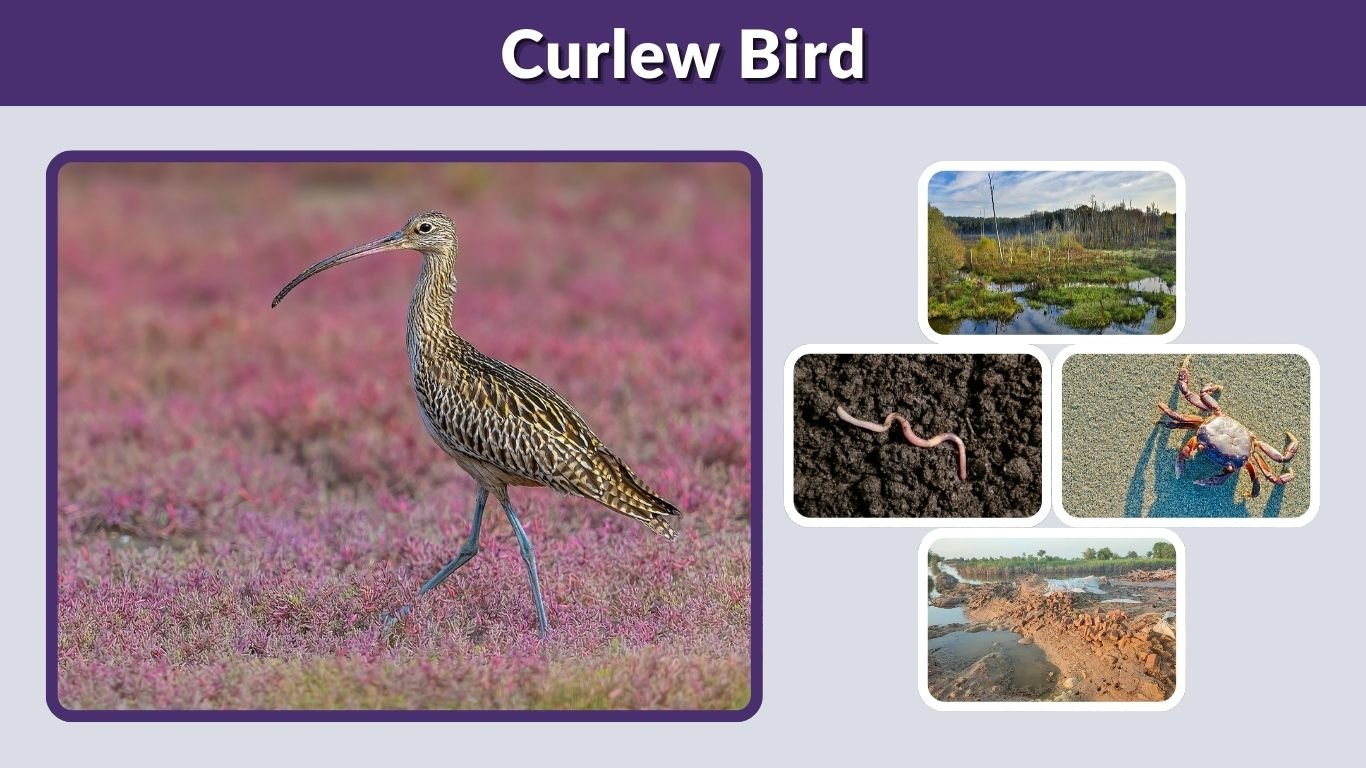
The curlew bird is best known for its exceptionally long, downward-curving bill and haunting, flute-like calls. Curlews belong to the sandpiper family and are typically associated with wetlands, coastal mudflats, grasslands, and open landscapes. Several species occur around the world, including the Long-billed Curlew, Eurasian Curlew, and Bristle-thighed Curlew. Although their appearance varies between species, their distinctive bills and long legs make them recognizable. This guide explains curlew identification, habitat, diet, behavior, sounds, major species, and conservation concerns.
What Is a Curlew Bird?
Curlews are large or medium-sized shorebirds belonging mainly to the genus Numenius within the sandpiper family, Scolopacidae. They are strongly associated with open habitats where their long bills help them locate food beneath soil, sand, and mud. Depending on the species and season, curlews may live along coastlines, marshes, prairies, tundra, and agricultural landscapes.
Curlew Identification
Several physical characteristics can help distinguish a true curlew from other shorebirds:
- Bill: Long, slender, and noticeably curved downward.
- Legs: Relatively long legs suited to walking through shallow water and mud.
- Plumage: Usually mottled brown, buff, gray, or cream.
- Body: Medium to large compared with many other sandpipers.
- Wings: Broad wings that appear powerful during migration.
- Neck: Moderately long and often extended while feeding.
- Flight pattern: Strong, direct flight with steady wingbeats.
- Call: Often a clear, bubbling, whistling, or rising musical sound.
Bill length varies considerably. Female curlews are often larger and may have longer bills than males, depending on the species.
Common Types of Curlews
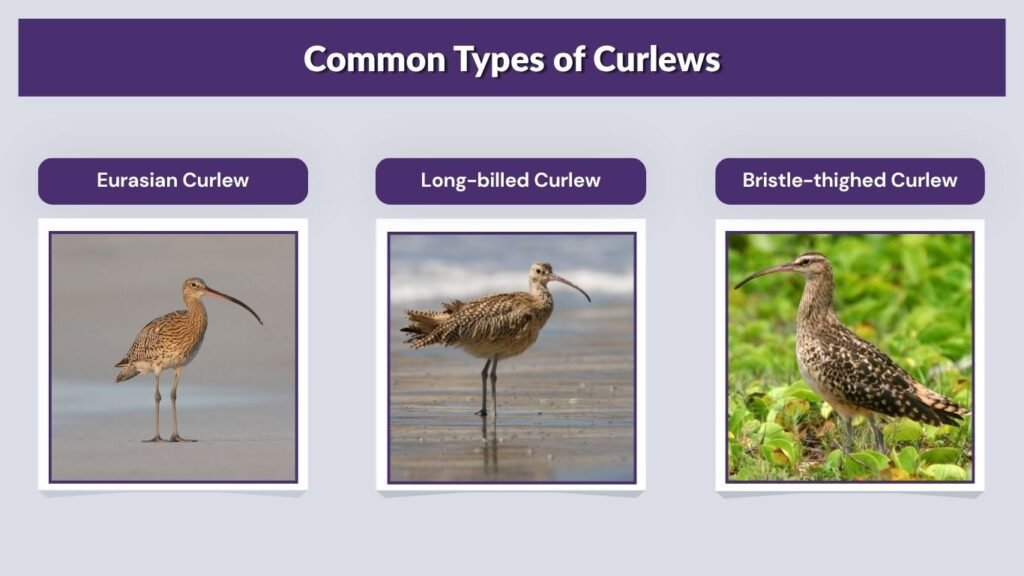
Several birds carry the curlew name, although not every bird called a “curlew” belongs to the same biological group. True curlews are primarily members of the genus Numenius. Some are widespread, while others have extremely restricted populations or uncertain conservation status.
Major Curlew Species
- Eurasian Curlew: One of the largest European shorebirds, recognized by its very long curved bill and brown patterned plumage.
- Long-billed Curlew: A large North American shorebird with an exceptionally long bill, warm cinnamon-colored underwings, and long legs.
- Bristle-thighed Curlew: A Pacific species famous for long-distance migration and unusual bristle-like feathers around its thighs.
- Whimbrel: A smaller member of the curlew group with a shorter curved bill and distinctive striped head.
- Eskimo Curlew: A North American species that suffered a catastrophic population decline and is considered possibly extinct.
- Slender-billed Curlew: Historically found across parts of Europe, western Asia, and North Africa and now widely regarded as likely extinct after decades without confirmed observations.
Long-Billed Curlew
The Long-billed Curlew is particularly easy to recognize because of its extremely elongated bill. It breeds primarily in open grasslands of western North America before many individuals migrate toward coastal areas for winter.
The bird uses its curved bill to probe deeply into soil and mud. Females generally possess especially long bills, allowing them to reach prey at greater depths than males.
Eurasian Curlew
The Eurasian Curlew occurs across large portions of Europe and Asia. Its long bill, patterned brown feathers, long legs, and distinctive voice make it one of the most recognizable wetland birds within its range.
During the breeding season, it may occupy moorlands, grasslands, farmland, and wet meadows. Outside the breeding period, many birds gather around estuaries, tidal flats, and other coastal feeding areas.
Where Do Curlews Live?

Curlews occupy surprisingly diverse environments. Although commonly described as shorebirds, many species spend important parts of their lives far from ocean coastlines. Their habitat requirements can also change seasonally as birds move between breeding, migration, and wintering grounds.
Typical Curlew Habitats
Curlews may be found in:
- Coastal mudflats and tidal estuaries
- Salt marshes
- Freshwater wetlands
- Wet grasslands
- Prairies and open plains
- Agricultural fields
- Moorlands
- Tundra
- Beaches and coastal lagoons
- Shallow riverbanks
Long-billed Curlews commonly breed in grasslands and prairies, while Eurasian Curlews frequently use wetlands and open farmland.
Curlew Migration
Many curlew populations are migratory. Birds may travel hundreds or thousands of miles between breeding and wintering locations.
Some of the most remarkable movements occur among Pacific species. The Bristle-thighed Curlew, for example, migrates between Alaska and islands across the Pacific. During migration, curlews depend heavily on suitable stopover areas where they can rest and rebuild energy reserves.
Habitat loss along migration routes can therefore affect birds even when their breeding habitat remains protected.
What Do Curlews Eat?
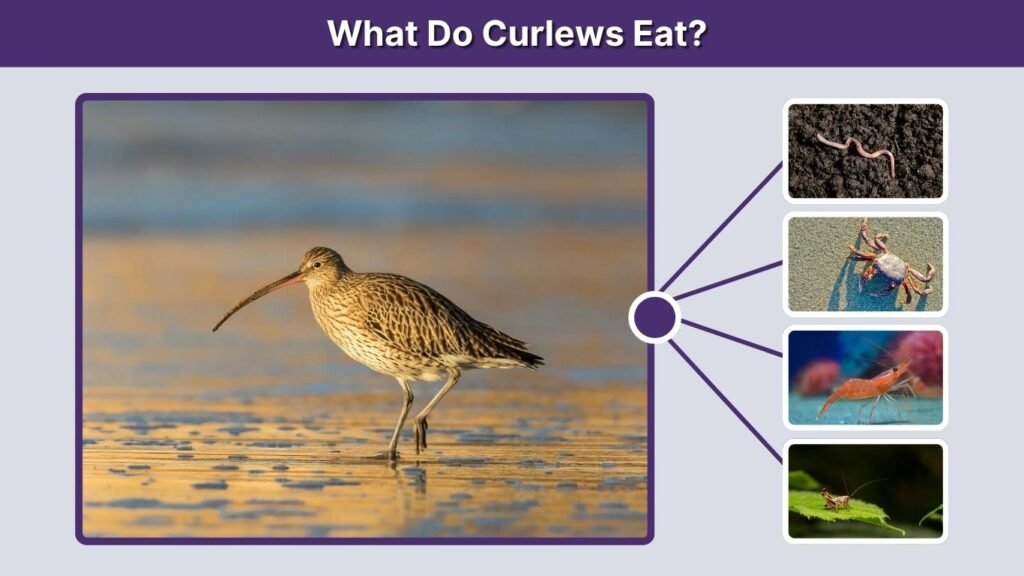
A curlew’s unusually shaped bill is an efficient feeding tool. The bird normally walks slowly through grass, mud, or shallow water while searching for prey. It can insert its bill deeply below the surface and detect animals that remain almost completely hidden.
Common Curlew Foods
Depending on habitat and species, curlews may eat:
- Worms
- Crabs
- Shrimp
- Insects
- Beetles
- Grasshoppers
- Small mollusks
- Spiders
- Crustaceans
- Small aquatic animals
- Berries
- Seeds and other plant material
How Curlews Use Their Long Bills
The downward curve gives curlews access to prey that shorter-billed shorebirds may struggle to reach. A bird can push its bill into mud while leaving much of its head above the surface.
On grasslands, curlews also pick insects directly from vegetation or soil. Their flexible feeding behavior allows them to exploit very different environments throughout the year.
Differences in bill length between individual birds may even reduce competition because birds can reach food at different depths.
What Does a Curlew Sound Like?
The curlew bird sound is one of its most memorable characteristics. Calls vary among species, but many have far-carrying whistles, bubbling notes, or rising musical phrases. These vocalizations are especially noticeable during breeding season when birds communicate across large, open landscapes.
Curlew Calls and Communication
Curlews use vocalizations for territory defense, courtship, warning signals, and communication between mates.
The Eurasian Curlew is particularly famous for its atmospheric call. Its voice can begin with clear notes before developing into a rolling or bubbling series of sounds. Long-billed Curlews also produce loud whistles that may carry considerable distances across open grasslands.
Young birds use quieter calls to communicate with their parents, while adults may become much louder when predators approach a nest.
Why Curlew Calls Are So Distinctive
Open habitats provide few physical barriers to sound. A strong, high-pitched call allows curlews to communicate across wetlands, moors, grasslands, and coastal areas where individuals may be separated by substantial distances.
Their vocalizations are especially important during breeding because pairs must maintain contact while also defending nesting territories.
Curlew vs Similar-Looking Birds
Several birds have “curlew” in their common names even though they are not true curlews. Understanding these differences can prevent identification mistakes, particularly when comparing curlews with Whimbrels, Curlew Sandpipers, and Stone-curlews.
Whimbrel vs Curlew
The Whimbrel belongs to the same genus as true curlews but is generally smaller than large species such as the Eurasian Curlew.
Its bill is shorter, while its head usually displays prominent dark and pale stripes. A large curlew typically has a longer, more dramatically curved bill and a less strongly striped crown.
Curlew Sandpiper
Despite its name, the Curlew Sandpiper is not a true curlew. It belongs to the genus Calidris.
It is much smaller and possesses a relatively modest curved bill. During breeding season, adults can develop striking reddish underparts, making them very different in appearance from the brown-patterned plumage typical of true curlews.
Stone-Curlew and Bush Stone-Curlew
Stone-curlews and Bush Stone-curlews belong to a different bird family. Their large yellow eyes, strong legs, and mostly terrestrial lifestyles distinguish them from true curlews.
The Bush Stone-curlew of Australia is mainly active at night and is famous for its eerie nighttime calls. Despite sharing the word “curlew,” it is not closely related to birds such as the Eurasian or Long-billed Curlew.
Curlew Conservation and Threats

Some curlew populations remain widespread, but others have experienced severe historical declines. Because many curlews depend on wetlands, grasslands, estuaries, and long migration routes, environmental changes across several different regions can affect the same population.
Major Threats to Curlews
Important pressures include:
- Loss of wetlands and natural grasslands
- Conversion of breeding habitat
- Coastal development
- Disturbance near nesting areas
- Changes in farming practices
- Predation of eggs and chicks
- Degradation of migration stopover sites
- Climate-related changes to breeding and feeding habitat
Slender-Billed and Eskimo Curlews
The Slender-billed Curlew has not produced reliable confirmed records for decades and is widely considered likely extinct. Its disappearance demonstrates how vulnerable migratory shorebirds can become when populations decline across large geographic areas.
The Eskimo Curlew experienced another dramatic collapse after once occurring in enormous numbers across the Americas. It has also gone many decades without broadly accepted confirmed sightings and is generally regarded as possibly extinct.
Protecting remaining curlew populations requires preserving breeding habitat as well as feeding and resting locations used throughout migration.
FAQs
Curlews attract attention because of their unusual bills, recognizable sounds, and remarkable migrations. Their common names can also create confusion because several unrelated birds include “curlew” in their names. The following answers address some of the most common questions about their appearance, behavior, distribution, and conservation.
1. What is a curlew?
A curlew is a long-billed shorebird primarily belonging to the genus Numenius. True curlews are members of the sandpiper family and are known for their long, downward-curving bills.
2. Why does a curlew have such a long bill?
The curved bill allows curlews to probe deeply into mud, sand, and soft soil to locate worms, crustaceans, insects, and other hidden prey.
3. Where does the Long-billed Curlew live?
Long-billed Curlews breed mainly in grasslands and open areas of western North America. Many move toward coastal regions, wetlands, agricultural areas, and other warmer locations outside the breeding season.
4. Is the Slender-billed Curlew extinct?
The Slender-billed Curlew has not had reliable confirmed sightings for decades and is now widely considered likely extinct, although its historical status has made definitive classification difficult.
5. Is a Bush Stone-Curlew a true curlew?
No. The Bush Stone-curlew belongs to a different bird family. Its long legs and somewhat similar appearance contributed to its common name, but it is not closely related to true Numenius curlews.
