
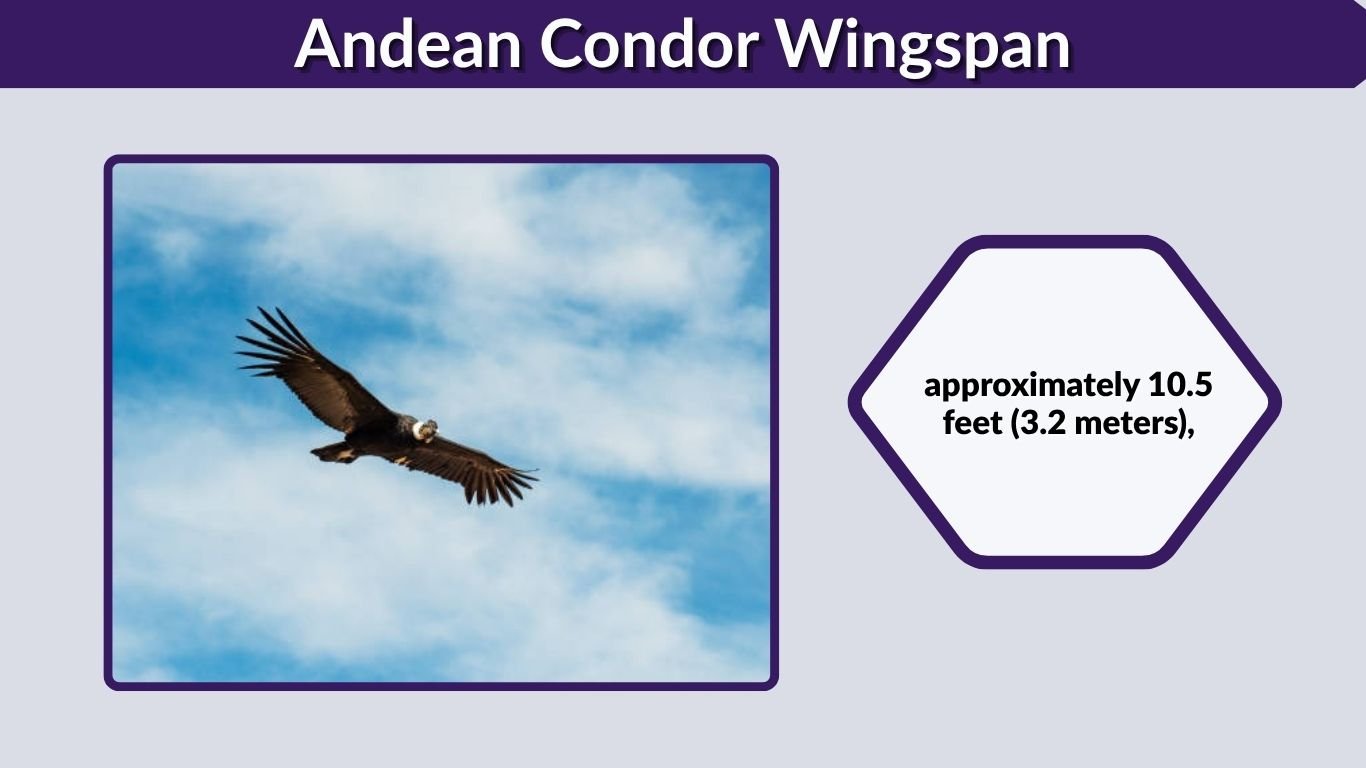
The Andean condor has an enormous wingspan that can reach approximately 10.5 feet (3.2 meters), making it one of the largest flying birds in the world. This impressive bird uses its broad, powerful wings to soar above the Andes Mountains of South America, often traveling long distances without flapping.
The Andean condor (Vultur gryphus) is particularly remarkable for its size, strength, and ability to ride rising air currents. Its wingspan is greater than that of most eagles, hawks, and other birds of prey. Although the wandering albatross has a longer wingspan, the Andean condor is among the largest soaring land birds. Understanding its measurements and flight adaptations reveals why this species is so extraordinary.
How Big Is an Andean Condor’s Wingspan?
An adult Andean condor can have a wingspan of approximately 3.2 meters, equivalent to 10 feet 6 inches.
This measurement represents the distance from one wingtip to the other when both wings are fully extended.
Andean Condor Wingspan in Feet
The wingspan of a large adult Andean condor can reach approximately 10.5 feet.
To understand this measurement, imagine a bird stretching its wings across a space wider than the length of many small rooms.
Its wings are not only long but also broad, providing the surface area needed for efficient soaring.
Andean Condor Wingspan in Meters
In metric measurements, the maximum wingspan commonly given for an Andean condor is approximately 3.2 meters, or 320 centimeters.
Some accounts mention exceptional measurements approaching 330 centimeters, although 320 centimeters is the more commonly cited upper measurement in zoological references.
Not every adult reaches this size. Wingspan varies according to sex, age, and individual development.
Andean Condor Size Chart
| Measurement | Approximate Size |
| Maximum commonly reported wingspan | 10.5 feet |
| Wingspan in meters | 3.2 meters |
| Wingspan in centimeters | 320 cm |
| Body length | Up to 4.25 feet |
| Maximum body weight | Around 33 pounds |
| Scientific name | Vultur gryphus |
| Bird family | Cathartidae |
Andean Condor Wingspan Compared to a Human
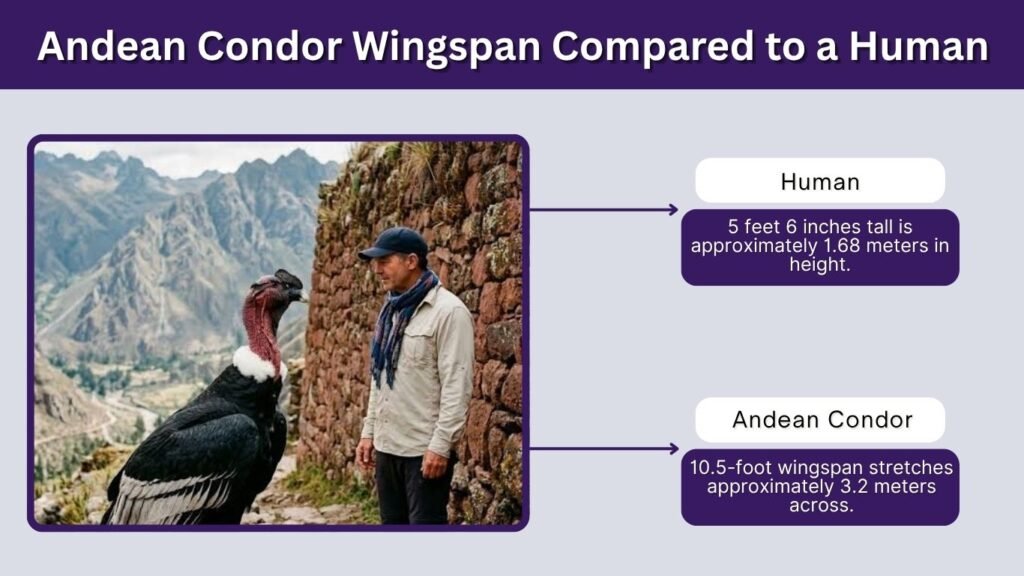
The Andean condor’s wingspan is nearly twice the height of an average adult human.
This comparison helps illustrate the bird’s remarkable size.
Human Height vs. Andean Condor Wingspan
An adult human measuring 5 feet 6 inches tall is approximately 1.68 meters in height.
A large Andean condor with a 10.5-foot wingspan stretches approximately 3.2 meters across.
This means its fully extended wings are nearly 1.9 times the height of that person.
The comparison becomes even more impressive when the bird flies overhead with its enormous wings spread across the sky.
How Wide Are an Andean Condor’s Wings?
Andean condors have long, broad wings designed for efficient gliding.
Their wing feathers extend outward with noticeable gaps between the outermost feathers.
These separated wingtip feathers help control airflow and allow the bird to make adjustments while soaring.
The combination of wing length and width helps support the condor’s substantial body weight.
Andean Condor vs. California Condor Wingspan
The Andean condor and California condor are closely related New World vultures. Both species possess exceptionally large wings that allow them to travel long distances while searching for food.
However, the Andean condor generally has the greater maximum wingspan.
Andean Condor Wingspan
The Andean condor can reach approximately 10.5 feet across its extended wings.
Large adult males usually have greater body dimensions than females.
Its wings are particularly suited to soaring over mountain valleys, coastal regions, and open landscapes.
California Condor Wingspan
The California condor (Gymnogyps californianus) has a wingspan of approximately 9.5 feet, although individual measurements vary.
It is the largest flying land bird in North America and uses rising air currents to travel over mountains, canyons, and open terrain.
Wingspan Comparison Table
| Feature | Andean Condor | California Condor |
| Scientific name | Vultur gryphus | Gymnogyps californianus |
| Wingspan | Up to 10.5 feet | Around 9.5 feet |
| Wingspan in meters | Up to 3.2 m | Around 2.9 m |
| Native range | South America | North America |
| Feeding type | Scavenger | Scavenger |
| Flight style | Soaring and gliding | Soaring and gliding |
The Andean condor generally exceeds the California condor in maximum wingspan, although both are enormous compared with most flying birds.
Andean Condor vs. Wandering Albatross Wingspan
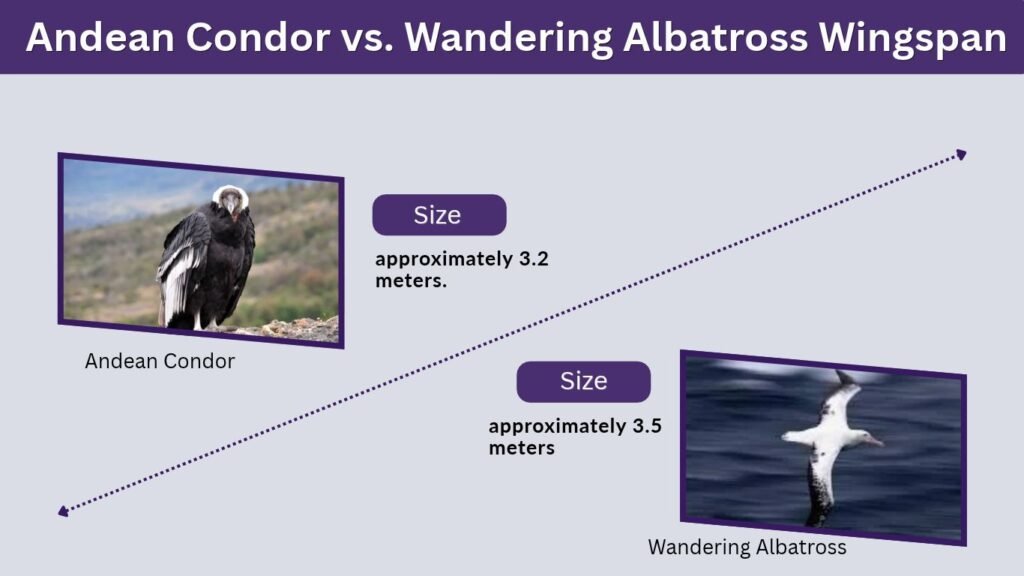
The wandering albatross has a greater wingspan than the Andean condor.
Although both birds are exceptional gliders, they occupy very different environments.
Andean Condor
The Andean condor has a maximum commonly reported wingspan of approximately 3.2 meters.
It primarily soars over mountains, valleys, grasslands, and coastal regions.
Its broad wings allow it to use rising air currents to remain airborne while searching for animal carcasses.
Wandering Albatross
The wandering albatross (Diomedea exulans) can reach approximately 3.5 meters across its wings, with exceptional recorded individuals exceeding that measurement.
It holds the record for the greatest wingspan among living birds.
Unlike the Andean condor, the wandering albatross spends much of its life soaring over the open ocean.
Its exceptionally long, relatively narrow wings are adapted for using winds above the sea.
Why Do Andean Condors Have Such Large Wings?
The Andean condor’s wingspan is closely related to its lifestyle as a large soaring scavenger.
Because it can weigh more than 30 pounds, remaining airborne through constant flapping would require substantial energy.
Its broad wings help overcome this challenge.
Using Rising Air Currents
Andean condors rely heavily on rising air currents, commonly called thermals.
When sunlight warms the ground, warm air rises into the atmosphere.
Condors can circle within these rising currents to gain altitude without repeatedly flapping their wings.
They also take advantage of air flowing upward along mountain slopes.
Flying Long Distances Without Flapping
Andean condors are remarkably efficient at soaring.
A scientific study examining their flight behavior found that the birds flapped their wings for only about 1% of their recorded flight time.
One tracked condor traveled more than 170 kilometers during a flight lasting over five hours without flapping.
This remarkable ability allows condors to search extensive landscapes for food while conserving energy.
Gliding Over Mountain Valleys
Once an Andean condor gains altitude, it can glide across mountain valleys and open landscapes.
Its large wings create the lift needed to remain airborne, while adjustments to individual feathers help maintain stability.
The bird may travel substantial distances between suitable rising air currents.
Do Male and Female Andean Condors Have the Same Wingspan?
Male Andean condors are generally larger and heavier than females.
This difference is unusual among many birds of prey, where females are often larger than males.
Male Andean Condor Wingspan
Adult males tend to have longer wings and greater overall body dimensions.
Large males can approach the species’ commonly reported maximum wingspan of approximately 3.2 meters.
Males also possess a prominent fleshy comb on top of the head, helping distinguish them from females.
Female Andean Condor Wingspan
Female Andean condors generally have somewhat smaller wingspans and lower body weights.
However, they still possess enormous wings compared with most other birds.
Their relatively smaller size does not prevent them from soaring efficiently through mountainous environments.
Is the Andean Condor the Largest Flying Bird in the World?
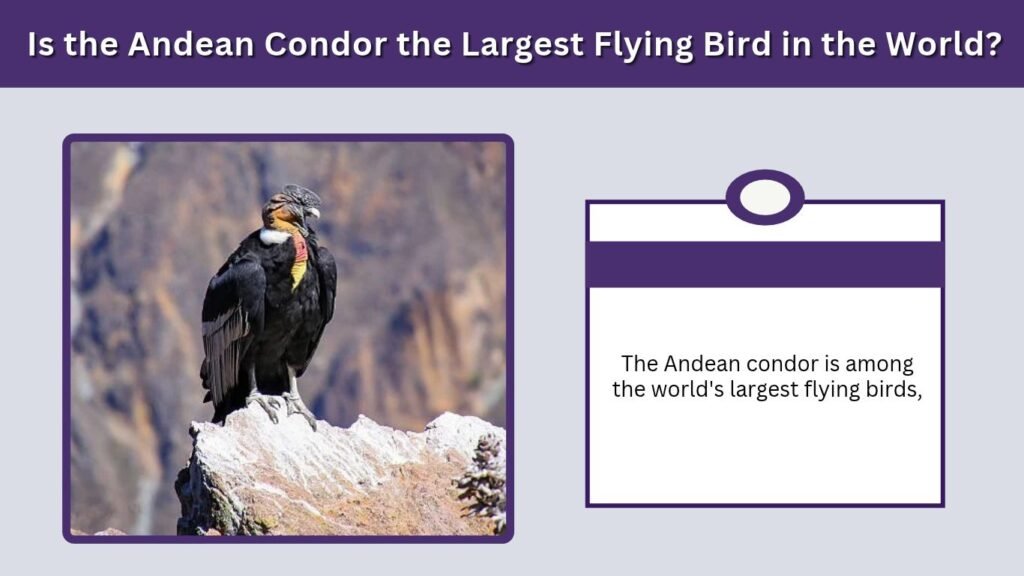
The Andean condor is among the world’s largest flying birds, but it does not hold every record for size.
The answer depends on whether size is measured by wingspan, weight, or body dimensions.
Largest Wingspan Among Birds of Prey
The Andean condor is widely recognized for having the greatest wingspan among living birds of prey.
Its approximately 3.2-meter wingspan exceeds that of most eagles, hawks, and other vultures.
Largest Wingspan Among All Birds
The wandering albatross has the greatest recorded wingspan among living birds.
Its wings can exceed 3.5 meters, making it longer-winged than the Andean condor.
Therefore, the Andean condor is an exceptionally large flying bird, but it is not the overall wingspan record holder.
How Does an Andean Condor’s Wingspan Help It Survive?
The Andean condor depends on its large wings for survival in the mountainous landscapes of South America.
These wings provide several important advantages.
Searching for Food
Andean condors are scavengers that primarily feed on the carcasses of large animals.
Because food can be widely scattered across mountainous regions, they must search extensive areas.
Their enormous wings allow them to cover long distances while using relatively little energy.
Conserving Energy
Soaring requires considerably less muscular effort than continuous powered flight.
By using thermals and mountain winds, Andean condors can remain airborne for extended periods.
This efficiency is particularly valuable for a large bird that may travel far before finding food.
Navigating Mountainous Terrain
Andean condors inhabit environments containing high mountains, steep valleys, and open landscapes.
Their broad wings help them glide between elevations and take advantage of changing wind conditions.
This ability makes them highly adapted to their mountainous surroundings.
FAQs
1. What Is the Maximum Wingspan of an Andean Condor?
The maximum wingspan commonly reported for an Andean condor is approximately 10.5 feet, or 3.2 meters. Some accounts mention particularly large individuals approaching 3.3 meters.
2. Is an Andean Condor Bigger Than a California Condor?
The Andean condor generally has a larger maximum wingspan and can be heavier than the California condor. The Andean condor’s wingspan reaches approximately 10.5 feet, compared with around 9.5 feet for the California condor.
3. Is an Andean Condor Bigger Than an Albatross?
An Andean condor is generally heavier than a wandering albatross, but the wandering albatross has a longer maximum wingspan. Wandering albatross wings can reach approximately 3.5 meters or more.
4. Can an Andean Condor Fly Without Flapping Its Wings?
Yes. Andean condors can soar for several hours by using rising air currents. Their large wings allow them to gain altitude and glide across extensive distances with minimal flapping.
5. How Big Is an Andean Condor Compared to a Human?
A large Andean condor’s wingspan is nearly twice the height of an average adult person. With wings extending approximately 10.5 feet, it appears enormous when compared with a human standing around 5.5 feet tall.