
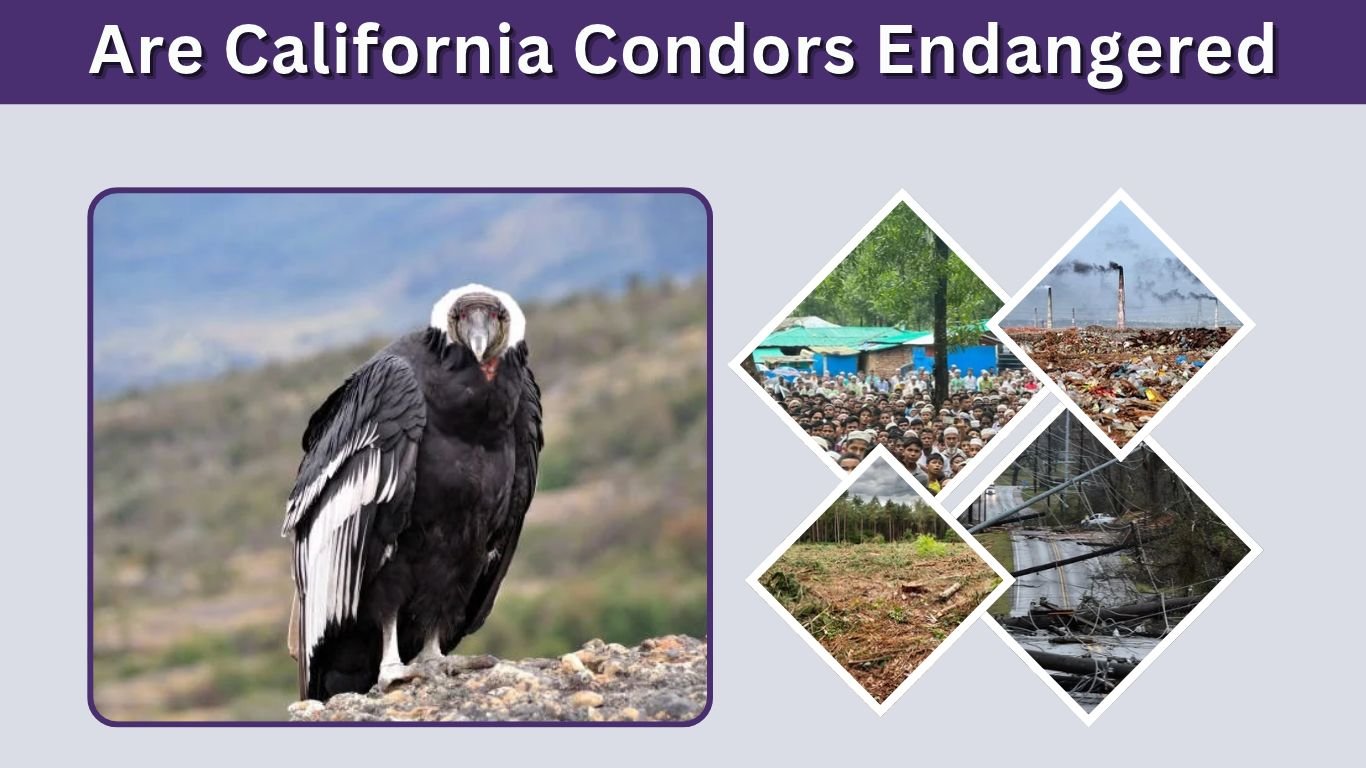
Yes, California condors are still endangered. The California condor (Gymnogyps californianus) is federally protected as an endangered species in the United States and is classified as Critically Endangered on the IUCN Red List. Despite decades of conservation work, it remains one of North America’s rarest birds.
California condors nearly disappeared during the twentieth century because of lead poisoning, habitat changes, hunting, and other human-related threats. By 1987, all 27 surviving birds were living in captivity as part of an emergency breeding effort. Conservation programs have since helped their population recover significantly. However, ongoing environmental threats and their naturally slow reproduction mean California condors continue to require intensive protection.
Why Are California Condors Endangered?
California condors became endangered because several threats caused their population to decline faster than the birds could reproduce.
The most significant ongoing threat is lead poisoning, but habitat loss, pollution, accidental deaths, and low reproductive rates also contribute to their vulnerability.
1. Lead Poisoning
Lead poisoning is the greatest continuing threat to California condors in the wild.
Condors are scavengers that feed on the carcasses of dead animals. When an animal is shot with lead ammunition, small fragments of the bullet can remain inside its body.
A condor feeding on the carcass may accidentally swallow these fragments.
Lead can damage the bird’s nervous system, digestive organs, and other vital tissues. Severe poisoning can cause weakness, paralysis, and death.
Because condors frequently feed on large animal carcasses, repeated exposure to contaminated food remains a serious conservation problem.
2. Habitat Loss
California condors require extensive natural areas for nesting, resting, and searching for food.
Historically, they occupied a much larger geographical range across North America.
As human settlements, roads, and agricultural activities expanded, many suitable habitats were altered or destroyed.
Habitat changes can reduce available food sources and increase the likelihood of encounters with human-made hazards.
3. Hunting and Human Persecution
Historically, California condors were sometimes shot intentionally because people misunderstood their feeding habits or viewed them as threats.
Although condors primarily consume dead animals rather than hunting healthy livestock, misconceptions contributed to persecution.
Illegal shooting remains a potential threat, although conservation laws now provide substantial protection.
4. Environmental Pollution
California condors can be exposed to harmful environmental contaminants.
Chemicals such as DDT and its breakdown products have historically affected bird reproduction by contributing to eggshell problems.
Other pollutants may also enter the food chain through contaminated animal carcasses.
5. Slow Reproduction
California condors reproduce much more slowly than many smaller bird species.
A breeding female typically lays only one egg during a nesting attempt, and pairs often raise just one chick every two years.
Young condors also require several years to reach breeding maturity.
This means the population cannot quickly replace adults lost to poisoning, accidents, or disease.
6. Power Lines and Human-Made Hazards
California condors can suffer injuries or death from collisions with power lines and other structures.
Their large wingspans make certain electrical installations especially dangerous.
Wind turbines, infrastructure development, and other human-made obstacles also create potential risks in condor habitats.
7. Disease and Other Threats
Disease can be particularly damaging to a species with such a small population.
In 2023, an outbreak of highly pathogenic avian influenza caused the deaths of 21 California condors in the Arizona-Utah population.
Other threats include predation, ingestion of small pieces of trash, and accidental poisoning.
When Did California Condors Become Endangered?
California condors were officially listed as endangered by the federal government on March 11, 1967, under the Endangered Species Preservation Act.
This legislation preceded the modern Endangered Species Act of 1973.
California Condor Endangered Species Timeline
| Year | Important Event |
| 1967 | Federally listed as endangered |
| 1979 | Major cooperative recovery efforts established |
| 1982 | Population reached approximately 22 birds |
| 1987 | All surviving wild birds brought into captivity |
| 1992 | Reintroduction of captive-bred condors began |
| 2004 | Important milestone in successful wild reproduction |
| 2025 | Global population reached 607 birds |
The decision to capture the remaining wild condors was controversial, but it helped prevent the species from disappearing completely.
How Many California Condors Are Left?
According to the U.S. Fish and Wildlife Service’s 2025 annual population report, the worldwide California condor population reached 607 individuals as of December 31, 2025.
This figure includes both wild birds and condors living in conservation breeding facilities.
California Condor Population in 2025
| Population Category | Number of Condors |
| Total worldwide population | 607 |
| Wild, free-flying population | 392 |
| Captive population | 215 |
| California wild population | 216 |
| Arizona and Utah wild population | 98 |
| Pacific Northwest wild population | 25 |
| Baja California, Mexico wild population | 53 |
These figures show substantial progress compared with the population collapse of the 1980s.
However, the species remains dependent on conservation efforts, including monitoring and veterinary treatment.
How Did California Condors Almost Become Extinct?

California condors once occupied extensive regions of western North America.
During the nineteenth and twentieth centuries, their population gradually declined because of human persecution, environmental contaminants, and changes to their habitat.
By the early 1980s, the species was approaching extinction.
Population Collapse in the 1980s
In 1982, only about 22 California condors remained.
Wildlife biologists recognized that the population was too small and vulnerable to survive without intervention.
Capturing the remaining wild birds for a carefully managed breeding program became an emergency conservation strategy.
The Last Wild Condor Was Captured in 1987
By 1987, all surviving California condors were living in captivity.
There were 27 birds remaining worldwide at that time.
Breeding programs at facilities including the Los Angeles Zoo and San Diego Wild Animal Park became essential to the species’ survival.
Without these efforts, California condors might have become completely extinct.
How Are California Condors Being Saved?
The California Condor Recovery Program brings together federal and state wildlife agencies, zoos, conservation organizations, researchers, and tribal partners.
The program focuses on increasing the population while reducing threats to birds living in the wild.
Captive Breeding Programs
Captive breeding has been one of the most successful elements of California condor conservation.
Wildlife specialists carefully manage breeding pairs, monitor eggs, and raise chicks in controlled environments.
Some chicks are later released into suitable natural habitats.
The program also works to maintain genetic diversity because the entire modern population descends from a very small group of surviving birds.
Reintroducing Condors Into the Wild
California condors have been reintroduced into several regions within their historical range.
These areas include central and southern California, northern Arizona, southern Utah, the Pacific Northwest, and Baja California in Mexico.
Released birds are frequently monitored using identification tags and tracking equipment.
Reducing Lead Exposure
Reducing exposure to lead ammunition is essential for long-term recovery.
Conservation organizations encourage hunters and land managers to use non-lead ammunition, such as copper bullets.
Biologists also monitor blood lead levels in wild condors and provide medical treatment when necessary.
Protecting Condor Habitat
Protected natural areas provide suitable nesting and feeding environments.
Conservation programs also work to reduce dangers from electrical infrastructure, human disturbance, and accidental poisoning.
Are California Condors Still Endangered Today?
Yes. California condors remain federally endangered despite significant population growth.
Their conservation status reflects continuing threats and the fact that their populations are not yet sufficiently self-sustaining.
Federal Endangered Status
The California condor is listed as Endangered under the U.S. Endangered Species Act.
This designation provides legal protections and supports continued conservation management.
IUCN Conservation Status
The International Union for Conservation of Nature classifies the California condor as Critically Endangered.
This classification reflects the species’ high extinction risk and ongoing conservation needs.
Although the population has increased dramatically, the species has not recovered enough to eliminate those concerns.
Where Do Endangered California Condors Live?

California condors now occupy several areas where conservationists have successfully reintroduced them.
California
Wild condors occur in parts of central and southern California, including areas around Big Sur, Pinnacles National Park, and the Los Padres National Forest.
Arizona and Utah
Reintroduced California condors also inhabit northern Arizona and southern Utah.
The Grand Canyon region is particularly well known for its wild condor population.
Pacific Northwest
Conservation programs have reintroduced condors into northern California and the Pacific Northwest, including areas associated with Redwood National and State Parks.
Baja California, Mexico
California condors have also returned to parts of Baja California through coordinated international conservation efforts.
What Happens If California Condors Become Extinct?
The extinction of California condors would represent the loss of an important scavenger from North American ecosystems.
Condors help remove large animal carcasses from the environment.
Their feeding behavior contributes to the natural decomposition and recycling of animal remains.
The species also holds cultural and ecological importance for several Indigenous communities.
Protecting California condors therefore supports biodiversity, ecosystem health, and the preservation of a remarkable native bird.
FAQs
1. Are California Condors Endangered or Threatened?
California condors are classified as Endangered under the U.S. Endangered Species Act. They are also listed as Critically Endangered by the IUCN, indicating that they remain at serious risk of extinction.
2. What Is the Biggest Threat to California Condors?
Lead poisoning is the most significant ongoing threat. Condors may swallow fragments of lead ammunition while feeding on animal carcasses, causing severe poisoning or death.
3. Were California Condors Ever Extinct?
California condors became extinct in the wild in 1987 when all remaining wild individuals were captured for conservation breeding. However, the species never became completely extinct because surviving birds were maintained in captivity.
4. Why Do California Condors Reproduce So Slowly?
California condors generally lay one egg per nesting attempt and often raise only one chick every two years. Their offspring require extended parental care, and young birds take several years to reach breeding maturity.
5. Will California Condors Ever Recover From Endangerment?
Recovery is possible, but it requires continued conservation work. Captive breeding and reintroduction have already increased the population substantially. Reducing lead exposure, protecting habitats, and maintaining successful wild breeding populations remain essential for long-term recovery.