
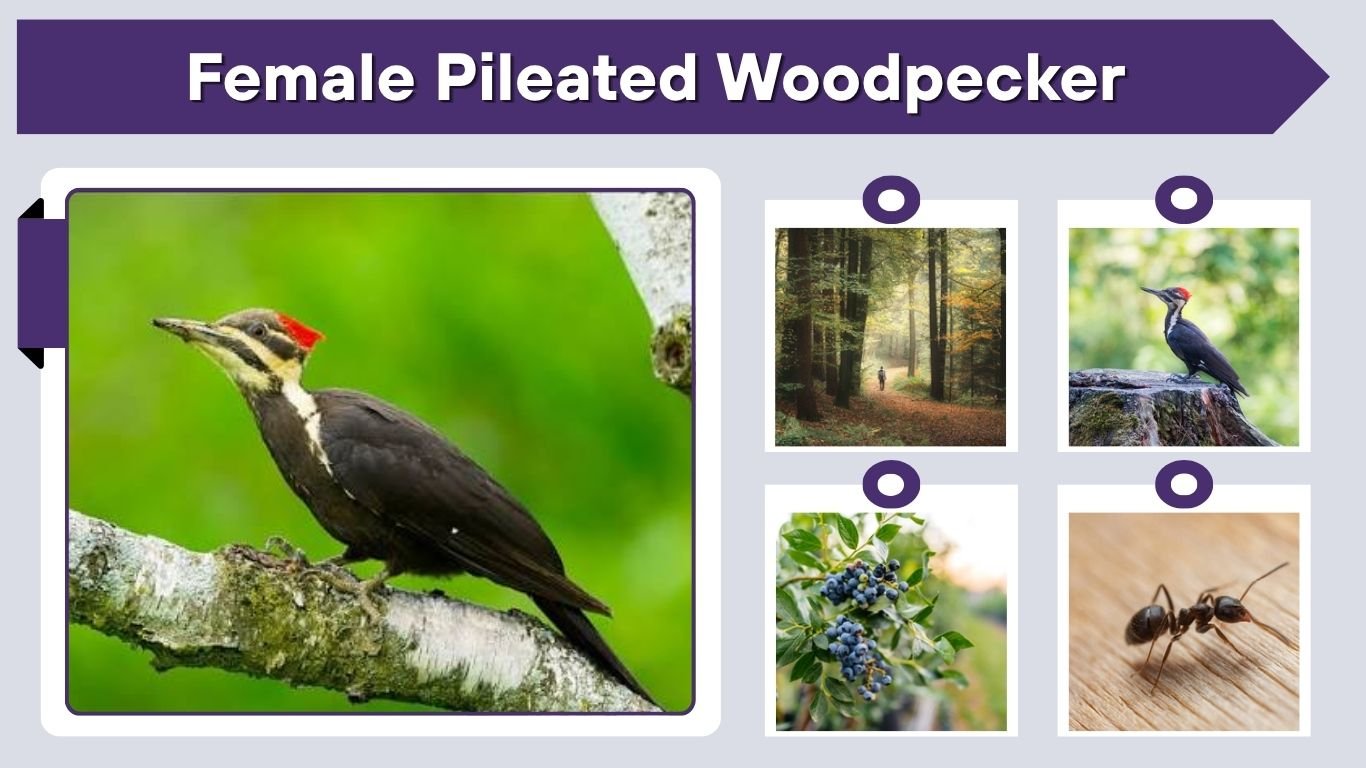
The female pileated woodpecker is a striking North American bird with a black body, bold white facial stripes, and a brilliant red crest. At first glance, females and males look nearly identical, which can make identification confusing. However, a close look at the forehead and cheek reveals reliable differences. Females have a dark forehead and black mustache stripe, while males show more red on the head and face. Understanding these markings makes it much easier to tell a male vs female pileated woodpecker apart in your backyard or woodland.
What Does a Female Pileated Woodpecker Look Like?
Female pileated woodpeckers (Dryocopus pileatus) are large, crow-sized woodpeckers with dramatic black, white, and red plumage. Their overall coloration is almost identical to that of males, but their facial markings provide important identification clues.
Female Pileated Woodpecker Identification
Look for these characteristics:
- Large black body
- Bright red crest
- Black forehead directly above the bill
- Black mustache or malar stripe
- White stripe extending from the face down the neck
- White markings beneath the wings
- Long, strong, dark-colored bill
- Long neck and tail
- Grayish feet with strong claws
The black forehead and black cheek stripe are the two easiest features to use when identifying an adult female.
Pileated Woodpecker Male vs Female
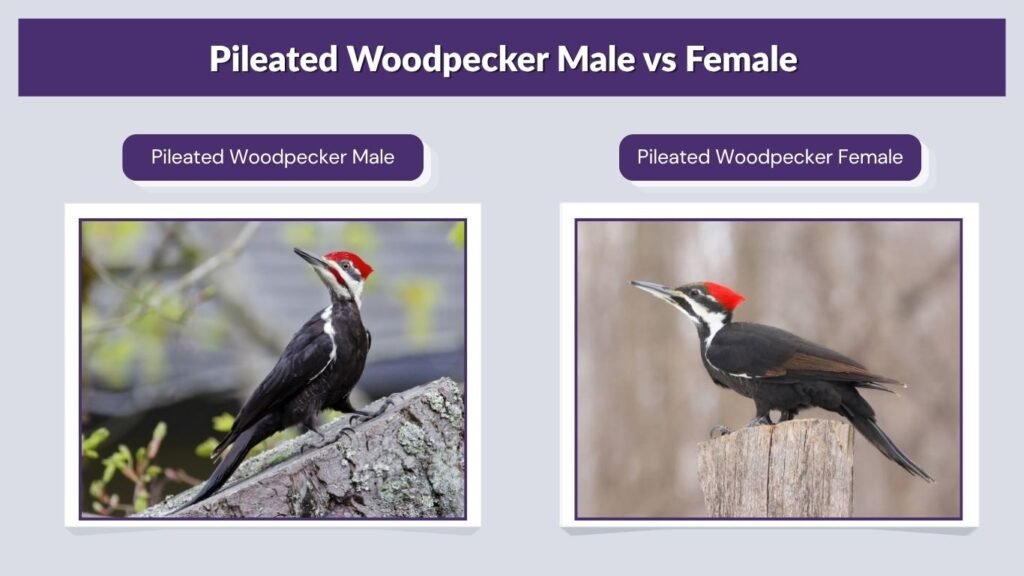
Male and female pileated woodpeckers have nearly the same body size and overall plumage. Their most obvious differences are concentrated around the head.
Male vs Female Identification
Male pileated woodpecker:
The male has a bright red crest that extends forward onto the forehead. He also has a distinctive red mustache-like stripe extending backward from the bill.
Female pileated woodpecker:
The female has a black or dark forehead instead of a fully red one. Her mustache stripe is black rather than red.
From behind, distinguishing the sexes may be difficult because both birds have prominent red crests.
Female Pileated Woodpecker Face
The face is the best place to concentrate when determining whether a pileated woodpecker is male or female.
Female Forehead and Crest
A female’s red crest begins farther back on the head. The area immediately above her bill appears dark.
On a male, the red coloring reaches farther forward toward the base of the bill.
This distinction can be especially useful when a bird is perched sideways on a tree trunk.
Female Cheek Stripe
The female’s mustache or malar stripe is dark black.
The male has a bright red patch in the same location.
If you can clearly see this stripe, identifying the bird’s sex becomes relatively straightforward.
Female Pileated Woodpecker Size
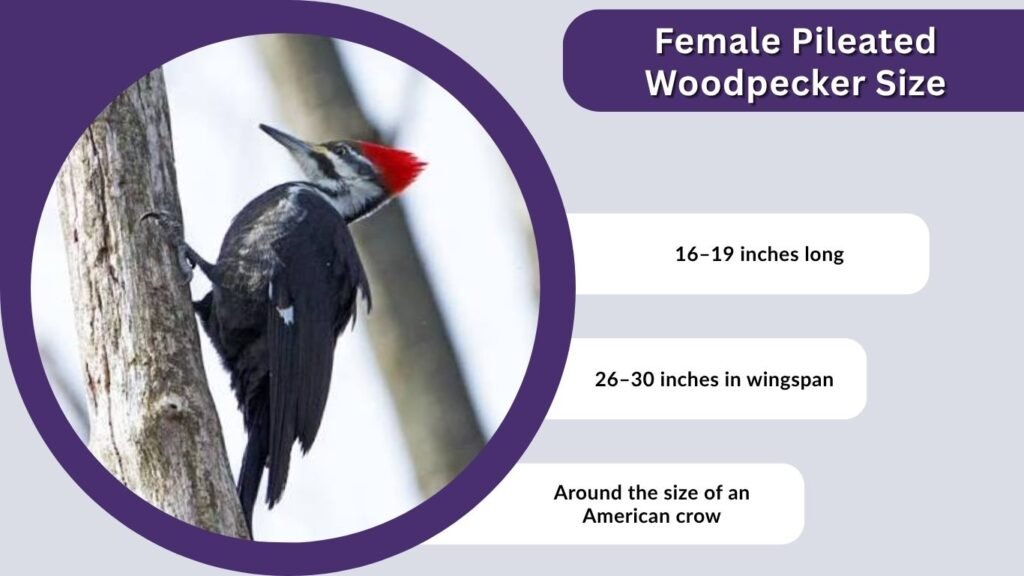
Female pileated woodpeckers are large birds and are generally similar in size to males.
How Big Is a Female Pileated Woodpecker?
Adults are commonly approximately:
- 16–19 inches long
- 26–30 inches in wingspan
- Around the size of an American crow
Individual size varies, and males may average slightly larger in some measurements, but size alone is not a dependable way to determine sex.
Head coloration is far more useful.
Female Pileated Woodpecker Sound
Female pileated woodpeckers are not silent. Both sexes produce loud calls and use drumming to communicate.
What Does a Female Pileated Woodpecker Sound Like?
Her familiar vocalization is a loud series of repeated notes that may sound like:
“kuk-kuk-kuk-kuk-kuk.”
The call can carry a long distance through woodland.
Females may vocalize when communicating with a mate, defending territory, or responding to another pileated woodpecker.
Do Females Drum on Trees?
Yes. Both female and male pileated woodpeckers drum.
Drumming can be used to:
- Advertise territory
- Communicate with a mate
- Warn other woodpeckers
- Strengthen pair communication
- Participate in breeding behavior
Drumming is usually faster and more regular than the irregular chopping sounds produced while excavating wood for food.
Female Pileated Woodpecker in Flight
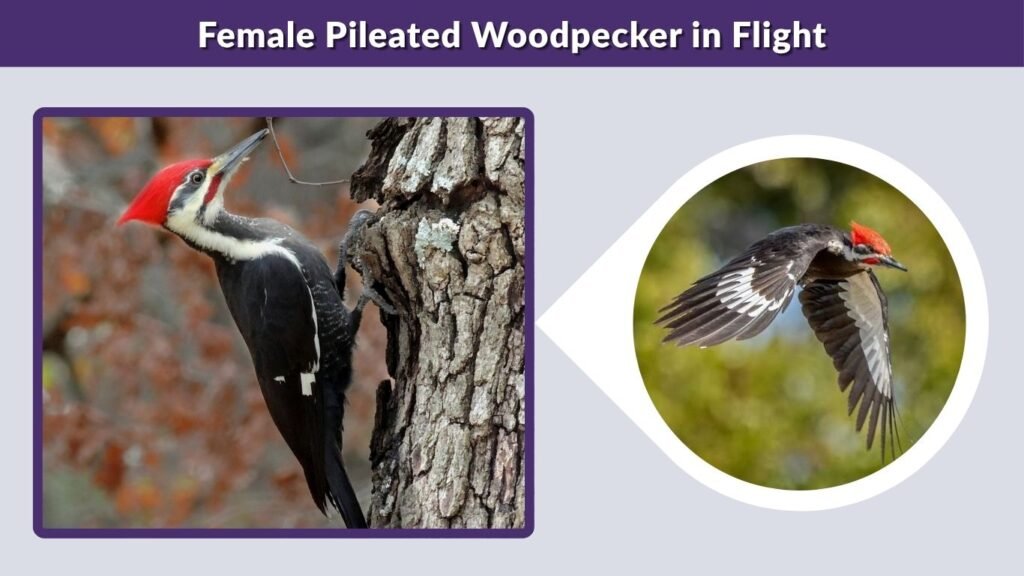
A female pileated woodpecker can be especially impressive when seen flying between large trees.
The bird has broad dark wings with striking white areas that become much easier to notice in flight.
Flight Identification
Look for:
- Large overall size
- Black wings
- White underwing patches
- Long neck
- Long pointed-looking bill
- Undulating woodpecker-style flight
Determining whether a flying bird is male or female can be difficult because the facial markings are usually impossible to see from a distance.
Female Pileated Woodpecker Habitat
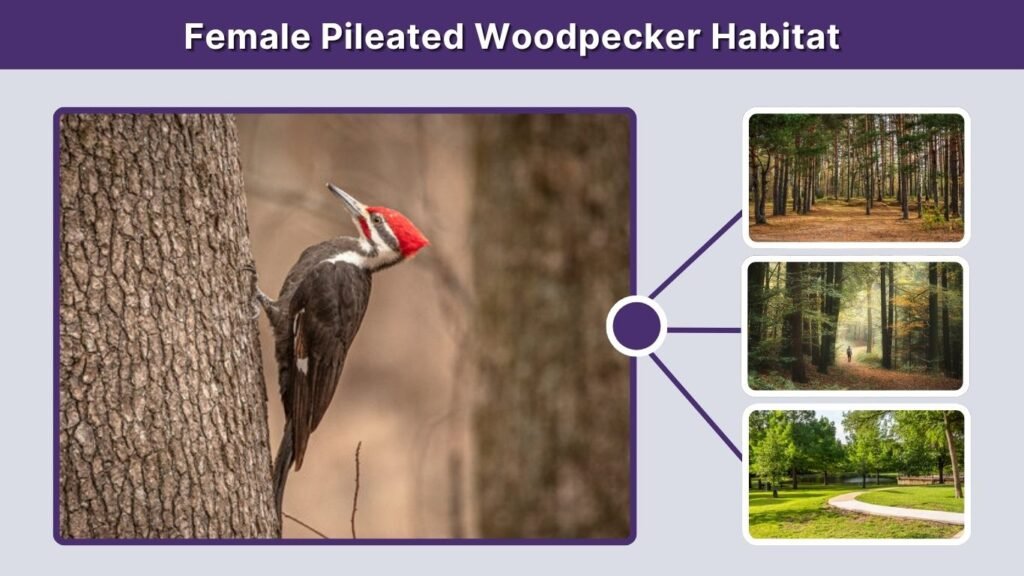
Female and male pileated woodpeckers occupy the same habitats.
They prefer woodland containing large trees, particularly areas where dead or decaying wood provides feeding and nesting opportunities.
Common Habitats
They may occur in:
- Mature forests
- Mixed woodlands
- Deciduous forests
- Wooded swamps
- Forest edges
- Large parks
- Suburban wooded areas
- Properties containing mature trees
Standing dead trees are particularly valuable because they provide insects, nesting cavities, and roosting locations.
What Does a Female Pileated Woodpecker Eat?
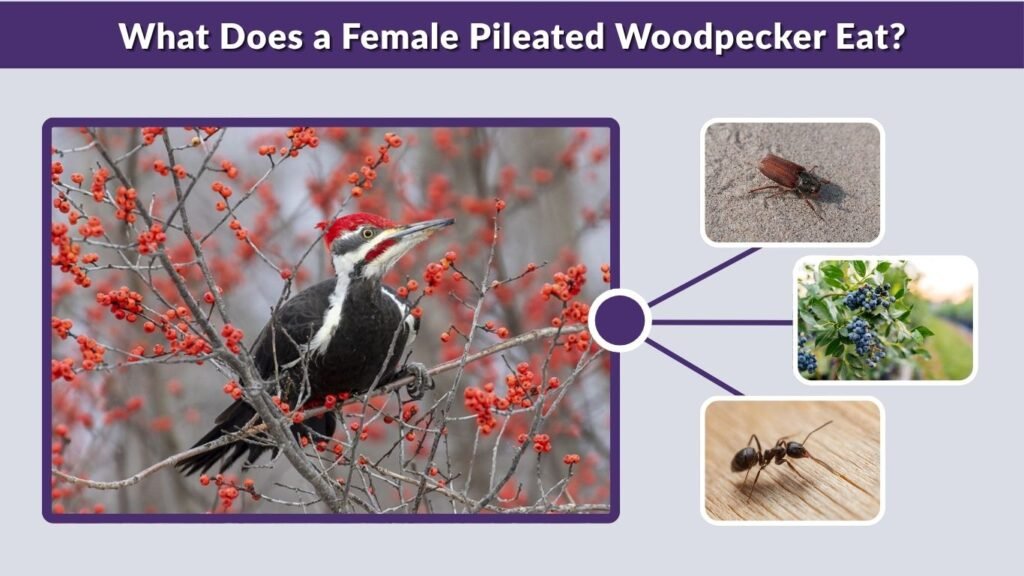
Female pileated woodpeckers have essentially the same diet as males.
They spend much of the day climbing trunks, examining damaged wood, and excavating areas containing insects.
Common Foods
Their diet includes:
- Carpenter ants
- Beetle larvae
- Wood-boring insects
- Other ants
- Termites
- Caterpillars
- Berries
- Wild fruits
- Nuts
Carpenter ants are an especially important food source.
A female may excavate a large rectangular opening in decaying wood and use her long tongue to extract insects hidden deep inside.
Female Pileated Woodpecker Nesting
Female and male pileated woodpeckers usually form breeding pairs and work together during nesting.
Nest Cavity
Rather than constructing a nest from twigs, pileated woodpeckers excavate a cavity inside a tree.
Dead trees and dead portions of living trees are frequently selected.
Both sexes can participate in excavation, using their powerful bills to remove wood and create a deep chamber.
Eggs and Incubation
The female lays several smooth white eggs directly inside the cavity.
Both parents participate in incubation, meaning the male may sit on the eggs while the female feeds and vice versa.
After hatching, both parents bring food to the nestlings.
Female Pileated Woodpecker and Her Young
Female pileated woodpeckers play an active role in raising their chicks.
Parents repeatedly travel between feeding sites and the nest cavity, carrying insects for the rapidly growing young.
After the Chicks Leave the Nest
Juveniles may remain with their parents temporarily after fledging.
During this period, young birds learn how to climb trees, excavate wood, locate insects, and survive independently.
A family group can therefore sometimes be observed traveling through the same wooded area.
Juvenile Female Pileated Woodpecker
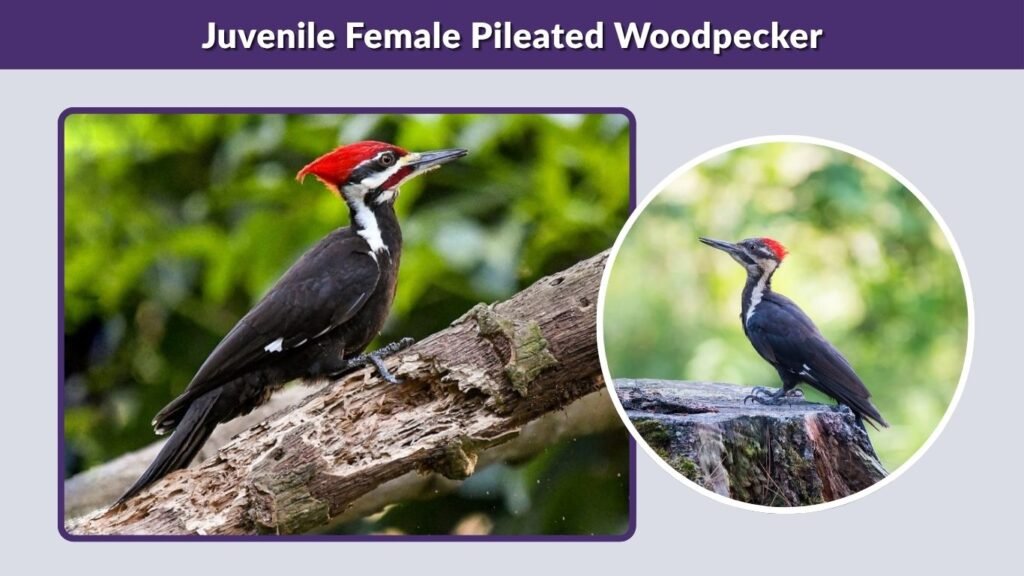
Determining whether a juvenile pileated woodpecker is male or female can be more difficult than identifying an adult.
Young birds generally resemble their parents but may have:
- Duller plumage
- Shorter-looking crests
- Less sharply defined facial patterns
- Darker or less polished feathers
As juveniles mature, their adult facial markings become easier to recognize.
A developing female eventually shows the characteristic dark forehead and black mustache stripe.
Female Pileated Woodpecker Behavior
Females are active, powerful birds that spend considerable time searching for food and maintaining their territory.
Common Behaviors
You may see a female:
- Climbing vertically along tree trunks
- Hammering into rotten wood
- Calling loudly from tall trees
- Drumming on resonant branches
- Excavating large rectangular holes
- Flying between feeding locations
- Visiting a nest cavity
- Interacting with her mate
Pileated woodpeckers can also move around the trunk to place the tree between themselves and an observer when they feel nervous.
Female Pileated Woodpecker at Feeders
Although they depend heavily on natural foods, female pileated woodpeckers occasionally visit backyard feeders.
How to Attract a Female Pileated Woodpecker
Helpful options include:
- Large suet feeders
- Sturdy platform-style feeders
- Mature trees
- Standing dead trees when safe
- Fallen logs
- Native fruit-producing plants
- Wooded sections of property
Because pileated woodpeckers are large, ordinary small woodpecker feeders may not provide enough room for them to perch comfortably.
Female Pileated Woodpecker vs Male: Quick Comparison
| Feature | Female | Male |
| Body color | Black | Black |
| Crest | Red | Red |
| Forehead | Black/dark | Red |
| Mustache stripe | Black | Red |
| White facial stripe | Yes | Yes |
| Size | Large | Large |
| Drumming | Yes | Yes |
| Nest care | Yes | Yes |
The forehead and mustache stripe provide the most dependable visual differences.
Interesting Female Pileated Woodpecker Facts
- Females have bright red crests just like males.
- Their forehead is dark rather than completely red.
- Females have black mustache stripes.
- Both sexes drum on trees.
- Females help excavate nesting cavities.
- Both parents incubate eggs.
- Both parents feed their chicks.
- Females are approximately crow-sized.
- Carpenter ants are an important part of their diet.
- Old pileated woodpecker cavities can later provide shelter for other animals.
FAQs
How Can You Tell a Female Pileated Woodpecker From a Male?
Look at the forehead and mustache stripe. Females have a dark forehead and black cheek stripe, while males have a red forehead and red mustache stripe.
Does a Female Pileated Woodpecker Have a Red Head?
Yes. Females have prominent red crests. However, unlike males, the red does not extend as far forward onto the forehead.
What Does a Female Pileated Woodpecker Sound Like?
Females produce loud repeated calls similar to males and also communicate by drumming rapidly against trees and other resonant surfaces.
Are Female Pileated Woodpeckers Smaller Than Males?
Males may average slightly larger in some measurements, but the difference is too small to be useful for normal field identification.
Do Male and Female Pileated Woodpeckers Stay Together?
Breeding pairs often maintain territories together and cooperate during nesting. Both sexes help excavate the nest cavity, incubate eggs, and feed their young.
