
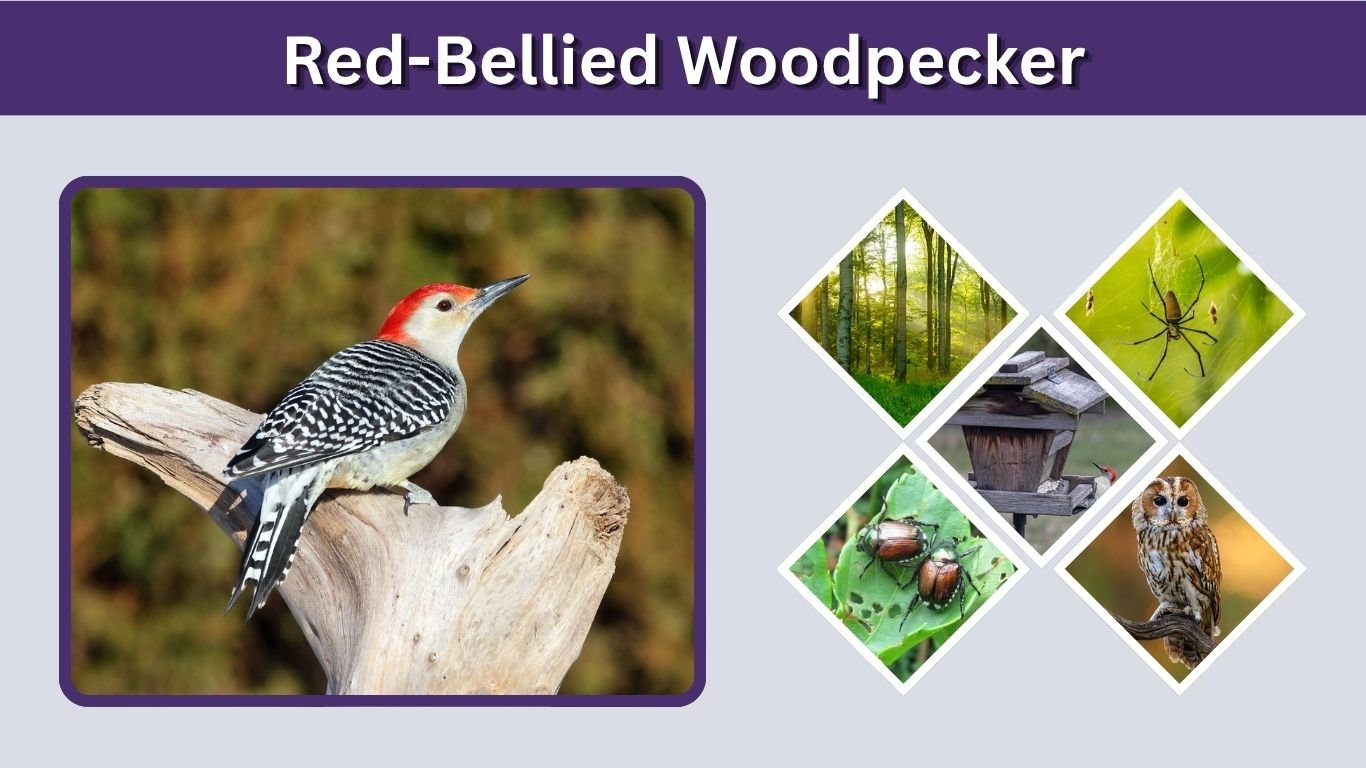
The red-bellied woodpecker is a common and easily recognized woodpecker of eastern North America. Despite its name, the bird’s most noticeable feature is usually the bright red coloring on its head rather than its belly. Its back has bold black-and-white barring, while the underside is pale with a faint reddish wash. Red-bellied woodpeckers are frequently seen in forests, parks, suburbs, and backyard feeders. They are active, vocal birds that eat insects, fruits, nuts, seeds, and occasionally small animals.
What Is a Red-Bellied Woodpecker?
The red-bellied woodpecker, scientifically known as Melanerpes carolinus, belongs to the woodpecker family Picidae.
It is a medium-sized woodpecker found across much of the eastern and central United States. The species has also expanded its range northward in recent decades.
Red-Bellied Woodpecker Identification
- Scientific name: Melanerpes carolinus
- Length: About 9–10.5 inches
- Wingspan: Roughly 15–18 inches
- Back: Black-and-white barred pattern
- Underparts: Pale grayish or buff
- Belly: Small reddish or pinkish patch
- Bill: Long, straight, and dark
- Tail: Stiff and supportive for climbing
- Male head: Red crown and nape
- Female head: Red mainly on the nape and near the bill
The red belly can be surprisingly difficult to see unless the bird is positioned at the right angle.
Male vs Female Red-Bellied Woodpecker
Male and female red-bellied woodpeckers look very similar, but the amount of red on the head makes them fairly easy to distinguish.
Male Red-Bellied Woodpecker
The male has a bright red crown extending from the forehead across the top of the head to the back of the neck.
Female Red-Bellied Woodpecker
The female has a grayish crown with red concentrated on the back of the head and nape. She may also have a smaller red patch above the bill.
Both sexes have similar black-and-white barred backs and pale undersides.
Juvenile Red-Bellied Woodpecker

A juvenile red-bellied woodpecker looks noticeably duller than an adult.
Young birds generally have brownish-gray heads rather than bright red ones. Their body pattern resembles the adults, although the black-and-white barring may appear less crisp.
As the juvenile matures, red feathers begin developing on the head.
Juvenile Identification
Look for:
- Gray or brownish head
- Little or no bright red
- Barred black-and-white back
- Pale underside
- Straight dark bill
- Adult-like body shape
Young birds may remain close to their parents for a period after leaving the nest.
What Does a Red-Bellied Woodpecker Sound Like?
The red-bellied woodpecker is a vocal species.
Its most familiar call is a rolling, somewhat nasal “churr” or “kwirr” sound. The call is often repeated and can carry a considerable distance through woodland.
Birds also make shorter contact calls and drumming sounds.
Why Do Red-Bellied Woodpeckers Drum?
Drumming is not primarily a feeding behavior.
Woodpeckers drum on resonant trees, utility poles, gutters, and other surfaces to:
- Advertise territory
- Attract mates
- Communicate with other woodpeckers
Both males and females can drum.
Red-Bellied Woodpecker Habitat
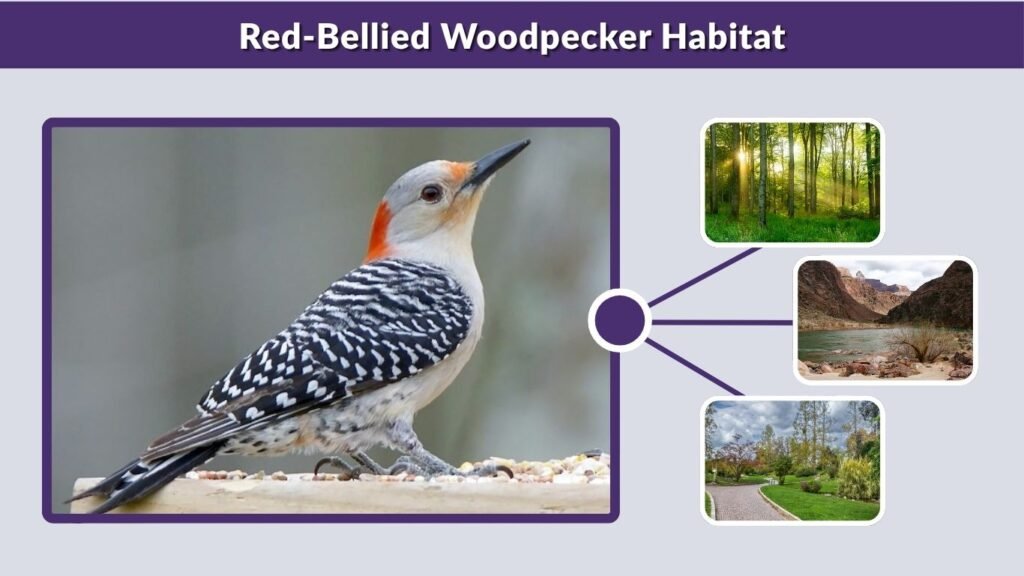
Red-bellied woodpeckers occupy a wide variety of wooded habitats.
They are especially common in:
- Deciduous forests
- Mixed forests
- Wooded wetlands
- River bottoms
- Parks
- Large gardens
- Suburban neighborhoods
- Orchards
Mature trees are particularly valuable because they provide nesting cavities, insects, and food.
Red-Bellied Woodpecker Range
The species occurs across much of the eastern United States, from the Southeast north through parts of the Midwest and Northeast.
It is especially common in states such as Florida, Virginia, Texas, Georgia, the Carolinas, and much of the Mississippi and Ohio River regions.
Red-bellied woodpeckers have expanded farther north over time and are now regularly observed in areas where they were once unusual, including parts of New England.
Most populations remain within their general range throughout the year rather than making long-distance migrations.
What Does a Red-Bellied Woodpecker Eat?
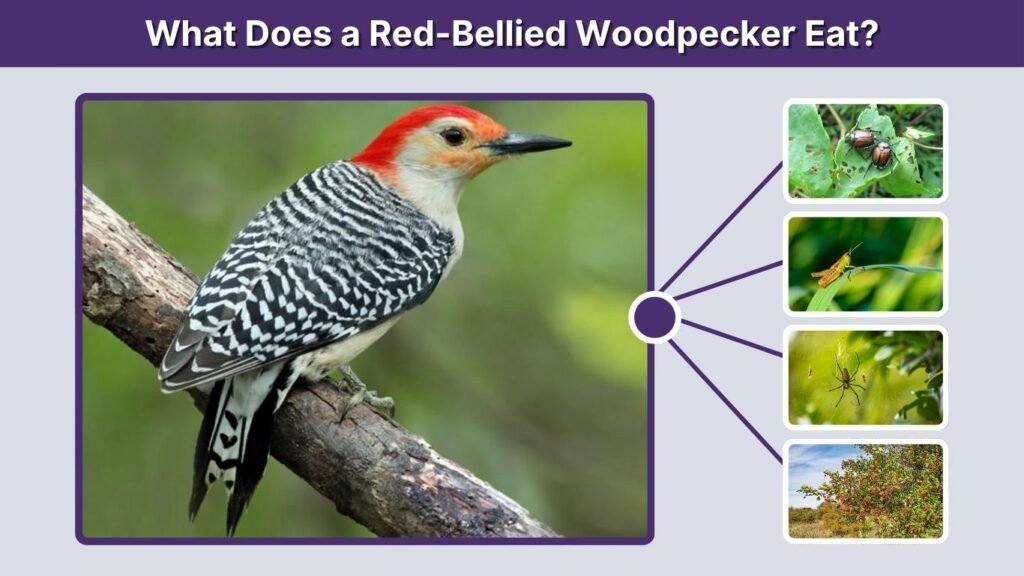
Red-bellied woodpeckers are omnivorous and have a surprisingly diverse diet.
They forage on tree trunks and branches, probe cracks in bark, search leaves, and occasionally catch food from the ground.
Red-Bellied Woodpecker Diet
Common foods include:
- Beetles
- Ants
- Grasshoppers
- Caterpillars
- Spiders
- Acorns
- Nuts
- Seeds
- Berries
- Grapes
- Other fruits
They may occasionally consume small vertebrates, eggs, or nestlings when the opportunity arises.
Red-bellied woodpeckers also store food in bark cracks and other hiding places for later use.
Red-Bellied Woodpecker Feeders
Red-bellied woodpeckers readily visit backyard bird feeders.
Some of the best foods for attracting them include:
- Suet
- Peanuts
- Sunflower seeds
- Peanut pieces
- Fruit
- Nut mixes
A sturdy suet feeder is particularly effective.
Providing mature trees and avoiding excessive pesticide use can also make a yard more attractive by preserving natural insect food.
Red-Bellied Woodpecker Nest
Red-bellied woodpeckers are cavity nesters.
A breeding pair usually excavates a nesting chamber inside a dead tree, dead limb, or softened section of living wood.
Both the male and female participate in creating the cavity.
Eggs and Nesting
A typical clutch contains approximately 3–6 white eggs.
Both parents help incubate the eggs and later feed the young.
The chicks hatch helpless and remain inside the cavity while the parents repeatedly bring insects and other food.
Once young birds become sufficiently developed, they leave the nest as fledglings.
Red-Bellied Woodpecker Nest Box
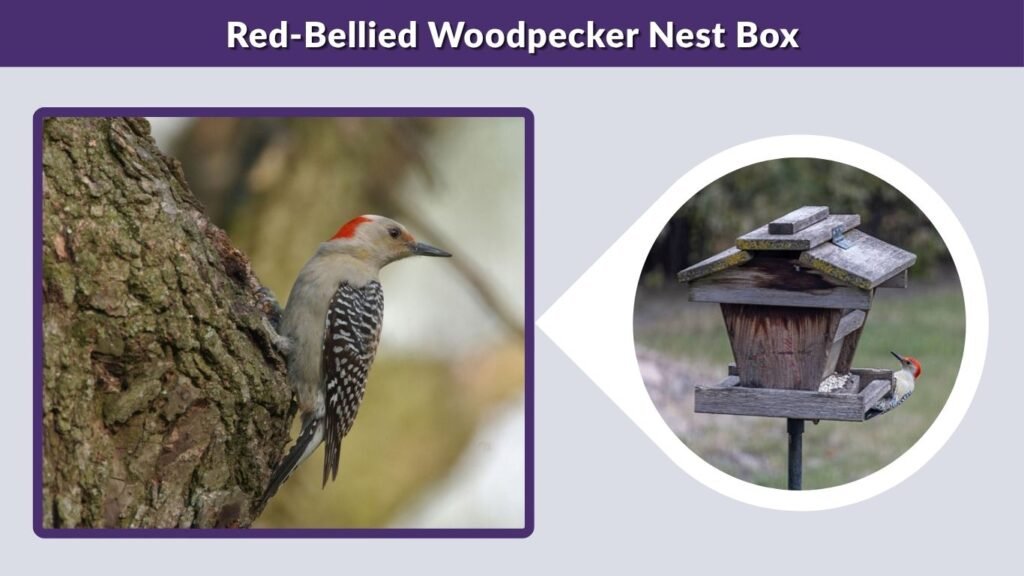
Red-bellied woodpeckers sometimes use artificial nest boxes when suitable natural cavities are limited.
A nest box should be:
- Strongly constructed
- Deep enough for a cavity-nesting bird
- Mounted securely
- Positioned several feet above the ground
- Protected from excessive disturbance
Leaving safe dead trees or standing snags can be even more beneficial because they provide natural nesting and foraging sites.
Red-Bellied Woodpecker Tongue
A woodpecker’s tongue is highly specialized for retrieving food from narrow spaces.
The red-bellied woodpecker can extend its tongue well beyond the end of its bill.
The tongue is useful for reaching insects and larvae hidden in cracks and holes.
Sticky saliva and specialized structures help the bird capture prey that would otherwise be difficult to reach.
Red-Bellied Woodpecker vs Northern Flicker
Red-bellied woodpeckers and northern flickers can occasionally be confused, but several differences make identification easier.
Red-Bellied Woodpecker
The red-bellied woodpecker has a strongly black-and-white barred back and noticeable red on the head.
Northern Flicker
Northern flickers are generally larger and browner, with dark spots on their underparts and a distinctive black chest crescent.
Flickers also spend considerably more time feeding on the ground, particularly when hunting ants.
Red-Bellied vs Red-Headed Woodpecker
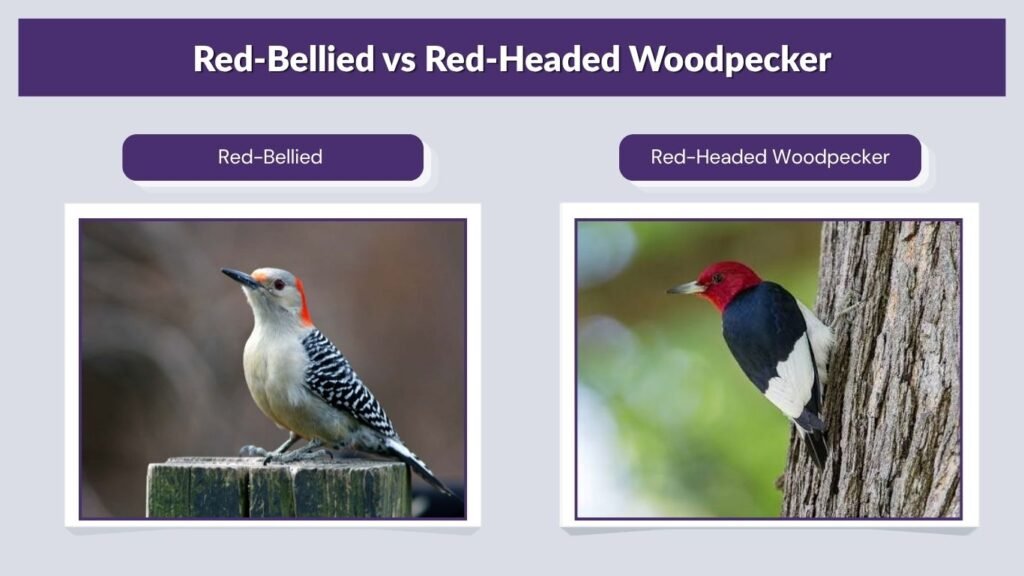
Despite their similar names, these birds look very different.
An adult red-headed woodpecker has an entirely bright red head, sharply contrasting white belly, and large black-and-white wing patches.
The red-bellied woodpecker has only partial red on its head and a finely barred black-and-white back.
The red-headed woodpecker therefore usually appears much more boldly patterned.
Red-Bellied vs Downy Woodpecker
A downy woodpecker is much smaller than a red-bellied woodpecker.
Downy woodpeckers have:
- Shorter bills
- White backs with black wings
- Small bodies
- Red patches only on adult males
Red-bellied woodpeckers are larger, have longer bills, and display extensive zebra-like barring across the back.
Red-Bellied Woodpecker Lifespan
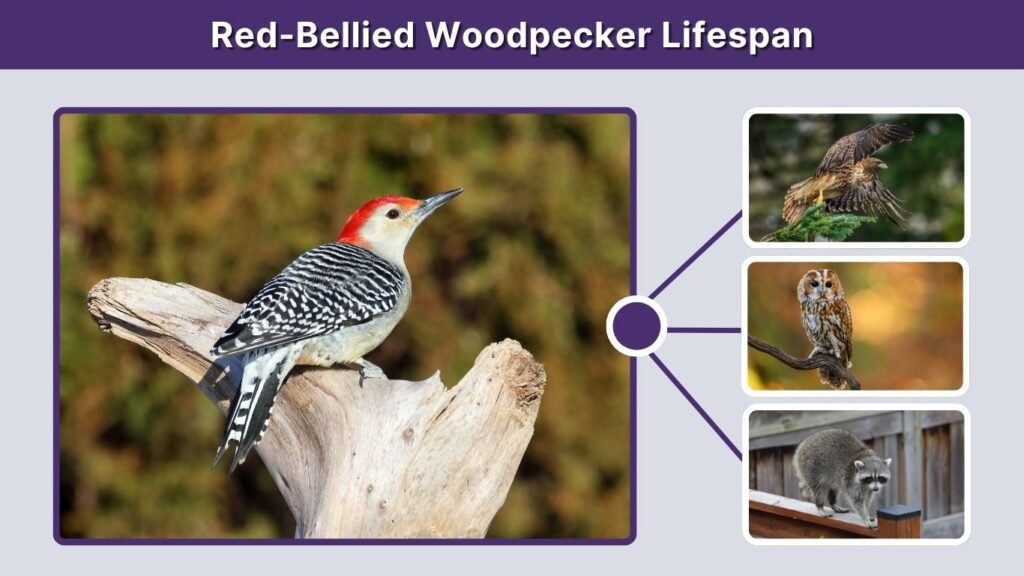
Many wild red-bellied woodpeckers live for several years, although survival varies depending on predators, weather, disease, habitat quality, and food availability.
Some banded individuals have survived for more than a decade.
Predators can include hawks, owls, snakes, raccoons, and other animals capable of reaching adults, eggs, or nestlings.
Red-Bellied Woodpecker Spiritual Meaning
In folklore and personal symbolism, woodpeckers are sometimes associated with persistence, opportunity, communication, and determination.
A red-bellied woodpecker does not have one scientifically defined spiritual meaning. Interpretations vary among cultures and individuals, so these associations are better understood as symbolic beliefs rather than biological facts.
FAQs
Why Is It Called a Red-Bellied Woodpecker?
The species has a reddish or pinkish patch on the lower belly. The coloring can be difficult to see when the bird is perched normally.
How Can You Tell a Male From a Female Red-Bellied Woodpecker?
Males have red extending across the crown from the forehead to the nape. Females have a gray crown with red mainly at the back of the head.
What Do Red-Bellied Woodpeckers Eat?
They eat insects, spiders, seeds, nuts, berries, fruits, and occasionally other small animal foods.
Do Red-Bellied Woodpeckers Visit Bird Feeders?
Yes. They commonly visit feeders offering suet, peanuts, sunflower seeds, and other high-energy foods.
Do Red-Bellied Woodpeckers Migrate?
Most are year-round residents. Some local movement occurs, but they are generally not considered long-distance migratory birds.
