
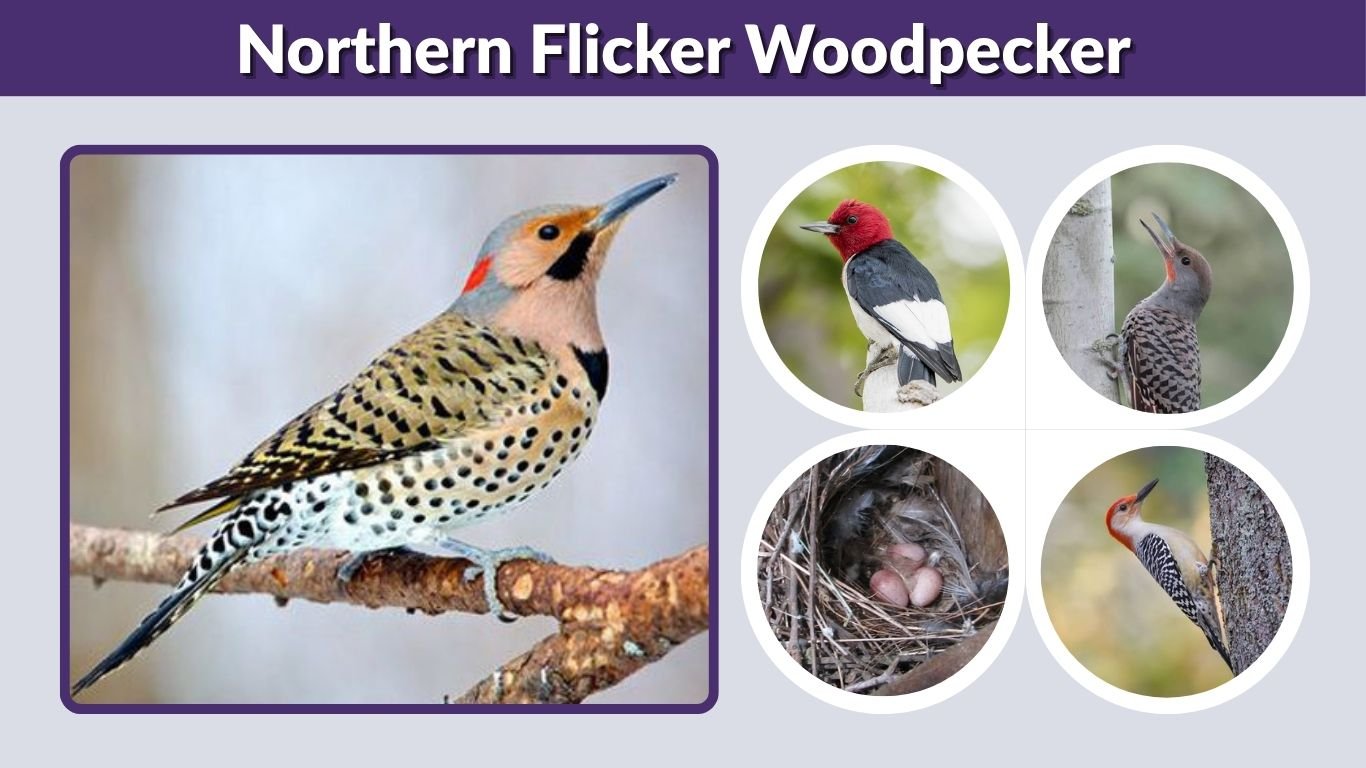
The northern flicker woodpecker is a large, colorful bird recognized by its spotted belly, black breast patch, and bright wing feathers. Unlike most woodpeckers, it spends considerable time on the ground searching for ants and beetles. Two main forms occur in North America: the eastern yellow-shafted flicker and the western red-shafted flicker. This guide explains how to identify northern flickers, distinguish males from females, recognize their calls, understand their diet and nesting behavior, and compare them with similar woodpeckers.
Is a Northern Flicker a Woodpecker?
The northern flicker (Colaptes auratus) is a true member of the woodpecker family, Picidae. It possesses the strong feet, stiff tail, specialized tongue, and cavity-excavating behavior associated with woodpeckers. However, its brown coloring and habit of feeding on lawns can make it appear different from more familiar black-and-white species.
Northern Flicker Identification
Look for the following characteristics:
- Approximately 11–14 inches long
- Wingspan measuring about 17–21 inches
- Brown or grayish-brown head and back
- Black crescent-shaped patch across the chest
- Pale belly covered with round black spots
- Dark bars across the back and wings
- Long, slightly curved bill
- White rump that flashes during flight
- Yellow or red coloring beneath the wings and tail
The spotted underparts sometimes cause people to call it a “polka-dot woodpecker.” Its white rump is one of the easiest features to recognize when the bird flies away.
Why Is It Called a Flicker?
The name may be connected to the bright flashes, or flickers, of color visible beneath the bird’s wings during flight. These feathers appear yellow in eastern populations and salmon-red in western populations.
The bird has also acquired regional names such as yellowhammer, golden-winged woodpecker, high-hole, and clape. “Yellowhammer” is especially associated with the yellow-shafted form.
Yellow-Shafted vs. Red-Shafted Northern Flicker
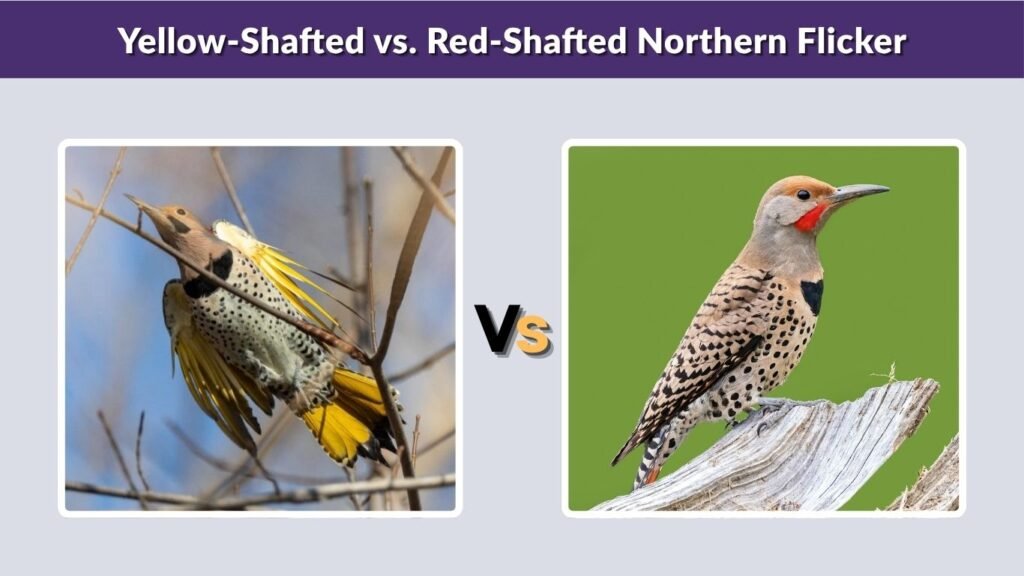
Northern flickers show noticeable geographic variation. Yellow-shafted birds occupy most of eastern and northern North America, while red-shafted birds dominate the West. Their populations meet and interbreed across portions of the Great Plains and Rocky Mountain region, producing individuals with mixed characteristics.
Yellow-Shafted Northern Flicker
Yellow-shafted flickers typically possess:
- Bright yellow flight and tail-feather shafts
- Tan or brown face
- Red crescent on the back of the neck
- Black mustache stripe on adult males
- No mustache stripe on adult females
This is the form commonly observed in the eastern United States, central Canada, and parts of the northern range.
Red-Shafted Northern Flicker
Red-shafted flickers generally have:
- Salmon-red wing and tail feathers
- Gray face
- No red crescent on the back of the neck
- Red mustache stripe on adult males
- No mustache stripe on adult females
This form occurs throughout much of western North America, including California, Colorado, British Columbia, and Alberta.
Hybrid Northern Flickers
Hybridization is common where the two forms meet. A hybrid may display orange wing feathers, a red nape combined with a red mustache, or other mixtures of eastern and western features.
These combinations make some birds difficult to classify from a single photograph. Location, facial color, nape pattern, and wing color should all be considered.
Male vs. Female Northern Flicker
Male and female northern flickers have approximately the same body size and share the spotted belly, barred back, black chest crescent, and white rump. The mustache-shaped stripe beside the bill is the most reliable difference between adults.
Male Northern Flicker
An eastern yellow-shafted male has a black mustache stripe extending backward from the bill. A western red-shafted male has a red mustache stripe in the same location.
Males also perform territorial displays involving head movements, calling, and drumming. However, both sexes drum and participate in excavating the nest.
Female Northern Flicker
Adult females lack a colored mustache stripe. A yellow-shafted female still has a red marking on the back of her neck, but her cheeks remain plain brown.
A red-shafted female has a gray face without a red mustache or red nape patch. Because females otherwise resemble males, examining the face is usually necessary for identification.
Juvenile Northern Flicker
Juveniles resemble adults but generally have softer, less clearly defined markings. Their plumage may appear duller, and young males can display an incomplete mustache stripe.
After leaving the nest, young flickers may follow their parents to productive feeding areas. Their calls can sound more persistent as they request food.
Northern Flicker Call and Sound
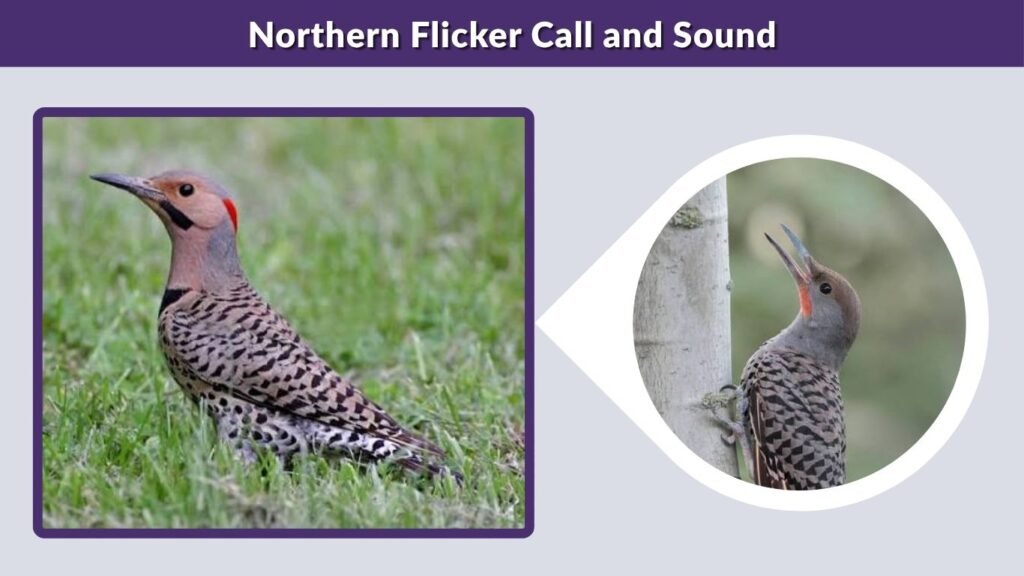
Northern flickers are vocal birds, particularly during spring courtship and territory establishment. Their loud calls can carry across open woodland and suburban neighborhoods. They also communicate through drumming, using resonant trees, metal roofs, gutters, and chimney covers to amplify the sound.
Common Calls
Northern flicker sounds include:
- A loud, repeated “wick-wick-wick” call
- A clear, single-note “kyeer” or “peah” call
- Soft conversational notes between mates
- Sharp alarm calls near a nest
- Rapid, evenly spaced drumming
The long “wick-wick-wick” series can resemble the call of a pileated woodpecker. However, the pileated woodpecker’s call often changes in pitch and comes from a much larger bird.
Why Do Northern Flickers Drum?
Drumming replaces singing as a means of advertising territory and attracting a mate. Both male and female flickers drum by striking a resonant surface rapidly.
A typical burst lasts roughly one second and may contain around 25 strikes. Metal objects can produce an especially loud sound, which explains why flickers sometimes choose gutters or chimney caps.
Diet and Ground-Feeding Behavior
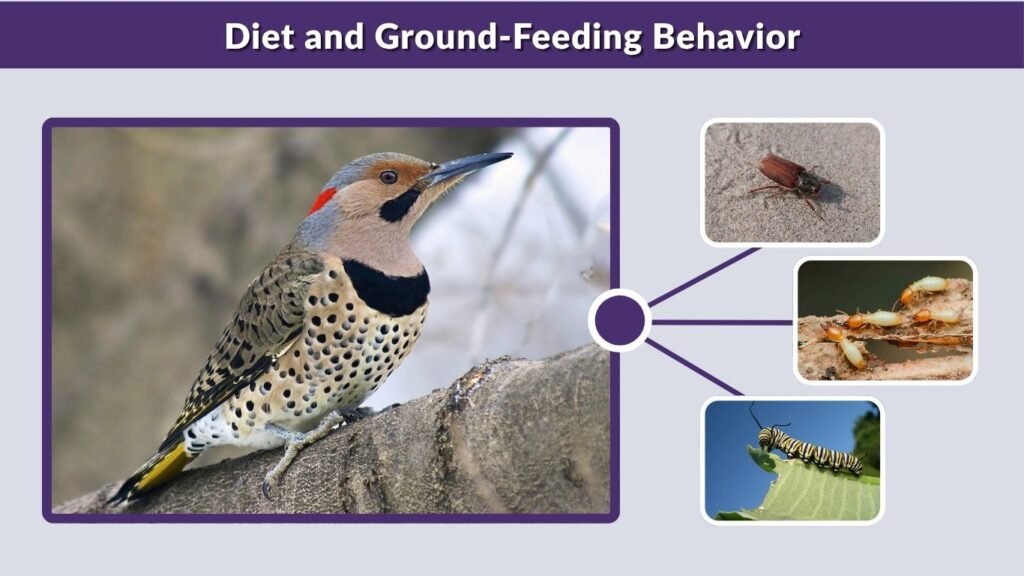
Northern flickers eat more ants and spend more time feeding on the ground than any other North American woodpecker. Their slightly curved bill helps them dig into soil, while their exceptionally long tongue reaches insects inside underground tunnels.
What Do Northern Flickers Eat?
Their diet includes:
- Ants and ant larvae
- Beetles and beetle larvae
- Termites
- Flies, moths, and butterflies
- Caterpillars and snails
- Wild grapes and cherries
- Elderberries and blueberries
- Dogwood, sumac, and hackberry fruit
- Poison ivy and poison oak berries
- Sunflower seeds and other seeds
Insects dominate the diet during warmer months. Fruits, berries, and seeds become increasingly important during autumn and winter. The tongue can extend approximately two inches beyond the end of the bill to capture underground prey.
How Northern Flickers Find Food
A flicker commonly hops across lawns, woodland clearings, roadsides, and fields while watching for ant activity. It drills or probes into the soil and uses its sticky tongue to collect workers, larvae, and pupae.
The holes created in a lawn are generally shallow and provide natural insect control. Flickers also climb trees, investigate bark, catch occasional flying insects, and visit branches carrying ripe fruit.
Habitat and Geographic Range
Northern flickers inhabit open forests, woodland edges, parks, farms, orchards, suburban neighborhoods, and mountain valleys. They need trees for nesting but prefer nearby open ground where they can hunt ants. Consequently, they are usually less common in dense, continuous forests without clearings.
Where Do Northern Flickers Live?
Their extensive range covers:
- Most of Canada and the United States
- Alaska and parts of the far north
- Mexico and portions of Central America
- The Pacific Northwest
- The Rocky Mountains and Great Plains
- Eastern forests and southern woodlands
Southern populations often remain in one area throughout the year. Flickers breeding in Canada, Alaska, and the northern United States commonly migrate south for winter.
Northern Flickers in Cities
Parks, cemeteries, golf courses, and older neighborhoods can provide excellent habitat. Mature trees offer cavities, while lawns and open soil support ants.
Flickers may also visit suet feeders, platform feeders, and yards containing berry-producing native plants. Avoiding broad insecticide use helps preserve their natural food supply.
Nesting and Reproduction
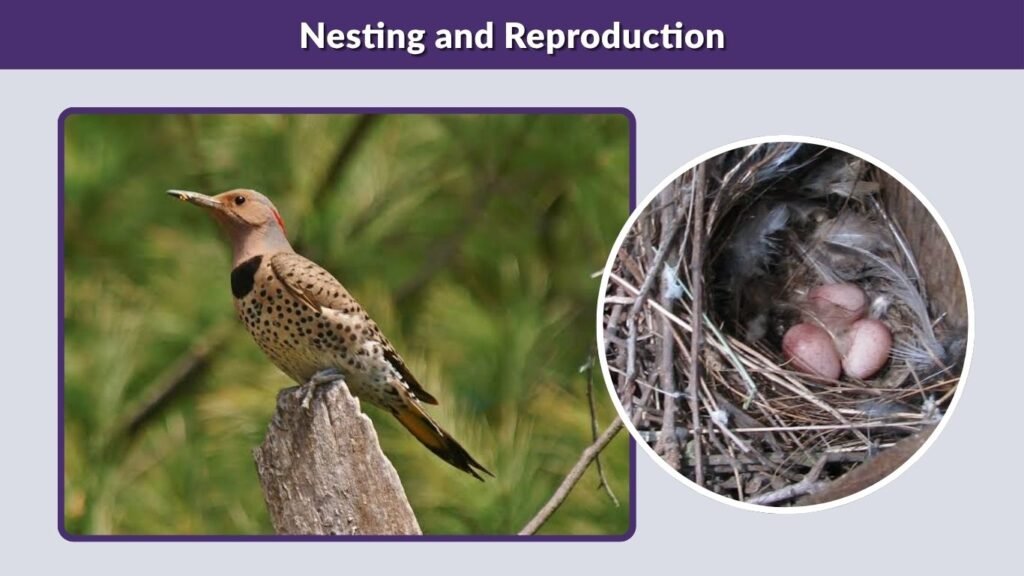
Northern flickers are cavity nesters. A pair may excavate a new cavity or enlarge an existing hole in a dead tree, decaying branch, fence post, utility pole, cactus, or occasionally a building. Old flicker cavities later provide valuable nesting sites for other birds and small mammals.
Nest and Eggs
Important nesting facts include:
- Usual clutch of five to eight eggs
- Smooth, glossy white eggs
- Incubation lasting approximately 11–16 days
- Both parents incubate the eggs
- The male commonly incubates at night
- Chicks remain in the cavity for about four weeks
- Parents feed nestlings by regurgitation
- Usually one brood per year
The nest has no added grass, leaves, or feathers. Eggs rest on wood chips left at the bottom during excavation.
Courtship Behavior
During courtship or territorial disputes, two flickers may face one another with their bills raised. They swing their heads, spread their tails, display the colored feathers beneath their wings, and produce rhythmic calls.
A third bird, often a potential mate, may watch the display. This distinctive interaction is sometimes described as a fencing dance.
Northern Flicker vs. Similar Woodpeckers
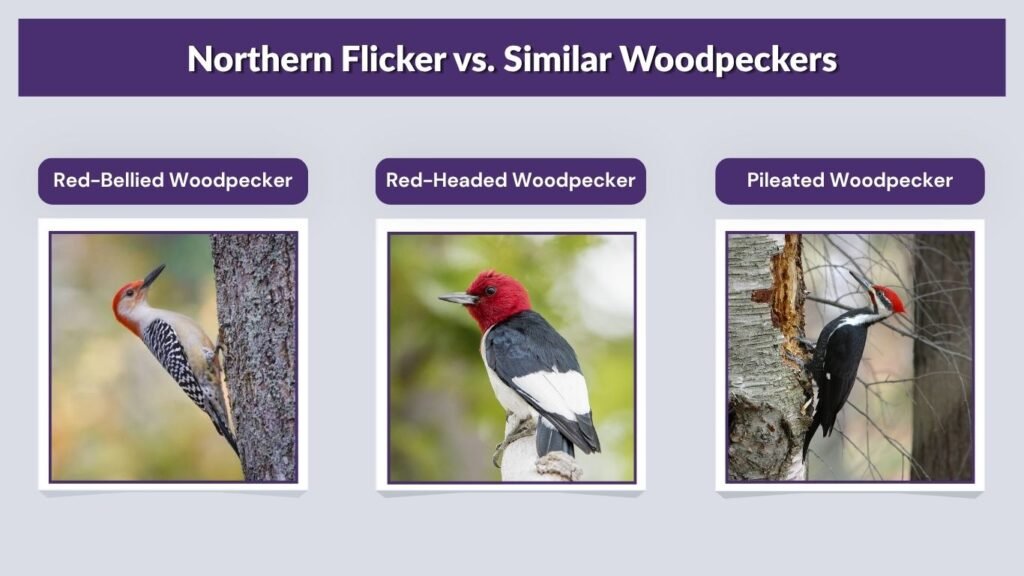
Several woodpeckers share parts of the northern flicker’s range. Body shape, overall color, rump pattern, habitat, and feeding behavior can help separate them.
Northern Flicker vs. Red-Bellied Woodpecker
A northern flicker is browner, has a spotted belly, a black chest crescent, and a conspicuous white rump. A red-bellied woodpecker has a strongly striped black-and-white back and a red crown or nape.
Red-bellied woodpeckers spend more time climbing trunks and branches. Flickers are more frequently seen feeding on lawns.
Northern Flicker vs. Red-Headed Woodpecker
An adult red-headed woodpecker has an entirely red head, clean white underparts, and large white wing patches. A northern flicker has a brown or gray head, spotted belly, barred back, and black chest crescent.
Northern Flicker vs. Pileated Woodpecker
A pileated woodpecker is crow-sized, predominantly black, and has a prominent red crest. A northern flicker is substantially smaller, brown, and lacks a large crest.
Their repeated calls may sound similar, but a pileated woodpecker generally produces a louder call that rises and falls more noticeably.
Northern Flicker vs. Gila Woodpecker
A Gila woodpecker has a strongly zebra-striped back and is closely associated with desert habitats and saguaro cacti. The northern flicker has spotted underparts, a black chest patch, and a white rump.
Northern Flicker Damage to Houses
A northern flicker may drum on metal surfaces without creating serious damage. However, it can excavate wooden siding, fascia boards, stucco, or roof trim when searching for insects or attempting to build a cavity.
Use reflective streamers, properly installed bird netting, and smooth protective panels to discourage activity. Treat any carpenter bees or wood-boring insects attracting the bird. Never poison or trap a flicker, and do not seal a cavity containing eggs or chicks because native woodpeckers are legally protected.
FAQs
Is a northern flicker a type of woodpecker?
Yes. It is a true woodpecker, although it feeds on the ground more frequently than most other members of its family.
What color is a northern flicker?
It is mainly brown with a spotted belly, barred back, black chest crescent, and white rump. Its flight feathers are yellow in the East and red in the West.
Do northern flickers visit bird feeders?
They sometimes visit suet and platform feeders. They may also eat sunflower seeds, peanuts, and fruit, particularly during winter.
What does seeing a northern flicker mean spiritually?
Some traditions associate flickers with change, rhythm, communication, or determination. These interpretations are cultural or personal beliefs rather than scientific characteristics.
Are northern flickers rare?
Northern flickers remain widespread across North America. Nevertheless, local numbers may decline where dead nesting trees, open feeding areas, and insect-rich habitat disappear.
