
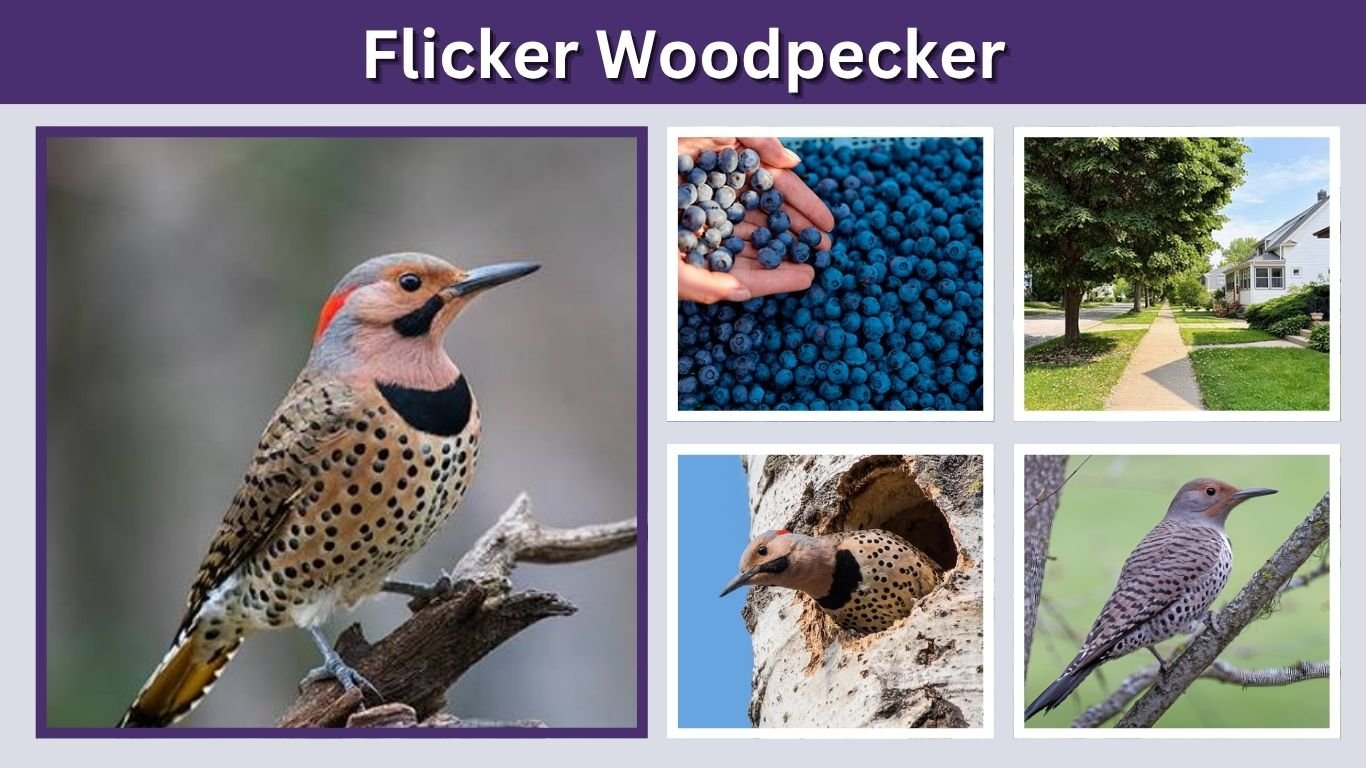
A flicker woodpecker may surprise you by feeding on a lawn instead of clinging to a tree. Despite this unusual habit, the northern flicker is a true woodpecker, with a strong bill, a spotted belly, and a bright white rump. Yellow or reddish flashes beneath its wings help distinguish regional forms, while facial markings separate adult males from females. This guide explains identification, calls, food, nesting, and the differences between northern flickers, gilded flickers, and other familiar woodpeckers you might see nearby.
What Is a Flicker Woodpecker?
The northern flicker, Colaptes auratus, belongs to the woodpecker family, Picidae. “Flicker” is a name used for certain woodpeckers, not a separate bird family. Its brown coloring and frequent ground feeding make it look different from familiar species that climb tree trunks. Once you recognize the breast markings and white rump, identification becomes much easier, even during a brief sighting.
Key Identification Features
- Size: About 11–12 inches long, with a wingspan around 16.5–20 inches.
- Body: Brownish overall, with black bars across the back.
- Underparts: Dark spots on a pale belly.
- Chest: A prominent black crescent or bib.
- Rump: A white patch that becomes conspicuous in flight.
- Bill: Long and slightly curved downward.
Flight and Feeding Behavior
Watch for an undulating flight, with flapping followed by short glides. On the ground, flickers probe for insects rather than simply collecting seeds.
Northern Flicker Forms and Gilded Flickers
Names involving yellow and red usually describe the color beneath the wings and tail, not the bird’s entire body. Yellow-shafted and red-shafted northern flickers belong to the same species and interbreed where their ranges meet. The gilded flicker is a different species. Comparing face color, feather color, and location helps distinguish these birds without relying on one isolated identifying feature.
Yellow-Shafted Northern Flicker
This form occurs across eastern North America and much of northern Canada into Alaska. Look for yellow beneath the wings and tail, a tan face, gray crown, and red crescent behind the head.
Red-Shafted Northern Flicker
Common across western North America, including California and Colorado, this form has reddish flight feathers, a gray face, and brown crown. Typical birds lack the red nape crescent. Hybrids can show mixed features.
Gilded Flicker
The gilded flicker, Colaptes chrysoides, inhabits southwestern deserts. It combines yellow underwings with a gray face and cinnamon crown. It often nests in giant cacti, including saguaros. Yellow wings alone cannot separate it from a northern flicker.
Male vs. Female Northern Flicker
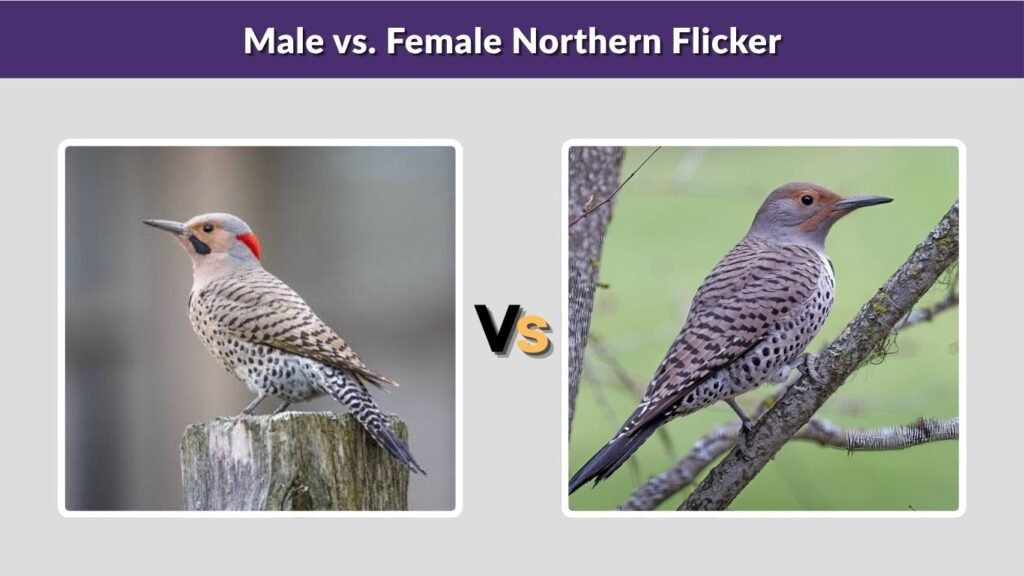
Adult male and female northern flickers share most body markings, including the spotted belly, barred back, and black chest crescent. The most useful difference is the mustache stripe beside the bill. Its color depends on the regional form. Do not identify sex from the small red patch behind the head alone, because that marking can occur in females as well.
Adult Facial Markings
- Yellow-shafted male: Black mustache stripe.
- Red-shafted male: Red mustache stripe.
- Female of either form: Lacks the male’s contrasting mustache.
- Yellow-shafted males and females: Both can have a red nape crescent.
Getting a Clear View
Check the cheek immediately below and behind the bill. A side view is more useful than a photograph showing only the back of the head. These distinctions apply to adult plumage.
Northern Flicker vs. Other Woodpeckers
A flicker is already a woodpecker, so the useful comparison is between particular species. Begin with the belly and chest, then compare the back pattern and head. Red markings alone can be misleading because several woodpeckers show them. Size, posture, and feeding behavior provide supporting clues, but visible plumage patterns usually offer the clearest starting point for a confident identification.
Northern Flicker vs. Red-Bellied Woodpecker
| Feature | Northern flicker | Red-bellied woodpecker |
| Belly | Bold black spots | Mostly plain and pale |
| Chest | Black crescent | No black crescent |
| Back | Brown with black bars | Contrasting black and white bars |
| Head | Regional facial markings | Red nape; male also has red crown |
The red-bellied woodpecker’s reddish belly can be difficult to see. Its plain underparts are more useful for this comparison. Cornell red-bellied woodpecker guide
Gila, Pileated, Downy, and Red-Headed Woodpeckers
Gila woodpeckers have relatively plain tan underparts without the flicker’s spotted belly and black bib. Cornell Gila guide
Pileated woodpeckers are much larger, mostly black, and prominently crested. Downy woodpeckers are much smaller and black and white. Adult red-headed woodpeckers have an entirely red head and large white wing patches.
Flicker Woodpecker Diet, Habitat, and Nesting
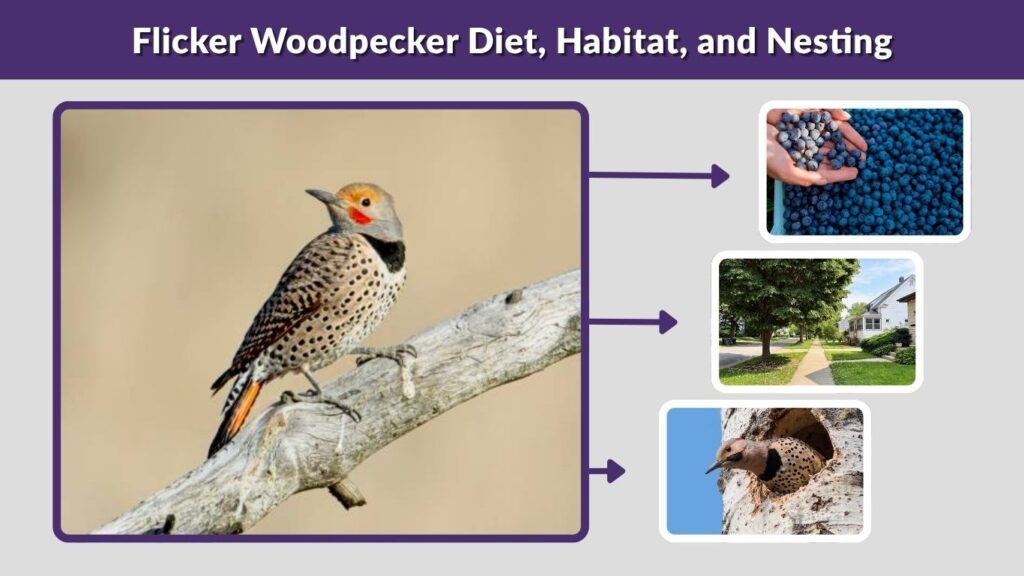
Northern flickers need feeding areas as well as places to shelter and reproduce. Open ground supplies much of their insect food, while trees provide nest cavities and resting sites. This combination explains why they occur in parks, gardens, woodland edges, and other mixed landscapes. Their behavior also changes seasonally as food availability, breeding activity, and weather conditions influence daily movements.
What Do Flicker Woodpeckers Eat?
Ants are a major food, alongside beetles and other insects. Flickers also consume fruit and berries, particularly in fall and winter, with seeds and nuts eaten occasionally.
Habitat and Migration
Look in open woods, suburban yards, and fields with scattered trees. Many northern populations migrate south for winter, while birds elsewhere may remain throughout the year.
Nesting and Young
Pairs excavate or reuse cavities, often in dead or decaying trees. A typical clutch contains five to eight white eggs. Incubation lasts about 11–13 days, and nestlings remain inside for roughly 24–27 days. Both parents participate in raising the young.
Northern Flicker Calls and Drumming
You may hear a flicker before seeing it, especially during the breeding season. Its vocalizations include loud calls that carry across open areas and softer sounds used during close interactions. Drumming is different: the bird creates it by striking a surface with its bill. Learning that distinction helps explain why a flicker sometimes chooses metal rather than wood for drumming.
Common Sounds
- Rolling rattle: A loud series often heard during spring territorial activity.
- Single call: A sharp note commonly rendered as “kyeer.”
- Display call: A quieter, rhythmic “wick-a, wick-a.”
- Drumming: A rapid burst produced by either sex.
Flicker vs. Pileated Woodpecker Calls
Their rattling calls can sound similar. Pileated calls tend to be more resonant and less even in rhythm. Compare recordings and look for the bird before relying on sound alone.
Attracting Flickers and Preventing House Damage
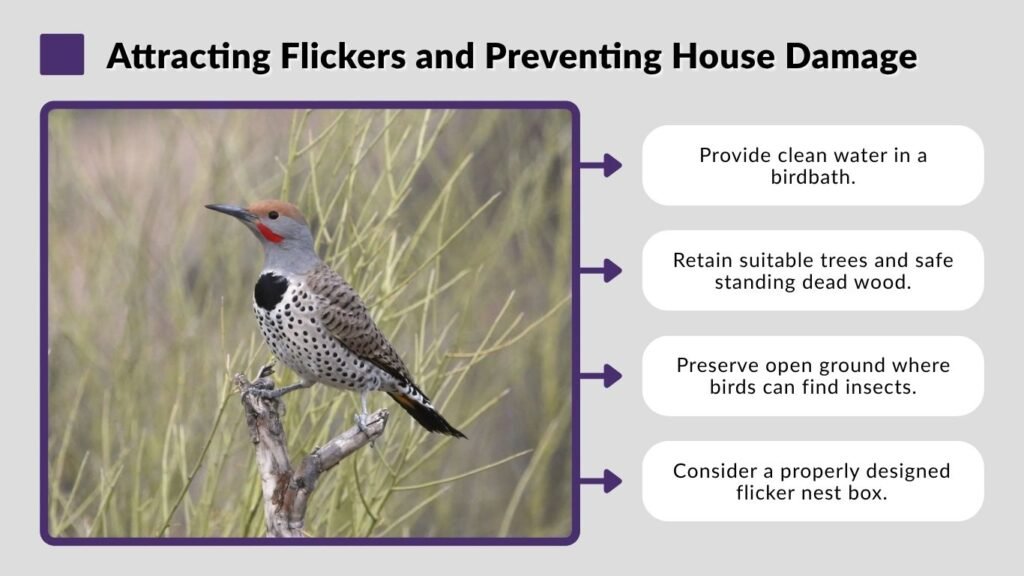
A yard with trees, open feeding space, and water may attract flickers without any special feeding routine. Their visits can provide excellent opportunities for watching natural behavior. Problems arise when a bird drums on siding or excavates a building. Before choosing a response, determine whether the activity involves communication, food searching, or nesting, because these situations call for different approaches.
Make Your Yard Welcoming
- Provide clean water in a birdbath.
- Retain suitable trees and safe standing dead wood.
- Preserve open ground where birds can find insects.
- Consider a properly designed flicker nest box.
Flickers do not regularly visit feeders, so habitat is often more useful than adding seed.
Responding to House Damage
Check for decaying wood or insects. Seek advice about humane exclusion before covering damaged areas, and never block an occupied cavity. Avoid sticky deterrents. In the United States, native woodpeckers are federally protected; consult wildlife authorities before actions affecting birds or active nests.
FAQs
Flickers attract attention because their habits and markings differ from what many people expect of woodpeckers. These answers address common questions about identity, color, movement, and nesting. For an unfamiliar bird, record your location and photograph its face, chest, and back when possible. Several views usually provide better evidence than a single distant image or a brief glimpse in flight.
Is a Northern Flicker Really a Woodpecker?
Yes. It belongs to the family Picidae, alongside downy, pileated, and red-bellied woodpeckers.
Is There a Red-Headed Flicker Woodpecker?
“Red-headed flicker” is not a standard species name. A red-headed woodpecker is a separate bird, while some flickers have red facial or nape markings.
Are Yellow and Red Flickers Different Species?
Yellow-shafted and red-shafted northern flickers are forms of one species. They can interbreed and produce birds with intermediate markings.
Why Is a Flicker Pecking My Lawn?
It is usually searching for ants and other insects. Ground feeding is normal behavior for northern flickers.
Will Northern Flickers Use a Birdhouse?
Sometimes. They may accept an appropriately sized nest box, although suitable natural cavities remain important. Install boxes before breeding begins.
