

The imperial woodpecker was a giant of Mexico’s mountain forests, with a powerful pale bill, striking black-and-white plumage, and an unmistakable crest. Recognized as the largest woodpecker species, it has not been recorded with certainty since 1956. Yet whether it is extinct requires a careful answer: its disappearance is widely suspected, but its conservation classification still reflects uncertainty. This guide explores the imperial woodpecker’s size, identification, habitat, diet, last confirmed sighting, and differences from ivory-billed and pileated woodpeckers.
What Is the Imperial Woodpecker?
The imperial woodpecker, Campephilus imperialis, is a species native only to Mexico. It belongs to the woodpecker family Picidae and is closely related to the ivory-billed woodpecker. Historical descriptions, preserved specimens, and a short film provide most of what we know about this extraordinary bird.
Identification and Size
An adult measured approximately 56–60 centimeters (22–24 inches) long, making it considerably larger than most familiar woodpeckers. Its key features included:
- A predominantly black body with contrasting white wing patches
- A large, pale, ivory-colored bill
- Narrow white markings on the upper back
- A black face and neck without the ivory-bill’s white neck stripes
- A red-and-black crest in males
- A long, black crest curling forward in females
The female’s curved crest was particularly distinctive. Both sexes were imposing birds, approaching a raven in overall length.
Imperial Woodpecker Habitat and Range

The imperial woodpecker inhabited the Sierra Madre Occidental of western Mexico. Its home was mountain forest, especially extensive stands of mature pines and oaks. Its survival depended on more than simply having trees: it needed the large trunks and dead wood characteristic of an old forest.
Where Did It Live?
Historical records include Chihuahua and Durango, with the broader range extending through parts of western Mexico. Many occupied areas were high plateaus with open forest beneath enormous pines.
Important habitat features included:
- Large, mature pine trees
- Standing dead or dying trunks
- Extensive forest suitable for moving between feeding sites
- Trees large enough to provide nesting and roosting cavities
What Did It Eat?
Its diet centered on large beetle larvae living beneath bark and within dead or dying wood. The bird used its powerful bill to remove bark and expose these grubs.
This feeding specialization made dead trees valuable resources. Removing them could reduce food availability even where some living forest remained.
Is the Imperial Woodpecker Extinct?
The imperial woodpecker is widely considered likely extinct. However, “likely extinct” and a formal assessment of “Extinct” are not interchangeable. The distinction matters because an absence of confirmed observations, even over many decades, does not establish the exact date when the final individual died.
Conservation Status
BirdLife treats the species as Critically Endangered, with possible extinction recognized. There has been no confirmed record since 1956, and no verified evidence establishes that a population survives today.
The cautious classification should not be interpreted as proof that birds remain alive. It reflects uncertainty about a species that disappeared before scientists could study it thoroughly.
Why Did It Disappear?
Researchers identify several pressures associated with its decline:
- Logging: Large pines were removed from its mountain habitat.
- Dead-tree removal: Standing dead trunks were harvested, reducing feeding resources.
- Hunting: Birds were killed for food and other purposes.
- Possible poisoning: Interviews with residents described poison being placed on feeding trees.
The poisoning accounts are historical testimony, not proof of how every population disappeared. Research points to both habitat loss and direct killing as important factors.
Imperial Woodpecker vs. Similar Species
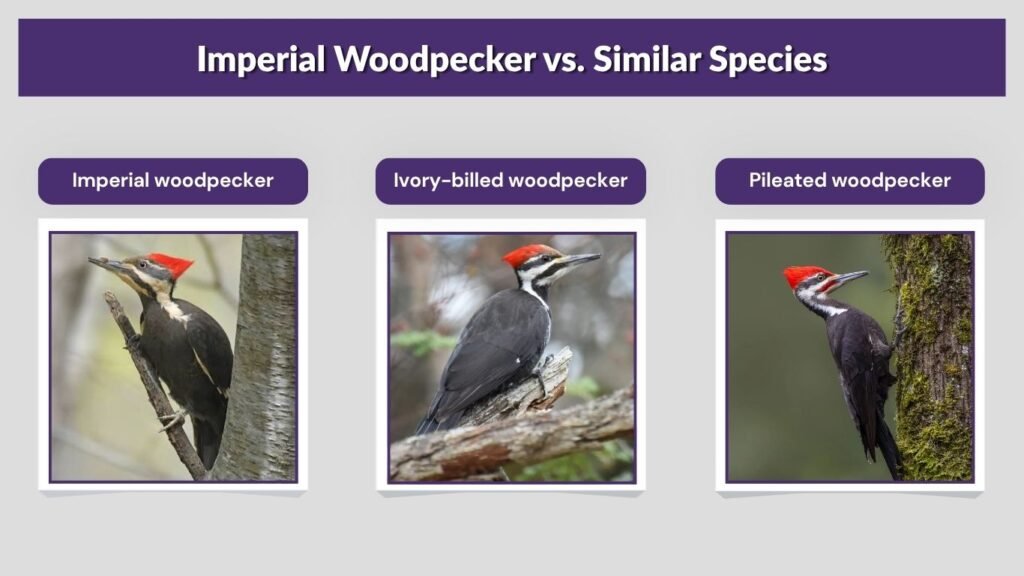
Imperial, ivory-billed, and pileated woodpeckers share a large size, dark plumage, white markings, and prominent crests. However, they are separate species. Comparing body length, facial markings, and the female’s crest is more useful than relying on a general impression of a huge black-and-white bird.
Identification Comparison
| Feature | Imperial woodpecker | Ivory-billed woodpecker | Pileated woodpecker |
| Approximate length | 56–60 cm | 46–51 cm | 40–49 cm |
| Bill | Large and pale | Large and pale | Darker and grayish |
| Face and neck | Black without white neck stripes | White stripes down the neck | Prominent white facial and neck stripes |
| Female crest | Black and curled forward | Black | Red |
Cornell’s identification guides document the smaller size and distinguishing markings of the ivory-billed woodpecker and pileated woodpecker.
Are Imperial and Ivory-Billed Woodpeckers the Same?
No. The imperial woodpecker is Campephilus imperialis, while the ivory-billed woodpecker is Campephilus principalis. Their close relationship explains their similar appearance, but a report involving one species does not establish the survival of the other.
FAQs
The imperial woodpecker attracts questions about its enormous size, disappearance, and surviving records. Because it was poorly studied while still regularly encountered, some details remain uncertain. Historical evidence should therefore be distinguished from estimates, later reports, and claims that have not been independently confirmed.
Is the Imperial Woodpecker Still Alive?
There is no confirmed evidence that it survives today. It is considered likely extinct, although its conservation classification retains uncertainty.
Was It the World’s Largest Woodpecker?
Yes. At approximately 56–60 centimeters long, it was the largest woodpecker species, exceeding both the ivory-billed and pileated woodpeckers.
When Was the Last Confirmed Sighting?
The last confirmed record was in Durango, Mexico, in 1956. Later reports have not established a verified rediscovery.
What Did the Imperial Woodpecker Sound Like?
Historical accounts compared its calls to a small toy horn and to the ivory-billed woodpecker’s calls. Audio attached to an online video should not automatically be treated as an authentic recording of this species.
Is There a Book About the Imperial Woodpecker?
Yes. Tim Gallagher’s Imperial Dreams: Tracking the Imperial Woodpecker Through the Wild Sierra Madre explores the bird’s history and the search for survivors.