
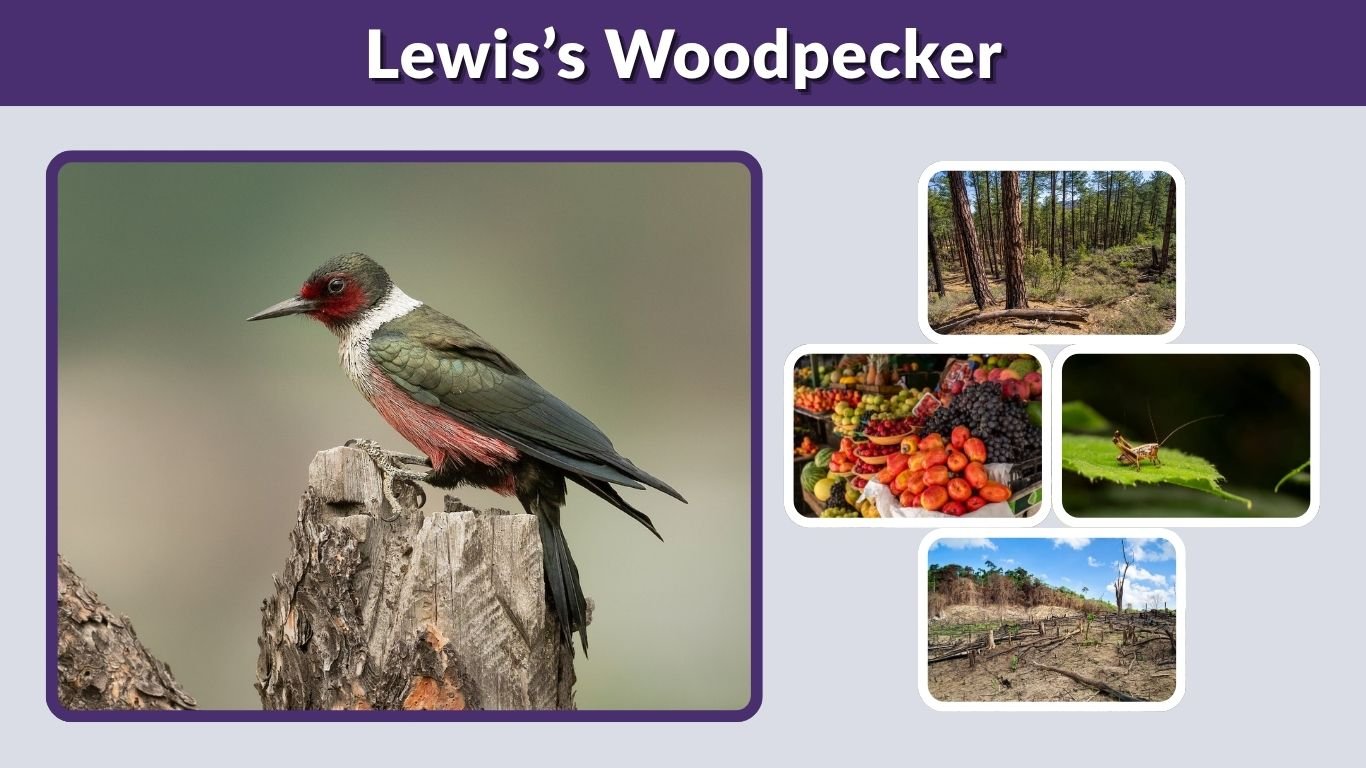
Lewis’s woodpecker is an unusual bird of western North America, recognizable by its dark green back, pink belly, and distinctive feeding behavior. Instead of spending most of its time drilling for insects, it often launches from exposed branches to catch them in flight. Its colors can disappear in poor lighting, making it look almost black from a distance. Whether you are identifying a female, watching a juvenile, or exploring its seasonal range, understanding its appearance and habits makes this remarkable woodpecker easier to recognize.
Lewis’s Woodpecker Identification
The scientific name of Lewis’s woodpecker is Melanerpes lewis. Its long wings, elongated body, and unusual colors help distinguish it from other woodpeckers. Good lighting is especially useful when checking the plumage.
Key Identification Features
- Length: Approximately 10.2–11 inches, or 26–28 centimeters.
- Wingspan: Around 19.3–20.5 inches, or 49–52 centimeters.
- Weight: Approximately 88–138 grams.
- Upperparts: Dark green, often appearing black at a distance.
- Face: Deep red or maroon.
- Chest and collar: Silvery gray.
- Belly: Pink to reddish pink.
These measurements and field marks are described in Cornell Lab’s identification guide.
Male vs. Female Lewis’s Woodpecker
Male and female Lewis’s woodpeckers have very similar plumage. Both display the red face, gray collar, and pink belly. Unlike some woodpecker species, females do not have an obvious missing red head patch.
A photograph usually cannot establish sex reliably. Labeling every brightly colored individual as male is a common identification mistake.
Juvenile Lewis’s Woodpecker
Juveniles look darker and less colorful than adults. Their gray collar and red facial markings may be absent or subdued, while the belly can show only limited pink. A dark young bird should therefore not be identified as female simply because it lacks strong adult colors. Audubon’s field guide describes the similar sexes and darker juvenile plumage.
Lewis’s Woodpecker Range and Migration
Lewis’s woodpecker has a patchy distribution across western North America. Suitable habitat matters more than a state boundary: birds may gather in one valley while being absent from nearby areas with dense forest or few nesting trees.
Where Does It Live?
Its range includes parts of the western United States, including Washington, Oregon, Idaho, Montana, California, Colorado, and New Mexico.
In Canada, regular breeding is concentrated in southern interior British Columbia. Birds occupy suitable valleys and nearby uplands, with the breeding distribution extending north to the Williams Lake area. British Columbia sightings should not be interpreted as evidence that the species is widespread throughout the province. Canada’s COSEWIC assessment details this distribution.
Does It Migrate?
Some populations migrate south or move to lower elevations, while others remain locally throughout the year. Winter movements can vary substantially with food availability.
A location occupied during one winter may have few birds the next. When interpreting a range map, distinguish breeding, wintering, and year-round areas.
Lewis’s Woodpecker Habitat and Diet
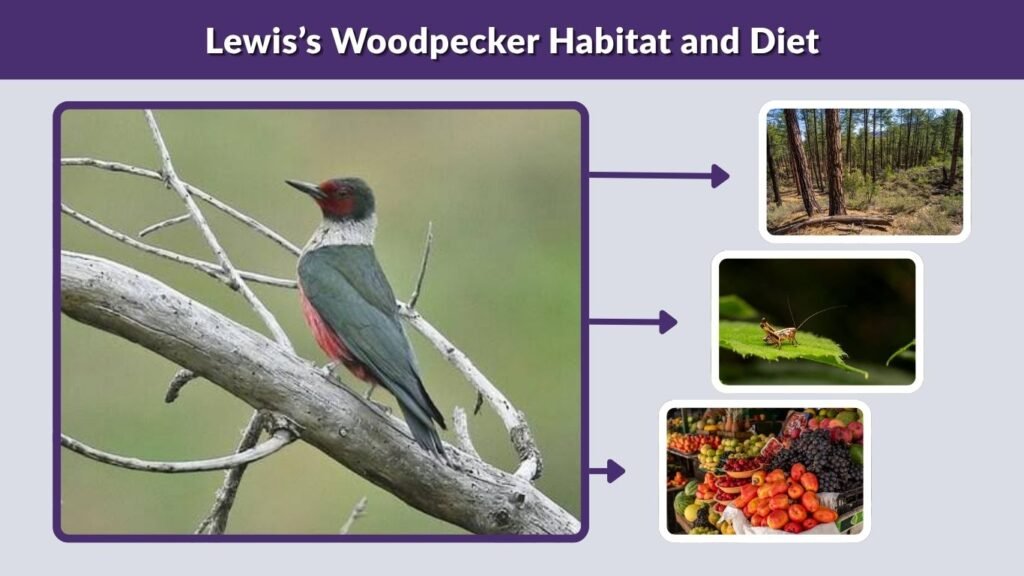
This species needs open space for aerial hunting and trees for perching, nesting, and storing food. Its habitat combines these resources rather than simply providing a large area of woodland.
Preferred Habitats
- Open ponderosa pine woodland.
- Burned forests retaining standing dead trees.
- Cottonwood groves beside rivers and streams.
- Open oak woodland.
- Orchards and agricultural landscapes with scattered trees.
Standing dead trees, called snags, are particularly valuable nesting resources. Partners in Flight emphasizes the importance of open forests and decaying nest trees.
What Does Lewis’s Woodpecker Eat?
Its diet includes insects, fruits, nuts, and some grains. During warmer months, it often catches flying insects by leaving a perch, seizing prey in the air, and returning to a lookout.
In autumn and winter, nuts and fruits become more important. Birds wedge acorns and other food into bark crevices and defend these stores. They also collect insects from surfaces, but excavating deeply for wood-boring insects is not their main feeding method. Cornell Lab’s life-history account describes these seasonal feeding habits.
Lewis’s Woodpecker Calls and Flight
Watching movement can be as useful as checking color. Lewis’s woodpeckers are relatively quiet, and their flight may initially suggest a different kind of bird.
What Does the Call Sound Like?
Calls include squeaks, chatter, and a harsh churring sound. Males give repeated churr notes during courtship, while alarm calls are sharp and squeaky.
Courtship drumming is relatively quiet, with an evenly spaced series of taps that may end with additional knocks. Cornell Lab’s sound guide includes recordings and call descriptions.
How Does It Look in Flight?
Deep wingbeats and frequent glides give the bird a crowlike appearance. Its flight is generally more direct than the strongly undulating pattern associated with many other woodpeckers. Watch for repeated flights from an exposed perch when it is hunting insects. Cornell Lab’s identification guide highlights this behavior.
Lewis’s Woodpecker Nesting and Breeding
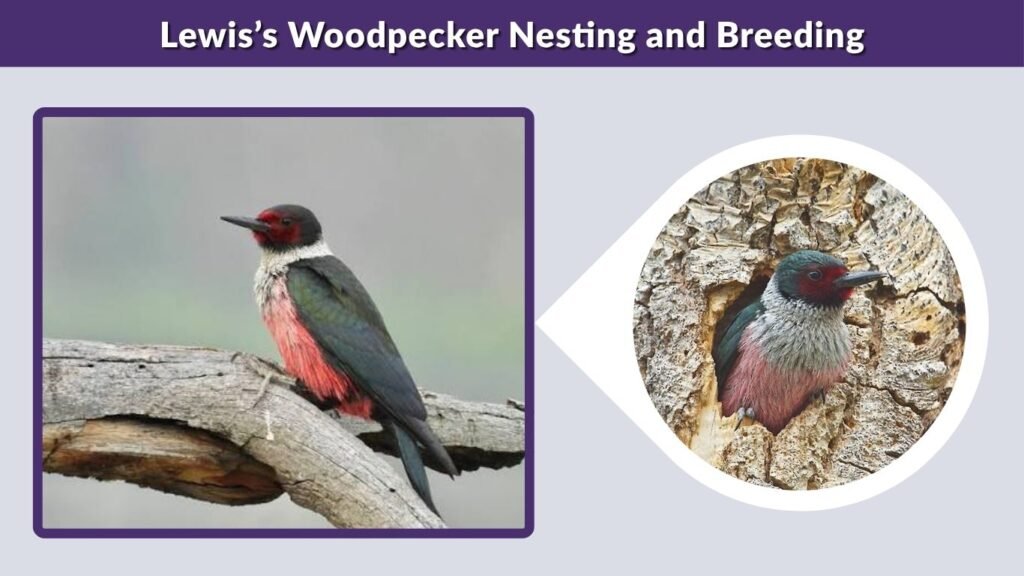
Lewis’s woodpeckers nest in tree cavities, often using existing holes in dead or decaying trees. They can modify cavities, but they are less powerful excavators than many other woodpeckers.
Eggs and Chick Development
Cornell lists a clutch of approximately five to nine white eggs and one brood annually. Incubation lasts around 12–16 days, and the nestling period is about 28–34 days.
These ranges describe typical development rather than a fixed schedule for every nest. Cornell Lab’s nesting account provides the breeding measurements.
Is Lewis’s Woodpecker Endangered?
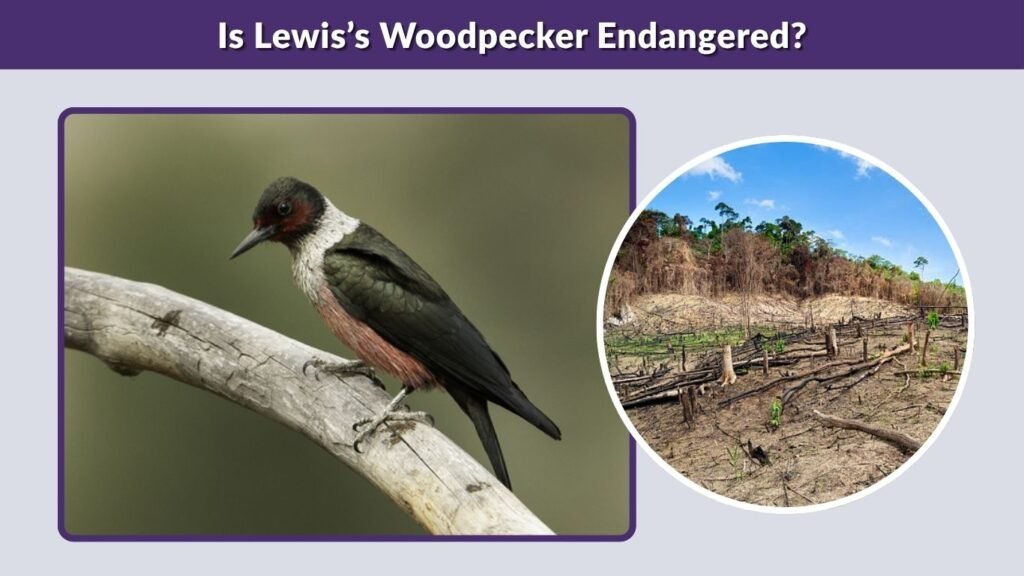
Conservation status depends on the geographic area and assessment system. A species can have a relatively low global extinction-risk category while facing serious regional declines.
Global and Canadian Status
Lewis’s woodpecker is categorized globally as Least Concern, but it is listed as Threatened in Canada. COSEWIC reaffirmed its threatened assessment in November 2024. These categories apply at different scales and are not contradictory.
Main Conservation Threats
Habitat loss, removal of nesting snags, changing forest structure, and competition with European starlings for cavities can reduce suitable breeding opportunities. Protecting open woodland and retaining appropriate nest trees where safe are useful conservation priorities. Partners in Flight identifies these habitat pressures.
FAQs
These short answers address common questions about the bird’s name, appearance, and behavior.
Why Is It Called Lewis’s Woodpecker?
It was named after Meriwether Lewis, who recorded the bird in 1805 during the Lewis and Clark expedition. Alexander Wilson formally described it in 1811. Cornell Lab’s species overview explains the naming history.
Is Lewis’s Woodpecker a Black Woodpecker?
It may look black in poor light, but adults have dark green upperparts and contrasting gray, red, and pink markings. “Black woodpecker” is not its proper common name.
Can You Identify a Female by Her Colors?
Usually not. Females and males share essentially the same color pattern, so plumage alone is not a reliable way to tell them apart.
Does Lewis’s Woodpecker Store Food?
Yes. It stores nuts and other food in tree crevices, creating supplies that it can use during autumn and winter.
Where Should You Look for One?
Start with open woodland, river groves, and suitable burned forest within its range. Scan exposed treetops and branches for a bird repeatedly flying out to catch insects.
