

The pileated woodpecker is one of the largest and most recognizable woodpeckers in North America. Its bold black body, flaming red crest, powerful bill, and loud calls make it difficult to overlook in mature forests. These birds spend much of their time searching dead and decaying trees for ants and other insects. Learning about pileated woodpecker size, sounds, habitat, diet, male and female differences, nesting behavior, and range makes identifying this impressive forest bird much easier.
Pileated Woodpecker Identification and Size
Pileated woodpeckers (Dryocopus pileatus) are large, crow-sized woodpeckers with long necks, broad wings, and prominent pointed crests. Their mostly black plumage contrasts strongly with white facial markings and white areas visible beneath the wings during flight. Their impressive dimensions and rectangular feeding holes help distinguish them from most other North American woodpeckers.
Pileated Woodpecker Identification
Key characteristics include:
- Length: About 16–19 inches
- Wingspan: Roughly 26–30 inches
- Body color: Mostly black
- Crest: Bright red and pointed
- Face: Bold black-and-white pattern
- Bill: Long, straight, and strong
- Flight: Powerful with noticeable white underwings
- Shape: Long neck and relatively long tail
Their size makes them considerably larger than downy, hairy, and red-bellied woodpeckers.
How Big Is a Pileated Woodpecker?
A pileated woodpecker is approximately the size of an American crow. Adults can approach 19 inches in length, making them one of the largest living woodpecker species in North America.
Their size is especially noticeable when they cling vertically to tree trunks. Their large body, long bill, and powerful feet allow them to excavate deep into dead wood while searching for insects.
Pileated Woodpecker in Flight
In flight, pileated woodpeckers show broad wings and flashes of white beneath them. Their flight can appear somewhat undulating, with several strong wingbeats followed by brief gliding periods.
Their large silhouette, pointed head crest, and contrasting white wing areas often make identification possible even when the bird is moving between distant trees.
Male vs Female Pileated Woodpecker
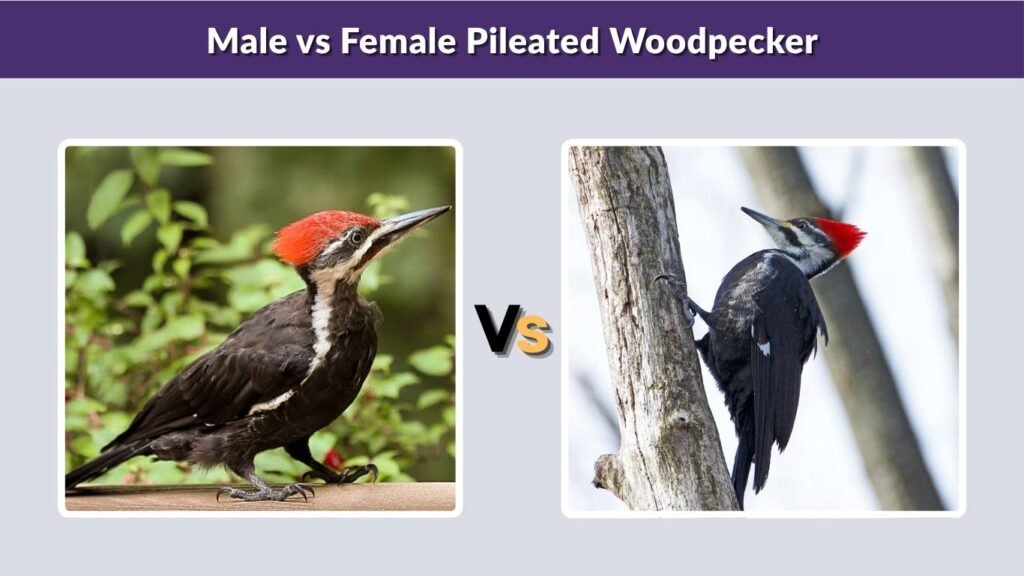
Male and female pileated woodpeckers look remarkably similar at first glance. Both have black bodies, white facial stripes, and dramatic red crests. However, several small facial markings make it possible to distinguish the sexes once you know what to look for. These differences are much easier to recognize at close range or through binoculars.
Male Pileated Woodpecker
Male pileated woodpeckers have:
- A red crest extending toward the forehead
- A red stripe along the cheek or “mustache” area
- Black-and-white facial markings
- Similar overall body size to females
The red cheek stripe is usually the easiest feature for identifying an adult male.
Female Pileated Woodpecker
Females also have a bright red crest, but the forehead immediately above the bill is typically darker rather than red.
Females also lack the male’s red cheek stripe. Instead, this area appears black. Otherwise, males and females are extremely similar in body size, plumage, and overall behavior.
Juvenile Pileated Woodpecker
Young pileated woodpeckers resemble adults but may have duller or less sharply defined plumage. Their crest can look shorter or less developed soon after leaving the nest.
Juveniles often remain near their parents while learning how to find food. Over time, their adult facial and crest patterns become easier to recognize.
Pileated Woodpecker Sounds and Calls
Pileated woodpeckers are noisy forest birds with calls that can travel considerable distances. Their vocalizations are often heard before the bird itself becomes visible. They also communicate by drumming on resonant wood. Understanding their calls and drumming sounds can be one of the easiest ways to detect pileated woodpeckers in a wooded area.
What Does a Pileated Woodpecker Sound Like?
Their most familiar call is a loud, ringing series of notes that may sound like rapid laughing or repeated “kuk-kuk-kuk” sounds.
The call can carry far through a forest and is sometimes confused with calls from other large woodland birds. Pileated woodpeckers may become especially vocal while defending territories or communicating with mates.
Pileated Woodpecker Drumming
Drumming is different from feeding. During drumming, the bird strikes a resonant surface rapidly to produce sound rather than excavate insects.
Pileated woodpeckers may drum on:
- Dead tree trunks
- Hollow branches
- Utility poles
- Wooden structures
- Other resonant surfaces
Drumming helps establish territory and communicate with potential mates.
Do Pileated Woodpeckers Call at Night?
Pileated woodpeckers are primarily daytime birds. Most calls occur during daylight hours, particularly around active territories.
Occasional sounds close to dawn, dusk, or during disturbance may create the impression that a bird is calling at night, but regular nighttime vocalizing is not typical behavior.
Pileated Woodpecker Habitat and Range
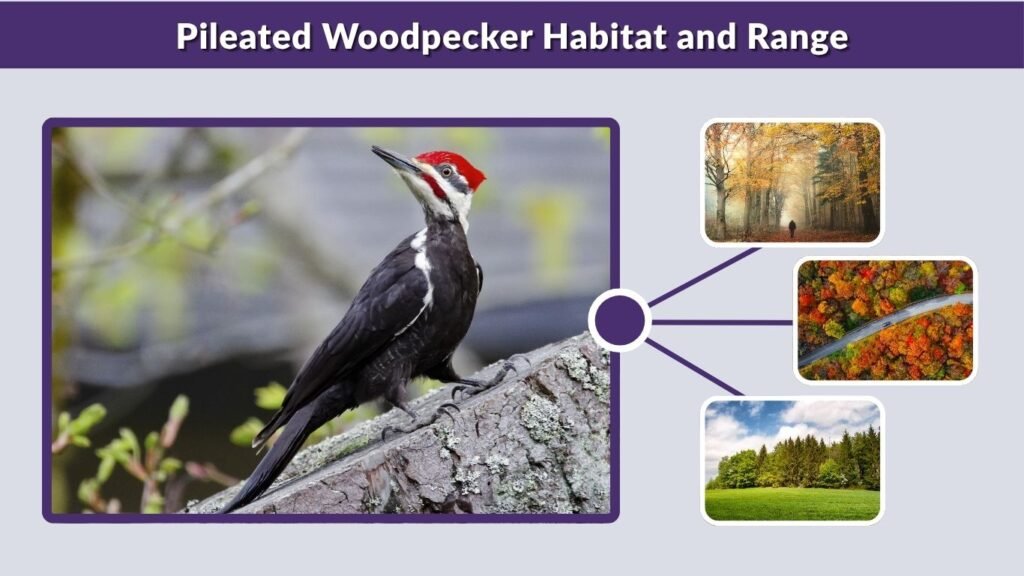
Pileated woodpeckers depend heavily on forested habitats containing large trees. Mature woodland provides nesting cavities, roosting sites, and dead wood filled with insects. Although strongly associated with forests, they can also appear in wooded suburban neighborhoods when enough large trees, fallen logs, and standing dead trees remain available.
Where Do Pileated Woodpeckers Live?
Common habitats include:
- Mature deciduous forests
- Mixed forests
- Wooded swamps
- Forest edges
- Large wooded parks
- Suburban areas with mature trees
- Areas containing standing dead trees
Large trees are particularly important because the birds need substantial trunks for nesting and feeding.
Pileated Woodpecker Range
Pileated woodpeckers occur across much of eastern North America and parts of western North America.
They can be found in many areas of the eastern United States, southeastern Canada, the Great Lakes region, the Pacific Northwest, and portions of the southeastern United States, including Florida.
Do Pileated Woodpeckers Migrate?
Most pileated woodpeckers remain within their general territories throughout the year rather than making long-distance seasonal migrations.
Local movements can occur as food availability changes, and young birds eventually leave their parents’ territories to establish areas of their own.
What Do Pileated Woodpeckers Eat?
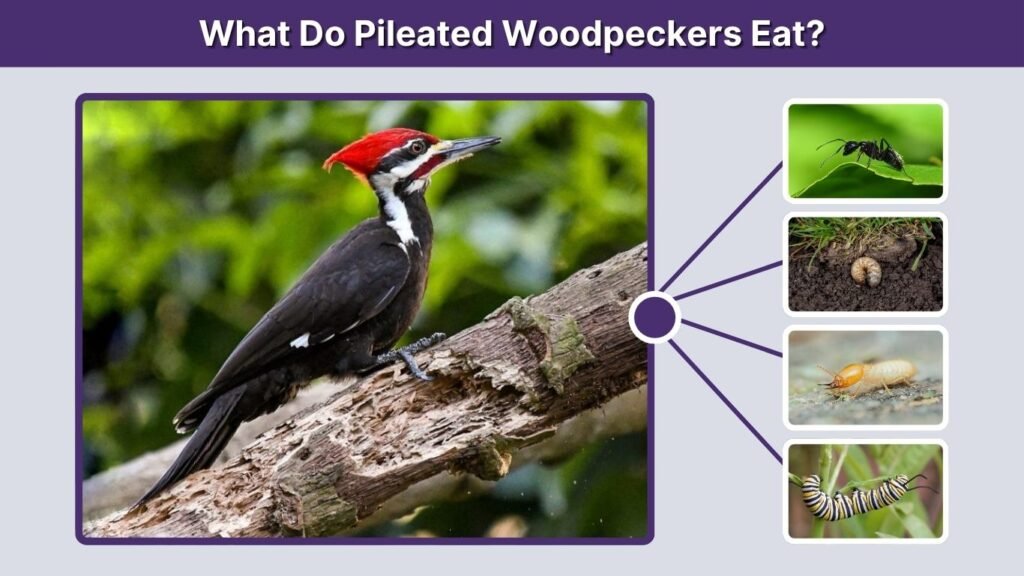
Pileated woodpeckers are specialized insect hunters. Their powerful bills allow them to break apart decaying wood and expose insects living inside. Carpenter ants are especially important in their diet. Feeding activity often leaves large rectangular holes in trunks and fallen logs, providing one of the clearest signs that pileated woodpeckers are present.
Pileated Woodpecker Diet
Their diet may include:
- Carpenter ants
- Other ants
- Beetle larvae
- Wood-boring insects
- Termites
- Caterpillars
- Other insects
- Wild fruits and berries
- Nuts
- Suet at bird feeders
They use their long tongues to reach insects deep inside excavated tunnels.
Pileated Woodpecker Holes in Trees
Pileated woodpeckers frequently create large rectangular or oblong holes while searching for insects.
These excavations can be surprisingly deep. Numerous holes in a dead or decaying tree often indicate a rich insect population.
Although the damage may look severe, woodpeckers frequently target trees that already contain rotting wood or insect infestations rather than causing the original decline.
Pileated Woodpecker Nesting and Reproduction
Pileated woodpeckers are cavity nesters. Rather than using an existing open nest, a pair excavates a chamber inside a large dead or partially decayed tree. Creating the cavity can take considerable effort. Once abandoned, these cavities may later provide valuable shelter for other birds, mammals, and wildlife.
Pileated Woodpecker Nest
A nesting pair excavates an entrance leading to a deeper chamber inside the tree.
The nest itself is relatively simple, with wood chips remaining at the bottom of the cavity. Both parents participate in caring for eggs and young.
Pileated woodpeckers typically choose large trees that provide enough internal space for a substantial nest chamber.
Do Pileated Woodpeckers Mate for Life?
Pileated woodpeckers often form long-term pair bonds and may remain associated for extended periods.
Pairs defend territories and communicate through calls and drumming. Even outside the immediate nesting period, established pairs may remain within the same general territory.
Pileated Woodpecker Young
Both parents help incubate eggs and feed nestlings. Young birds remain inside the cavity until they are sufficiently developed to leave.
After fledging, juveniles may continue following their parents and receiving food while gradually learning independent feeding techniques.
How to Attract Pileated Woodpeckers
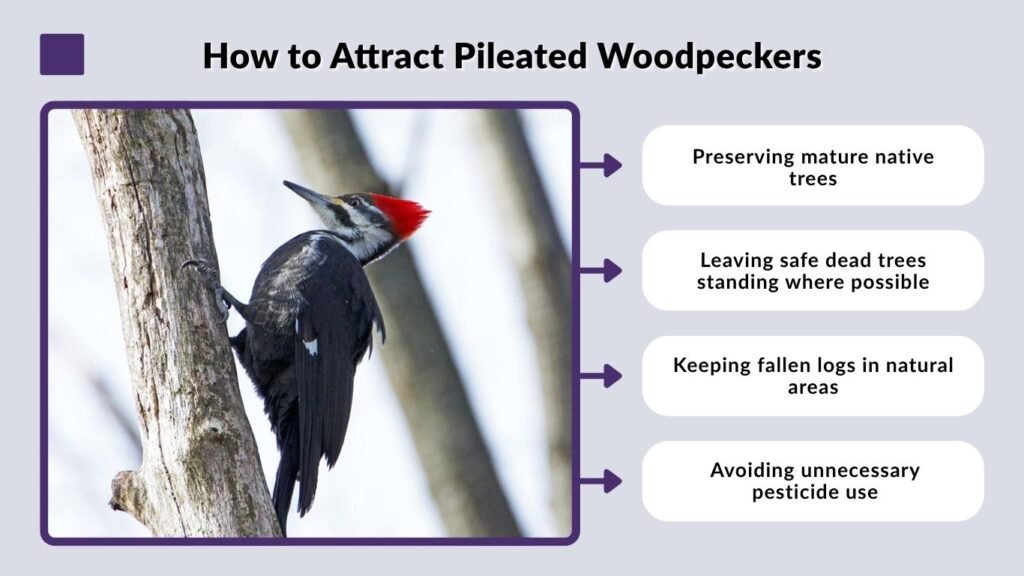
Attracting such a large woodpecker involves more than simply placing a small feeder outside. Pileated woodpeckers are strongly associated with large trees and natural food sources. Properties near mature woodland have the best chance of receiving visits, especially when dead wood and insect-rich habitats are preserved safely.
Ways to Attract Pileated Woodpeckers
You can make a property more attractive by:
- Preserving mature native trees
- Leaving safe dead trees standing where possible
- Keeping fallen logs in natural areas
- Avoiding unnecessary pesticide use
- Providing large suet feeders
- Installing feeders with adequate tail support
- Maintaining wooded habitat
- Growing native fruit-producing plants
Large suet feeders are particularly useful during periods when natural foods are less readily available.
Are Pileated Woodpeckers Rare or Endangered?
Pileated woodpeckers can seem rare because they require relatively large territories and are usually associated with wooded habitats. However, seeing one is not necessarily an indication that an extremely rare species has appeared. Their populations occur across a broad North American range where appropriate forest habitat exists.
Are Pileated Woodpeckers Endangered?
Pileated woodpeckers are not generally considered an endangered species. They have benefited in some areas from recovering forests and the availability of mature trees.
Protecting large forest tracts, dead trees, and nesting habitat remains important because these features support both pileated woodpeckers and many other cavity-dependent animals.
FAQs
Pileated woodpeckers generate plenty of questions because of their unusual size, striking crest, loud sounds, and impressive excavations. Knowing their distinguishing characteristics can also prevent confusion with other large woodpeckers.
How do you pronounce pileated woodpecker?
“Pileated” is commonly pronounced either PIE-lee-ay-tid or PILL-ee-ay-tid. Both pronunciations are widely used.
What is the scientific name of the pileated woodpecker?
The scientific name is Dryocopus pileatus. It belongs to the woodpecker family Picidae.
Is a pileated woodpecker bigger than an ivory-billed woodpecker?
The historically known ivory-billed woodpecker was larger. Pileated woodpeckers are smaller but can appear similar because both are large black-and-white woodpeckers with prominent crests.
Why do pileated woodpeckers make large holes?
They usually excavate large holes while searching for carpenter ants, beetle larvae, and other insects inside dead or decaying wood.
Can pileated woodpeckers visit bird feeders?
Yes. They sometimes visit large feeders offering suet. Feeders designed for big woodpeckers with enough space for their bodies and tails are usually most suitable.
