
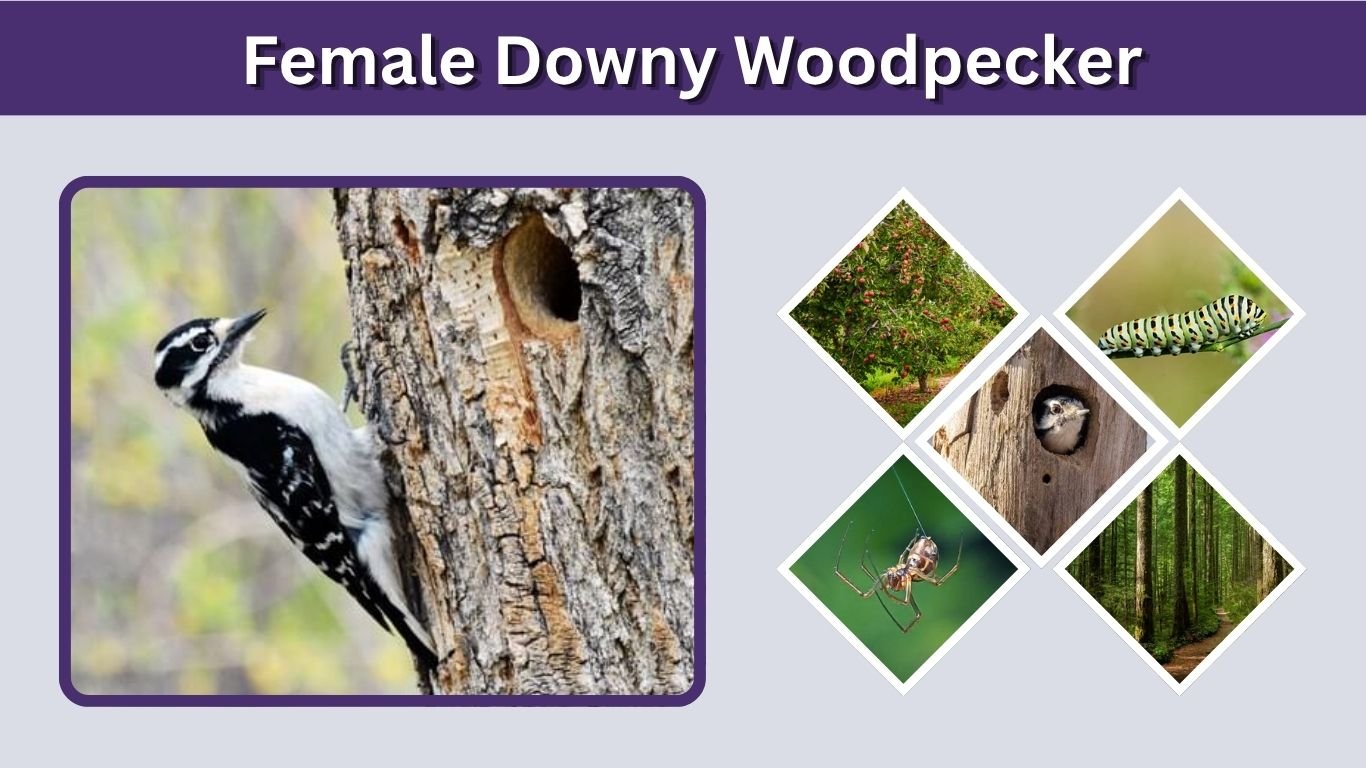
The female Downy Woodpecker (Dryobates pubescens) is a small black-and-white bird found across much of North America. She looks almost identical to the male but lacks the bright red patch on the back of the head, making sex identification relatively easy in adults. Females are active insect hunters, cavity nesters, and frequent visitors to backyard suet feeders. This guide explains what a female Downy Woodpecker looks like, how she differs from males and Hairy Woodpeckers, and her nesting, feeding, calling, and winter behavior.
What Does a Female Downy Woodpecker Look Like?
Female Downy Woodpeckers have the same basic black-and-white pattern as males. Their small size, short bill, white back, and patterned wings make them distinctive once you know what to look for. The absence of red on the back of an adult female’s head is the easiest way to separate her from an adult male.
Female Downy Woodpecker Identification
Look for these features:
- Black crown without an adult red patch
- White stripe down the middle of the back
- White belly and breast
- Black wings covered with white spots
- Black-and-white facial stripes
- Short, narrow, pointed bill
- White outer tail feathers with small dark spots
- Compact body about the size of a small sparrow
Female Downies often climb vertically along tree trunks and small branches while searching for insects hidden beneath bark.
Do Female Downy Woodpeckers Have Red?
Adult female Downy Woodpeckers do not have the red patch found on adult males.
A mature female’s head is entirely black and white. This is usually the quickest way to determine whether an adult Downy Woodpecker is male or female.
Juvenile birds can be more confusing because young Downy Woodpeckers may show red feathers on the crown. The location of this juvenile red differs from the small red patch on the back of an adult male’s head.
Male vs Female Downy Woodpecker
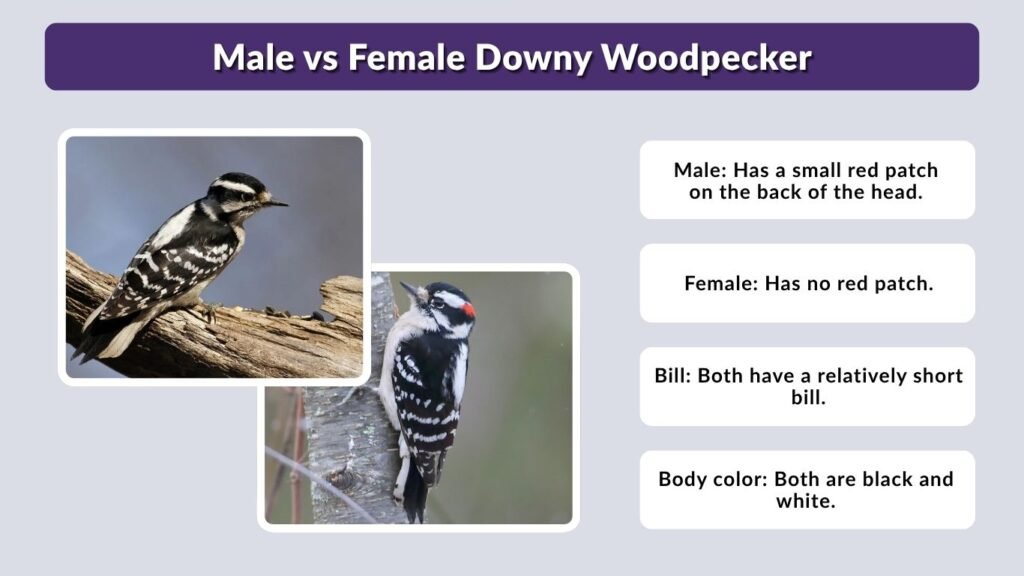
Male and female Downy Woodpeckers are remarkably similar in body size, shape, and overall plumage. Unlike bird species in which males and females have completely different colors, Downies show only a small obvious difference between adult sexes.
Main Male and Female Differences
- Male: Has a small red patch on the back of the head.
- Female: Has no red patch.
- Body color: Both are black and white.
- Size: Males and females are similar in overall size.
- Bill: Both have a relatively short bill.
- Wings: Both have black wings spotted with white.
- Back: Both have a broad white central stripe.
- Behavior: Both climb trees, forage for insects, and participate in nesting.
The red head marking is therefore much more reliable than trying to identify sex based on body size alone.
Is the Female Larger Than the Male?
Female Downy Woodpeckers are not dramatically larger than males. Their measurements overlap considerably, making size unreliable for determining sex in the field.
Behavior and head coloration provide much stronger clues. If an adult bird lacks red on the back of the head, it is normally a female.
Female Downy Woodpecker vs Female Hairy Woodpecker
Female Downy and Hairy Woodpeckers can be surprisingly difficult to distinguish. Both lack a red head patch and display similar black-and-white plumage. However, differences in size, bill length, tail markings, and overall proportions can make identification easier.
How to Tell Them Apart
Female Downy Woodpecker:
- Smaller overall
- About 5.5–6.7 inches long
- Short bill
- More delicate appearance
- Black spots usually visible on white outer tail feathers
- Frequently visits small branches and backyard feeders
Female Hairy Woodpecker:
- Noticeably larger
- Around 7–10 inches long
- Long, heavy bill approaching head length
- More robust appearance
- White outer tail feathers usually lack obvious black spotting
- Often favors larger tree trunks and mature woodland
Bill length is one of the easiest differences. A Downy’s bill looks noticeably shorter than the width of its head, while a Hairy Woodpecker’s bill appears much longer and stronger.
Female Downy Woodpecker Behavior
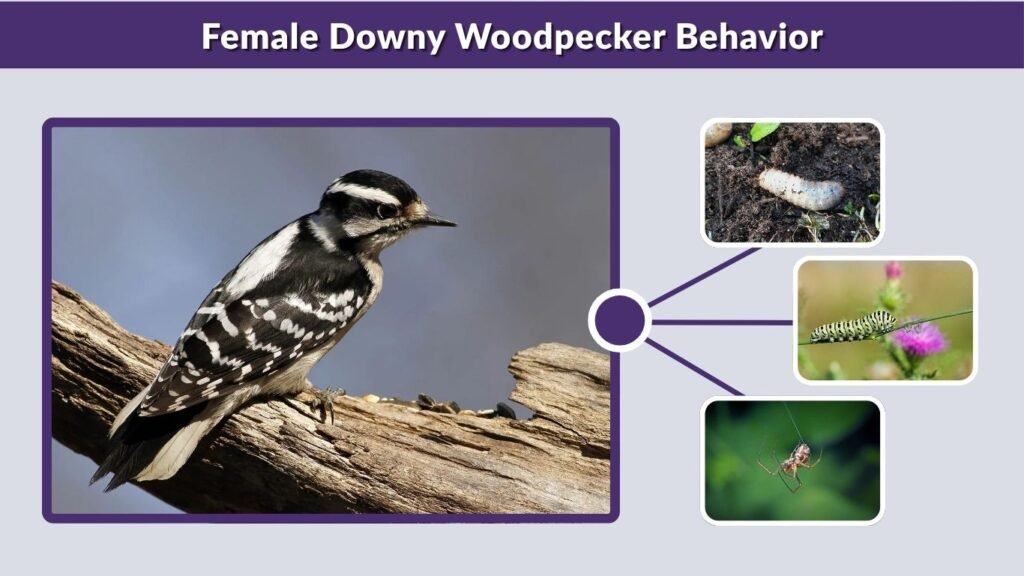
Females are active throughout the day, spending considerable time climbing trees and inspecting bark for insects. Their small size allows them to reach thin branches and weed stems that larger woodpeckers may not use.
Feeding Behavior
Female Downy Woodpeckers eat:
- Beetle larvae
- Ants
- Caterpillars
- Other small insects
- Spiders
- Seeds
- Berries
- Acorns
- Suet
- Sunflower seeds
They use their bills to probe bark, open insect galleries, and pick prey from cracks.
Downies frequently visit backyard suet feeders, especially during winter. They may also investigate seed feeders and occasionally visit hummingbird feeders for sugar water.
Winter Behavior
Female Downy Woodpeckers remain throughout most of their range during winter instead of undertaking long-distance migrations.
During cold months, they spend more time searching bark and branches for hidden insects and may become regular visitors to feeders.
They sometimes associate loosely with mixed winter flocks containing chickadees, titmice, and nuthatches, which can make food easier to locate and improve awareness of predators.
Female Downy Woodpecker Call and Sound
Male and female Downy Woodpeckers both communicate using calls and drumming. Their vocalizations can help birdwatchers locate individuals that are difficult to see among branches.
What Does a Female Downy Woodpecker Sound Like?
Common sounds include a short, sharp “pik” call and a longer descending series commonly called the whinny.
Females also drum on resonant trees and other surfaces.
Drumming is different from feeding. When feeding, the bird produces irregular taps while searching for bark. Territorial or courtship drumming consists of a deliberate rapid burst designed to communicate with other woodpeckers.
Female Downy Woodpecker Nesting
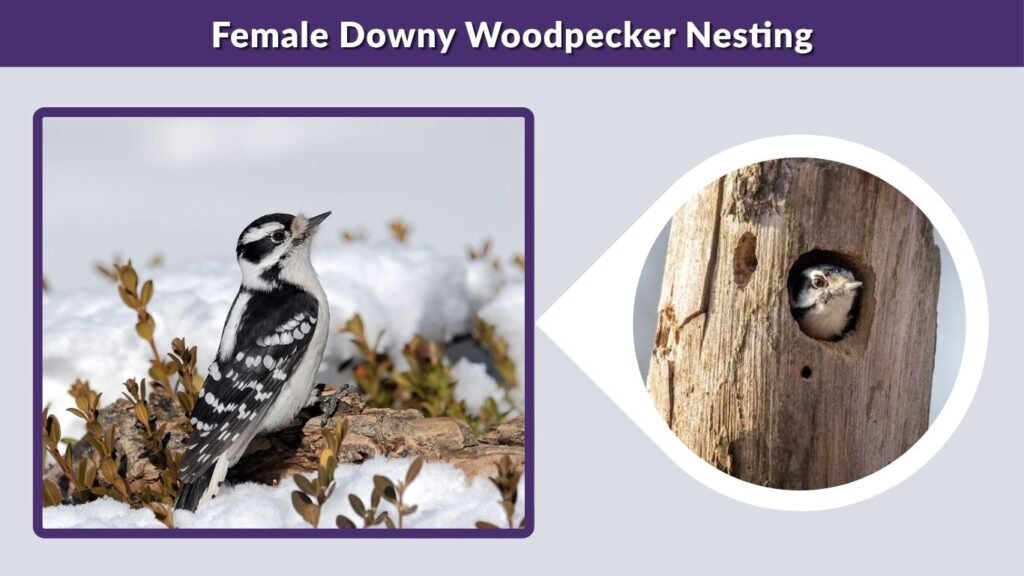
Downy Woodpeckers nest inside cavities excavated in dead trees, dead branches, or soft decaying sections of living trees. Both sexes contribute to nest excavation, although their exact share of the work may vary between pairs.
Nest and Eggs
Typical nesting characteristics include:
- Nest excavated in soft or decaying wood
- Entrance approximately 1–1.5 inches across
- Cavity often 6–12 inches deep
- Usually 3–8 white eggs
- No traditional grass or twig nest
- Wood chips remain at the bottom
- One brood is typical each year
The eggs rest directly on wood fragments within the cavity.
Does the Female Incubate the Eggs?
Yes. Both male and female Downy Woodpeckers participate in incubation.
The eggs typically hatch after about 12 days. Males often take an important share of incubation, including nighttime duties.
After hatching, both parents bring insects to the nestlings. Young Downies usually remain inside the nest cavity for roughly 18–21 days before fledging.
Juvenile Female Downy Woodpecker
Identifying young Downies can be trickier than identifying adults. Juvenile coloration changes as the birds mature, and red crown feathers may temporarily appear on young birds of either sex.
Juvenile vs Adult Female
An adult female has:
- No red crown
- No red nape patch
- Clean adult black-and-white head pattern
A juvenile may show:
- Fluffier plumage
- Less crisp markings
- Red or reddish crown feathers
- Shorter-looking tail feathers
- Begging behavior near adults
Once juvenile plumage is replaced, a female develops the standard black-and-white adult head without red.
Where Do Female Downy Woodpeckers Live?
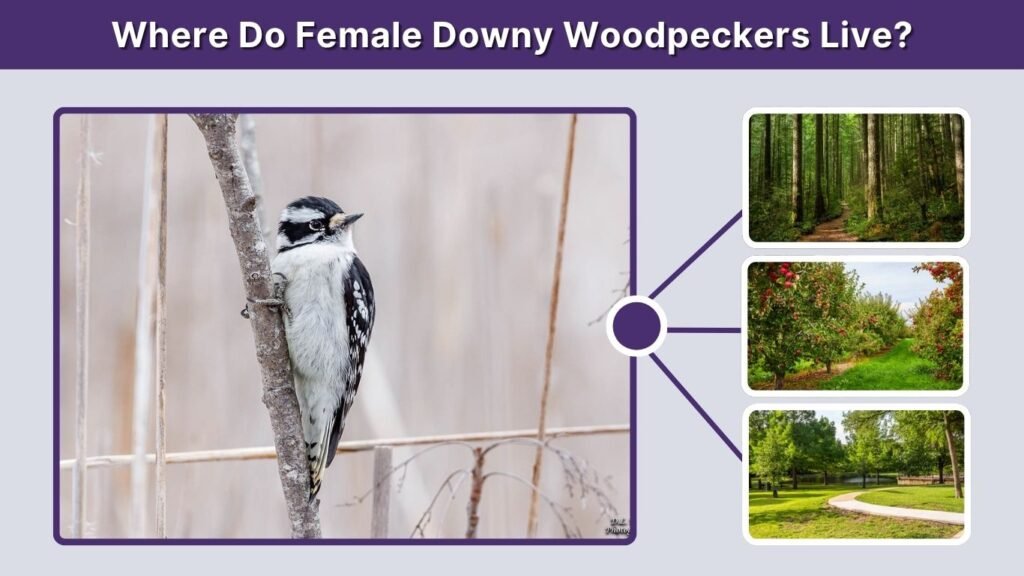
Females share the same broad range as males. Downy Woodpeckers occur throughout much of the United States and Canada and occupy both natural and developed landscapes.
Female Downy Woodpecker Habitat
Common habitats include:
- Deciduous forests
- Woodland edges
- Orchards
- Parks
- Suburban neighborhoods
- Gardens
- Streamside woodland
- Areas containing dead trees and branches
They are common year-round residents in many eastern and midwestern states, including Pennsylvania, Ohio, Indiana, and Minnesota.
Backyards containing mature trees and suet feeders can provide particularly good opportunities to watch females.
Female Downy Woodpecker Lifespan
Wild Downy Woodpeckers face predators, storms, food shortages, collisions, and other hazards, so many individuals do not reach old age. However, banding records show that successful birds can survive for many years.
How Long Can Female Downy Woodpeckers Live?
There is no separate established average lifespan specifically for females. Both sexes have the potential to survive several years under favorable conditions.
The oldest documented Downy Woodpeckers have lived for more than a decade, although such longevity represents exceptional individuals rather than the expected age of every wild bird.
FAQs
How can you identify a female Downy Woodpecker?
Look for a small black-and-white woodpecker with a short bill and broad white stripe along its back. An adult female lacks the red patch on the back of the head.
What is the difference between male and female Downy Woodpeckers?
Adult males have a small red patch on the back of the head. Adult females have an entirely black-and-white head.
Do female Downy Woodpeckers have red on their heads?
Adult females do not. Juveniles may temporarily show red crown feathers, which can cause confusion.
Do male and female Downy Woodpeckers both make nests?
Yes. Both sexes participate in excavating their nesting cavity and later help incubate eggs and feed the young.
How can you tell a female Downy from a female Hairy Woodpecker?
Female Downies are smaller, have much shorter bills, and usually show black spots on their white outer tail feathers. Female Hairy Woodpeckers are larger and have longer, heavier bills.
