
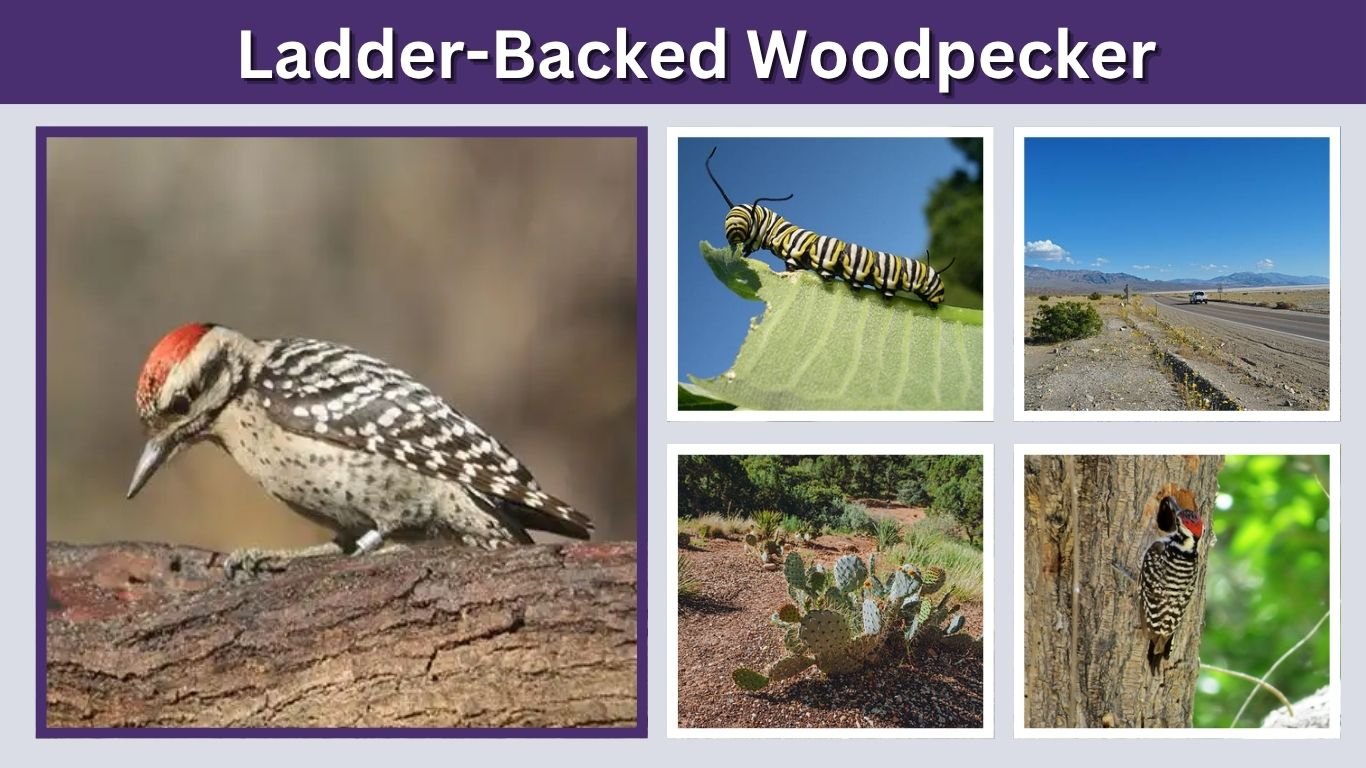
The Ladder-backed Woodpecker (Dryobates scalaris) is a small black-and-white woodpecker of deserts and dry scrublands in the southwestern United States, Mexico, and parts of Central America. Its name comes from the neat horizontal bars across its back, which resemble the rungs of a ladder. Males have a bright red crown, while females have a black crown. These agile birds forage among mesquite, cactus, yucca, and other desert vegetation, searching mainly for insects hidden in bark and stems.
Ladder-Backed Woodpecker Identification
Ladder-backed Woodpeckers are compact birds with short necks, square-looking heads, straight bills, and stiff tails used for support while climbing. Their bold barred backs are their most distinctive feature. They are larger than Downy Woodpeckers but smaller than Hairy Woodpeckers.
What Does a Ladder-Backed Woodpecker Look Like?
Look for these identifying characteristics:
- Black-and-white ladder-like bars across the back
- Checkered black-and-white wings
- Pale grayish or buffy underparts
- Small dark spots on the breast and sides
- Black-and-white striped face
- Straight, pointed bill
- Stiff tail feathers
- Red crown on adult males
- Dark crown on adult females
The strong horizontal pattern across the back gives the species its common name.
Ladder-Backed Woodpecker Size
Adults measure approximately 6.3–7.1 inches (16–18 cm) long. They weigh roughly 0.7–1.7 ounces (21–48 g) and have a wingspan around 13 inches (33 cm).
Their relatively small size allows them to forage on thin branches, cactus stems, shrubs, and other vegetation that may not support larger woodpeckers.
Male vs Female Ladder-Backed Woodpecker
Male and female Ladder-backed Woodpeckers have almost identical black-and-white body patterns. The crown provides the easiest way to tell adult males and females apart.
Male Ladder-Backed Woodpecker
The male has:
- Bright red crown
- Black-and-white face
- Strongly barred back
- Spotted or streaked underparts
- Slightly longer bill on average
The red often covers much of the top of the male’s head, making him easy to recognize when viewed clearly.
Female Ladder-Backed Woodpecker
Females have the same ladder-patterned back but lack the red crown. Instead, the top of the head is black or dark.
Females may also forage somewhat differently. Cornell notes that males tend to use trunks and larger branches more often, while females frequently forage on smaller plants, bushes, and outer vegetation.
Ladder-Backed Woodpecker Habitat and Range
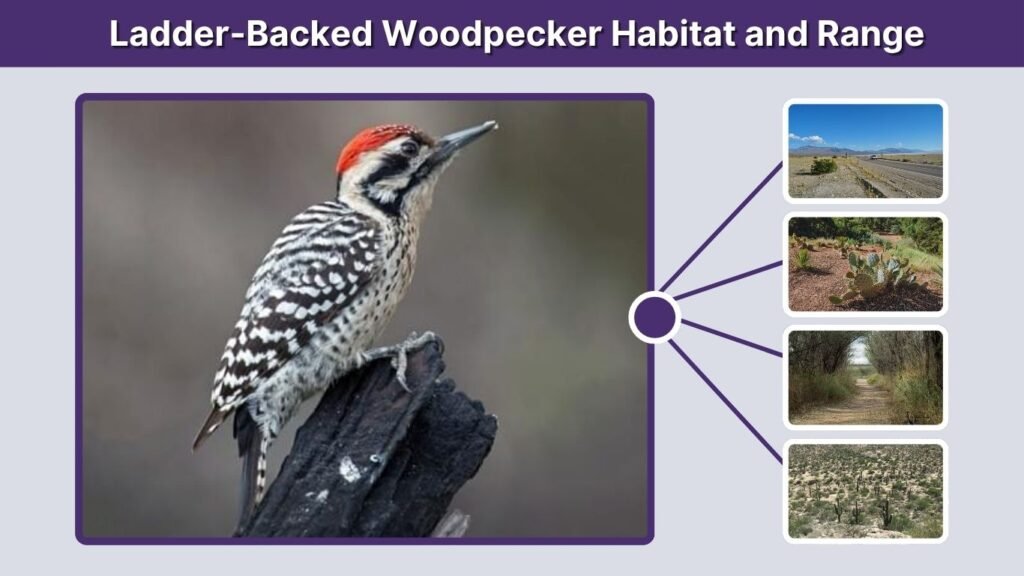
This species is strongly associated with hot, dry landscapes. It can thrive in places that appear almost too treeless for a woodpecker because it readily uses cactus, yucca, mesquite, and other desert vegetation.
Where Do Ladder-Backed Woodpeckers Live?
Typical habitats include:
- Desert scrub
- Thorn forest
- Mesquite woodland
- Dry washes
- Cactus-covered desert
- Pinyon-juniper woodland
- Joshua tree habitat
- Dry agricultural edges
- Open woodland
In the United States, the species occurs primarily across the Southwest and southern Great Plains, including Texas, Arizona, New Mexico, and parts of nearby states. Its overall range continues south through Mexico and as far as Nicaragua.
Ladder-Backed Woodpeckers in Arizona and Texas
Arizona and Texas are particularly good states for seeing this bird.
In Arizona, Ladder-backed Woodpeckers occur among mesquite, paloverde, acacia, yucca, cholla, and other desert vegetation. Texas supports extensive populations in dry brushland and similar habitats.
The species is primarily a year-round resident, rather than a long-distance migrant.
What Do Ladder-Backed Woodpeckers Eat?
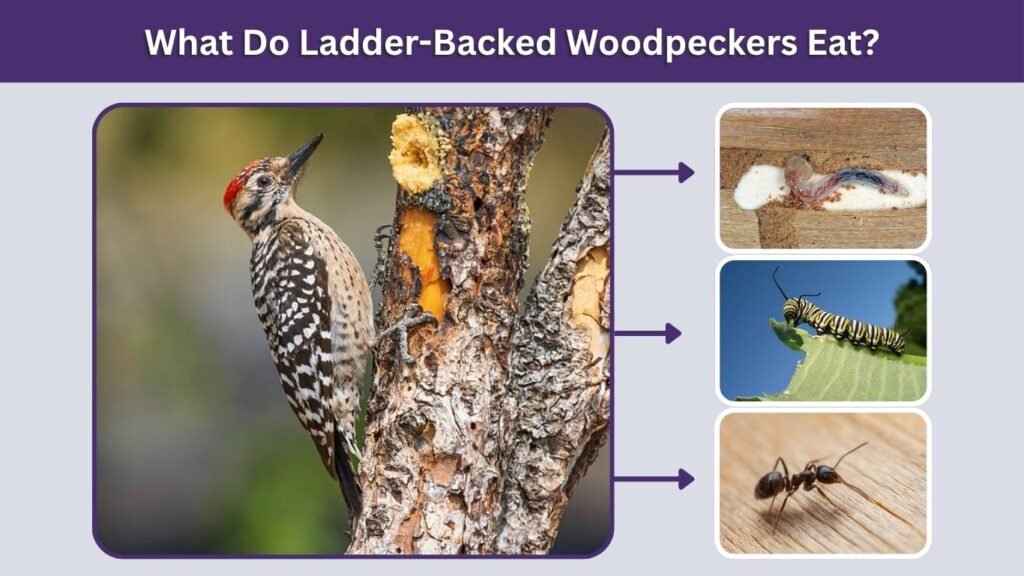
Ladder-backed Woodpeckers are primarily insectivores. Rather than drilling deeply into thick trees like some larger woodpeckers, they often pick, probe, pry, and tap at bark and plant stems.
Ladder-Backed Woodpecker Diet
Their foods include:
- Wood-boring beetle larvae
- Adult beetles
- Caterpillars
- Ants
- True bugs
- Other insect larvae
- Spiders and similar small prey
- Occasional berries
- Cactus fruit
Cornell reports that insects and their larvae make up most of the diet, although fruit is occasionally eaten.
At backyard feeding stations, Ladder-backed Woodpeckers may sometimes take mealworms, black-oil sunflower seeds, or suet.
Ladder-Backed Woodpecker Call and Sound
These birds can be difficult to see among dense thorny vegetation, so their calls are often the first indication that one is nearby.
What Does a Ladder-Backed Woodpecker Sound Like?
Its most characteristic vocalization is a loud, sharp “peek” call.
It also produces:
- Descending rattling calls
- Short contact notes
- Territorial calls
- Rapid drumming
Pairs use calls to stay in contact when vegetation blocks their view of one another.
Males drum especially during late winter and spring to advertise territories. Their drum is rapid and short, averaging roughly 30 taps per second.
Ladder-Backed Woodpecker Nest and Eggs
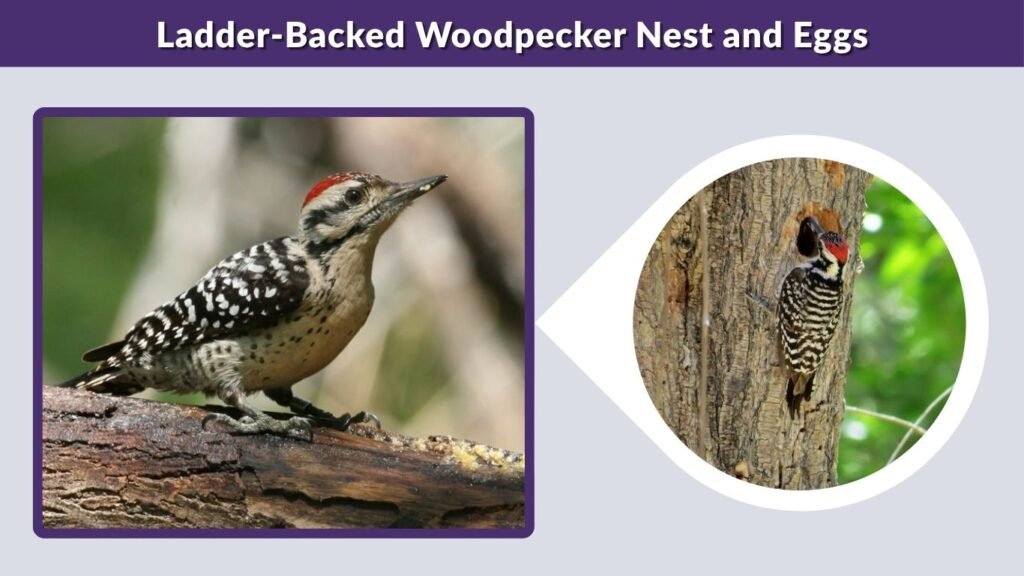
Like most woodpeckers, this species nests inside cavities rather than constructing an exposed cup-shaped nest. Trees are used where available, but their desert lifestyle has made Ladder-backed Woodpeckers remarkably flexible about cavity locations.
Nesting Behavior
Nesting sites can include:
- Mesquite trees
- Cottonwoods
- Willows
- Oaks
- Hackberries
- Joshua trees
- Yuccas
- Agave stalks
- Cacti
- Old fence posts
Males perform much of the cavity excavation. Recorded nest entrances are about 1.25–1.6 inches across, with cavities roughly 7–14 inches deep.
Eggs and Baby Woodpeckers
A typical clutch contains 2–7 white eggs, although three or four are common.
Both parents incubate the eggs, with incubation lasting approximately 13 days. After hatching, both adults bring insects to their helpless nestlings.
Juveniles resemble adults but may have less crisp plumage and different crown markings while developing their mature feathers.
Ladder-Backed vs Downy Woodpecker
The Downy Woodpecker is another small black-and-white species and can cause identification confusion.
Main Differences
Ladder-backed Woodpecker:
- Strong horizontal barring across the back
- Primarily southwestern distribution
- Common in desert scrub
- Male has extensive red crown
- Usually 6.3–7.1 inches long
Downy Woodpecker:
- Broad white stripe down the center of the back
- Widespread across much of North America
- Common in woodland, parks, and suburbs
- Male has only a small red patch on the back of the head
- Usually 5.5–6.7 inches long
The Ladder-backed is generally slightly larger and has a dramatically different back pattern.
Ladder-Backed vs Nuttall’s Woodpecker
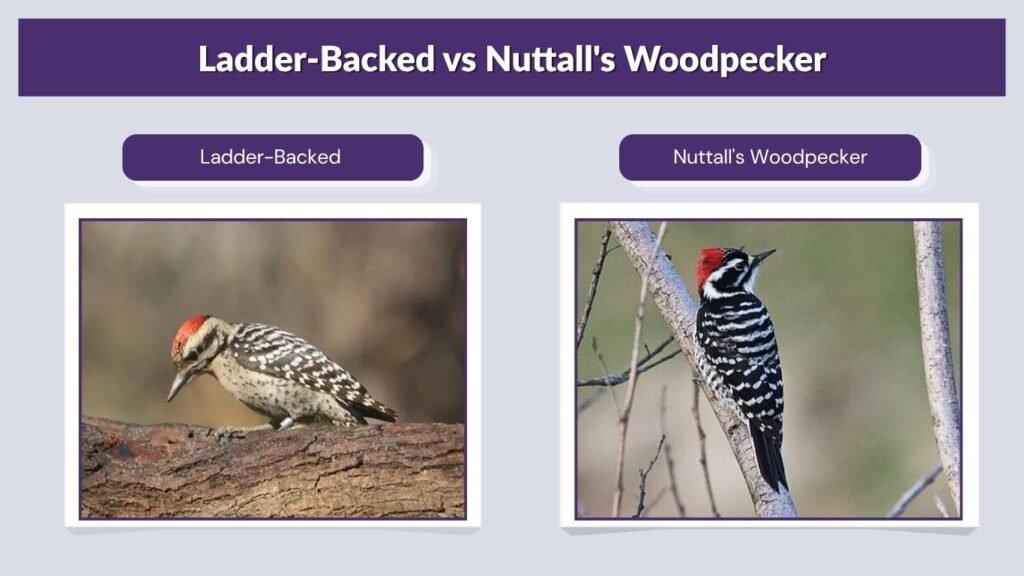
Nuttall’s Woodpecker is arguably the Ladder-backed’s closest look-alike. Both have barred black-and-white backs and red crowns in males.
How to Tell Them Apart
On Ladder-backed Woodpeckers, the pale barring continues farther up the back toward the neck. On Nuttall’s Woodpeckers, the barred pattern tends to stop lower on the upper back.
Nuttall’s also typically has narrower white facial stripes and whiter underparts. Habitat and geographic range provide additional clues: Nuttall’s is strongly associated with California oak woodland, whereas Ladder-backed favors much drier desert and scrub environments.
The two species occasionally hybridize where their ranges meet in California.
Are Ladder-Backed Woodpeckers Rare?
Ladder-backed Woodpeckers can appear uncommon simply because their dry habitats and quiet behavior make them easy to overlook. They often remain hidden among thorny vegetation.
The species is currently considered of relatively low conservation concern and remains widespread through much of its range.
An unusual individual can occasionally wander far outside its normal distribution. Cornell documents a female that remained in Kansas for years, hundreds of miles from the typical range.
FAQs
What does a Ladder-Backed Woodpecker eat?
It primarily eats insects, including beetle larvae, caterpillars, ants, and true bugs. It occasionally eats berries and cactus fruit.
How can you tell a male from a female Ladder-Backed Woodpecker?
Adult males have a bright red crown. Adult females have a black crown without the prominent red coloration.
Where do Ladder-Backed Woodpeckers live?
They inhabit deserts, desert scrub, thorn forests, dry woodland, and pinyon-juniper habitats of the southwestern United States, Mexico, and parts of Central America.
What does a Ladder-Backed Woodpecker sound like?
Its common call is a sharp “peek.” It also makes descending rattles and rapid drumming sounds, particularly during the breeding season.
Do Ladder-Backed Woodpeckers use nest boxes?
They generally excavate their own cavities in trees, cactus, yucca, agave, or similar structures and do not typically use conventional nest boxes. Leaving safe dead trees and native vegetation can provide more natural nesting opportunities.
