
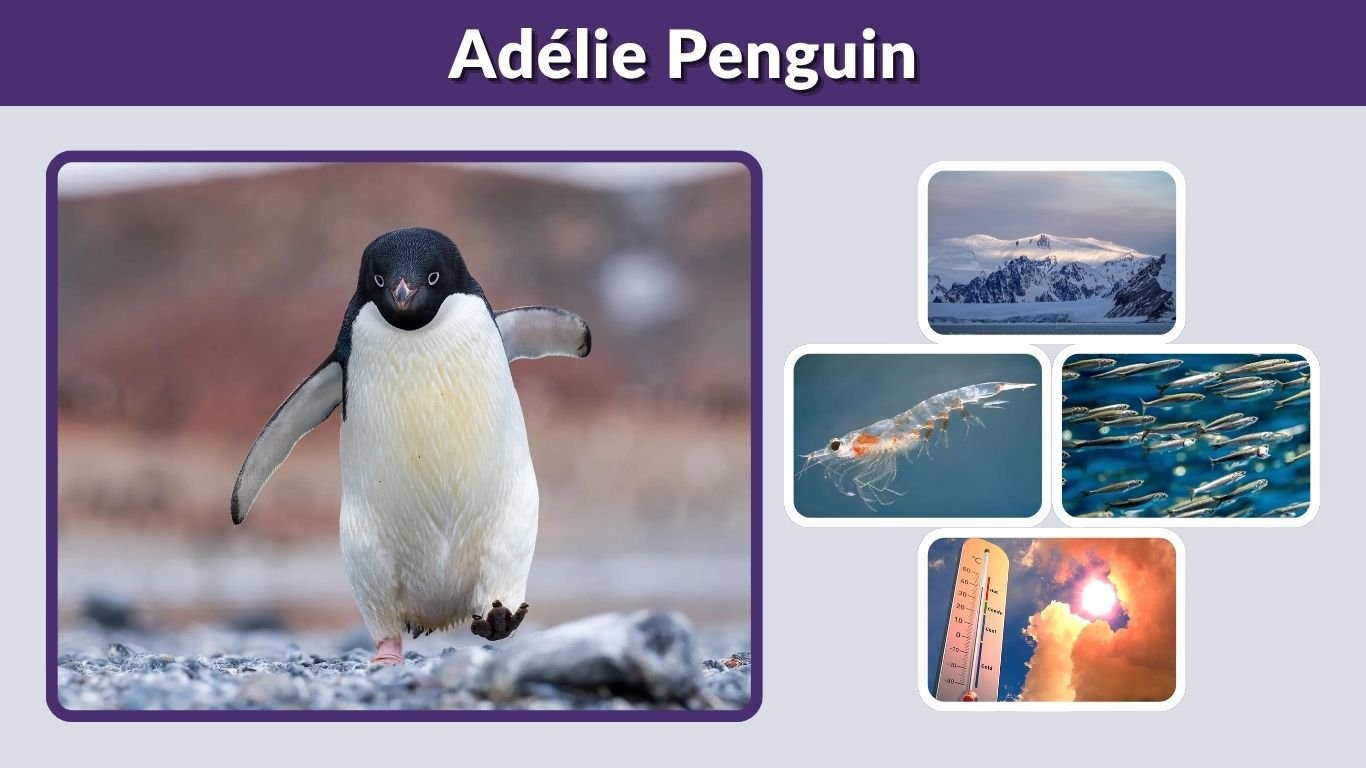
The Adélie penguin is one of Antarctica’s most recognizable birds, known for its classic black-and-white plumage, bright white eye rings, and energetic personality. Scientifically called Pygoscelis adeliae, this medium-sized penguin spends much of its life around Antarctic sea ice and coastal waters. Adélie penguins eat mainly krill, fish, and other small marine animals while facing predators such as leopard seals and skuas. Below, explore their habitat, diet, size, behavior, breeding, chicks, lifespan, adaptations, and conservation status.
Adélie Penguin Facts and Identification
Adélie penguins are true Antarctic specialists. They breed around the continent’s coast and spend much of the non-breeding season at sea among pack ice. Their compact bodies, waterproof feathers, strong flippers, and thick insulation help them function in an exceptionally cold environment. Their white eye rings are among the easiest features to use when identifying adults.
Quick Adélie Penguin Facts
- Scientific name: Pygoscelis adeliae
- Family: Spheniscidae
- Height: About 70 cm (28 inches)
- Weight: Roughly 3–6 kg (6.6–13.2 lb)
- Lifespan: About 10–20 years
- Diet: Krill, fish, amphipods, and other small marine animals
- Habitat: Antarctic coasts, islands, sea ice, and surrounding ocean
- Conservation status: Least Concern
- Distinctive feature: White ring surrounding each eye
Appearance and Physical Characteristics
An adult Adélie penguin has a black head and back contrasting sharply with a white chest and belly. Its short bill is mostly dark, while the feet are pinkish. The conspicuous white eye ring gives the bird an alert appearance.
Males and females look very similar and are difficult to distinguish simply by observing their plumage. At around 70 cm tall, Adélies are medium-sized compared with other penguins and considerably smaller than emperor penguins.
Adélie Penguin Habitat and Distribution
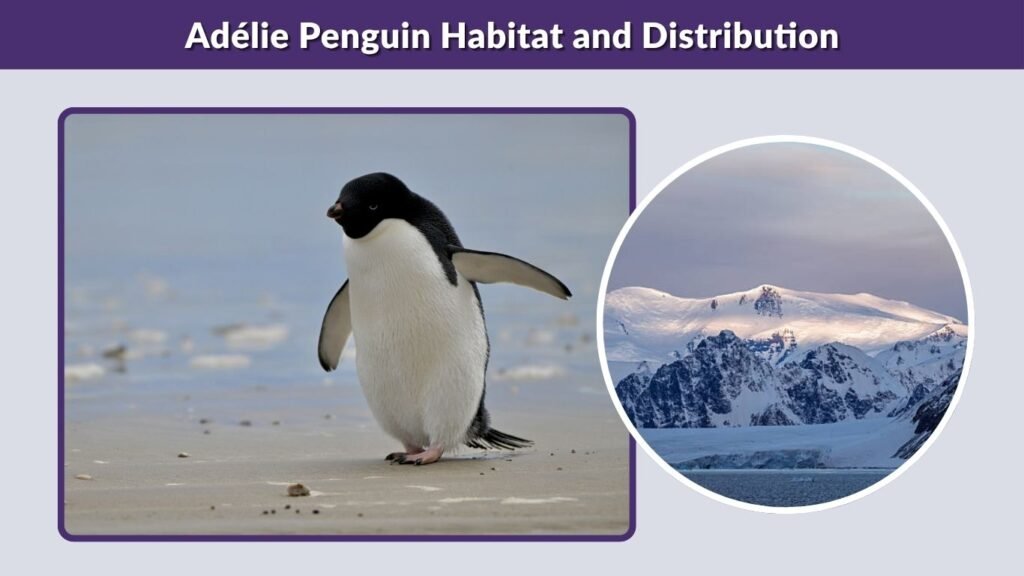
The Adélie penguin has one of the most distinctly Antarctic distributions among penguins. Breeding colonies occur around the Antarctic coastline and on nearby islands where exposed, ice-free ground provides suitable nesting sites. Their lives are closely connected with both land and ocean, because they must nest on shore while depending entirely on marine environments for food.
Where Does the Adélie Penguin Live?
Adélies breed around the Antarctic coast, particularly where rocky ground becomes free of snow and ice during the breeding season. Good nesting areas are often gently sloping and contain small stones that can be collected for nests.
Outside the breeding season, the birds spend extensive periods at sea, often associated with Antarctic pack ice. Some tracked individuals travel more than 1,000 km from their breeding areas.
Adélie Penguin Adaptations
- Dense, overlapping feathers help provide waterproof insulation.
- A layer of body fat reduces heat loss in freezing conditions.
- Powerful flippers propel the penguin efficiently underwater.
- Feet and tail help with steering while swimming.
- Their streamlined shape reduces resistance underwater.
- Adélies can walk long distances across sea ice.
- When conditions permit, they slide on their bellies, a movement known as tobogganing.
What Do Adélie Penguins Eat?
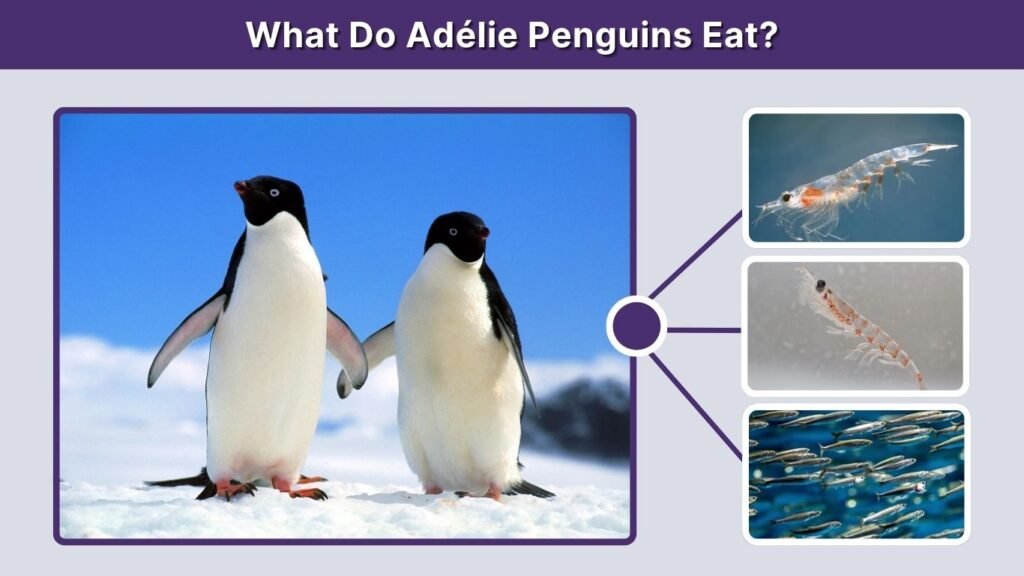
Adélie penguins are marine predators whose diets vary according to location, season, and available prey. Krill are especially important, although fish and other small marine animals also contribute significantly. During breeding, adults repeatedly leave colonies to collect enough food for themselves and their rapidly growing chicks, sometimes traveling considerable distances offshore.
Adélie Penguin Diet and Prey
Common foods include:
- Antarctic krill
- Crystal krill
- Small fish
- Amphipods
- Other small crustaceans
Near some colonies, crystal krill, fish, and amphipods are important, while offshore feeding can involve large amounts of Antarctic krill. Adélies generally forage within the upper part of the water column, although individuals have been recorded diving as deep as about 175 meters.
Adélie Penguin Predators and Enemies
Leopard seals are important predators of Adélie penguins at sea, especially near areas where penguins enter and leave the water. Eggs and young chicks face a different danger: skuas patrol breeding colonies and can take unprotected eggs or chicks.
Predation is therefore different depending on the penguin’s life stage. Adults face greater danger in the ocean, while eggs and chicks are particularly vulnerable on land.
Adélie Penguin Behavior, Breeding and Life Cycle
Adélie penguins are highly social during breeding and may gather in enormous colonies. Their reproductive schedule is closely synchronized with the short Antarctic summer. Adults return to nesting sites, establish pebble nests, lay eggs, incubate them cooperatively, and then devote weeks to feeding rapidly developing chicks before the young birds eventually become independent.
Nesting, Mating and Courtship
Breeding begins during the Antarctic spring. Adélie penguins build simple nests from pebbles on exposed ground. Returning adults often use the same nesting location and may reunite with a previous mate when both survive and return.
Females generally produce two eggs by around mid-November. Both parents participate in incubation and alternate between guarding the nest and traveling to sea to feed.
Adélie Penguin Chick and Life Cycle
- Adults return to breeding colonies in spring.
- A pair constructs or repairs a pebble nest.
- Two eggs are typically present by mid-November.
- Parents take turns incubating the eggs.
- Chicks generally hatch during December.
- At about three weeks, chicks begin gathering in protective groups called crèches.
- Young penguins replace their down with waterproof juvenile feathers.
- At roughly 7–9 weeks, they are ready to enter the ocean.
- Many return to breeding colonies when several years old.
Conservation Status and Climate Change
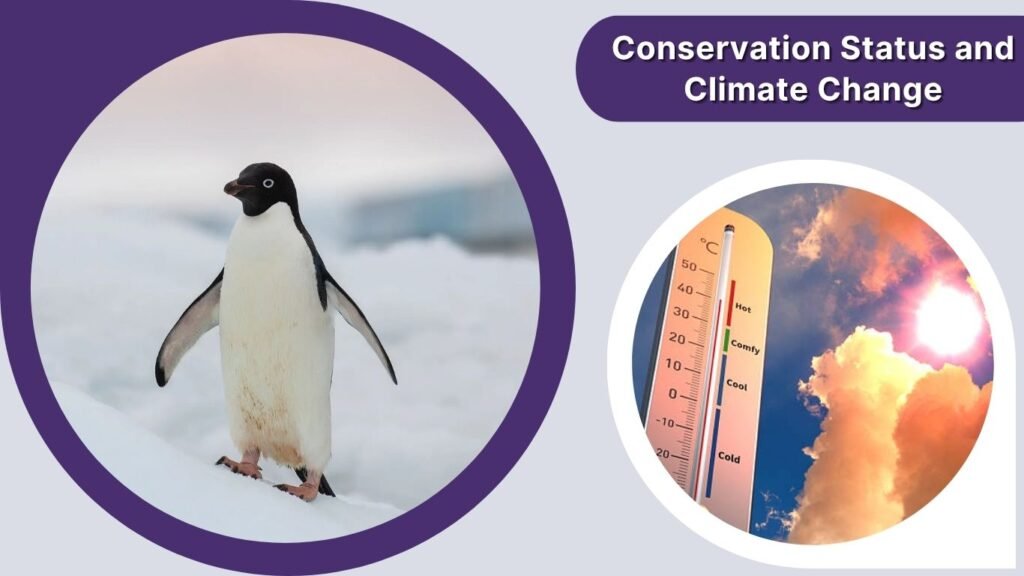
The global conservation picture for the Adélie penguin is complex. The species remains widespread around Antarctica and is currently classified as Least Concern, but individual colonies do not all follow the same population trend. Changes in sea ice, prey availability, breeding habitat, and marine conditions can benefit colonies in some regions while creating serious difficulties in others.
Are Adélie Penguins Endangered?
No. Adélie penguins are currently categorized as Least Concern, so they are not classified globally as Endangered, Vulnerable, or Near Threatened.
However, that status does not mean every population is increasing. Research has found substantial geographic variation, with some colonies growing, others remaining relatively stable, and others declining.
Climate Change and Other Challenges
Adélie penguins depend on a balance of suitable sea ice, accessible feeding areas, food availability, and ice-free breeding land. Climate-driven changes can alter these conditions. Too much fast ice may force parents to travel farther to open water, while major reductions in sea ice can affect marine food webs and prey availability.
Krill availability is particularly important because these small crustaceans form a major part of the Adélie’s food supply.
Adélie Penguin Pronunciation and Fun Facts
The name Adélie has an interesting human history as well as a scientific one. French explorer Jules Dumont d’Urville named Adélie Land after his wife, Adèle, and scientists from his Antarctic expedition subsequently applied the name to the penguin. Beyond their name, these birds display impressive swimming, walking, diving, and long-distance traveling abilities.
How Do You Pronounce Adélie Penguin?
Adélie is commonly pronounced approximately “uh-DAY-lee.” The accented spelling “Adélie” reflects the French origin of the name.
The scientific name, Pygoscelis adeliae, belongs to the same genus as gentoo and chinstrap penguins, making these three species close relatives.
Interesting Adélie Penguin Behavior
Adélies may look comical while waddling over ice, but they are highly capable travelers. Their average walking speed on ice is about 2.5 km/h, while swimming speeds are around 4–8 km/h. They may also slide across snow on their bellies instead of walking.
Some individuals travel enormous distances during winter and feeding journeys, illustrating how strongly this species is adapted to a life divided between Antarctic land, sea ice, and open ocean.
FAQs
Adélie penguins generate many questions because their appearance, Antarctic lifestyle, breeding colonies, and relationship with sea ice differ considerably from those of familiar land birds. These answers cover the most searched topics, including where Adélies live, what they eat, how tall they become, whether they can fly, and how long they typically survive in the wild.
1. Where does the Adélie penguin live?
Adélie penguins live in Antarctica, breeding around the continent’s coast and nearby islands. During winter, they spend much of their time at sea among Antarctic pack ice.
2. What does an Adélie penguin eat?
Adélie penguins mainly eat krill and fish, along with amphipods and other small crustaceans. Their exact diet varies by location and feeding distance from their colony.
3. How tall is an Adélie penguin?
An adult Adélie penguin stands approximately 70 cm, or about 28 inches, tall and generally weighs around 3–6 kg.
4. Can Adélie penguins fly?
No. Adélie penguins are flightless birds. Their wings evolved into powerful flippers that provide propulsion underwater, making them excellent swimmers rather than aerial flyers.
5. How long do Adélie penguins live?
Adélie penguins have an estimated life expectancy of around 10–20 years. Survival varies depending on environmental conditions, food availability, predators, and other pressures experienced throughout their lives.