
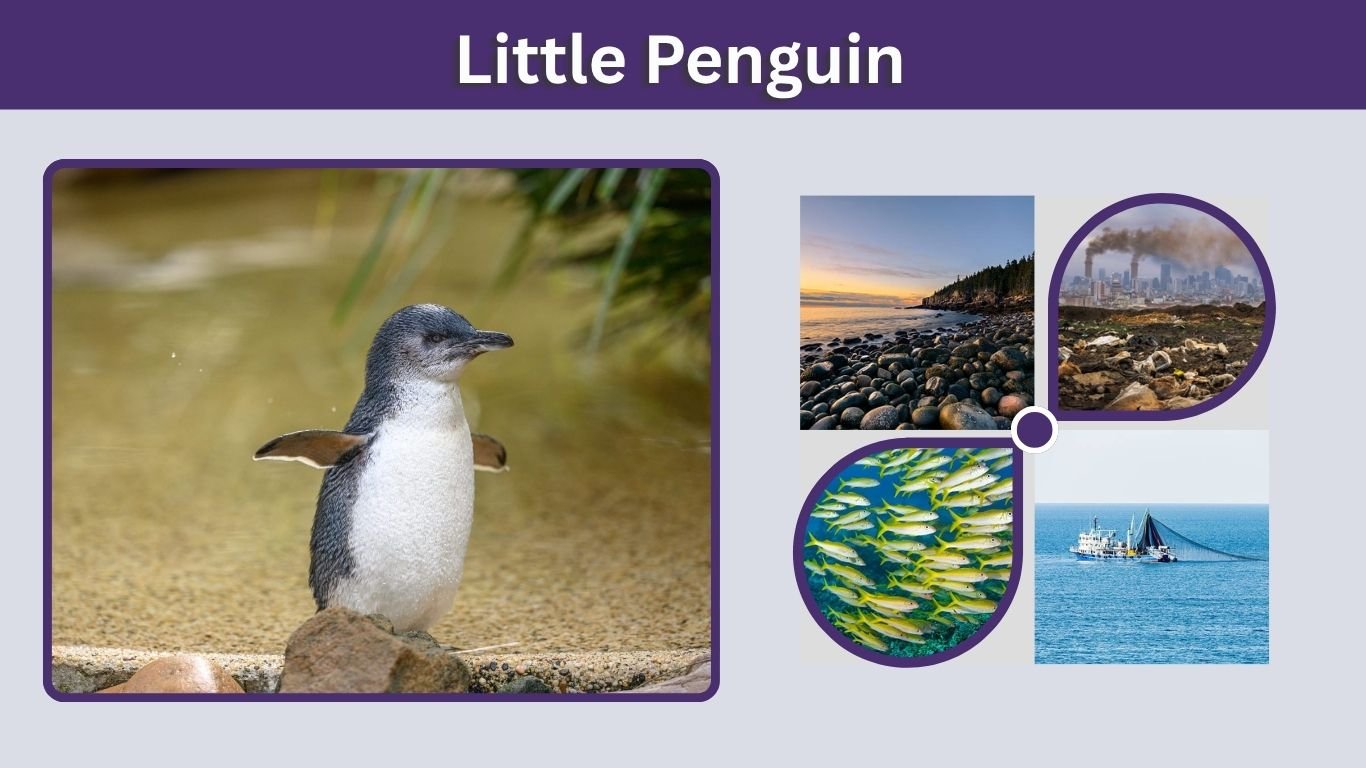
The little penguin is the smallest penguin species in the world, famous for its compact body and beautiful blue-gray feathers. Also called the little blue penguin or fairy penguin, this tiny seabird lives mainly along the coasts of southern Australia and New Zealand. Despite its small size, it is an excellent swimmer that spends much of its life at sea searching for food. This guide explores little penguin size, habitat, diet, behavior, adaptations, predators, breeding, chicks, and fascinating facts.
What Is a Little Penguin?
The little penguin belongs to the genus Eudyptula and is best known by the scientific name Eudyptula minor. It is unlike the large Antarctic penguins many people picture because it inhabits temperate coastal environments rather than relying on snow and ice. Little penguins breed on land but spend most of their time feeding and traveling at sea.
Little Penguin Identification
The little penguin has several distinctive characteristics:
- Scientific name: Eudyptula minor
- Family: Spheniscidae
- Upper body: Blue to blue-black
- Underparts: White
- Bill: Dark and relatively short
- Feet: Pink to pale gray
- Wings: Modified into swimming flippers
- Flight: Flightless
Its blue-and-white coloration helps distinguish it from most other penguin species.
Little Penguin vs Little Blue Penguin
Little penguins and little blue penguins generally refer to the same familiar group of small penguins. “Fairy penguin” is another traditional name used in some places.
Taxonomy can be more complicated, however. Some classifications distinguish Australian populations as Eudyptula novaehollandiae, while Eudyptula minor applies to other New Zealand populations. For general wildlife discussions, “little penguin” remains the widely recognized common name.
Little Penguin Size and Appearance
Little penguins earned their name because they are remarkably small compared with emperor, king, and other penguins. Their compact bodies are adapted for swimming efficiently through coastal waters. Instead of the strongly black-and-white appearance associated with many penguins, their upper feathers can have a noticeably blue tone, explaining the popular name “little blue penguin.”
How Big Is a Little Penguin?
Little penguins can reach about 40 cm in maximum size, according to the Australian Museum, while many individuals are smaller. They generally weigh around one kilogram, making them lightweight compared with larger penguin species.
Their small bodies allow them to move efficiently underwater while pursuing small fish and other marine prey.
Why Are Little Penguins Blue?
The blue-gray upper feathers serve an important purpose in the ocean.
When viewed from above, the darker blue back helps the penguin blend with the water. From below, its white underside can blend with light near the surface. This countershading provides useful camouflage from potential predators while the penguin swims and feeds.
Where Do Little Penguins Live?
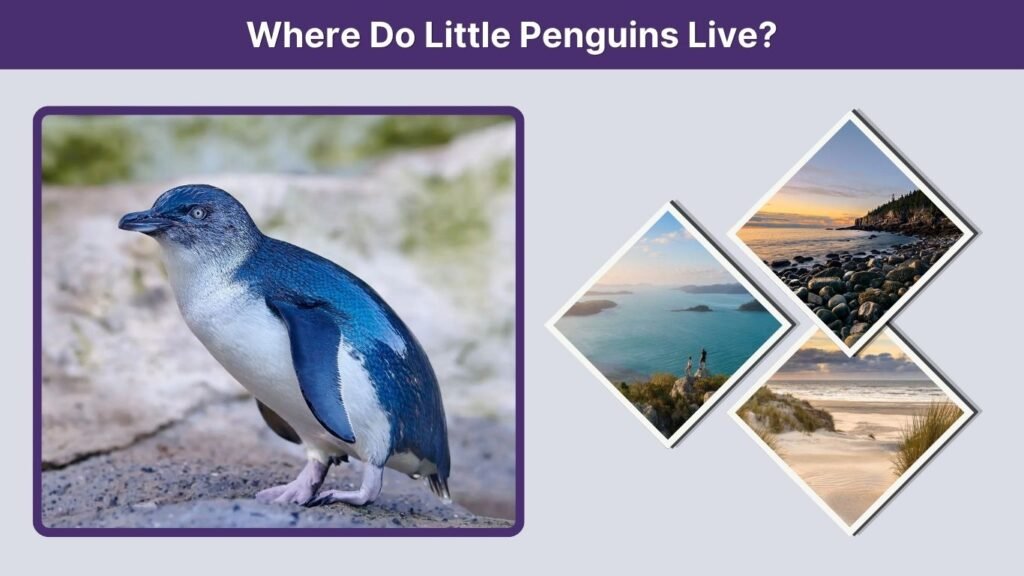
Little penguins are coastal seabirds closely associated with southern Australia and New Zealand. Their lives alternate between marine feeding areas and protected nesting sites on land. Colonies may occur around islands, beaches, rocky shorelines, vegetation, and even areas relatively close to human settlements. Their exact distribution varies among populations.
Little Penguin Habitat
Common little penguin habitats include:
- Coastal waters
- Rocky shorelines
- Sandy coastal areas
- Offshore islands
- Coastal vegetation
- Underground burrows
- Rock crevices
- Caves and protected spaces
On land, they look for sheltered locations where nests and chicks can remain protected. New Zealand birds may even nest beneath buildings or other human-made structures.
Little Penguins in Australia
Little penguins occur along parts of southern mainland Australia and Tasmania. Phillip Island in Victoria supports a particularly famous breeding population and is well known for penguins returning from the ocean to their burrows after dusk.
Little Penguins in New Zealand
In New Zealand, little penguins are commonly called kororā. They occur around much of the country’s coastline and use a variety of nesting habitats.
During the day, many are at sea feeding or remain hidden in burrows. They typically return to shore after dark, helping reduce exposure to predators.
What Do Little Penguins Eat?
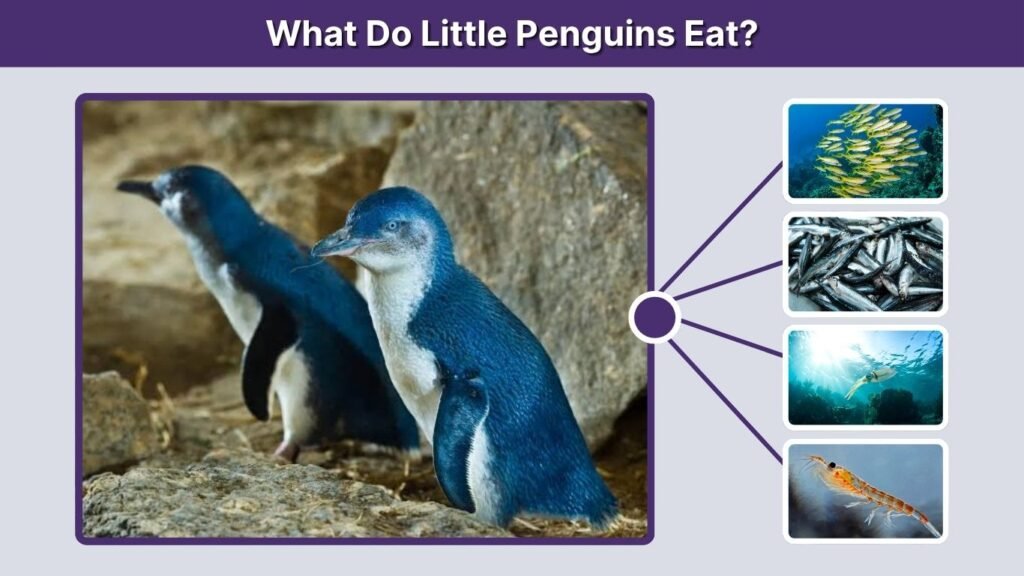
Little penguins are marine hunters whose diets depend on locally available prey. Their streamlined bodies, powerful flippers, and underwater vision allow them to pursue fast-moving animals below the surface. They may make numerous dives during a single feeding trip and spend substantial amounts of their lives at sea looking for enough food to maintain themselves and raise chicks.
Little Penguin Diet
Their diet can include:
- Small fish
- Anchovies
- Pilchards
- Small barracouta
- Squid
- Krill
- Small crustaceans
- Other small marine organisms
The precise diet changes between regions and seasons because little penguins take advantage of prey available in surrounding coastal waters.
How Little Penguins Find Food
Little penguins are excellent pursuit divers. Their wings have evolved into flippers that propel them through the water while their feet help with steering.
They commonly forage during daylight and return toward their colonies later. Adults raising chicks must repeatedly travel between productive feeding areas and their nests so they can deliver food to their growing young.
Little Penguin Behavior and Adaptations
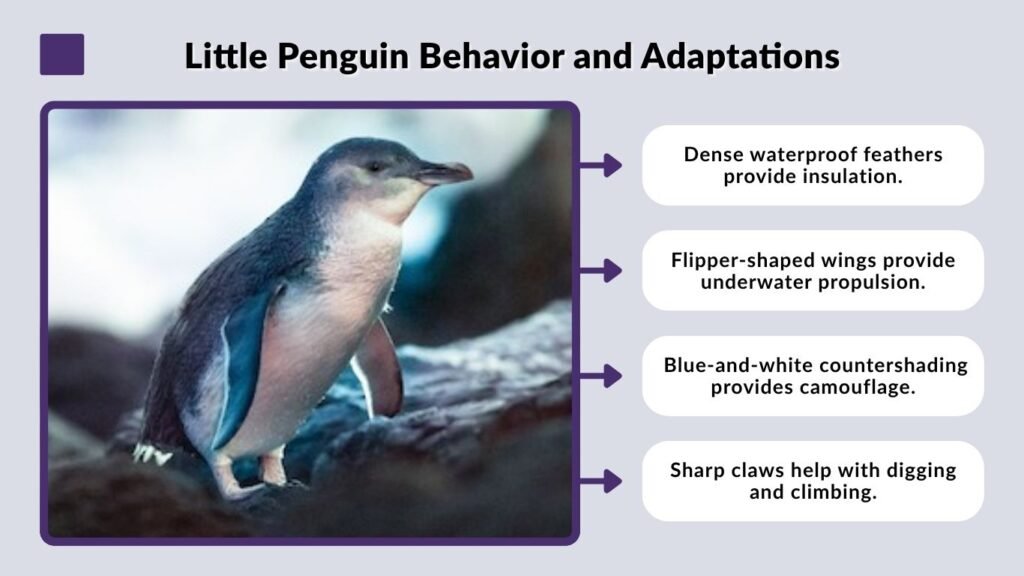
Life for a little penguin is divided between land and sea. Phillip Island Nature Parks reports that little penguins spend roughly 80% of their lives in the ocean. Their physical and behavioral adaptations help them swim, stay warm, navigate coastal environments, avoid predators, and return to nesting colonies after feeding trips.
Important Little Penguin Adaptations
Several adaptations help them survive:
- Dense waterproof feathers provide insulation.
- Flipper-shaped wings provide underwater propulsion.
- Blue-and-white countershading provides camouflage.
- Sharp claws help with digging and climbing.
- Specialized salt glands remove excess salt.
- An extra transparent eyelid helps protect the eyes underwater.
- Strong hearing helps individuals recognize mates and chicks.
These features make the species highly suited to a marine lifestyle.
Coming Ashore at Night
One recognizable behavior occurs when little penguins return from the ocean.
Before reaching land, individuals may gather offshore in groups sometimes called rafts. They commonly wait until dusk before crossing exposed beaches and returning to their burrows. Traveling after dark reduces exposure to aerial predators and helps them reach nesting areas more safely.
Little Penguin Life Cycle
The little penguin life cycle includes courtship, egg laying, incubation, chick development, fledging, and eventually adulthood. Breeding timing differs somewhat between locations and years because conditions such as food availability can influence reproduction. Both parents play important roles in caring for eggs and providing food for their young.
Eggs and Breeding
A typical breeding cycle involves:
- Adults establishing or returning to nest sites.
- Pairs maintaining burrows or sheltered nests.
- Females commonly laying two eggs.
- Both parents sharing incubation duties.
- Eggs hatching after roughly 35 days.
- Parents bringing food from the ocean to their chicks.
- Young eventually leaving the nest for the sea.
Phillip Island Nature Parks notes that chicks generally head to sea at around eight weeks old.
Little Penguin Chicks
Young chicks initially depend entirely on their parents.
Adults return from feeding trips and regurgitate marine food for them. As chicks grow, they develop the waterproof plumage needed for an ocean lifestyle.
Eventually they leave the colony and enter the sea without receiving swimming lessons from their parents. Their ability to swim and search for food develops largely through instinct and experience.
Little Penguin Predators and Threats
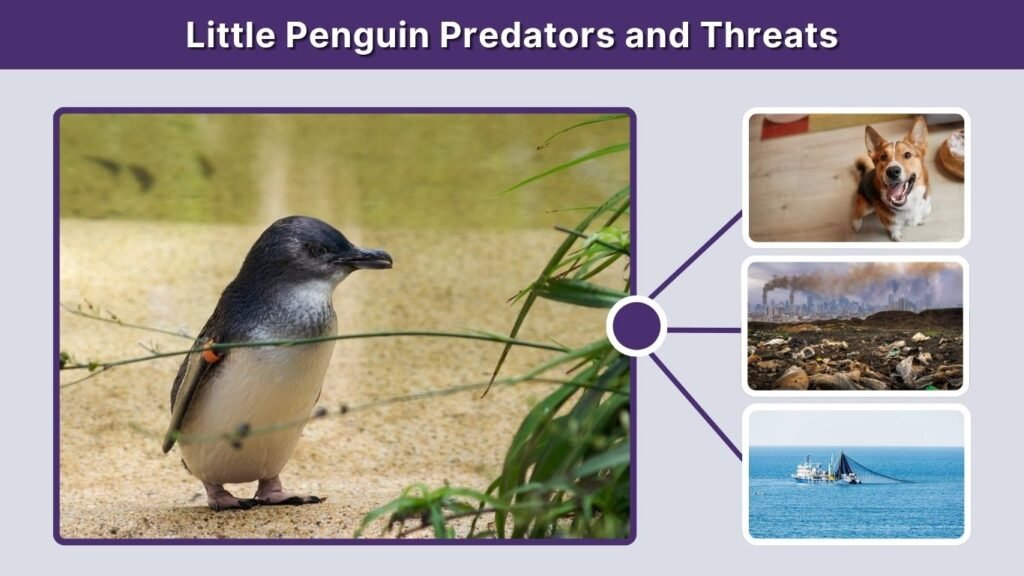
Despite being skillful swimmers, little penguins face threats both at sea and on land. Eggs and young birds can be particularly vulnerable around colonies. Human activities can also create problems when nesting habitat is disturbed or penguins encounter traffic, pets, pollution, fishing activity, or changes in their marine environment.
Predators of Little Penguins
Potential threats can include introduced terrestrial predators, birds of prey, and marine predators. Pacific gulls and sea eagles are among the birds that can threaten penguins around colonies.
Returning to land after dusk is one behavioral strategy that can reduce exposure to some daytime predators.
Protecting Little Penguins
Protecting nesting areas is particularly important because little penguins must return to land to breed, raise chicks, and moult.
People living or visiting near colonies can help by keeping dogs controlled, giving penguins space, avoiding disturbed nesting areas, reducing litter, and following local wildlife-management rules.
Interesting Little Penguin Facts
The little penguin’s miniature size is only one reason the species attracts attention. These seabirds possess specialized biological features that allow them to alternate between underwater hunting and life in coastal burrows. Their swimming ability, unusual blue plumage, nocturnal shore returns, and independent young make them one of the most distinctive members of the penguin family.
Fun Facts About Little Penguins
- They are the world’s smallest penguins.
- Their upper feathers have a distinctive blue coloration.
- They spend much of their lives at sea.
- Their wings function as underwater flippers rather than flying wings.
- They can nest in burrows and rock crevices.
- They often return to shore after dusk.
- Both parents participate in raising chicks.
- Young penguins head to sea at roughly eight weeks old.
- They possess salt glands that help process seawater.
- Their waterproof plumage provides insulation and buoyancy.
FAQs
What Is the Scientific Name of the Little Penguin?
The little penguin is commonly classified as Eudyptula minor. However, modern taxonomy may distinguish some Australian-associated populations as Eudyptula novaehollandiae. Because classifications can differ, Eudyptula minor remains the scientific name frequently encountered in general references about the little penguin.
How Tall Is a Little Blue Penguin?
Little penguins are the smallest penguins in the world and can reach approximately 40 centimeters at the upper end of their reported size range. Many are shorter. Their compact size and weight of roughly one kilogram make them dramatically smaller than large species such as emperor and king penguins.
Where Does a Little Blue Penguin Live?
Little blue penguins live around coastal areas of southern Australia and New Zealand. They forage in coastal waters and return to land for nesting, breeding, moulting, and raising young. Nest locations can include burrows, caves, rock crevices, vegetation, and occasionally protected structures near human settlements.
What Does a Little Blue Penguin Eat?
A little blue penguin primarily eats marine prey such as small fish, squid, krill, and other small crustaceans. Specific prey differs depending on location and season. Penguins capture their food while swimming and diving at sea, using their streamlined bodies and powerful flippers to pursue prey underwater.
Why Is the Little Penguin Called a Fairy Penguin?
“Fairy penguin” is a traditional common name referring to the species’ unusually tiny size. “Little penguin” and “little blue penguin” are also widely used names, with “little blue” referring to its blue-gray upper plumage. In New Zealand, the bird is commonly known by its Māori name, kororā.
