
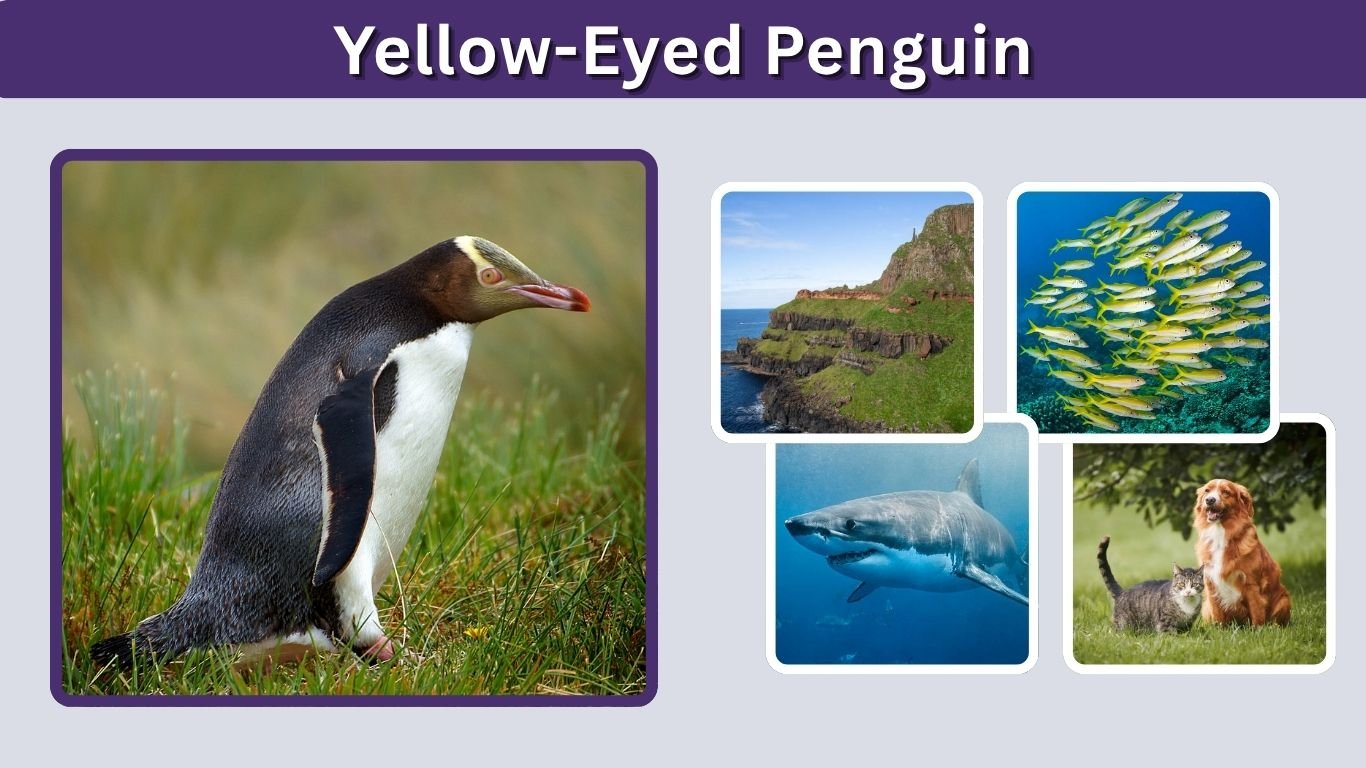
The yellow-eyed penguin is one of New Zealand’s most distinctive and threatened seabirds. Known in Māori as hoiho, this rare penguin is recognized by its pale-yellow eyes and striking yellow band that runs around the back of its head. Its scientific name is Megadyptes antipodes, and it breeds only in New Zealand. Unlike many penguins that form dense colonies, yellow-eyed penguins prefer privacy when nesting. Below, you’ll discover their habitat, diet, size, life cycle, predators, adaptations, conservation status, and fascinating facts.
What Is a Yellow-Eyed Penguin?
The yellow-eyed penguin, or hoiho, is a large penguin native exclusively to New Zealand. Its scientific name, Megadyptes antipodes, roughly refers to a “large diver from southern lands.” Adults have unmistakable yellow eyes and a yellow band around the head. Hoiho are unusually shy penguins and typically choose secluded nesting sites away from neighboring pairs.
Yellow-Eyed Penguin Identification
Key characteristics include:
- Scientific name: Megadyptes antipodes
- Māori name: Hoiho
- Height: Approximately 56–78 cm
- Head: Dark with yellow feathering
- Eyes: Distinctive yellow
- Eye band: Yellow band extending around the back of the head
- Back: Charcoal or slate gray
- Underparts: White
- Bill: Narrow and reddish-orange
- Feet: Pale pink
Young birds initially have gray eyes and much less yellow coloring than mature adults.
What Does Hoiho Mean?
The Māori name hoiho means “noise shouter.” The name refers to the bird’s distinctive shrill calls, particularly around breeding sites.
Despite that noisy name, hoiho are relatively private penguins. Unlike species that crowd together in large nesting colonies, they prefer nesting places hidden from neighboring birds by vegetation or natural landscape features.
Yellow-Eyed Penguin Habitat and Distribution
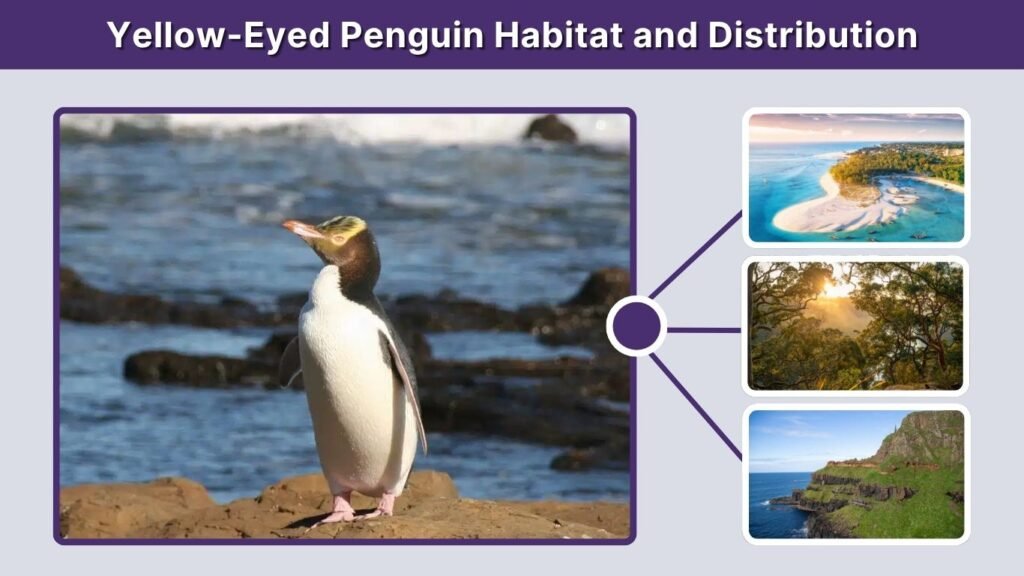
Yellow-eyed penguins depend on both terrestrial and marine habitats. They require productive ocean waters for feeding and secluded coastal areas for breeding, resting, socializing, and moulting. Their restricted New Zealand distribution makes the condition of these habitats especially important. Loss of coastal vegetation and changes in marine ecosystems can therefore directly affect their ability to survive and reproduce.
Where Do Yellow-Eyed Penguins Live?
Important areas within their range include:
- Southeastern South Island
- Banks Peninsula
- Otago Peninsula
- The Catlins
- Stewart Island/Rakiura
- Nearby offshore islands
- Auckland Islands
- Campbell Island
DOC describes two broadly separated populations: a northern population around the South Island and Rakiura, and a southern population on the subantarctic Auckland and Campbell islands.
Yellow-Eyed Penguin Nesting Habitat
Hoiho prefer secluded nesting sites rather than open, densely packed colonies.
Suitable habitat may contain coastal forest, shrubs, grasses, and other vegetation that gives nesting pairs privacy. Their nests can be well separated from neighboring pairs.
Loss of native coastal vegetation has reduced suitable habitat in parts of the South Island, which is why restoration programs include planting native shrubs and creating protected nesting areas.
What Does a Yellow-Eyed Penguin Eat?
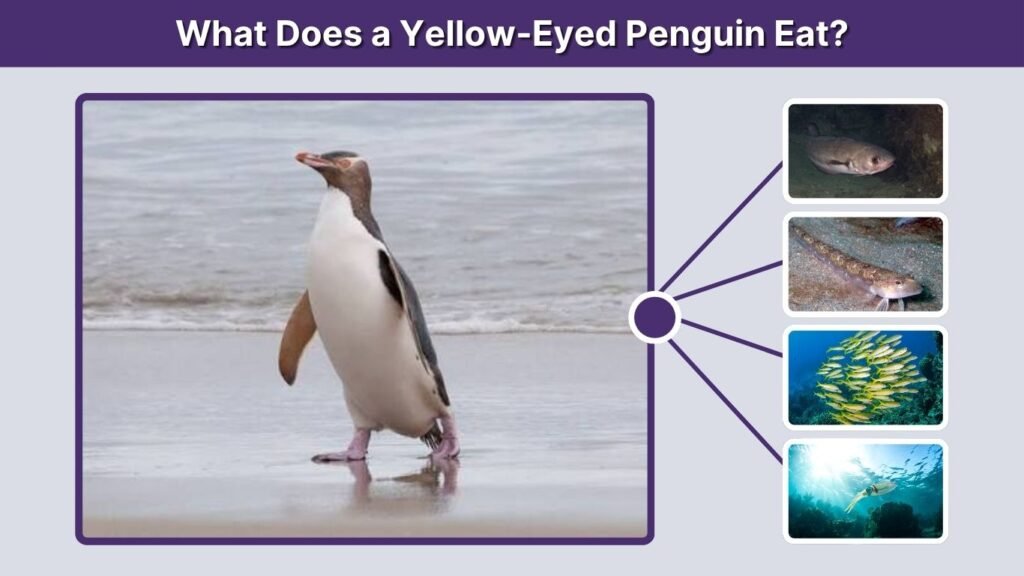
Yellow-eyed penguins are marine predators that obtain virtually all their food from the ocean. They are visual hunters and generally dive toward the seabed in search of prey. Feeding conditions are particularly important during breeding because adults must obtain enough food both for themselves and for their rapidly developing chicks. Changes in prey availability can therefore affect breeding success.
Yellow-Eyed Penguin Diet
Their diet can contain:
- Red cod
- Blue cod
- Opalfish
- Sprat
- Ahuru
- Silverside
- Arrow squid
- Other small fish
Adult hoiho often forage within about 25 km of shore during breeding, although some travel farther. They commonly make repeated dives toward the ocean floor while searching for food.
How Do Yellow-Eyed Penguins Hunt?
Hoiho use their powerful flippers to propel themselves underwater while pursuing prey.
They commonly dive between about 30 and 60 meters, although considerably deeper dives are possible. DOC reports depths reaching around 160 meters, while the Yellow-eyed Penguin Trust notes birds may perform as many as 200 dives during a day of foraging.
Yellow-Eyed Penguin Size and Adaptations
The yellow-eyed penguin is considerably larger than the tiny little penguin but smaller than giant species such as the emperor penguin. Its body is specialized for aquatic life in cool New Zealand waters. Streamlined shape, powerful flippers, insulating feathers, and strong diving abilities enable hoiho to move efficiently underwater while searching for fish and squid along the continental shelf.
How Tall Is a Yellow-Eyed Penguin?
Adult yellow-eyed penguins generally reach about 56 to 78 centimeters in length, according to New Zealand conservation guidance.
Males and females look very similar, although males tend to be slightly larger. Their relatively substantial size and unique facial coloring make adult hoiho fairly easy to distinguish from New Zealand’s smaller penguin species.
Yellow-Eyed Penguin Adaptations
Their important adaptations include:
- Streamlined bodies for underwater movement
- Powerful flippers for propulsion
- Dense feathers for insulation
- Waterproof adult plumage
- Strong diving ability
- Excellent underwater vision
- Countershaded dark backs and pale undersides
- Strong feet for moving across coastal terrain
These characteristics allow hoiho to alternate between demanding ocean feeding trips and extended periods on land for nesting and moulting.
Yellow-Eyed Penguin Life Cycle
The yellow-eyed penguin’s annual cycle revolves around breeding, raising chicks, moulting, and feeding at sea. Hoiho parents share responsibilities for incubating eggs and caring for offspring. During successful breeding seasons, a pair may raise two chicks. Once fledged, young penguins face an especially difficult period as they begin surviving independently in the ocean.
Eggs and Yellow-Eyed Penguin Chicks
Breeding pairs return to nesting territories and prepare secluded nest sites. Both parents participate in incubation and chick care.
Chicks hatch covered in thick brown down rather than the waterproof feathers required for swimming. Parents return from sea and feed them regurgitated fish and squid.
By around February, surviving chicks develop waterproof juvenile plumage and begin their independent lives at sea.
Moulting
Hoiho experienced an annual “catastrophic moult,” replacing all their feathers over a short period.
During this process, they must remain on land because their plumage is temporarily unsuitable for swimming and insulation. The Yellow-eyed Penguin Trust says the moult typically lasts around three to four weeks.
Because the birds cannot feed at sea during this period, they rely heavily on stored body reserves.
Yellow-Eyed Penguin Predators
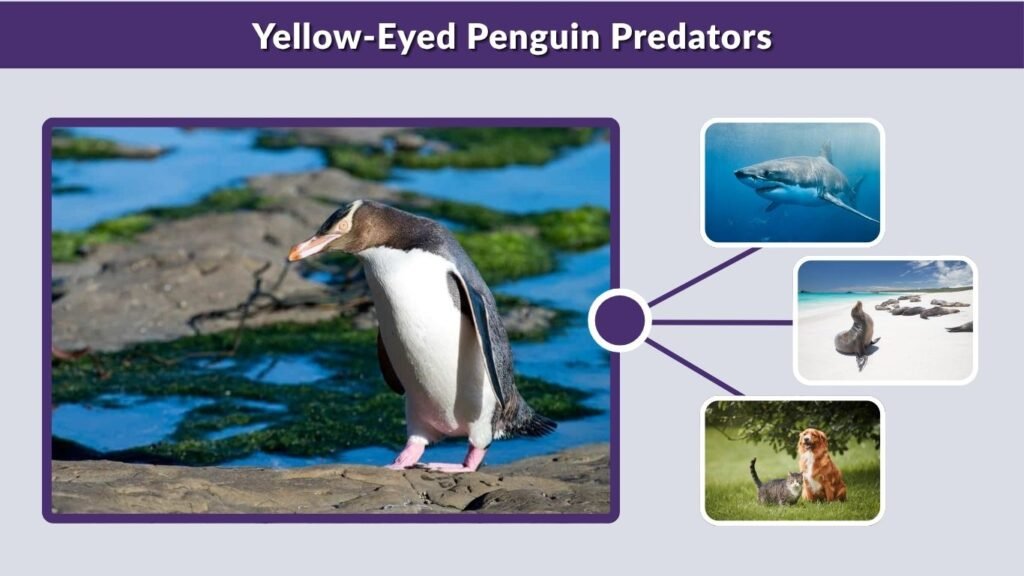
Life is hazardous for hoiho both on land and at sea. Natural marine predators have always been part of their environment, but introduced mammals have created additional pressure around nesting areas. Chicks and moulting adults can be particularly vulnerable because they cannot quickly escape into the ocean when threatened.
Predators and Other Dangers
Threats include:
- Sharks
- Seals
- Sea lions
- Stoats
- Ferrets
- Cats
- Dogs
- Feral pigs in some locations
- Disease
- Fisheries interactions
- Human disturbance
Dogs are especially dangerous when penguins are resting or moulting ashore. Introduced predators such as stoats and ferrets may also attack chicks at mainland nesting sites.
Is the Yellow-Eyed Penguin Endangered?
Yes. New Zealand’s Department of Conservation currently lists hoiho as Threatened–Nationally Endangered. DOC’s page cites a 2019 estimate of approximately 4,000–5,000 mature individuals, so that figure should not be interpreted as a new 2026 population count. The northern population has experienced substantial long-term decline, making ongoing conservation particularly important.
Why Are Yellow-Eyed Penguins Endangered?
The decline is connected to several interacting problems rather than one single cause.
Habitat loss reduces safe nesting opportunities, while disease affects both adults and chicks. Introduced predators attack birds on land. Human disturbance can prevent parents from returning promptly to nests, and fisheries interactions may cause direct mortality.
Climate-driven changes in ocean conditions can also alter the availability and nutritional quality of important prey.
Yellow-Eyed Penguin Conservation
Conservation work includes predator control, nest monitoring, veterinary treatment, restoration of coastal vegetation, management of visitors, provision of safer nesting areas, and research into penguin feeding and disease.
DOC works with organizations including the Yellow-eyed Penguin Trust and other conservation partners to protect remaining populations and improve both terrestrial and marine conditions.
Interesting Yellow-Eyed Penguin Facts
Yellow-eyed penguins stand apart from many familiar penguin species because of their appearance, behavior, and unusually private nesting habits. They are strongly associated with southern New Zealand and are an important focus of national conservation efforts. Understanding their biology also highlights how closely marine health, coastal habitat, disease, predators, and human activity are connected.
Fun Facts About Yellow-Eyed Penguins
- Hoiho are found naturally only in New Zealand.
- Their scientific name is Megadyptes antipodes.
- Hoiho means “noise shouter.”
- Adults have striking yellow eyes.
- They prefer isolated nesting sites.
- Both parents help raise their chicks.
- They mainly eat fish and squid.
- They can dive to approximately 160 meters.
- Adults replace all their feathers during an annual moult.
- They are among the world’s rarest penguin species.
FAQs
What Is the Scientific Name of the Yellow-Eyed Penguin?
The scientific name of the yellow-eyed penguin is Megadyptes antipodes. The name is commonly interpreted as referring to a large diver from southern lands. It is the only living species in its genus and is native to New Zealand, where it is better known by its Māori name, hoiho.
Where Does the Yellow-Eyed Penguin Live?
Yellow-eyed penguins live only in New Zealand. Their range includes southeastern parts of the South Island, Banks Peninsula, Stewart Island/Rakiura, and several offshore and subantarctic islands, including the Auckland and Campbell islands. They require both suitable coastal nesting vegetation and productive marine feeding grounds.
What Does a Yellow-Eyed Penguin Eat?
Yellow-eyed penguins mainly eat small fish and squid. Important prey can include red cod, blue cod, sprat, opalfish, ahuru, silverside, and arrow squid. They typically hunt underwater near the seafloor, repeatedly diving during daylight hours to locate and capture prey.
Is the Yellow-Eyed Penguin Endangered?
Yes. New Zealand classifies the yellow-eyed penguin as Threatened–Nationally Endangered. Its populations face pressures from disease, introduced predators, fisheries interactions, human disturbance, habitat degradation, and climate-related changes in marine food supplies. Conservation programs are actively working to protect nests, restore habitat, and improve survival.
Why Is the Yellow-Eyed Penguin Called Hoiho?
Hoiho is the Māori name for the yellow-eyed penguin and means “noise shouter.” The name refers to its distinctive, shrill vocalizations around breeding sites. Although the birds can be loud when communicating, they are relatively shy penguins and usually prefer secluded nesting locations away from neighboring pairs.
