
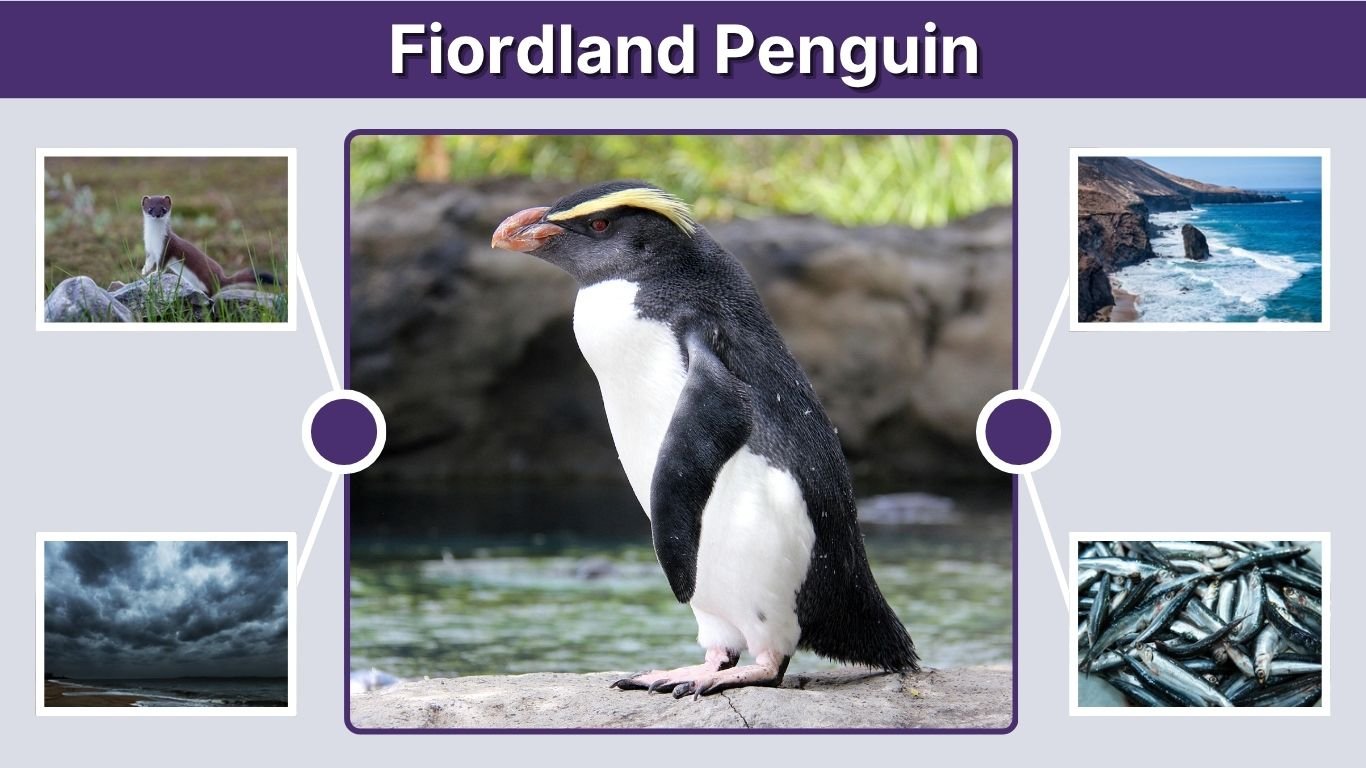
The Fiordland penguin, also known as the Fiordland crested penguin or tawaki, is a rare penguin found only in New Zealand. Recognizable by its bright yellow eyebrow-like crests, thick orange bill, and black-and-white body, this secretive bird breeds in remote coastal forests and rocky areas. Its scientific name is Eudyptes pachyrhynchus. From remarkable ocean journeys to unusual nesting behavior, the Fiordland penguin has many fascinating characteristics. Here is a complete guide to its habitat, diet, size, breeding, predators, adaptations, and conservation.
What Is a Fiordland Crested Penguin?
The Fiordland crested penguin is an endemic New Zealand seabird and the only crested penguin that breeds on the country’s mainland. It is also called tawaki, its Māori name. Unlike penguins associated with open ice, tawaki often nest beneath dense rainforest vegetation, among rocks, or inside caves along isolated coastlines.
Fiordland Penguin Identification
A Fiordland penguin can be recognized by several distinctive features:
- Scientific name: Eudyptes pachyrhynchus
- Māori name: Tawaki
- Length: Around 55–60 cm
- Upperparts: Dark blue-gray to black
- Underparts: White
- Crest: Bright yellow stripe above each eye
- Bill: Thick and orange
- Feet: Pale pink
- Juveniles: Smaller with a reduced pale-yellow eyebrow
The long yellow crests extend backward from near the bill and give the species its characteristic appearance.
Why Is It Called a Crested Penguin?
The term “crested” refers to the conspicuous yellow feathers above its eyes. Several penguins in the genus Eudyptes have similar ornamentation, including rockhopper and macaroni penguins.
Fiordland penguins can be distinguished by their thick bills and the pattern of their facial crests. Adults may also show faint white markings on their cheeks, although these are not always obvious.
Where Does the Fiordland Penguin Live?
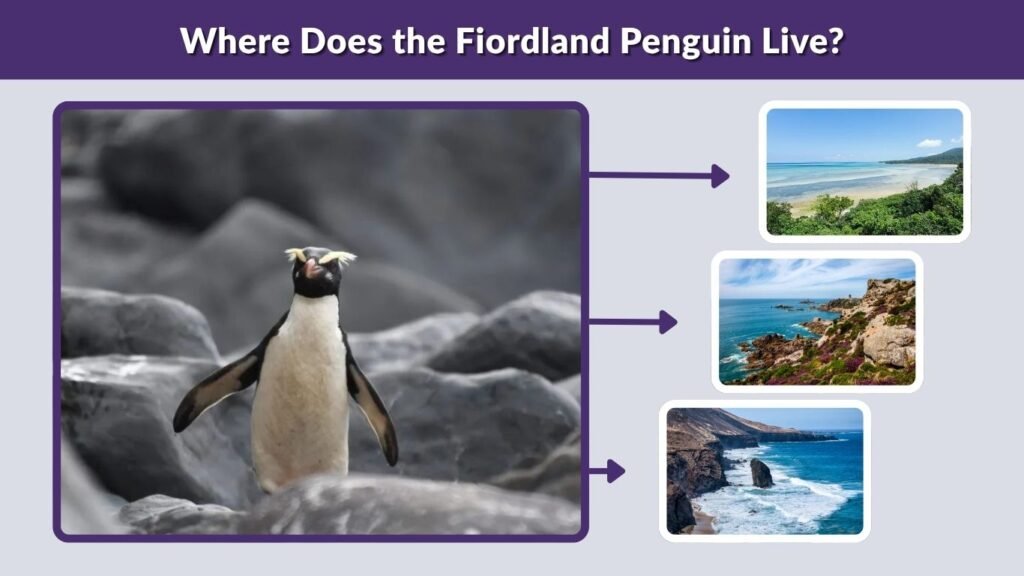
Fiordland penguins have a restricted breeding distribution in southwestern New Zealand. Their colonies are often difficult to reach because they occur along rugged coastlines, remote islands, dense forests, and rocky shorelines. This isolation has helped protect some colonies but also makes accurate population surveys challenging, contributing to the species being comparatively poorly studied.
Fiordland Penguin Habitat
Typical Fiordland penguin habitat includes:
- Dense coastal rainforest
- Podocarp-broadleaf forest
- Coastal scrub
- Caves
- Rock crevices
- Boulder beaches
- Remote headlands
- Small offshore islands
During breeding, tawaki generally forage relatively close to the coast. Outside the breeding season, however, they can undertake remarkable long-distance ocean journeys.
Fiordland Penguins in New Zealand
Tawaki breed mainly along the southwest coast of the South Island and around Stewart Island/Rakiura and nearby islands.
They are especially associated with South Westland and Fiordland. The Department of Conservation notes that visitors may encounter them around places such as Munro Beach, Jackson Bay, and Milford Sound during the appropriate season.
What Does a Fiordland Penguin Eat?
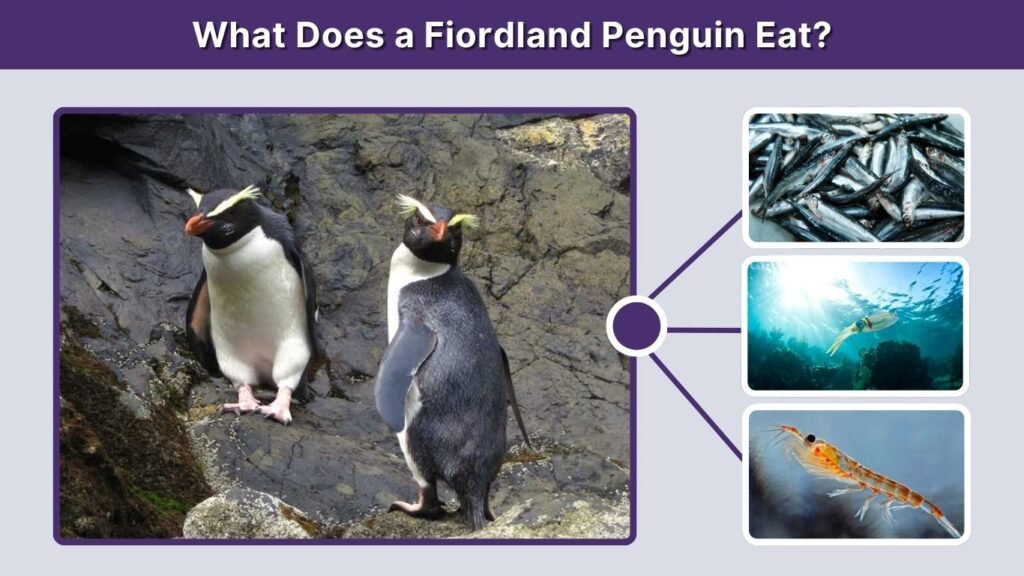
Fiordland penguins obtain their food entirely from the ocean. Like other penguins, they cannot fly through the air, but their modified wings act as powerful flippers underwater. Tawaki pursue marine animals by diving and swimming rapidly beneath the surface, with the composition of their diet varying according to location and available prey.
Fiordland Penguin Diet
Their diet primarily includes:
- Fish
- Squid
- Krill
- Other crustaceans
- Small marine organisms
Fish, cephalopods, and crustaceans provide the energy adults need for breeding, moulting, and lengthy ocean migrations.
How Do Fiordland Penguins Find Food?
Tawaki are pursuit divers. Their streamlined bodies and strong flippers allow them to chase prey underwater much more effectively than they can move on land.
During breeding, they generally remain within about 50 kilometers of shore. Before moulting, tracked birds have undertaken journeys of thousands of kilometers toward productive oceanic frontal zones, demonstrating that this forest-nesting penguin is also an extraordinary long-distance marine traveler.
Fiordland Penguin Size and Adaptations
The Fiordland penguin is considered a medium-sized penguin. Although it is much smaller than an emperor penguin, it has a strong, streamlined body perfectly suited to life at sea. Its waterproof plumage, powerful flippers, countershaded coloring, and diving abilities help it survive in the cool coastal waters surrounding southern New Zealand.
How Tall Is a Fiordland Penguin?
Fiordland crested penguins are approximately 55–60 centimeters long. DOC guidance describes them as mid-sized penguins around 55 cm, while more recent DOC material notes tawaki standing about 60 cm tall.
Males and females look broadly similar, although males may be somewhat larger and possess heavier bills.
Fiordland Penguin Adaptations
Important adaptations include:
- Streamlined bodies for efficient swimming
- Strong flippers for underwater propulsion
- Dense plumage providing insulation
- Waterproof feathers
- Dark backs and white undersides for camouflage
- Powerful feet for moving over rocky ground
- Strong underwater vision
- Thick bills suited to capturing slippery prey
These adaptations allow tawaki to move between two dramatically different environments: rugged coastal forests and the open ocean.
Fiordland Penguin Life Cycle
The breeding cycle of the Fiordland penguin begins during the New Zealand winter. Pairs return to secluded nesting areas and establish nests hidden among rocks, caves, tree roots, or thick vegetation. Tawaki form relatively loose colonies, with individual nests often separated from neighboring pairs rather than packed closely together.
Eggs and Breeding
Females normally lay two eggs, approximately three to six days apart. Interestingly, the first egg is smaller than the second.
Incubation begins after the second egg is laid and lasts approximately 31–36 days. Both parents take turns incubating, although their shifts can involve lengthy fasting and feeding trips.
Despite laying two eggs, Fiordland penguins usually raise only one chick successfully.
Fiordland Penguin Chicks
Chicks usually hatch in September. During their first weeks, males remain with and protect the young while females return from sea with food.
As chicks grow, they may gather in small groups called crèches. Both parents then continue feeding them until fledging.
Young tawaki generally leave for the ocean at around 75 days old, often during late November or early December.
Fiordland Penguin Predators and Threats
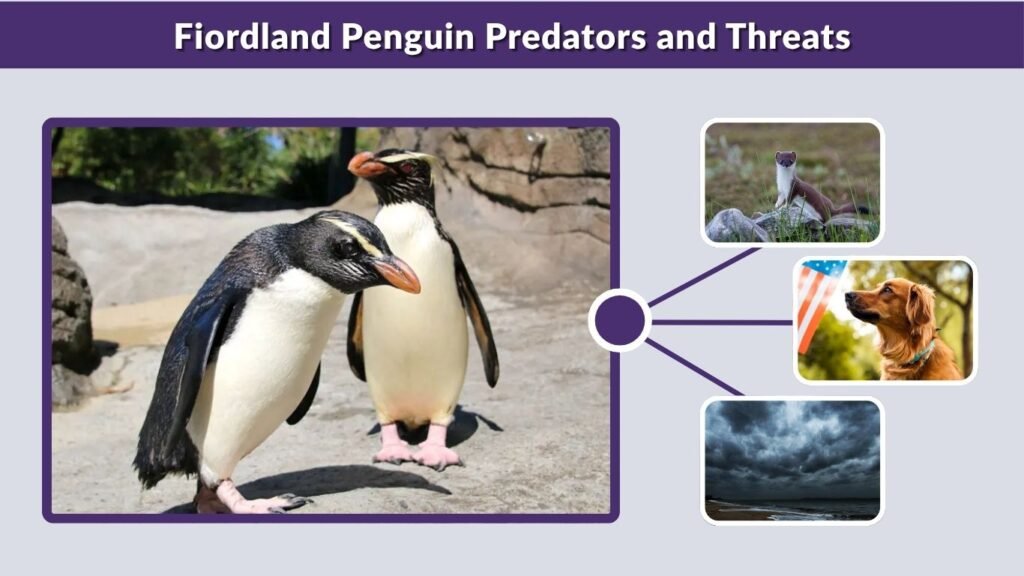
Fiordland penguins face risks on both land and at sea. Introduced mammals create particular problems around mainland nesting sites because New Zealand’s native birds evolved without many mammalian predators. Human activity around nesting beaches can also disrupt breeding, while marine environmental changes may influence food availability and survival.
Main Threats to Fiordland Penguins
Important threats include:
- Stoats
- Uncontrolled dogs
- Human disturbance
- Fisheries bycatch
- Changes in ocean conditions
- Climate-related environmental change
- Loss or degradation of secure breeding habitat
Stoats can attack chicks as well as injured adults, while DOC warns that a single uncontrolled dog could cause severe losses within a colony.
Is the Fiordland Penguin Endangered?
The Fiordland crested penguin remains a conservation concern. New Zealand’s Department of Conservation currently places tawaki in the At Risk–Declining category and estimates the population at roughly 2,500–3,000 breeding pairs. The species has undergone substantial historical declines, and its restricted breeding range increases its vulnerability.
Fiordland Penguin Conservation
Conservation efforts focus heavily on protecting breeding colonies from introduced predators and unnecessary human disturbance.
Researchers also monitor colonies and study movements at sea to understand how ocean conditions affect survival. Because many breeding sites occur in extremely remote forests and coastal areas, accurately counting and monitoring the birds can be difficult.
Visitors can help by keeping their distance and keeping dogs away from penguin habitats.
Interesting Fiordland Penguin Facts
Fiordland crested penguins combine a highly unusual nesting environment with impressive marine abilities. Few people associate penguins with temperate rainforest, yet tawaki may walk beneath dense vegetation before reaching secluded nests. Their ability to alternate between remote forests and journeys thousands of kilometers across the ocean makes them one of New Zealand’s most remarkable seabirds.
Fun Facts About Fiordland Penguins
- They are found naturally only in New Zealand.
- Their Māori name is tawaki.
- Their scientific name is Eudyptes pachyrhynchus.
- They are the only crested penguins breeding on mainland New Zealand.
- Adults have striking yellow eyebrow-like crests.
- They usually lay two eggs but commonly raise one chick.
- Both parents participate in chick care.
- They can nest inside dense coastal rainforest.
- Some pre-moult journeys cover thousands of kilometers.
- DOC estimates about 2,500–3,000 breeding pairs remain.
FAQs
What Is the Scientific Name of the Fiordland Penguin?
The scientific name of the Fiordland crested penguin is Eudyptes pachyrhynchus. It belongs to the penguin family Spheniscidae and the crested-penguin genus Eudyptes. Other common names include tawaki, thick-billed penguin, and New Zealand crested penguin.
Where Does the Fiordland Penguin Live?
Fiordland penguins breed along remote parts of southwestern New Zealand, particularly South Westland, Fiordland, Stewart Island/Rakiura, and nearby islands. Their nesting habitat includes dense coastal forest, scrub, caves, boulder beaches, and rocky shelters. Outside breeding season, they spend most of their time at sea.
What Does a Fiordland Penguin Eat?
Fiordland penguins mainly eat fish, squid, and crustaceans. They hunt by diving underwater and pursuing prey with their powerful flippers. Their exact diet can vary according to season and location because they take advantage of the marine food available around their feeding grounds.
How Many Fiordland Penguins Are Left?
DOC currently estimates the tawaki population at approximately 2,500–3,000 breeding pairs. Because many colonies occur in remote and difficult-to-survey locations, population assessment can be challenging. The species is classified in New Zealand as At Risk–Declining, reflecting concern about its long-term population trend.
What Is the Best Time to See Fiordland Penguins?
DOC says the best opportunity to see tawaki is generally during their July-to-November breeding season. They may also appear during the moulting period from mid-January to early March. Visitors should observe from a respectful distance because nesting Fiordland penguins are highly sensitive to disturbance.
