
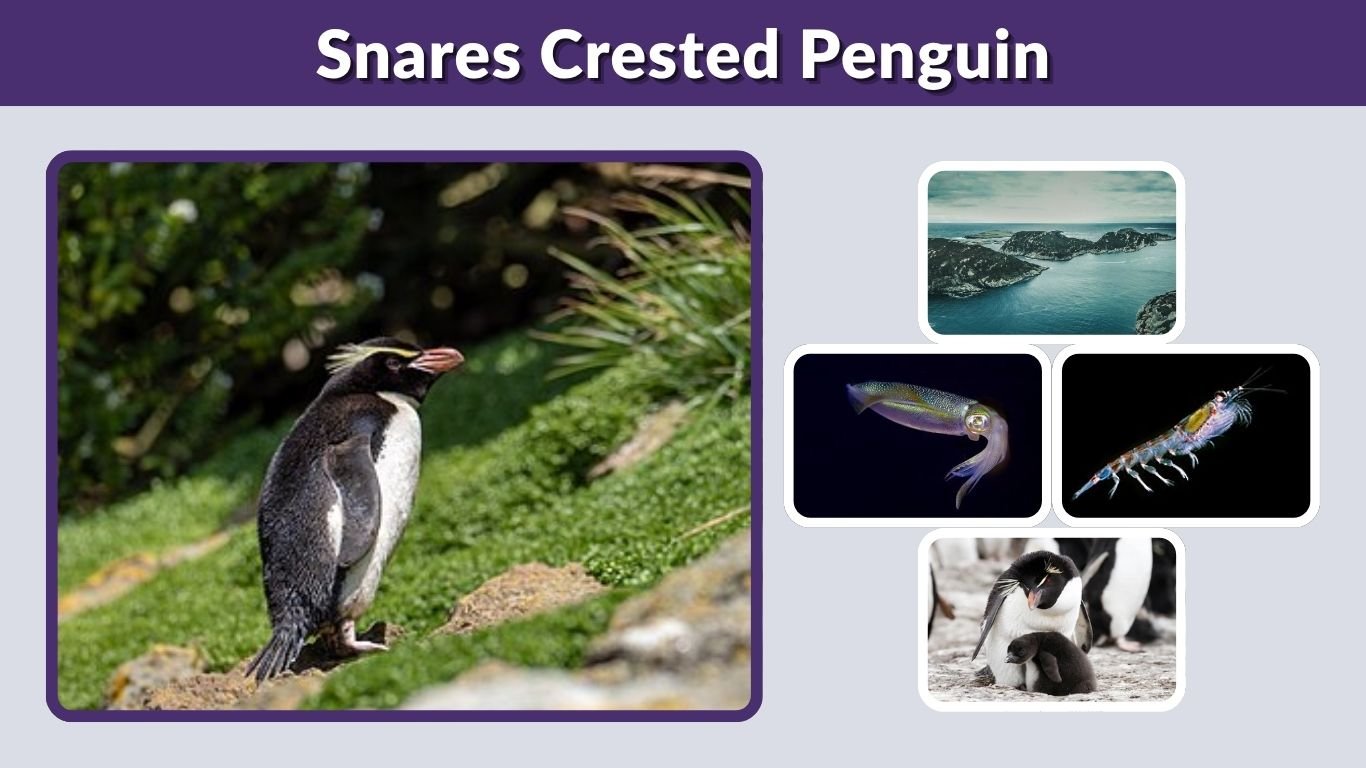
The Snares crested penguin (Eudyptes robustus), also called the Snares penguin or Snares Island penguin, is a distinctive crested penguin found naturally only around New Zealand’s remote Snares Islands. Recognizable by its black-and-white body, orange bill, and yellow eyebrow-like crest, this penguin has one of the most restricted breeding ranges of any crested penguin. From its specialized diet and dense breeding colonies to its chicks, predators, adaptations, and population, the Snares penguin has a fascinating life closely connected to the surrounding ocean.
What Is a Snares Crested Penguin?
The Snares crested penguin is a medium-sized, flightless seabird belonging to the penguin family Spheniscidae. It is endemic to New Zealand and breeds only within the small Snares Islands group. Although it resembles several other crested penguins, features around its bill and yellow crest make adults relatively easy to distinguish at close range.
Snares Penguin Identification
- Scientific name: Eudyptes robustus
- Other names: Snares penguin, Snares Island penguin, pokotiwha
- Length: About 60 cm
- Weight: Around 3 kg
- Upperparts: Black
- Underparts: White
- Bill: Large, robust, and orange
- Eyes: Brownish-red
- Feet: Pinkish-white
- Crest: Yellow stripes extending above the eyes
- Native range: Snares Islands, New Zealand
The pink bare skin around the base of the bill is particularly useful for separating this species from the similar Fiordland crested penguin.
What Does a Snares Penguin Look Like?
A Snares penguin has the classic dark back and white underside associated with penguins, but its head gives it a much more distinctive appearance. Narrow yellow eyebrow stripes begin near the nostrils and extend backward into feathered crests.
Viewed from the front, the two yellow crests spread outward to form a noticeable V shape. Adults also have a thick orange bill surrounded by an area of pink skin. Young birds have less-developed crests and smaller bills.
Snares Penguin Habitat and Distribution
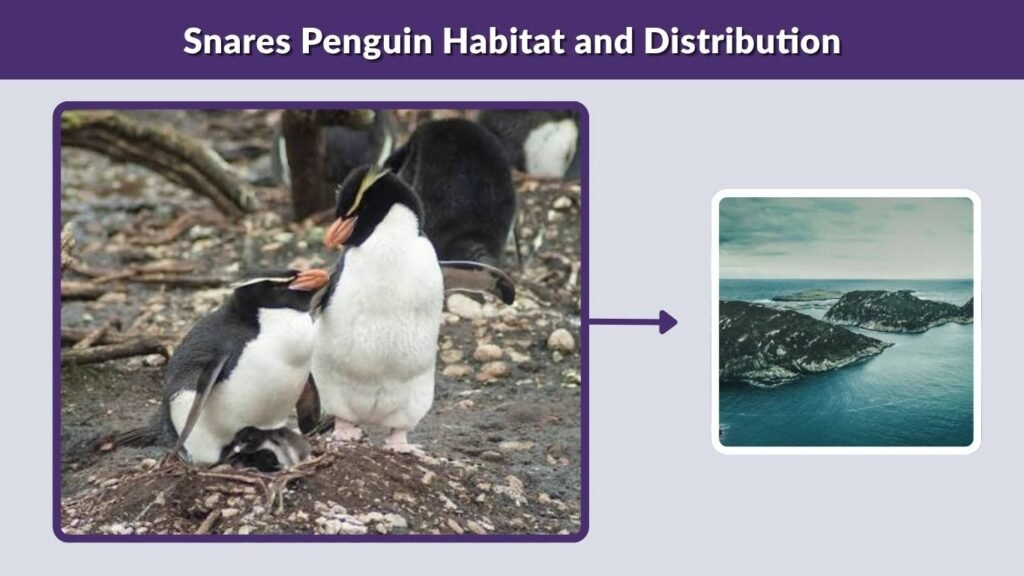
The Snares penguin has an exceptionally restricted breeding distribution. Its breeding colonies occur only on the Snares Islands, a remote island group roughly 100 km southwest of Stewart Island/Rakiura, New Zealand. These islands remain largely untouched and have never established populations of introduced terrestrial mammals, giving native seabirds unusually secure breeding habitat.
Where Does the Snares Penguin Live?
Snares penguins spend much of their lives at sea and normally return to land for breeding and moulting. On the islands, many breeding colonies are located beneath Olearia forest or among dense shrubland, although some colonies occupy exposed rocky areas.
Penguins can travel hundreds of metres inland from coastal landing areas to reach their colonies. During the breeding season, adults forage in waters surrounding and east of the Snares. Tracking has shown that some travel much farther west during winter, including into waters south of Tasmania.
Why Are the Snares Islands Ideal?
The absence of introduced mammals is especially important. Rats, cats, stoats, and similar predators can cause severe problems for ground-nesting seabirds elsewhere.
Because these mammals never became established on the Snares Islands, penguins can breed without many of the land-based threats faced by other New Zealand seabirds. Tourist landings are also prohibited to help protect the islands.
Snares Penguin Diet and Feeding
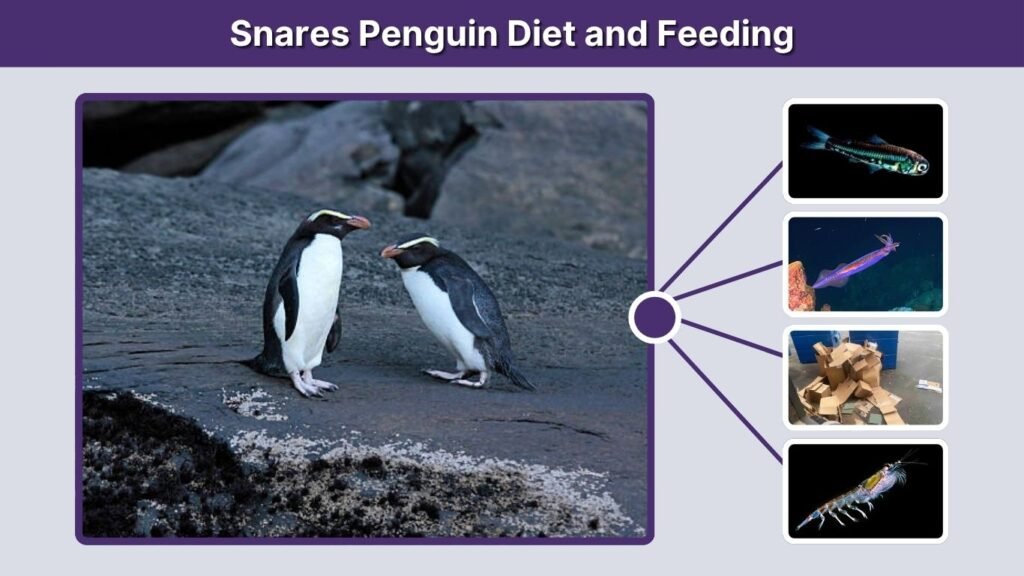
Snares penguins are marine predators that obtain all their food from the ocean. Their diet changes somewhat between adults and growing chicks and includes fish, squid, krill, and other marine organisms. Their streamlined bodies, powerful flippers, and diving ability allow them to chase mobile prey efficiently underwater.
What Do Snares Penguins Eat?
Their diet can include:
- Krill and other small crustaceans
- Juvenile redbait
- Red cod
- Lanternfish
- Long-snouted pipefish
- Arrow squid
- Warty squid
- Violet squid
- Small quantities of octopus
Chicks are fed largely on small crustaceans, especially krill, along with fish and squid. Adults consume proportionally more pelagic fish and squid.
How Do They Find Food?
Snares penguins are pursuit divers. Instead of waiting for prey, they actively chase fish, squid, and crustaceans beneath the surface.
Recorded dives can reach about 120 metres, although typical feeding depths are approximately 15–80 metres. Near their breeding islands, adults may forage in small groups, particularly when food is concentrated in productive marine areas.
Snares Penguin Breeding and Life Cycle
Breeding is highly synchronized in the main Snares penguin colonies. Adults return to their breeding sites during the southern spring and form dense nesting groups. Both parents participate in incubation and chick care, helping their offspring survive until they are capable of heading to sea independently.
Eggs and Chicks
- Adults return to colonies around September.
- Eggs are generally laid from mid-September to mid-October.
- A typical clutch contains two eggs.
- Incubation lasts roughly 31–37 days.
- Both parents participate in incubation.
- Two chicks may hatch, but usually only one survives beyond the early period.
- Young chicks are guarded for approximately three weeks.
- Older chicks gather together in groups called crèches.
- Fledglings generally leave the islands around late January.
Interestingly, birds breeding on the Western Chain islets begin breeding around six weeks later than those on the two main islands.
Snares Penguin Lifespan
Snares penguins do not begin breeding immediately after reaching adulthood. Available records indicate that they generally first breed at around six years of age.
New Zealand Birds Online reports a maximum recorded longevity of about 22 years, although the actual lifespan of individual wild penguins varies with food availability, breeding success, predation, and conditions at sea.
Snares Penguin Adaptations
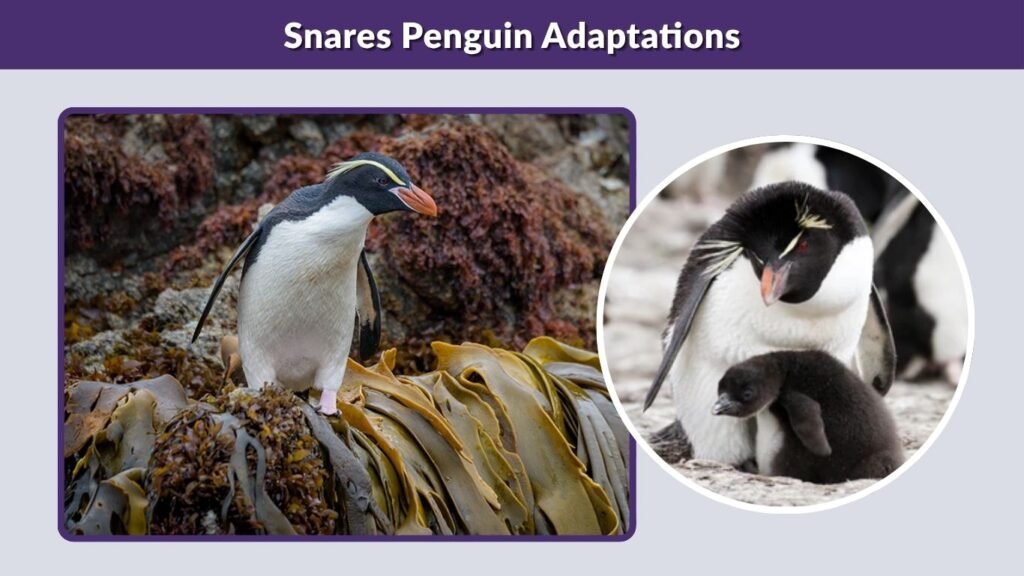
Life on a remote subantarctic island and months spent at sea require several useful adaptations. Like other penguins, Snares penguins are unable to fly, but their bodies are highly specialized for swimming, diving, maintaining body temperature, and travelling between marine feeding areas and rugged breeding colonies.
Important Adaptations
- Flipper-shaped wings provide powerful underwater propulsion.
- Streamlined bodies reduce resistance while swimming.
- Dense feathers provide waterproof insulation.
- A layer of body fat helps conserve heat.
- Webbed feet help with swimming and movement on land.
- Dark upperparts and pale underparts provide countershading in the ocean.
- Strong legs help them travel through rocky and forested colony areas.
Their feathers are replaced during an annual moult. Snares penguins remain ashore for roughly three to four weeks while completing this process before returning to sea.
Snares Penguin Population and Predators
Despite breeding across an extremely small geographical area, the Snares penguin population has been considered comparatively stable relative to many other crested penguins. New Zealand conservation authorities closely monitor breeding colonies because such a restricted range means environmental changes could potentially affect a large portion of the species.
How Many Snares Penguins Are There?
Around 30,000 breeding pairs occur on North East and Broughton Islands, while several hundred additional pairs breed on Toru and Rima islets in the Western Chain.
The New Zealand Department of Conservation monitors the population through periodic nest counts. Its national conservation status is At Risk–Naturally Uncommon.
Snares Penguin Predators and Threats
Natural predators include New Zealand sea lions, New Zealand fur seals, and occasional leopard seals. Skuas and red-billed gulls can take eggs and small chicks, while giant petrels may prey upon young penguins entering the ocean.
Long-term concerns include changes in climate and marine food availability. Several prey species eaten by Snares penguins are also commercially harvested, making changes to the surrounding marine ecosystem important to monitor.
Snares Penguin vs Fiordland Penguin
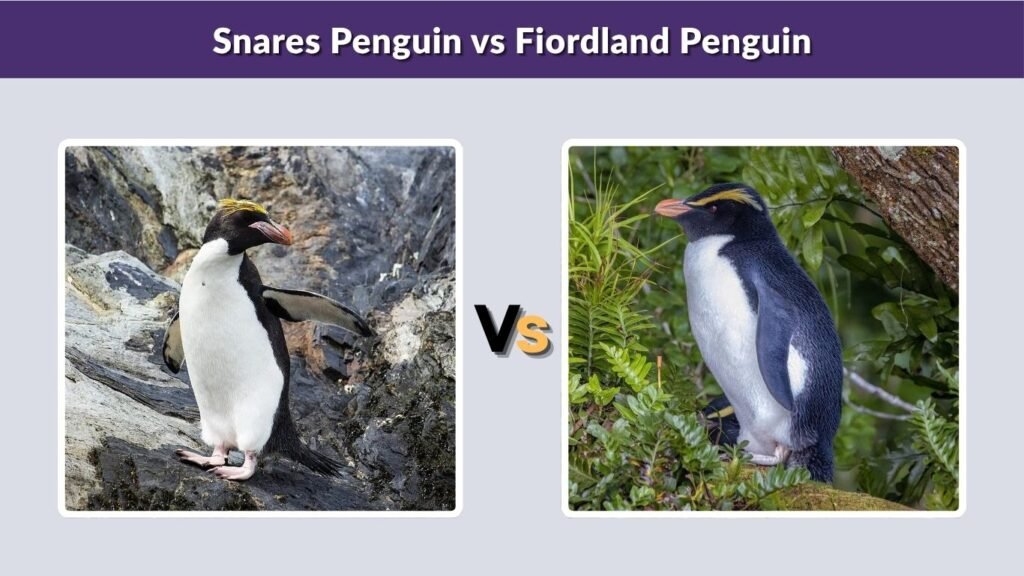
The Snares and Fiordland crested penguins can look remarkably similar because both have dark upperparts, white bellies, orange bills, and yellow eyebrow crests. However, careful examination reveals several characteristics that help distinguish these two New Zealand crested penguins.
How to Tell Them Apart
The Snares penguin generally has a larger, more robust bill with conspicuous pink bare skin around its base. Its yellow eyebrow stripes tend to be narrower.
The Fiordland crested penguin has a smaller bill and lacks the same prominent pink skin around the bill base. Fiordland penguins also breed across parts of southwestern New Zealand rather than being confined to the Snares Islands.
Interesting Snares Penguin Facts
The restricted range and unusual breeding ecology of this species make it one of New Zealand’s most interesting seabirds. Its isolation has also protected its nesting colonies from many introduced predators that have affected other native birds.
Quick Fun Facts
- Snares penguins breed naturally nowhere else in the world.
- Some colonies contain more than 1,000 breeding pairs.
- Penguins may walk hundreds of metres inland to nest.
- Chicks form crèches when they are about three weeks old.
- Adults can dive to depths around 120 metres.
- Some penguins travel toward Tasmania during the nonbreeding season.
- Adults replace all their feathers during an annual moult.
- They generally begin breeding at about six years old.
- Maximum recorded longevity is about 22 years.
- Their scientific name is Eudyptes robustus.
FAQs
Where does the Snares penguin live?
The Snares penguin breeds exclusively on the Snares Islands south of New Zealand. Most nesting occurs on North East and Broughton Islands, with smaller numbers on Western Chain islets. Outside the breeding season, the birds spend most of their time at sea and may travel considerable distances across the southern Tasman region.
What does a Snares penguin eat?
Snares penguins eat a mixture of fish, squid, krill, and other marine prey. Adults commonly consume fish such as juvenile redbait and red cod along with several squid species. Chicks receive a diet containing substantial amounts of small crustaceans, particularly krill, as well as fish and squid.
How tall is a Snares penguin?
An adult Snares crested penguin is approximately 60 cm long and typically weighs around 3 kg. This places it among the medium-sized crested penguins. Males and females look broadly similar, although males generally have heavier, more robust bills than females.
What is the Snares penguin population?
Approximately 30,000 breeding pairs occur on North East and Broughton Islands, with additional pairs breeding on nearby Western Chain islets. The population has been regarded as comparatively stable, but its extremely restricted breeding distribution makes continued monitoring particularly important.
What is special about the Snares crested penguin?
Its most remarkable feature is its tiny breeding range. The species breeds only in New Zealand’s Snares Islands. It can also be recognized by its yellow V-shaped crests, robust orange bill, and prominent pink skin around the bill base—features that help distinguish it from the similar Fiordland crested penguin.
