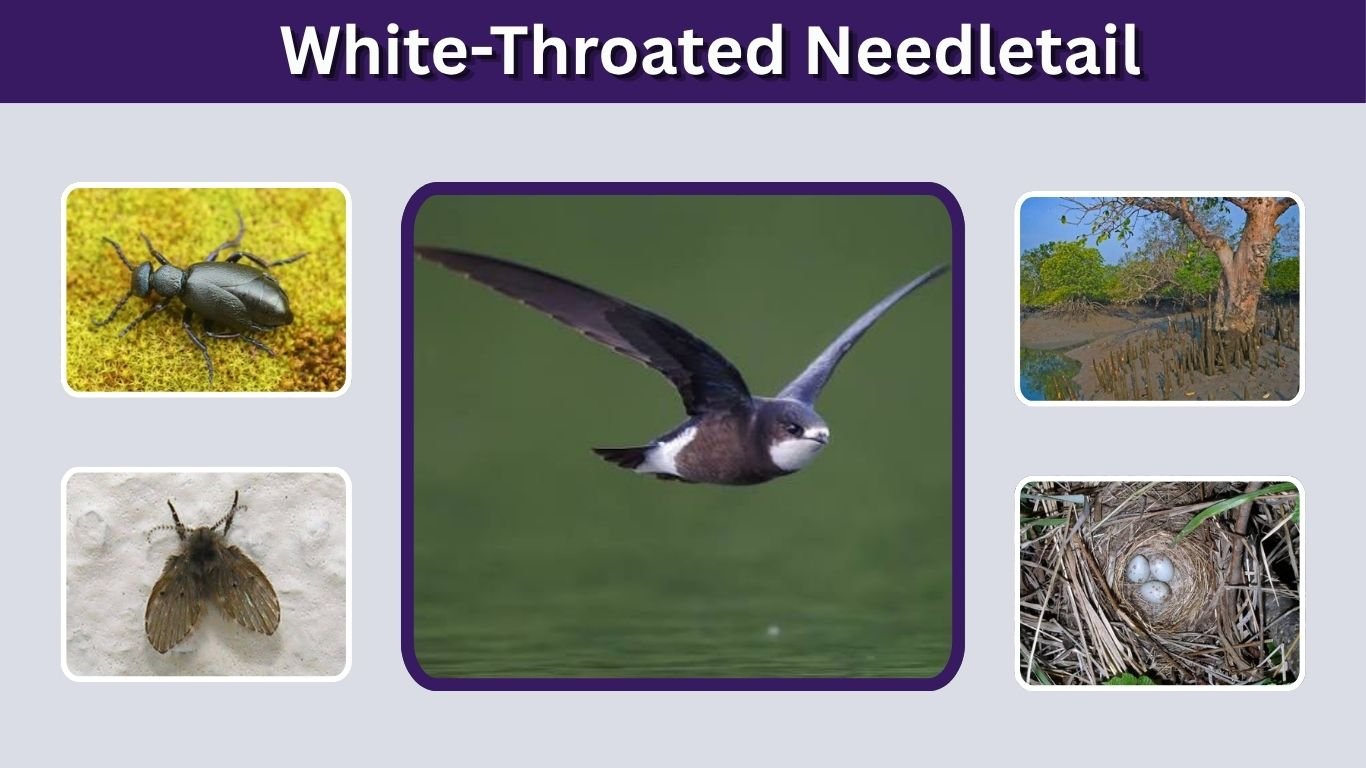
The white-throated needletail (Hirundapus caudacutus) is a remarkable migratory bird famous for its extraordinary flying ability and streamlined body. Often described as one of the fastest birds in level flight, this swift spends much of its life soaring through the sky while hunting insects. Its distinctive white throat, long pointed wings, and short, spiny tail make it easy to recognize. Found across parts of Asia and Australia, the white-throated needletail plays an important role in natural ecosystems by controlling flying insect populations.
What Is a White-Throated Needletail?
The white-throated needletail is a large, fast-flying swift belonging to the family Apodidae. It is also called the needle-tailed swift or spine-tailed swift because of the stiff, needle-like extensions at the tips of its tail feathers.
Unlike birds that frequently perch on branches or walk on the ground, this species is highly adapted to aerial life. It catches insects, drinks water, and travels enormous distances while flying.
Scientific Classification
- Common Name: White-Throated Needletail
- Scientific Name: Hirundapus caudacutus
- Family: Apodidae
- Order: Apodiformes
- Genus: Hirundapus
- Bird Type: Migratory swift
The species is a member of the swift family, not a swallow or a bird of prey.
White-Throated Needletail Appearance and Identification
The white-throated needletail has a muscular, streamlined body designed for fast and efficient flight. Its distinctive markings make it recognizable even when flying high overhead.
The bird has dark grayish-brown plumage, with a slight greenish gloss visible under favorable lighting. Its long, curved wings and short, square-shaped tail create a distinctive silhouette.
Key Identification Features
- White throat: A noticeable white patch beneath its dark head.
- Long wings: Narrow, pointed wings that curve backward during flight.
- Spiny tail: Short, stiff tail feathers with projecting needle-like shafts.
- Body color: Dark gray-brown plumage with a greenish sheen.
- White undertail: Pale markings around the lower belly and tail base.
Male and female birds look very similar. Juveniles usually have duller plumage and less noticeable white markings than adults.
White-Throated Needletail Size and Wingspan
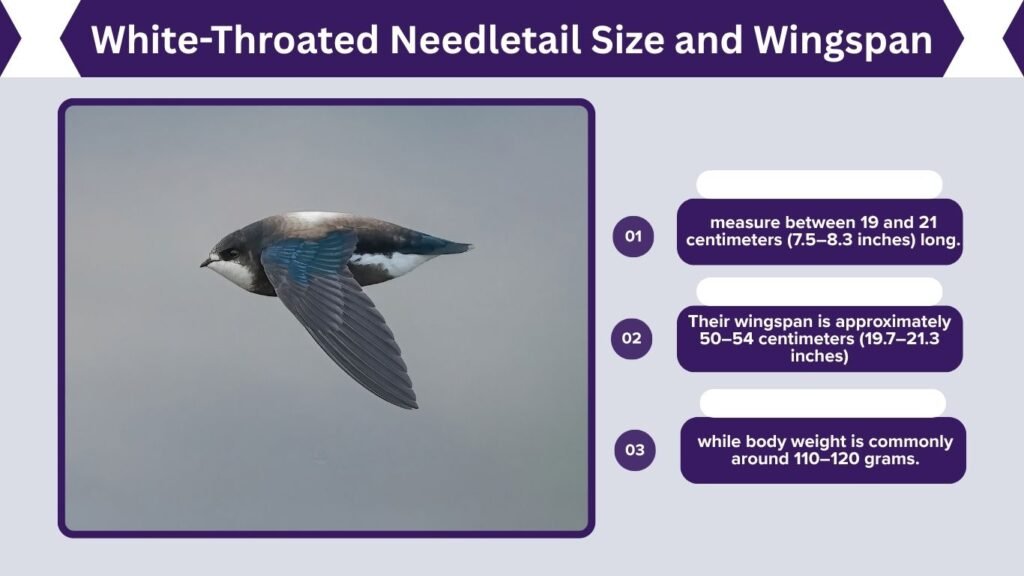
Despite its remarkable flying ability, the white-throated needletail is relatively small compared with many other fast birds.
Adult birds typically measure between 19 and 21 centimeters (7.5–8.3 inches) long. Their wingspan is approximately 50–54 centimeters (19.7–21.3 inches), while body weight is commonly around 110–120 grams.
Their long wings are particularly important because they provide lift and support rapid flight over large distances. The body is compact and powerful, helping the bird maneuver quickly while chasing insects.
The combination of broad wing coverage and a relatively lightweight body makes the white-throated needletail an exceptionally capable aerial hunter.
How Fast Is a White-Throated Needletail?
The white-throated needletail is famous for its impressive flight speed. It is frequently described as one of the fastest birds in horizontal flight.
Many websites claim that it reaches approximately 105–106 mph (169–170 km/h). However, this figure has not been scientifically verified through published measurement methods.
The Australian Museum reports speeds of up to 130 km/h (81 mph), although this should not be confused with a rigorously established world speed record.
Why Is the White-Throated Needletail So Fast?
Several physical characteristics contribute to its exceptional flying ability:
- Streamlined body: Reduces aerodynamic resistance.
- Long, curved wings: Help generate lift and support fast flight.
- Powerful flight muscles: Support rapid wingbeats and aerial maneuvering.
- Lightweight construction: Helps the bird remain airborne efficiently.
White-Throated Needletail vs. Peregrine Falcon
The peregrine falcon is generally considered the fastest bird in the world because it can reach approximately 200 mph (320 km/h) during hunting dives.
However, diving speed differs from sustained horizontal flight. The white-throated needletail is notable for its rapid, powered flight, while the peregrine falcon reaches its greatest speeds through gravity-assisted diving.
White-Throated Needletail Habitat and Distribution
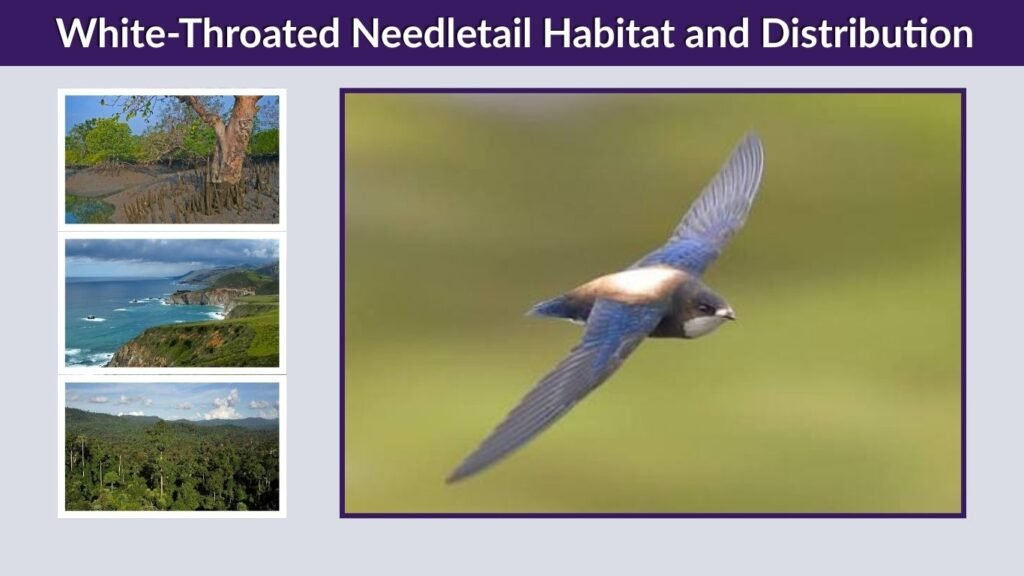
The white-throated needletail inhabits a wide range of environments across Asia and Australia. It spends most of its time airborne, searching for insects above forests, grasslands, and open landscapes.
The species is frequently observed above wooded regions, including rainforests and open forests. It may also fly over farmland, coastal areas, hills, and mountain slopes where rising air currents support its movement.
Migration and Geographic Range
White-throated needletails breed in northeastern Asia, including parts of Siberia, Mongolia, northeastern China, and Japan.
Many migrate south through Asia toward Australia for the non-breeding season. They generally arrive in Australia around September or October and return north during the following autumn.
In Australia, they are especially associated with eastern regions, although sightings occur across a wider area. These long-distance seasonal movements demonstrate their remarkable endurance.
What Do White-Throated Needletails Eat?
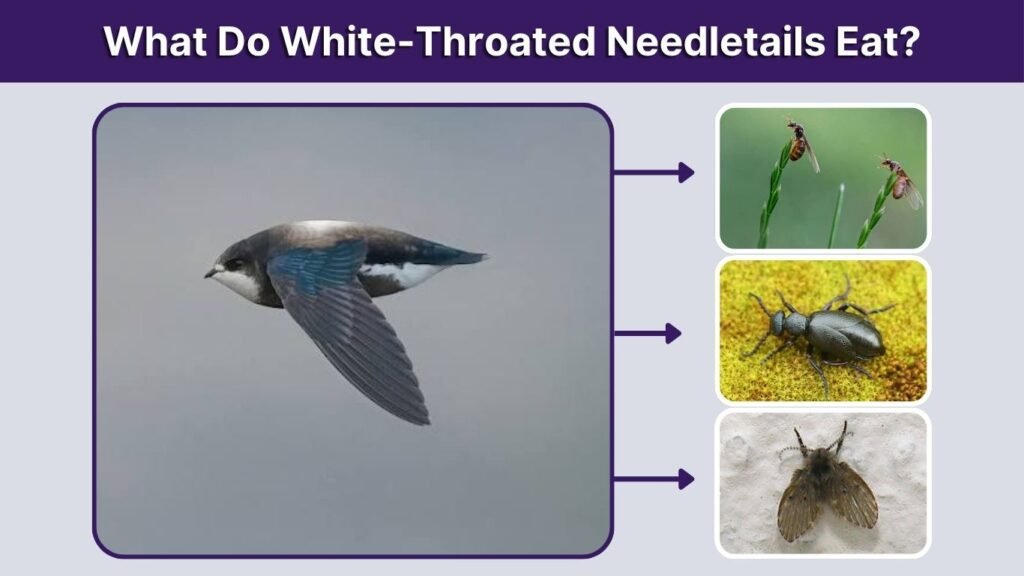
The white-throated needletail is an insectivorous bird that captures flying insects directly from the air. Its broad mouth helps it collect prey while traveling at high speeds.
It commonly feeds in areas where wind currents, warm air, or approaching weather systems concentrate flying insects.
Common Foods
- Flying ants: An important food source during insect swarms.
- Termites: Captured during their winged reproductive stage.
- Beetles: Taken while flying above forests and open areas.
- Flies and moths: Caught during rapid aerial movements.
- Bees and wasps: Occasionally consumed as part of its varied insect diet.
By consuming numerous flying insects, white-throated needletails contribute to maintaining balance in natural insect populations.
White-Throated Needletail Behavior and Flight Habits
White-throated needletails are highly aerial birds that spend much of their active time flying. They often gather in groups and may form large flocks when food is abundant.
They frequently follow weather fronts where rising air currents carry insects upward, creating favorable feeding conditions.
Although people once believed that these birds never landed during their stay in Australia, scientific observations have confirmed that they roost in trees.
Researchers have documented birds resting among dense foliage and in tree hollows. Their strong attachment to aerial life does not mean they remain continuously airborne.
White-Throated Needletail Breeding and Reproduction
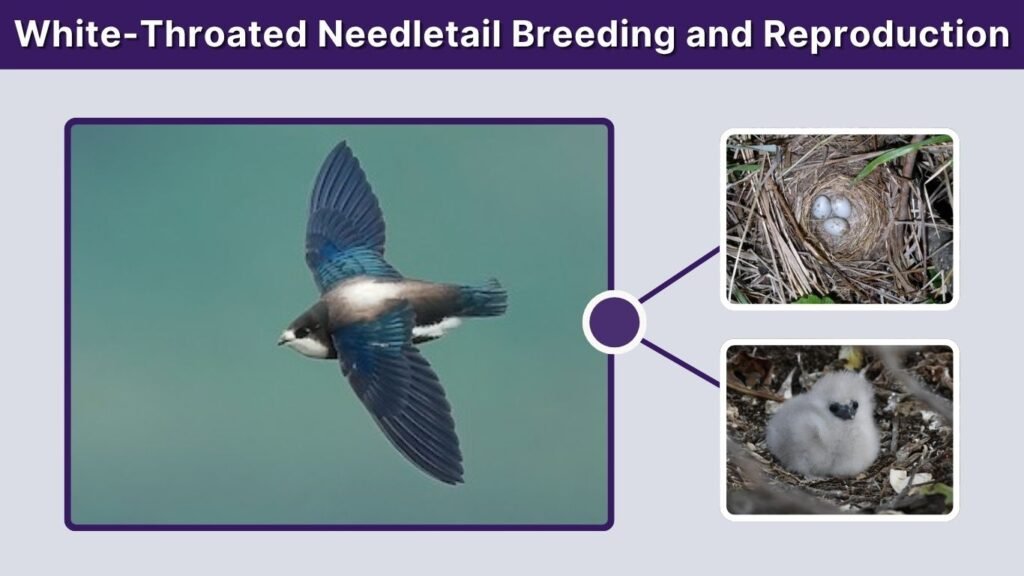
White-throated needletails breed primarily in the Northern Hemisphere during late spring and early summer. Unlike their aerial feeding behavior, reproduction requires suitable nesting locations.
They commonly build nests inside hollows of tall trees or sheltered crevices along rocky cliffs.
The nest may consist of small twigs and plant materials attached to a vertical surface using saliva. Some birds also use natural depressions inside tree hollows.
A typical clutch contains approximately two eggs, although larger clutches have been documented. Both parents participate in incubation and caring for the developing chicks.
Young birds remain dependent on their parents until they develop the strength and flight ability needed to leave the nest.
White-Throated Needletail Predators and Conservation Status
Despite their exceptional flying ability, white-throated needletails face several natural and human-related threats.
Birds of prey, including some falcons and hawks, may attack them, particularly near nesting or roosting locations.
Human activities create additional risks. Collisions with wind turbines, power lines, buildings, and other structures can cause fatalities. Habitat loss and insecticide use may also reduce available roosting sites and food supplies.
The species is currently classified as Least Concern globally, but it is listed as Vulnerable under Australia’s national environmental legislation. These classifications reflect different geographic assessments.
Protecting mature trees, maintaining healthy insect populations, and reducing dangerous collisions can contribute to conserving this remarkable migratory bird.
FAQs
1. Can a white-throated needletail fly 106 mph?
The bird is often credited with reaching 106 mph (170 km/h), but this claimed speed has not been scientifically verified. The Australian Museum reports speeds of up to approximately 81 mph (130 km/h).
2. What is the average lifespan of a white-throated needletail?
A reliable average lifespan has not been firmly established for wild white-throated needletails. Researchers have more information about their migration and breeding behavior than their longevity.
3. Can white-throated needletails perch on trees?
Yes. Despite spending most of their active time flying, white-throated needletails can perch and roost in trees, including among dense foliage and within tree hollows.
4. Is the white-throated needletail a raptor?
No. It belongs to the swift family, Apodidae, and primarily eats flying insects. Raptors are predatory birds such as hawks, eagles, and falcons.
5. Is the white-throated needletail endangered?
The white-throated needletail is globally classified as Least Concern, rather than Endangered. However, Australia recognizes it as a Vulnerable species because of conservation concerns affecting its population.