
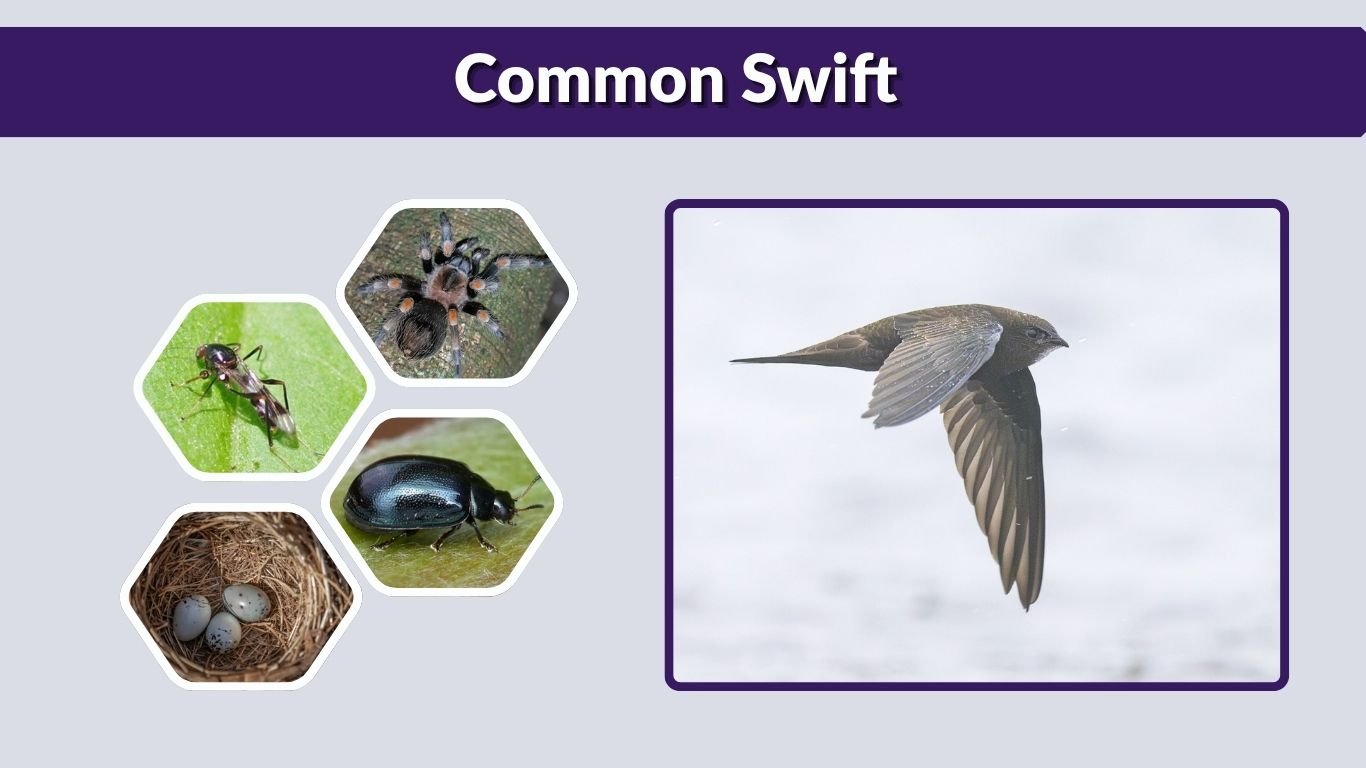
The common swift is an extraordinary bird famous for its incredible flying abilities and remarkable endurance. Unlike most birds, common swifts spend nearly their entire lives in the air, catching insects, traveling long distances, and even resting while flying. These small, dark-colored birds migrate between Europe, Asia, and Africa, covering thousands of miles annually. Their unusual behavior, streamlined bodies, and distinctive calls make them fascinating to birdwatchers. Understanding common swift identification, flight time, feeding habits, nesting behavior, and lifespan reveals why they are considered masters of the sky.
What Is a Common Swift?
The common swift (Apus apus) is a small migratory bird belonging to the family Apodidae. It is widely distributed across Europe and parts of Asia during the breeding season before migrating to sub-Saharan Africa for winter.
Although swifts resemble swallows, they belong to a completely different bird family. Their bodies are specially adapted for sustained flight, allowing them to perform nearly all their daily activities in the air.
Common Swift Size and Appearance
Adult common swifts measure approximately 16–17 centimeters (6.3–6.7 inches) long, with a wingspan of roughly 40–48 centimeters (16–19 inches). They typically weigh around 40 grams.
Their dark plumage, narrow wings, and streamlined bodies make them easy to recognize when flying overhead.
Common Swift Identification
Common swifts have distinctive physical characteristics that separate them from other small aerial birds. Their dark bodies and long, curved wings create a recognizable silhouette against the sky.
They are often observed flying rapidly above buildings, open countryside, and wooded areas.
Key Identification Features
- Body color: Dark brown plumage that appears nearly black from below.
- Wings: Long, narrow, sickle-shaped wings designed for rapid flight.
- Tail: Short, slightly forked tail.
- Throat: Small, pale patch beneath the beak.
- Beak: Short bill with a wide gape for catching insects.
- Feet: Short legs and strong claws adapted for gripping vertical surfaces.
Common Swift Call and Sounds
Common swifts produce loud, high-pitched screaming calls, especially when flying together in groups.
These sharp vocalizations are frequently heard over towns and cities during summer. Groups may circle buildings while calling repeatedly, particularly around established nesting locations.
How Long Can a Common Swift Fly Without Landing?
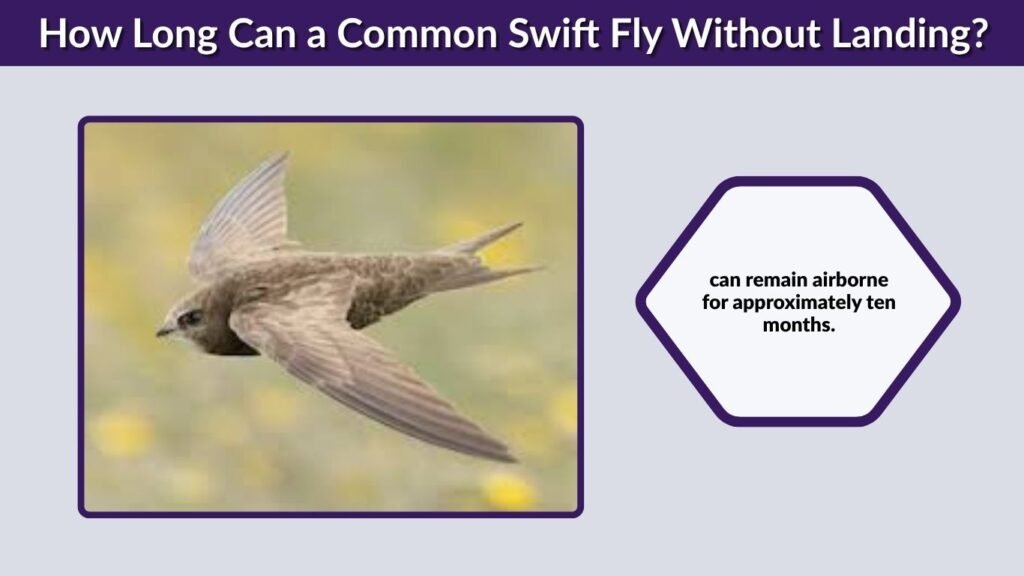
Common swifts are among the world’s most remarkable endurance flyers. Scientific research has shown that these birds can remain airborne for extraordinarily long periods, particularly outside their breeding season.
Their specialized wings and efficient flight patterns allow them to travel, feed, and rest without regularly landing.
Can Common Swifts Fly for 10 Months?
Yes. A 2016 study by researchers at Lund University demonstrated that common swifts can remain airborne for approximately ten months.
Researchers fitted birds with miniature tracking devices and discovered that they spent more than 99% of their nonbreeding period in flight.
Some individuals apparently remained continuously airborne, although others made occasional brief landings.
Do Common Swifts Ever Land?
Common swifts do land, especially during breeding. They enter nesting cavities in buildings, cliffs, and other suitable structures.
However, they rarely perch casually on branches or wires. Their short legs are adapted for gripping surfaces rather than walking comfortably on the ground.
Do Common Swifts Sleep While Flying?
One of the most fascinating questions about common swifts concerns their sleeping behavior. Because some individuals remain airborne for months, scientists believe they must obtain rest without regularly landing.
Their ability to glide for extended periods may help them conserve energy during prolonged flights.
How Do Common Swifts Sleep?
Common swifts are widely believed to sleep while airborne, although precisely how they accomplish this remains incompletely understood.
They may obtain short periods of sleep while gliding, but detailed sleep patterns have not been established through direct brain-activity measurements.
Researchers have also observed common swifts ascending to higher altitudes around dusk and dawn.
What Do Common Swifts Eat?
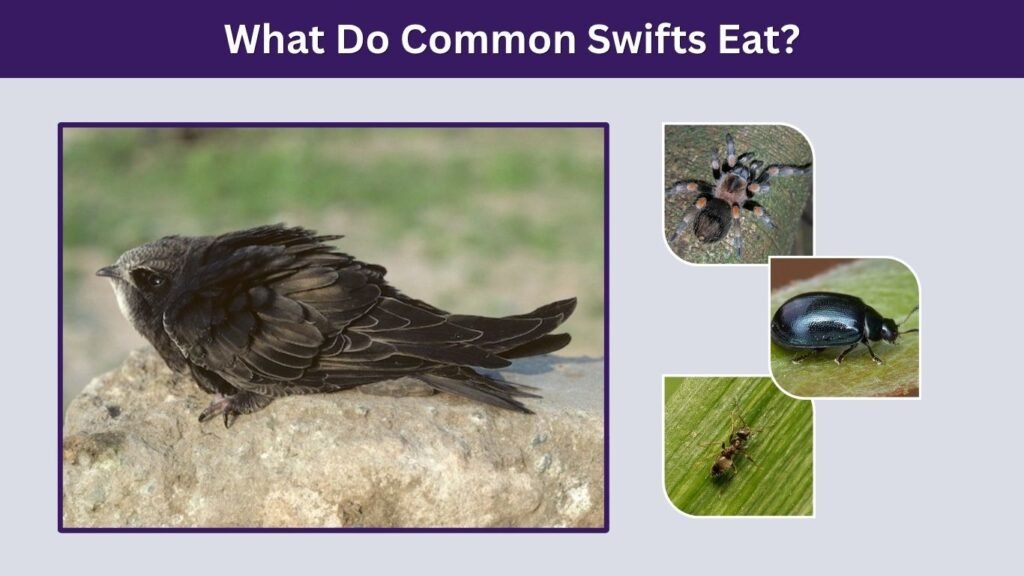
Common swifts are insectivorous birds that catch food almost entirely while flying. Their wide mouths allow them to capture small airborne animals efficiently.
They often follow concentrations of insects, changing their feeding altitude according to weather and prey availability.
Common Swift Diet
Their natural diet includes:
- Small flies and midges
- Flying ants
- Mosquitoes
- Aphids
- Small beetles
- Airborne spiders
- Other tiny flying insects
How Do Common Swifts Feed Their Babies?
Adult swifts collect numerous insects in their mouths and throats, forming compact food balls.
They carry these food packages back to their nests and feed them to their chicks. During favorable weather, adults can gather large quantities of insects during hunting trips.
Common Swift Habitat and Migration
Common swifts occupy a wide range of environments, including towns, villages, forests, agricultural landscapes, and open countryside.
They spend most of their time in open airspace, where flying insects provide their food. However, suitable nesting cavities are essential during the breeding season.
Where Do Common Swifts Live?
Common swifts breed throughout much of Europe and across parts of Asia. They frequently nest in older buildings, churches, and structures with small roof openings.
Outside the breeding season, they migrate to Africa, where they spend the northern winter.
Common Swift Migration
Common swifts are long-distance migrants that travel thousands of miles between breeding and wintering areas.
In Britain, many arrive during late April or May and leave around July or August.
Their migration routes vary, and individual birds may travel enormous distances each year while following favorable weather and insect availability.
Common Swift Nesting and Reproduction
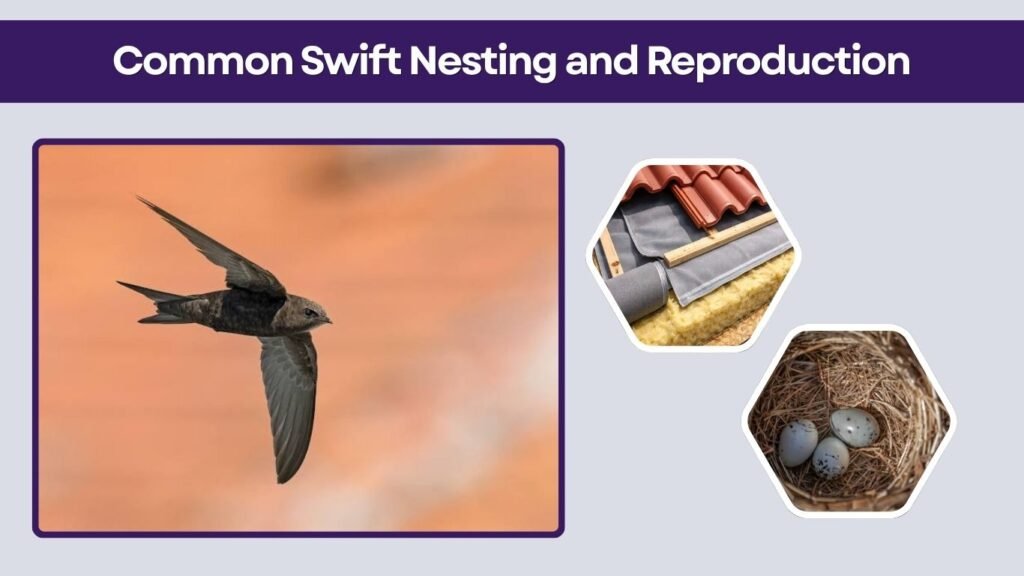
Common swifts usually return to established nesting locations during spring and summer. Breeding pairs often reuse the same nesting cavity for multiple years.
Their nests are relatively small and constructed from lightweight materials collected while flying.
Common Swift Nest and Eggs
Common swift breeding characteristics include:
- Nest location: Cavities beneath roof tiles, inside buildings, or in natural rock crevices.
- Nest materials: Feathers, grass, and other airborne materials joined with saliva.
- Eggs: Usually two or three white eggs.
- Incubation: Approximately 18–24 days.
- Fledging: Young birds generally leave the nest after 37–56 days.
When Do Baby Common Swifts Fly?
Young common swifts develop their flight muscles while remaining inside the nest.
Once they fledge, they can undertake sustained flights and begin catching insects independently. Unlike many songbirds, young swifts generally receive little extended parental care after leaving the nest.
Common Swift Lifespan and Speed
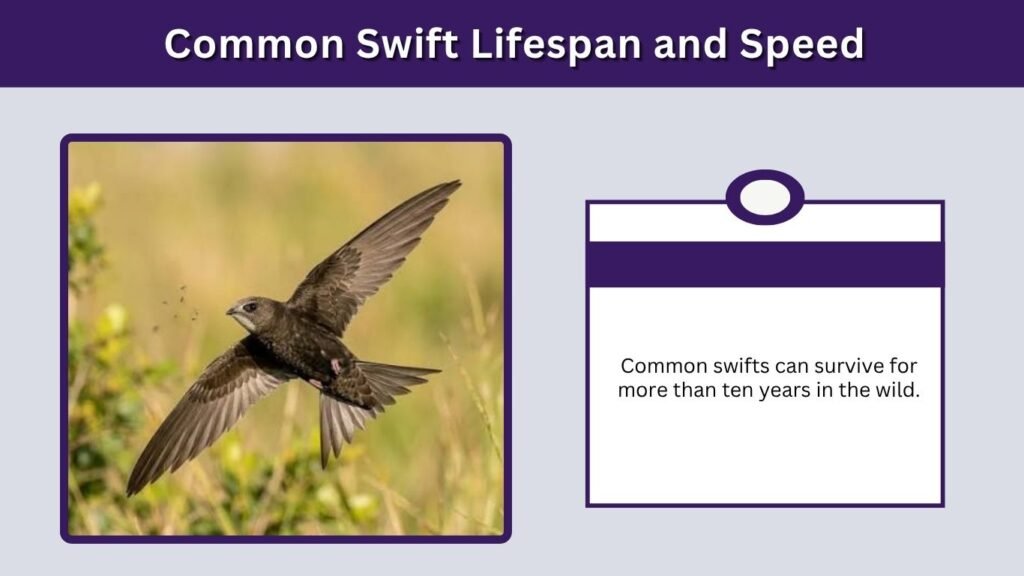
Common swifts are surprisingly long-lived birds despite their small size and demanding migratory lifestyle.
Their streamlined bodies also make them extremely fast flyers capable of impressive aerial maneuvers.
How Long Do Common Swifts Live?
Common swifts can survive for more than ten years in the wild. British Trust for Ornithology data estimate a typical life expectancy of approximately nine years for birds that reach breeding age.
Exceptional individuals have been recorded living for more than 20 years.
How Fast Can a Common Swift Fly?
Common swifts are among the fastest birds in powered, level flight.
Their maximum measured speed is approximately 111 kilometers per hour (69 miles per hour), although normal traveling speeds are considerably lower.
They often perform rapid aerial chases and sharp turns while pursuing insects or interacting with other swifts.
Common Swift vs. Swallow and Chimney Swift
Common swifts are sometimes confused with swallows and chimney swifts because all three are agile birds that spend considerable time flying.
However, these species differ in appearance, geographic distribution, and behavior.
Common Swift vs. Swallow
Swallows generally have broader wings, lighter underparts, and more deeply forked tails. They also regularly perch on wires and branches.
Common swifts have darker bodies, longer curved wings, and a stronger preference for remaining airborne.
Common Swift vs. Chimney Swift
The chimney swift (Chaetura pelagica) is primarily found in North America, while the common swift breeds mainly across Europe and Asia.
Chimney swifts have relatively short, squared-off tails and frequently roost inside chimneys. Common swifts have longer, sickle-shaped wings and spend much longer periods continuously airborne.
FAQs
1. Can Common Swifts Really Fly for 10 Months?
Yes. Scientific tracking has demonstrated that common swifts can remain airborne for approximately ten months during their nonbreeding season. Some individuals apparently never land during this period, while others occasionally rest briefly on solid surfaces.
2. Do Common Swifts Sleep in the Air?
Common swifts are believed to sleep while flying because they spend extremely long periods airborne. However, scientists have not fully established their sleeping mechanisms. Their ability to glide efficiently may allow them to obtain rest without landing.
3. Why Do Common Swifts Have Short Feet?
Common swifts have short legs and strong, curved claws suited to gripping nesting surfaces. Their feet are less suitable for walking or perching on branches. This adaptation reflects their highly aerial lifestyle rather than an inability to land.
4. Are Common Swifts Endangered?
Common swifts are classified globally as Least Concern, but populations have declined in several regions. In the United Kingdom, they are on the Red List of conservation concern, partly because of nesting-site losses and pressures affecting insect populations.
5. What Is the Difference Between a Common Swift and a Pallid Swift?
Pallid swifts generally have lighter brown plumage, broader-looking wings, and a more extensive pale throat patch. Common swifts usually appear darker and have more sharply pointed wings. Their similar appearances can make identification challenging.