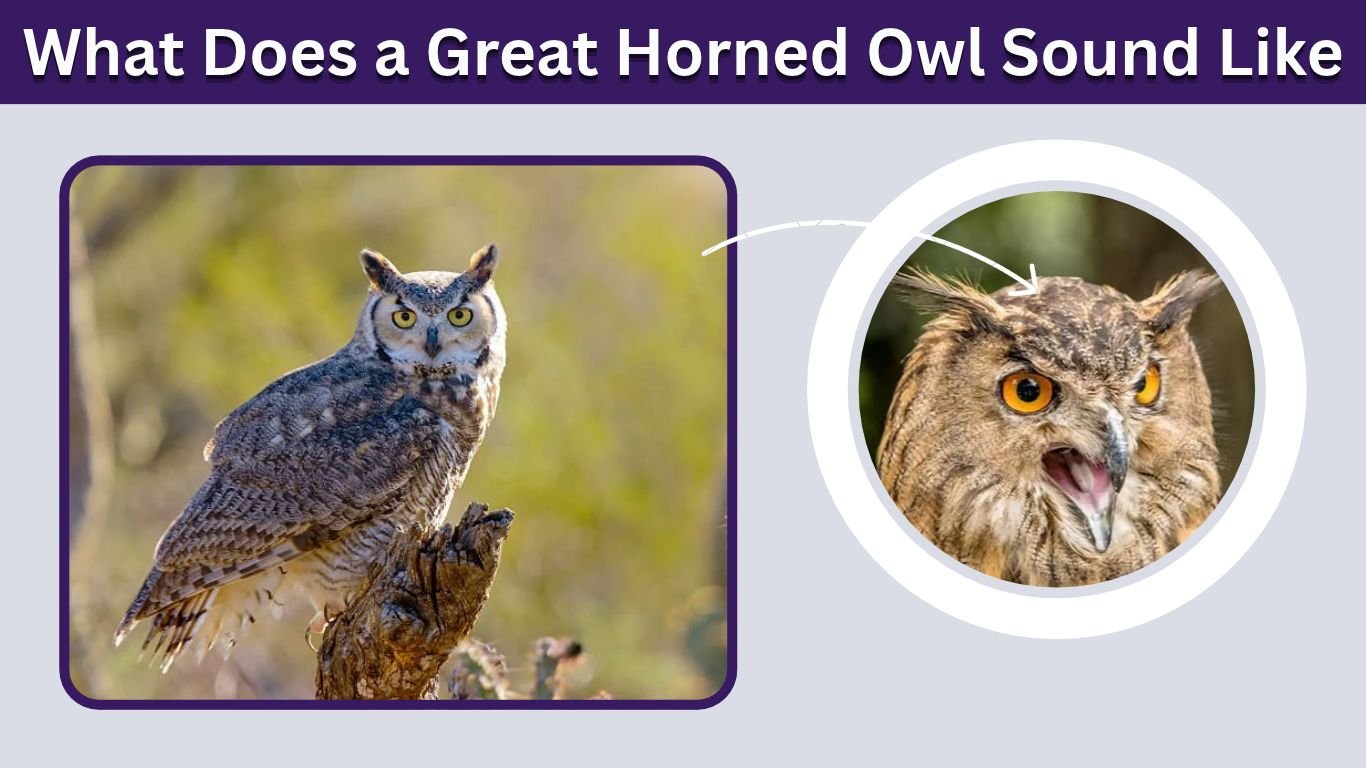
What does a great horned owl sound like? The great horned owl produces deep, rhythmic hoots that often echo through forests, fields, and neighborhoods at night. Its familiar call sounds like a series of low “hoo-hoo” notes, but these powerful birds make many other noises, including screams, barks, hisses, and squawks. Their vocalizations help them communicate with mates, defend territories, and protect their young. Learning to recognize great horned owl sounds can help birdwatchers identify these mysterious nocturnal predators even when they remain hidden.
What Does a Great Horned Owl Sound Like?
The great horned owl (Bubo virginianus) is famous for its deep, resonant hooting. Its familiar territorial call usually contains four or five notes arranged in a distinctive, uneven rhythm. The sound can carry considerable distances, especially during quiet evenings. Although hooting is its most recognizable vocalization, the species produces many other calls depending on its behavior and surroundings.
What Does a Great Horned Owl Hoot Sound Like?
A typical great horned owl hoot can be represented as:
“Hoo-h’HOO-hoo-hoo.”
The notes are low, rounded, and slightly uneven, with one note receiving stronger emphasis. Individual owls vary in their rhythm and number of notes.
These calls are often described as deep and hollow, somewhat resembling a distant foghorn.
How Loud Is a Great Horned Owl?
Great horned owl hoots can travel across wooded landscapes and open areas. Their low-pitched calls remain recognizable even when the bird is some distance away.
The apparent loudness depends on distance, wind, background noise, and the surrounding environment. Screams and alarm calls may sound considerably sharper than ordinary hooting.
6 Types of Great Horned Owl Sounds and Their Meanings
Great horned owls possess a surprisingly diverse collection of vocalizations. While many people associate them exclusively with hooting, they also produce sounds that resemble screams, barks, and hisses. Different calls communicate territorial ownership, courtship, distress, or defensive behavior.
Common Great Horned Owl Vocalizations
- Territorial hoots: Deep, rhythmic calls used to advertise territory and communicate with other owls. These are the familiar sounds most people recognize.
- Screams: High-pitched, piercing cries produced during stressful situations, nest defense, or food begging by young owls.
- Barking calls: Short, sharp sounds resembling rough animal barks. Adults may produce them when disturbed or threatened.
- Hissing sounds: Harsh, breathy noises associated with defensive behavior, particularly when an owl feels threatened.
- Squawks and chitters: Irregular, sometimes rapid vocalizations used in different social interactions, including communication between paired birds.
- Bill snapping: Sharp clicking or clacking noises made by rapidly closing the beak. This defensive behavior can occur when potential threats approach.
What Does a Great Horned Owl Sound Like at Night?
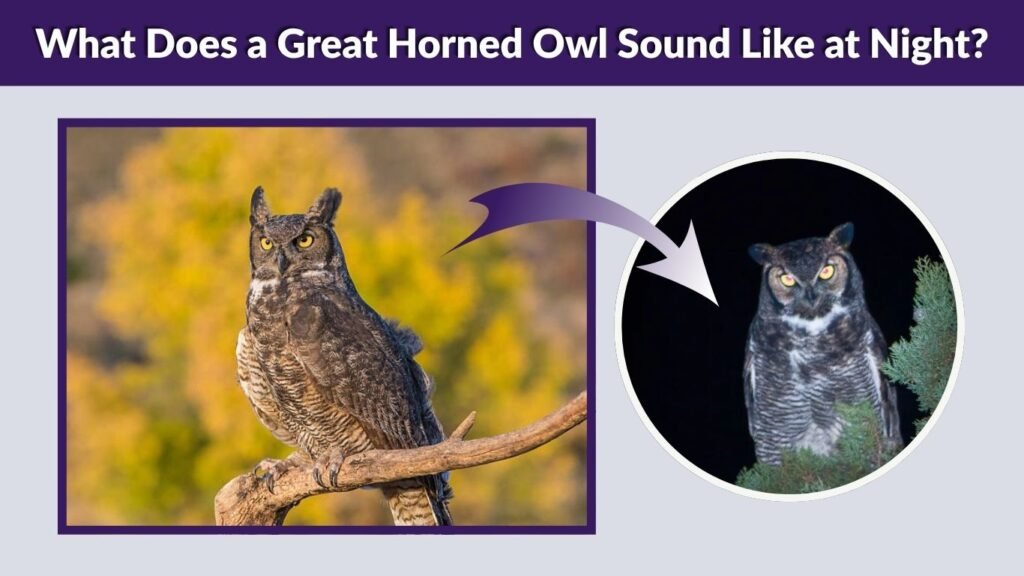
Great horned owls are primarily nocturnal, making nighttime the most familiar period for hearing their calls. Their distinctive hooting frequently becomes noticeable shortly after sunset or before sunrise. However, these birds do not call continuously throughout the night.
Why Do Great Horned Owls Hoot at Night?
Great horned owls use their calls to establish territories, maintain contact with mates, and communicate during breeding activities.
A male may hoot repeatedly from a prominent perch to advertise his presence. Nearby owls sometimes respond, creating exchanges of calls across the landscape.
These vocal interactions can help individuals recognize neighboring birds and maintain territorial boundaries.
When Are Great Horned Owls Most Vocal?
Great horned owls often become particularly vocal around dusk and before dawn.
Calling activity can increase during courtship and early breeding periods, frequently beginning in autumn or winter depending on the region.
Although they are generally nocturnal, occasional daytime vocalizations also occur.
Male vs Female Great Horned Owl Sounds
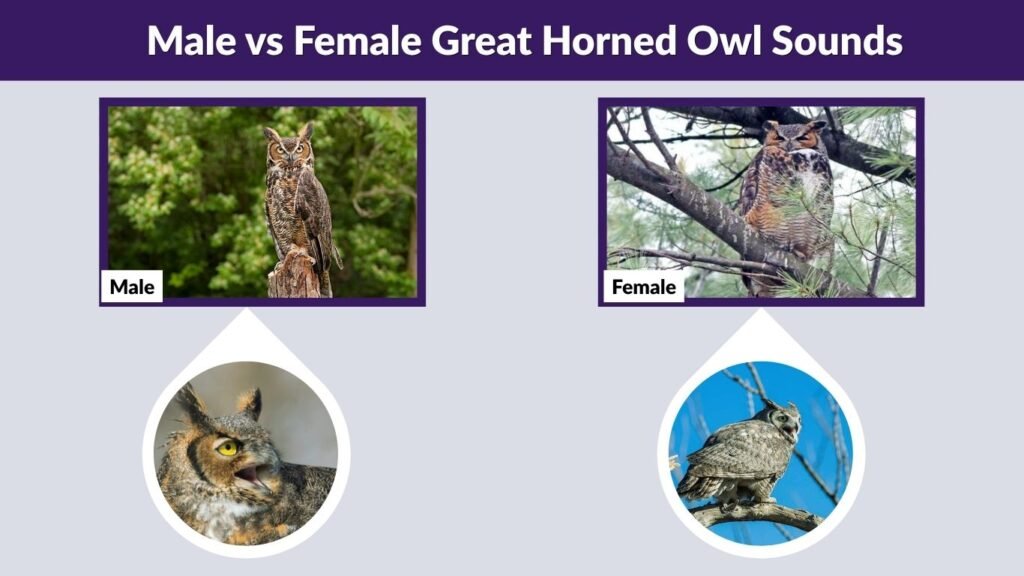
Male and female great horned owls produce similar territorial hoots, but their voices differ in pitch. Recognizing this distinction can help listeners understand whether one or two owls are calling nearby.
Male Great Horned Owl Call
Male great horned owls typically produce deeper, lower-pitched hoots.
Their calls often sound mellow and resonant, with a rhythmic sequence of several notes. Males use these vocalizations during territorial advertisement and interactions with their mates.
Female Great Horned Owl Call
Female great horned owls generally produce higher-pitched hoots than males.
During courtship, a male and female may alternate their calls in a vocal duet. The contrast between their voices helps listeners distinguish the two birds even when neither is visible.
Females can also produce loud screams and other defensive vocalizations.
What Does a Baby Great Horned Owl Sound Like?
Baby great horned owls sound quite different from adults. Instead of producing the familiar low hoots, young owls communicate through weak chirps, whimpering noises, and increasingly loud begging calls. Their vocalizations change considerably as they develop.
Newly Hatched Great Horned Owl Sounds
Newly hatched owlets produce quiet, rasping chirps and soft whimpering sounds.
As they grow, their voices become stronger and more noticeable. These early vocalizations help the young communicate their needs to their parents.
Juvenile Great Horned Owl Screams
Juvenile great horned owls frequently produce loud, piercing begging screams.
These calls may sound similar to a harsh whistle or a high-pitched screech. Young birds use them to request food from their parents, sometimes long after leaving the nest.
Young males may begin practicing adult-like hooting during their first winter.
Do Great Horned Owls Sound Like Cats, Dogs, or Ghosts?
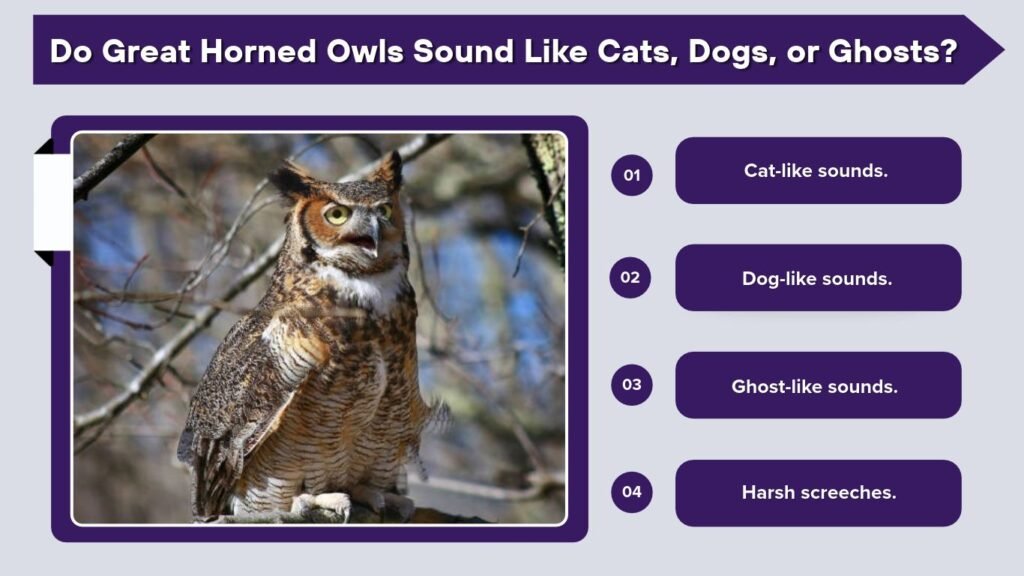
Not every great horned owl sound resembles the familiar deep hoot. Their less common vocalizations sometimes remind listeners of other animals or strange nighttime noises.
These similarities can make identification confusing, particularly when the owl remains hidden in dense vegetation.
Sounds That Can Be Confusing
- Cat-like sounds: Some squawks, wavering cries, and chittering calls can resemble meowing or distressed cats.
- Dog-like sounds: Short, sharp barking calls may sound similar to a small dog barking from a distance.
- Ghost-like sounds: Long, piercing screams can create an eerie, haunting impression during quiet nights.
- Harsh screeches: Young owls begging for food may sound more like screaming birds than typical hooting owls.
However, these similarities are subjective. A familiar animal-like noise alone cannot reliably confirm the presence of a great horned owl.
Great Horned Owl vs Other Owl Sounds
Several North American owl species produce calls that can be confused with those of great horned owls. However, their pitch, rhythm, and vocal patterns often differ. Recognizing these characteristics helps birdwatchers identify owls more accurately without seeing them.
Common Owl Sound Differences
- Great horned owl: Deep, slow, uneven hooting, usually consisting of four or five notes.
- Barred owl: A longer, distinctive hooting pattern often remembered as “Who cooks for you?”
- Eastern screech-owl: A descending whinny or soft, trembling trill rather than traditional deep hoots.
- Long-eared owl: Repeated low hoots, often more evenly spaced and less complex than great horned owl calls.
How to Identify a Great Horned Owl by Sound
Identifying a great horned owl requires attention to its call pattern, pitch, and surroundings. These birds often remain concealed during the day, making their nighttime vocalizations especially valuable for identification.
5 Helpful Identification Tips
- Listen for deep hoots: The territorial call typically sounds low, hollow, and resonant.
- Count the notes: Listen for approximately four or five hoots with an uneven rhythm.
- Notice alternating voices: A deeper male and higher-pitched female may exchange calls.
- Pay attention to timing: Hooting is frequently heard around dusk and before sunrise.
- Compare recordings: Listen to verified examples from Cornell Lab of Ornithology or the International Owl Center.
Avoid approaching active nests or playing repeated recordings to provoke responses, particularly during the breeding season.
What Does a Great Horned Owl Look Like?
Recognizing the bird’s physical appearance can help confirm an identification made by sound. Great horned owls are large, powerful birds with conspicuous feather tufts, broad wings, and striking facial features.
Physical Identification Features
Adult great horned owls have bright yellow eyes, prominent ear tufts, mottled gray-brown feathers, and a white throat patch. Their coloration helps them blend into tree bark and surrounding vegetation.
Young owls often appear fluffier and paler than adults. Their characteristic ear tufts become more noticeable as they mature.
FAQs
1. What Does a Great Horned Owl Sound Like at Night?
A great horned owl typically produces deep, rhythmic hoots at night. Its familiar territorial call contains approximately four or five notes with an uneven rhythm. These sounds are commonly heard around sunset, before sunrise, and during courtship activities.
2. Does a Great Horned Owl Sound Like a Cat?
Sometimes. Great horned owls produce various squawks, chitters, and wavering cries that listeners may interpret as cat-like sounds. However, their usual territorial hooting sounds quite different. Cat-like noises alone are not enough to identify the bird reliably.
3. What Does a Baby Great Horned Owl Sound Like?
Baby great horned owls initially produce soft chirps and whimpering sounds. As they develop, their begging calls become louder and sharper. Older juveniles often make piercing screams while requesting food from their parents, sometimes continuing after leaving the nest.
4. Why Do Great Horned Owls Hoot Repeatedly?
Great horned owls hoot to advertise territory, communicate with mates, and interact with nearby owls. Repeated calling is especially noticeable during courtship and breeding periods. Mated pairs may exchange alternating hoots, creating recognizable nighttime vocal duets.
5. Can Great Horned Owls Scream Instead of Hooting?
Yes. Great horned owls can produce loud screams, particularly when defending nests or responding to threats. Juvenile owls also make piercing begging screams. Their vocal repertoire includes barking, squawking, hissing, and bill snapping in addition to familiar territorial hoots.