
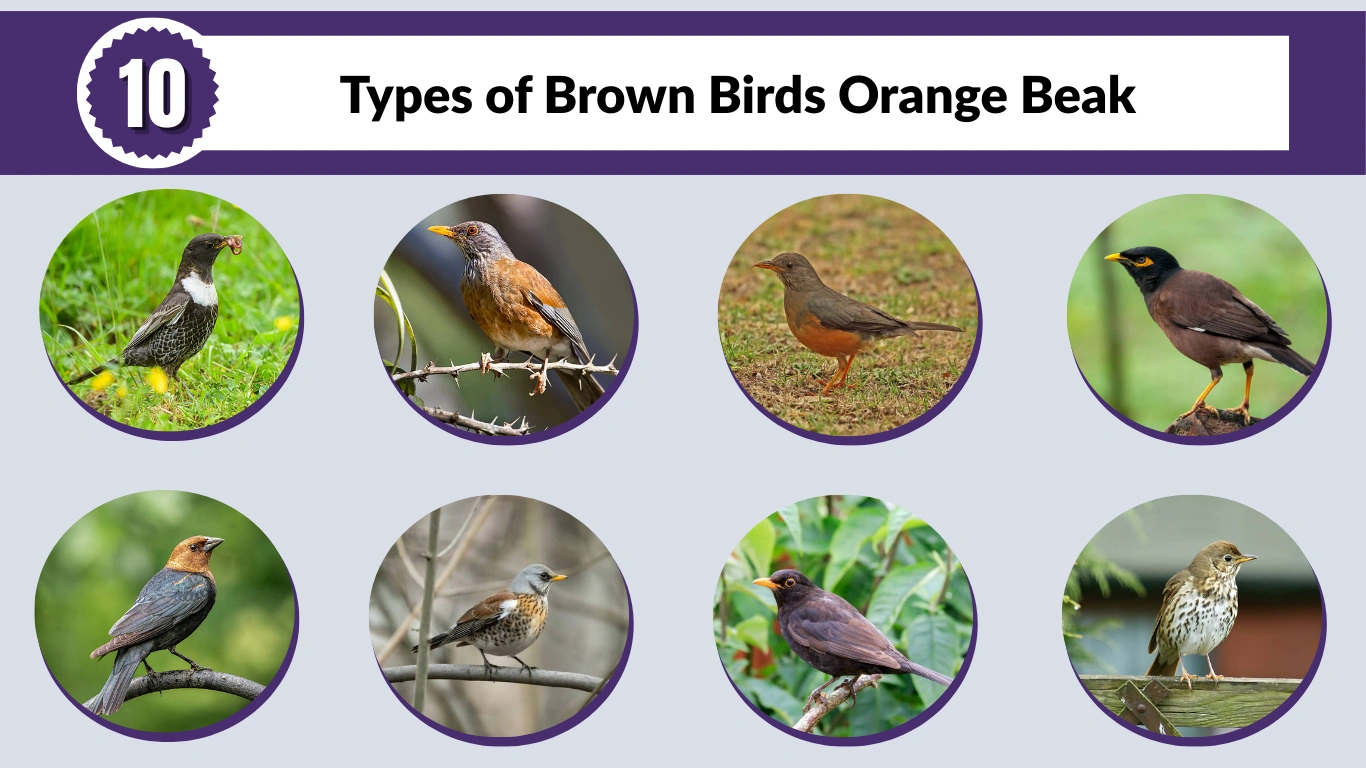
Brown birds with orange beaks are easy to recognize because their soft, earthy plumage contrasts beautifully with their bright, warm-colored bills. These birds are found in many parts of the world, from quiet forests and open farmlands to busy city gardens and parks. Many belong to the thrush family and are well known for their sweet, melodious songs. In this guide, you’ll discover ten fascinating types of brown birds that feature eye-catching orange beaks.
1. Eurasian Blackbird (Turdus merula)
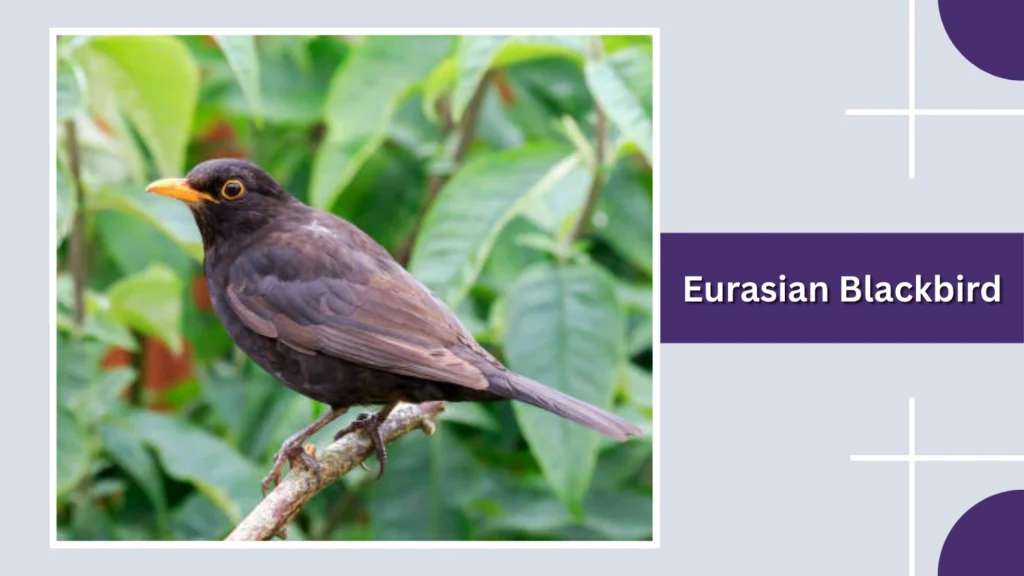
The Eurasian Blackbird is a well-known brown bird with a bright orange to yellow-orange beak, commonly found across Europe, Asia, and parts of North Africa. Although adult males appear jet black, females and juveniles are rich brown, making them a perfect example of a brown bird with an orange beak. This species is famous for its beautiful, flute-like song and its ability to adapt easily to gardens, parks, and forests.
Identification
- Brown to dark brown body (females and juveniles)
- Bright orange to yellow-orange beak
- Yellow eye-ring in adults
- Medium-sized thrush with a long tail
- Length about 23–29 cm (9–11 inches)
Habitat and Range
Eurasian Blackbirds live in woodlands, gardens, city parks, farmland edges, and hedgerows. Their range stretches across most of Europe, western and central Asia, and North Africa, and they have also been introduced to Australia and New Zealand.
Diet and Feeding Behavior
They mainly feed on insects, earthworms, berries, fruits, and seeds. Eurasian Blackbirds are often seen hopping on the ground, listening carefully before pulling worms from the soil, especially early in the morning or after rainfall.
Behavior and Song
This bird is best known for its rich, melodious song, often heard at dawn and dusk. Males sing from rooftops, treetops, or other high perches to defend territory and attract mates, while both sexes can become very territorial during breeding season.
Breeding and Nesting
Eurasian Blackbirds build cup-shaped nests from grass, mud, and fine plant material. The female lays 3–5 eggs, and both parents help feed the chicks. In warm regions, they may raise two or even three broods in a single year.
2. Song Thrush (Turdus philomelos)
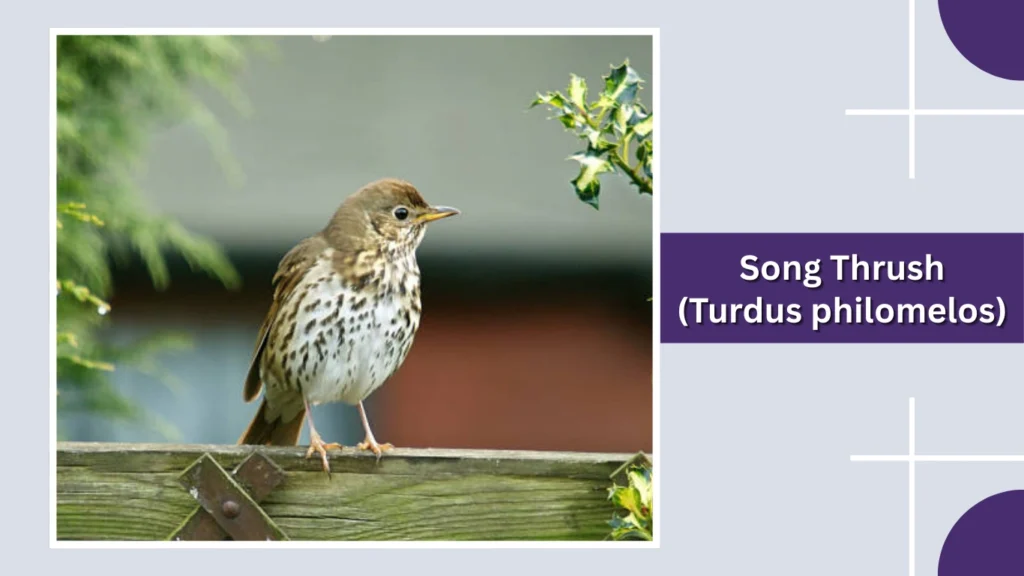
The Song Thrush is a brown, spotted bird with a warm orange-brown beak that is widely found across Europe and parts of Asia. It is especially famous for its loud, repetitive, and musical song. With its rich brown upperparts and lighter underparts, the Song Thrush fits perfectly among brown birds that show orange tones on the beak.
Identification
- Warm brown upperparts with creamy underparts
- Dark arrow-shaped spots on chest and belly
- Yellow-orange to orange-brown beak
- Medium-sized thrush with a rounded head
- Length about 20–23 cm (8–9 inches)
Habitat and Range
Song Thrushes live in woodlands, gardens, parks, hedgerows, and farmland areas. Their range covers most of Europe, western Asia, and parts of North Africa, and many populations migrate south during winter.
Diet and Feeding Behavior
They feed on insects, earthworms, snails, berries, and fruits. Song Thrushes are well known for breaking snail shells against stones, often using the same “anvil” repeatedly.
Behavior and Song
The Song Thrush’s song is powerful and flute-like, with repeated phrases that make it easy to recognize. Males often sing from high perches, especially early in the morning and after rain.
Breeding and Nesting
They build neat, mud-lined cup nests in shrubs, trees, or hedges. The female usually lays 4–5 eggs, and both parents care for the chicks until they are ready to leave the nest.
3. Fieldfare (Turdus pilaris)
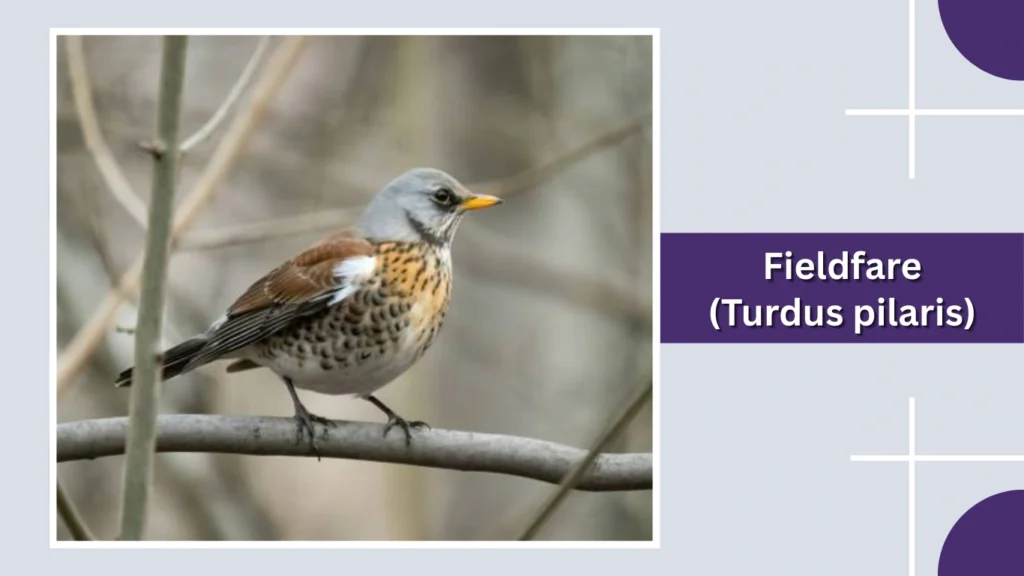
The Fieldfare is a striking thrush with a brown back and wings, a gray head, and a noticeable orange-yellow beak. It is commonly seen across Europe and northern Asia, especially in open fields, farmlands, and woodland edges. During winter, Fieldfares often gather in large flocks, making them easy to spot.
Identification
- Brown back and wings with a gray head and rump
- Heavily spotted breast
- Orange-yellow beak with a darker tip
- Medium to large thrush with long wings
- Length about 24–27 cm (9.5–10.5 inches)
Habitat and Range
Fieldfares breed in northern Europe and Asia, favoring open woodland, forest edges, and farmland with scattered trees. In winter, they migrate south and are commonly found in fields, orchards, parks, and hedgerows.
Diet and Feeding Behavior
Their diet includes insects, worms, berries, and fallen fruit. In colder months, berries such as rowan and hawthorn become especially important food sources.
Behavior and Social Life
Fieldfares are more social than many other thrushes. They often forage in noisy flocks and will aggressively mob predators, sometimes diving at them together to protect nesting areas.
Breeding and Nesting
They build cup-shaped nests in trees or bushes. The female lays 4–6 eggs, and both parents take part in feeding the young until they fledge.
4. Brown-headed Cowbird (Molothrus ater)
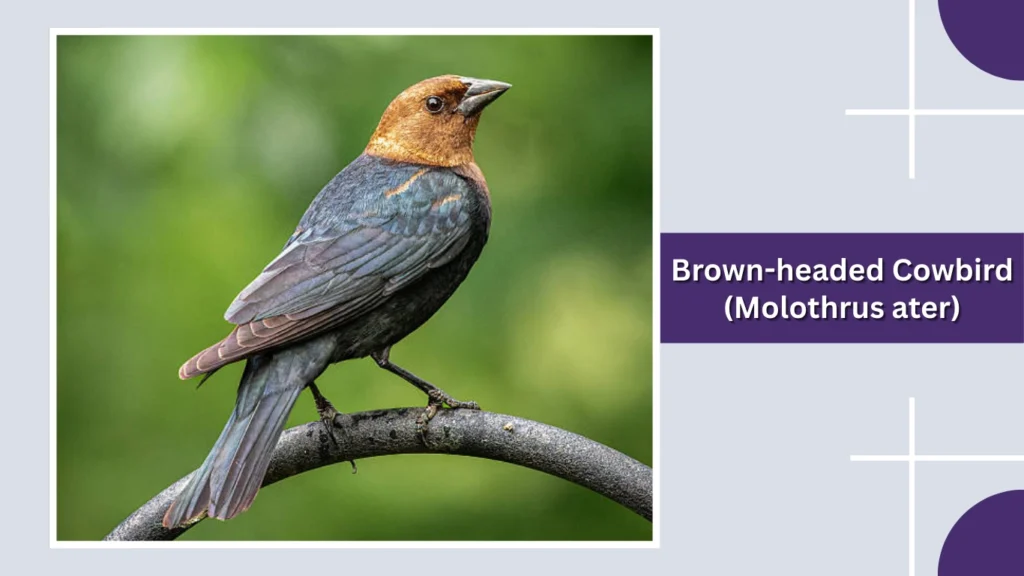
The Brown-headed Cowbird is a small, stocky bird known for its brown head and contrasting dark body, along with a short, thick beak that often appears yellow-orange in breeding males and many juveniles. It is native to North America and is commonly seen around open fields, farmland, and suburban areas, often near grazing animals.
Identification
- Brown head with darker body (adult males); overall brownish in females
- Short, conical orange-tinged beak
- Red-brown eyes
- Compact body with a short tail
- Length about 15–20 cm (6–8 inches)
Habitat and Range
Brown-headed Cowbirds are found across most of North America. They prefer open habitats such as grasslands, agricultural fields, forest edges, and city parks, often following livestock or feeding near human settlements.
Diet and Feeding Behavior
They eat seeds, grains, insects, and other small invertebrates. Cowbirds are usually seen foraging on the ground, sometimes mixing with blackbirds and starlings in feeding flocks.
Behavior and Lifestyle
This species is famous for brood parasitism—females lay their eggs in the nests of other birds, leaving the host parents to raise the chicks. They are social birds and often gather in large mixed flocks outside the breeding season.
Breeding and Reproduction
Instead of building their own nests, females place eggs in the nests of over 200 different bird species. The cowbird chick often hatches earlier and grows faster, sometimes outcompeting the host’s young.
5. Common Myna (Acridotheres tristis)
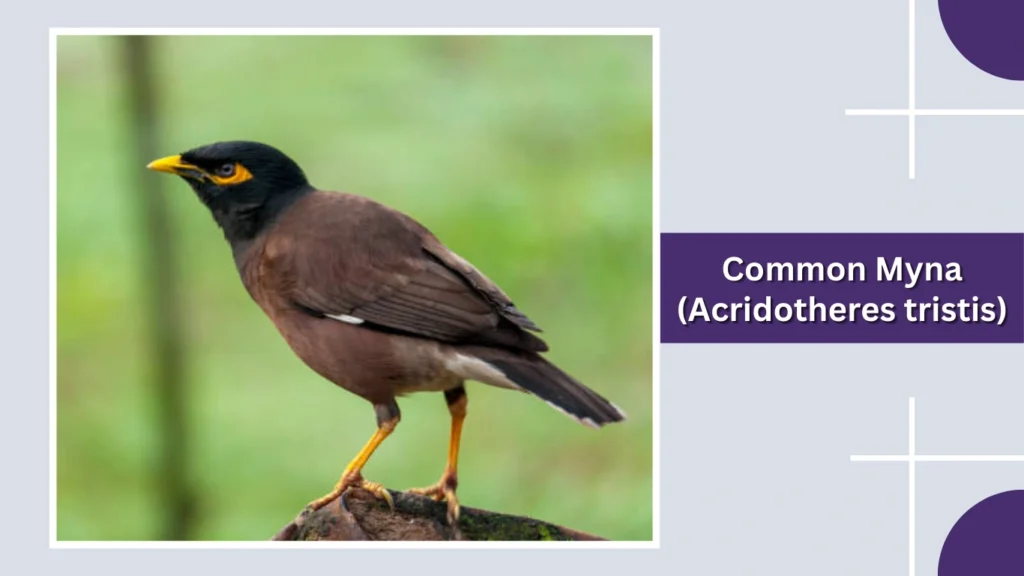
The Common Myna is a bold, intelligent brown bird with a bright orange to yellow-orange beak, widely found across South Asia and introduced to many other regions. It is especially familiar in towns and cities, where it confidently walks on the ground and perches on buildings, wires, and trees.
Identification
- Dark brown body with a blackish head
- Bright orange to yellow-orange beak
- Yellow eye patch and legs
- White wing patches visible in flight
- Length about 23–26 cm (9–10 inches)
Habitat and Range
Common Mynas thrive in open woodlands, farmland, parks, gardens, and urban areas. Native to the Indian subcontinent, they are now established in parts of Southeast Asia, the Middle East, Australia, and many Pacific islands.
Diet and Feeding Behavior
They are omnivorous, eating insects, fruit, seeds, kitchen scraps, and even small reptiles. Common Mynas often forage on the ground and are frequent visitors to markets and human settlements.
Behavior and Social Traits
Highly vocal and social, Common Mynas live in pairs or noisy groups. They are known for mimicking sounds and aggressively defending feeding and nesting sites.
Breeding and Nesting
They nest in tree holes, building crevices, and nest boxes. The female lays 3–6 eggs, and both parents share incubation and chick-feeding duties.
6. Clay-colored Thrush (Turdus grayi)
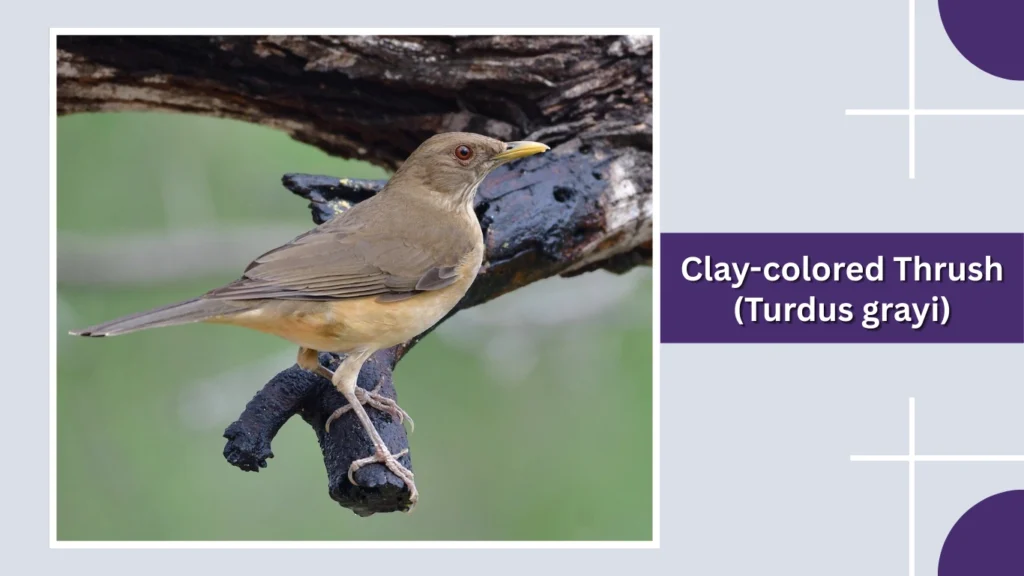
The Clay-colored Thrush is a medium-sized brown bird with a soft orange to yellow-orange beak, best known as the national bird of Costa Rica. Its plain brown appearance and warm-toned bill make it a classic example of a brown bird with an orange beak. It is often heard singing before it is seen.
Identification
- Plain brown to gray-brown body
- Pale throat and belly
- Orange to yellow-orange beak
- Dark eyes with a faint eye-ring
- Length about 22–25 cm (8.5–10 inches)
Habitat and Range
This thrush lives in open woodlands, gardens, plantations, forest edges, and urban areas. Its range extends from southern Texas through Central America to northern South America.
Diet and Feeding Behavior
Clay-colored Thrushes feed on insects, earthworms, berries, and small fruits. They usually forage on the ground, flipping leaves and probing soil for hidden prey.
Behavior and Song
They are especially known for their loud, rich dawn song, which can echo through neighborhoods and forest edges. These birds are often solitary or found in pairs.
Breeding and Nesting
They build cup-shaped nests in trees, shrubs, or on building ledges. The female lays 2–4 eggs, and both parents help feed and protect the young.
7. Rufous-backed Robin (Turdus rufopalliatus)
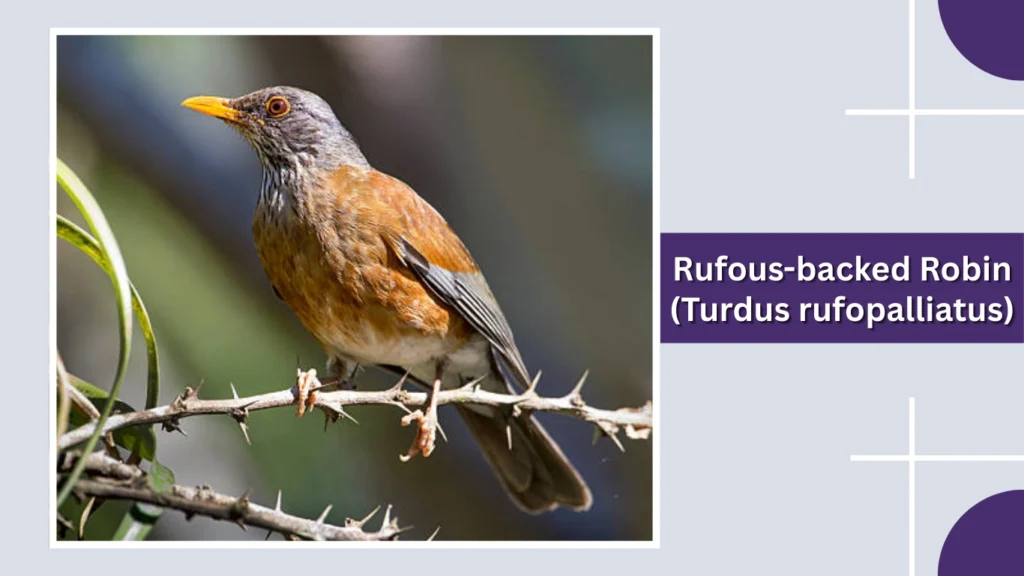
The Rufous-backed Robin is a warm-toned thrush with a brownish body, a rich rufous back, and a bright orange-yellow beak. Native to western Mexico, this attractive bird is often seen hopping on the ground in gardens, open woodlands, and town edges, where it searches for food.
Identification
- Brownish-gray head and underparts
- Distinct rufous-orange back and shoulders
- Orange to yellow-orange beak
- Dark eyes with a pale eye-ring
- Length about 23–24 cm (9–9.5 inches)
Habitat and Range
Rufous-backed Robins inhabit open forests, forest edges, parks, and suburban gardens. Their main range is western Mexico, but some individuals wander into the southwestern United States.
Diet and Feeding Behavior
They feed on insects, spiders, earthworms, berries, and small fruits. Most feeding happens on the ground, where they run, pause, and then pick up prey.
Behavior and Vocalizations
Males are strong singers and often perform from exposed perches. They are territorial during the breeding season and can become aggressive toward intruders.
Breeding and Nesting
Nests are cup-shaped and placed in trees or shrubs. The female lays 2–4 eggs, and both parents are involved in raising the chicks.
8. Olive Thrush (Turdus olivaceus)
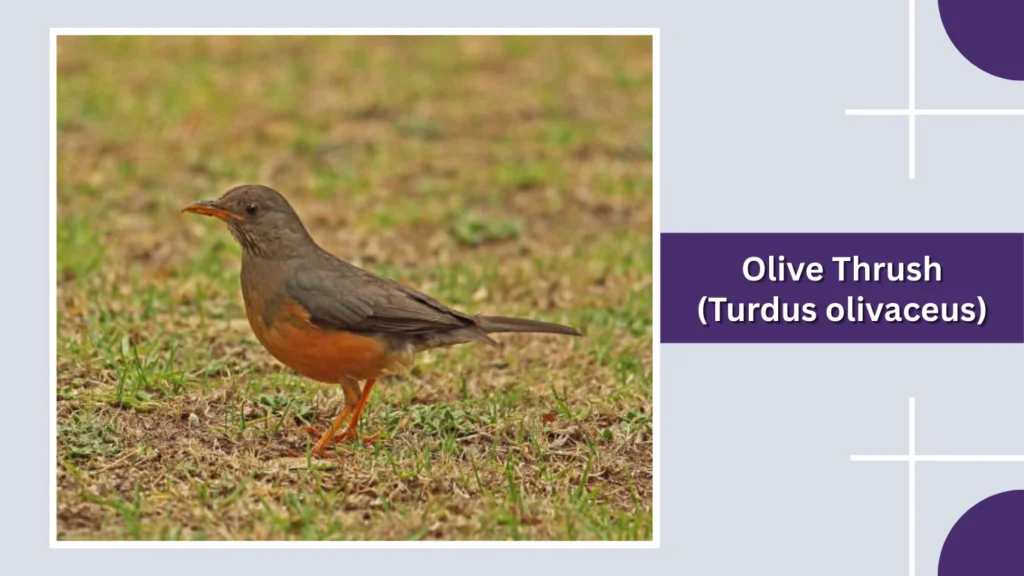
The Olive Thrush is a brownish bird with olive tones and a bright orange beak, native to sub-Saharan Africa. It is often heard singing rich, melodious songs from trees before it is noticed moving quietly on the ground.
Identification
- Olive-brown upperparts with paler underparts
- Orange to yellow-orange beak
- Orange eye-ring
- Medium-sized thrush with a long tail
- Length about 23–25 cm (9–10 inches)
Habitat and Range
Olive Thrushes live in forests, woodland edges, gardens, and urban parks across much of southern and eastern Africa. They adapt well to human-modified environments.
Diet and Feeding Behavior
They eat insects, worms, snails, and a wide range of fruits and berries. Foraging usually happens on the ground, where they search leaf litter for hidden prey.
Behavior and Song
This species is well known for its beautiful, fluting song, commonly heard at dawn and dusk. They are usually solitary or found in pairs.
Breeding and Nesting
They build sturdy cup nests in trees or shrubs. The female lays 2–3 eggs, and both parents help incubate and feed the young.
9. Ring Ouzel (Turdus torquatus)
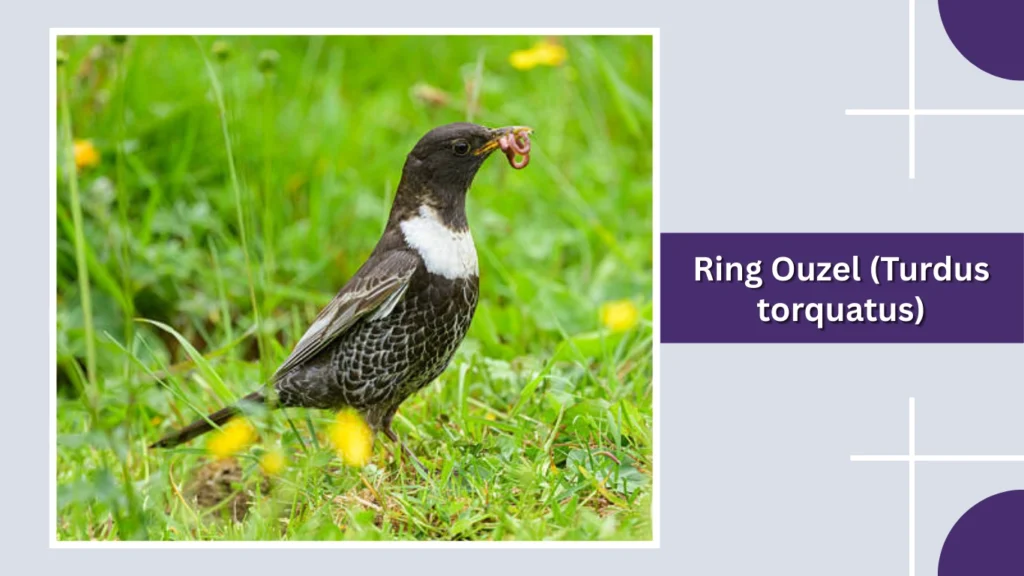
The Ring Ouzel is a dark brown to blackish thrush with a bold white chest band and a bright orange-yellow beak. Although darker than many brown birds, females and juveniles are noticeably brown, fitting well into the group of brown birds with orange beaks. It is often seen in upland and mountainous areas.
Identification
- Dark brown to blackish body with a white chest crescent
- Females and juveniles are browner
- Orange-yellow beak
- Pale-edged feathers giving a scaly look
- Length about 23–24 cm (9–9.5 inches)
Habitat and Range
Ring Ouzels breed in mountainous regions of Europe and western Asia and winter in southern Europe and North Africa. They favor rocky slopes, heaths, and open upland areas.
Diet and Feeding Behavior
They eat insects, worms, snails, and berries. During autumn, berries become a major food source and are important for migration.
Behavior and Lifestyle
Ring Ouzels are shy and alert birds. Males sing from prominent rocks or treetops, producing a rich, thrush-like song.
Breeding and Nesting
They build nests in low shrubs, rocky crevices, or banks. The female lays 3–5 eggs, and both parents care for the chicks until fledging.
10. Tawny Thrush (Turdus obsoletus)
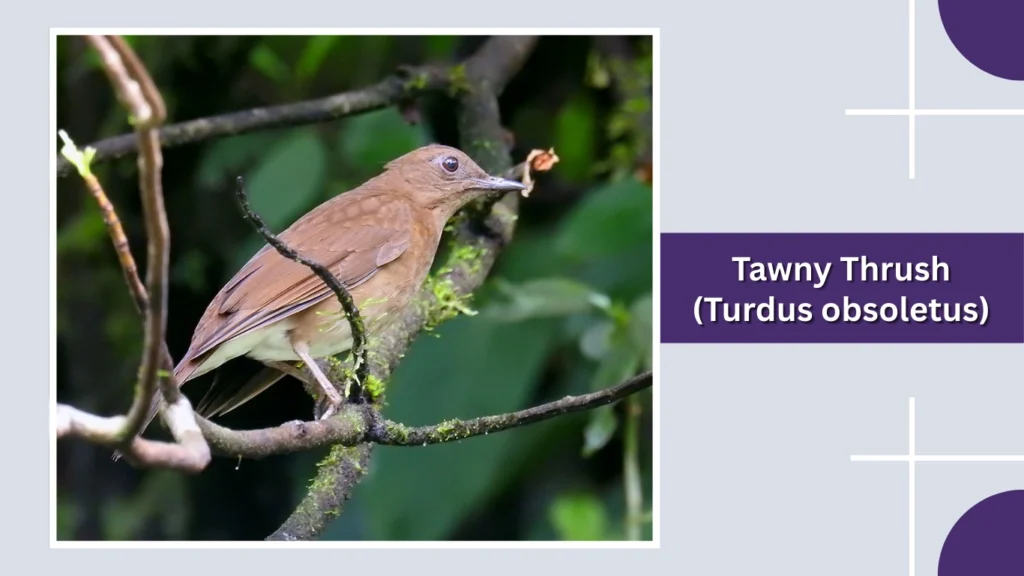
The Tawny Thrush is a warm brown forest thrush with an orange-yellow beak, native to East Asia. Its soft brown plumage and gentle behavior make it a classic brown bird with an orange beak. It is often seen quietly hopping along the forest floor, especially in shaded woodland areas.
Identification
- Uniform tawny-brown upperparts
- Paler underparts with faint spotting
- Orange-yellow beak
- Dark eyes with a subtle eye-ring
- Length about 21–23 cm (8–9 inches)
Habitat and Range
Tawny Thrushes inhabit dense forests, woodland edges, and mountain woodlands. They are found mainly in China, Korea, Japan, and parts of Southeast Asia, with some populations migrating seasonally.
Diet and Feeding Behavior
Their diet includes insects, earthworms, berries, and fallen fruits. They forage mostly on the ground, turning over leaves to locate hidden prey.
Behavior and Song
This species is shy and usually solitary. Its song is soft, flute-like, and often heard during early morning hours in breeding territories.
Breeding and Nesting
They build cup-shaped nests in shrubs or low trees. The female typically lays 3–4 eggs, and both parents take part in feeding and protecting the chicks.
FAQs
What are common features of brown birds with orange beaks?
Brown birds with orange beaks usually have earthy-toned feathers that help them blend into forests and gardens, while the bright beak stands out clearly. The orange color often signals health and maturity and is common in thrushes, mynas, and blackbirds.
Are brown birds with orange beaks found worldwide?
Yes, brown birds with orange beaks are found on almost every continent. Species such as the Eurasian Blackbird live in Europe and Asia, Common Mynas in South Asia, Olive Thrushes in Africa, and Clay-colored Thrushes in Central America.
Why do some brown birds have orange beaks?
Orange beaks are often linked to diet and breeding health. Pigments from fruits and other foods can influence beak color, and brighter beaks may help attract mates or signal strength to rivals.
Do brown birds with orange beaks migrate?
Some species migrate, while others stay year-round. For example, Fieldfares and Ring Ouzels migrate seasonally, but Common Mynas and Eurasian Blackbirds in mild climates often remain in the same areas throughout the year.
Are brown birds with orange beaks good for gardens?
Yes, many of them are excellent garden birds. They eat insects, worms, and pests, helping control populations naturally. Species like the Eurasian Blackbird and Song Thrush are especially welcomed by gardeners.
