

The Golden Eagle (Aquila chrysaetos) is one of the most powerful and widely distributed birds of prey in the world. Recognized by its dark brown plumage and golden feathers on the back of its head and neck, this magnificent raptor inhabits mountains, grasslands, and open landscapes across North America, Europe, Asia, and parts of North Africa. With exceptional eyesight, impressive hunting skills, and a massive wingspan, the Golden Eagle has become a symbol of strength and freedom in many cultures throughout history.
What Is a Golden Eagle?
The Golden Eagle is a large bird of prey belonging to the family Accipitridae. It is considered one of the world’s most successful eagle species due to its adaptability and powerful hunting abilities. Found across the Northern Hemisphere, this eagle occupies vast territories and plays an important role as a top predator within many ecosystems.
Species Overview
The Golden Eagle is known for its dark brown body and distinctive golden-colored feathers around the crown and neck. Adult birds are powerful hunters capable of capturing a variety of prey. Their impressive flight skills allow them to soar for hours while searching for food across extensive hunting territories.
Golden Eagle Scientific Name
The scientific name of the Golden Eagle is Aquila chrysaetos. The genus Aquila refers to true eagles, while chrysaetos comes from Greek words meaning “golden eagle.” This scientific classification reflects the bird’s distinctive appearance and its position among the world’s most powerful raptors.
How to Identify a Golden Eagle

Golden Eagles possess several distinctive features that help birdwatchers and wildlife enthusiasts identify them. Their large size, broad wings, and golden head feathers make them stand out among other birds of prey. Understanding these characteristics can make field identification much easier.
Physical Appearance
Adult Golden Eagles have dark brown feathers covering most of their body. The back of the head and neck displays a golden-brown sheen that gives the species its common name. Their strong hooked beak and powerful talons are perfectly adapted for hunting mammals and birds.
Golden Eagle Size
Golden Eagles rank among the largest eagle species in the world.
Key size measurements include:
- Length: 66–102 cm (26–40 inches)
- Weight: 3–7 kg (6.6–15.4 pounds)
- Females larger than males
- Body built for strength and endurance
Their large size enables them to capture prey significantly larger than many other birds of prey can handle.
Golden Eagle Wingspan
One of the eagle’s most impressive features is its broad wingspan. These wings provide excellent lift and allow the bird to soar efficiently over mountainous and open landscapes.
Typical wingspan measurements include:
- Average wingspan: 1.8–2.3 meters
- Maximum wingspan: Up to 2.4 meters
- Long, broad wings for soaring
- Excellent gliding capabilities
This wingspan helps Golden Eagles conserve energy while covering large distances in search of prey.
Golden Eagle Habitat
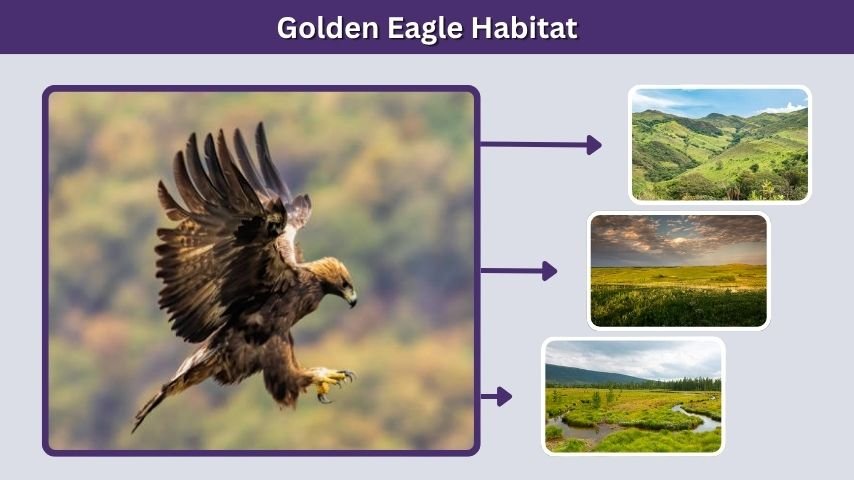
Golden Eagles thrive in environments that provide open hunting grounds and secure nesting locations. Their habitat preferences vary slightly across regions, but they generally favor landscapes with limited human disturbance and abundant prey populations.
Preferred Habitats
Golden Eagles are commonly found in mountainous regions, cliffs, grasslands, tundra, and open countryside. These environments provide excellent visibility for locating prey and suitable locations for nesting. Large, undeveloped areas are especially important because Golden Eagles require extensive territories.
Habitat Requirements
Successful Golden Eagle habitats must provide adequate food sources and safe nesting opportunities. Cliffs, rocky outcrops, and tall trees are often used as nesting sites. Areas with healthy populations of rabbits, hares, and other small mammals are particularly attractive to breeding pairs.
Geographic Distribution
The Golden Eagle has one of the broadest distributions of any eagle species. It occurs throughout North America, Europe, Asia, and parts of North Africa. Some populations remain resident throughout the year, while others migrate seasonally depending on weather conditions and prey availability.
Golden Eagle Range and Migration
The Golden Eagle occupies a vast geographic range that spans multiple continents. Its ability to adapt to different climates and habitats contributes to its widespread distribution. Understanding its range helps explain why the species remains one of the most successful raptors in the world.
Global Range
Golden Eagles can be found across much of the Northern Hemisphere. Populations occur in countries including the United States, Canada, Scotland, Spain, Norway, Mongolia, China, and Kazakhstan. Despite regional differences, most populations require large open areas for hunting and nesting.
Seasonal Migration
Migration patterns vary according to location. Eagles living in northern regions often move south during winter when food becomes scarce or weather conditions become severe. Birds in milder climates may remain within the same territory year-round.
Important migration facts include:
- Northern populations migrate farther south
- Young birds travel longer distances than adults
- Migration occurs mainly during autumn and spring
- Weather influences migration timing
Range Expansion and Changes
Population trends differ across regions. Conservation efforts have helped stabilize some populations, while habitat loss and human activities continue to affect others. Monitoring programs help researchers understand changes in distribution and population size over time.
Golden Eagle Diet and Hunting Behavior

The Golden Eagle is a highly skilled predator capable of capturing a wide variety of prey. Its exceptional eyesight, speed, and powerful talons make it one of the most effective hunters among birds of prey. As an apex predator, it plays an important role in maintaining ecological balance throughout its range.
What Do Golden Eagles Eat?
Golden Eagles primarily feed on mammals and birds, although their diet varies depending on local prey availability.
Common prey species include:
- Rabbits
- Hares
- Ground squirrels
- Marmots
- Small deer
- Game birds
These prey items provide the energy needed to support the eagle’s active lifestyle and large territory requirements.
Golden Eagle Hunting Techniques
Golden Eagles are among the most skilled hunters in the bird world. Their remarkable eyesight allows them to detect prey from great distances, while their speed and agility help them launch precise attacks. These abilities make them highly effective predators in a variety of habitats.
Hunting Methods
Golden Eagles use several hunting strategies depending on terrain and prey type. They often soar high above open landscapes before diving toward a target. In mountainous areas, they may use cliffs and ridges to approach prey unnoticed.
Common hunting techniques include:
- High-altitude soaring
- Low-level surprise attacks
- Pursuit flights
- Ambush hunting
- Cooperative hunting by pairs
These methods help increase hunting success while conserving energy.
Hunting Speed and Power
Golden Eagles are capable of impressive flight speeds. During dives, they can reach remarkable velocities while maintaining control and accuracy. Their powerful talons exert tremendous force, enabling them to capture and hold struggling prey securely.
Role as an Apex Predator
As top predators, Golden Eagles help regulate populations of small mammals and birds. Their presence contributes to ecosystem balance by preventing prey populations from growing beyond sustainable levels.
Golden Eagle Sound and Communication
Although Golden Eagles are generally quiet birds, they use vocalizations and visual displays to communicate. Sounds are most commonly heard during the breeding season or when defending territories.
Golden Eagle Sounds
Golden Eagles produce high-pitched whistles, chirps, and barking calls. These sounds may vary depending on age, situation, and location.
Typical vocalizations include:
- Whistling calls
- Alarm calls
- Courtship vocalizations
- Calls between adults and chicks
Unlike some other birds of prey, Golden Eagles rely heavily on visual communication.
Communication Methods
Body posture, flight displays, and aerial acrobatics are important communication tools. During courtship, pairs perform spectacular aerial displays that strengthen pair bonds and establish breeding territories.
When Golden Eagles Vocalize
Most vocal activity occurs near nesting sites. Adults may call while defending territory, interacting with mates, or responding to potential threats near the nest.
Golden Eagle Nesting Habits

Golden Eagles invest significant effort in building and maintaining nests. These structures are often reused for many years and can become extremely large over time. Nesting success depends on habitat quality, prey abundance, and limited disturbance.
Golden Eagle Nest Construction
Golden Eagles typically build nests on cliffs, rocky ledges, or large trees. Sticks form the foundation, while grasses and softer materials line the interior.
Important nest features include:
- Constructed from sticks and branches
- Located on cliffs or tall trees
- Used repeatedly over many years
- Expanded each breeding season
Many pairs maintain multiple nests within their territory and alternate between them.
Golden Eagle Nest Size
Golden Eagle nests can become enormous after years of continuous use. Some nests measure several meters across and weigh hundreds of kilograms. Their size reflects the long-term occupation of successful breeding territories.
Breeding and Reproduction
Breeding usually begins in late winter or early spring. Females typically lay one to three eggs, and both parents help care for the young. Chicks remain in the nest for several weeks before fledging and gradually learning hunting skills.
Golden Eagle Lifespan

Golden Eagles are relatively long-lived birds, especially when they reach adulthood. Survival depends on food availability, habitat quality, weather conditions, and human impacts.
Average Lifespan
Adult Golden Eagles often survive for decades under favorable conditions.
Typical lifespan estimates include:
- 20–30 years in the wild
- More than 40 years in captivity
- Longer survival in protected habitats
- Higher mortality among juveniles
Many young birds face significant challenges before reaching maturity.
Factors Affecting Survival
Food shortages, severe weather, habitat loss, collisions with human structures, and illegal persecution can all affect lifespan. Conservation measures have helped reduce some of these threats in many regions.
Juvenile Survival Rates
The first years of life are the most difficult. Young eagles must learn to hunt effectively while competing with experienced adults. Those that survive this period often establish territories and reproduce successfully.
Golden Eagle vs Bald Eagle
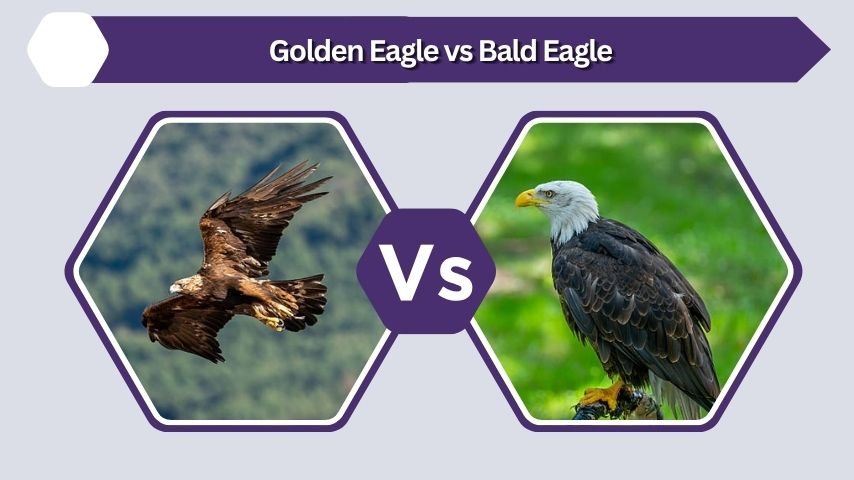
Golden Eagles and Bald Eagles are two of the most famous eagle species in the world. Although both are powerful birds of prey, they differ significantly in appearance, habitat, and hunting behavior.
Physical Differences
Golden Eagles have dark brown plumage with golden feathers on the head and neck. Bald Eagles are distinguished by their white head and tail. Golden Eagles often appear slimmer, while Bald Eagles have a heavier build and larger beak.
Habitat Differences
Golden Eagles prefer mountains, grasslands, and open country. Bald Eagles are more closely associated with rivers, lakes, and coastal habitats where fish are abundant.
Hunting and Diet Comparison
Golden Eagles mainly hunt mammals and birds, while Bald Eagles rely heavily on fish. These differences reduce competition in areas where both species occur.
Which Eagle Is Stronger?
Many wildlife experts consider the Golden Eagle the more powerful hunter because of its exceptional speed, agility, and ability to capture large terrestrial prey. However, both species are highly successful predators within their respective habitats.
Golden Eagle Conservation Status
Although Golden Eagles remain widespread, they face several conservation challenges. Population trends vary across regions, highlighting the importance of continued monitoring and habitat protection.
Population Trends
Global populations are generally stable, but some local populations have declined because of habitat fragmentation and human activities. Conservation programs help track population health and breeding success.
Threats to Golden Eagles
Major threats include:
- Habitat loss
- Wind turbine collisions
- Poisoning
- Electrocution
- Human disturbance
Addressing these issues is essential for long-term conservation.
Conservation Programs
Protected areas, habitat management, legal protections, and research initiatives all contribute to Golden Eagle conservation. These efforts help maintain healthy populations across the species’ range.
Interesting Facts About Golden Eagles
Golden Eagles possess eyesight that is several times more powerful than human vision. They can spot prey from great distances while soaring high above the landscape. Their diving speed can exceed 150 miles per hour, making them among the fastest birds of prey. Some individuals maintain territories covering hundreds of square kilometers, demonstrating the vast space required to support these remarkable hunters.
FAQs
How fast can a Golden Eagle fly?
Golden Eagles can fly at speeds of 30–50 mph (48–80 km/h) during normal flight. When diving to capture prey, they can reach speeds of over 150 mph (240 km/h).
Are Golden Eagles endangered?
No, Golden Eagles are not currently classified as endangered. The species is listed as Least Concern globally, although some regional populations face threats from habitat loss, collisions, and human disturbance.
Can Golden Eagles carry off large animals?
Golden Eagles are powerful predators capable of carrying prey that weighs several pounds. While they can capture animals such as rabbits, hares, and fox kits, they generally cannot fly away with prey heavier than their own body weight.
What is the difference between a Golden Eagle and a Bald Eagle?
Golden Eagles have dark brown plumage with golden feathers on the head and neck, while Bald Eagles have a distinctive white head and tail. Golden Eagles mainly hunt mammals, whereas Bald Eagles primarily feed on fish.
How good is a Golden Eagle’s eyesight?
Golden Eagles have exceptional eyesight and can spot prey from more than a mile away. Their vision is estimated to be four to eight times stronger than that of humans, making them highly effective hunters in open landscapes.
