
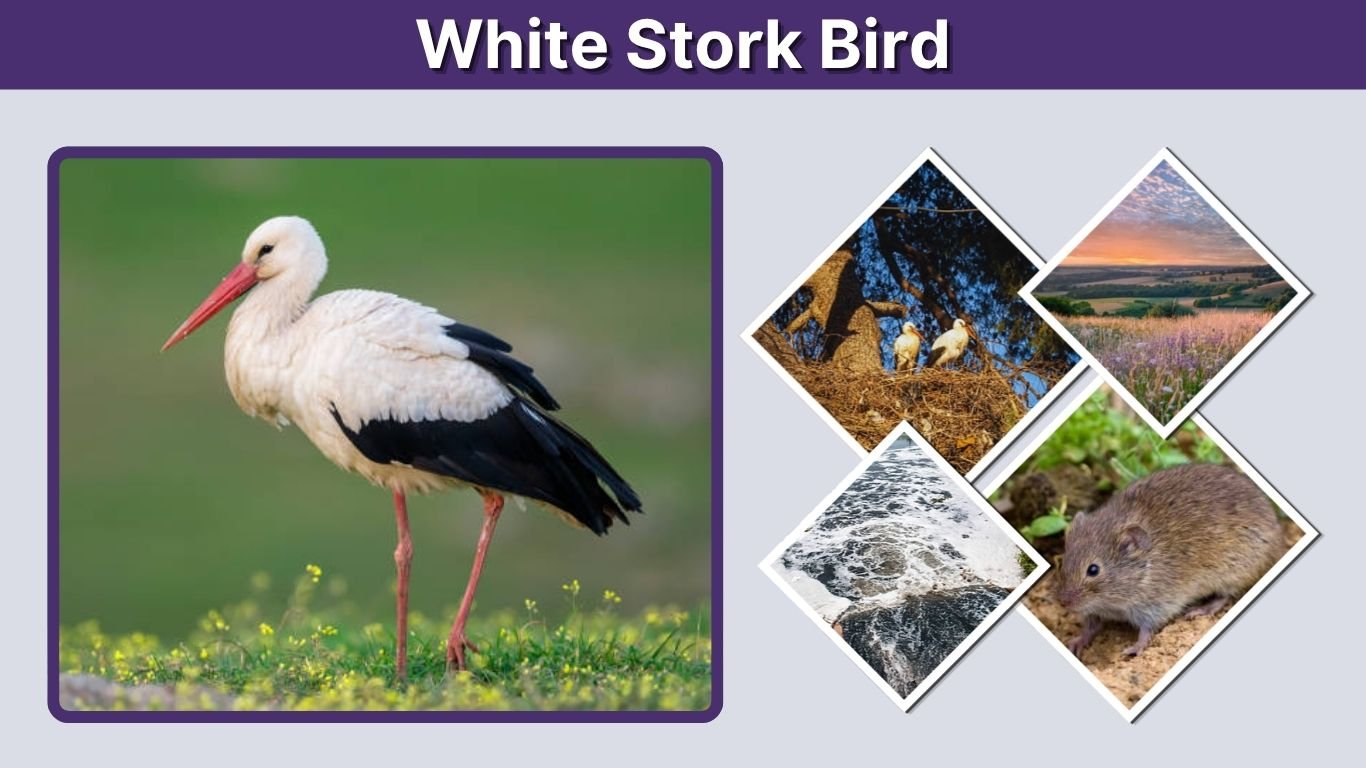
The white stork is a large, graceful wading bird recognized by its white body, black flight feathers, long red legs, and pointed red bill. Its scientific name is Ciconia ciconia. White storks inhabit open countryside, wetlands, farmland, and grasslands across Europe, Africa, and parts of Asia. Famous for building enormous nests on rooftops and towers, these migratory birds also hold an important place in folklore, where they represent birth, family, good fortune, and the arrival of spring.
White Stork Quick Facts
White storks are among the most recognizable members of the stork family. Their long legs, broad wings, and contrasting plumage make adults relatively easy to identify.
Size and identification
| Feature | Description |
| Scientific name | Ciconia ciconia |
| Length | Approximately 100–115 cm |
| Wingspan | Around 155–215 cm |
| Weight | Approximately 2.3–4.5 kg |
| Plumage | White body with black flight feathers |
| Bill and legs | Bright red in adults |
| Average lifespan | Around 20–25 years in the wild |
| Conservation status | Least Concern globally |
Male and female white storks
Male and female white storks have almost identical plumage. Males are generally slightly larger and may have longer, heavier bills, but these differences are difficult to notice without comparing two birds directly.
Juvenile white stork
A juvenile white stork resembles an adult but has a darker bill and duller, yellowish-grey or pinkish legs. Its feathers may also appear less clean and sharply contrasted. The bill and legs gradually become brighter as the bird matures.
What Does a White Stork Look Like?
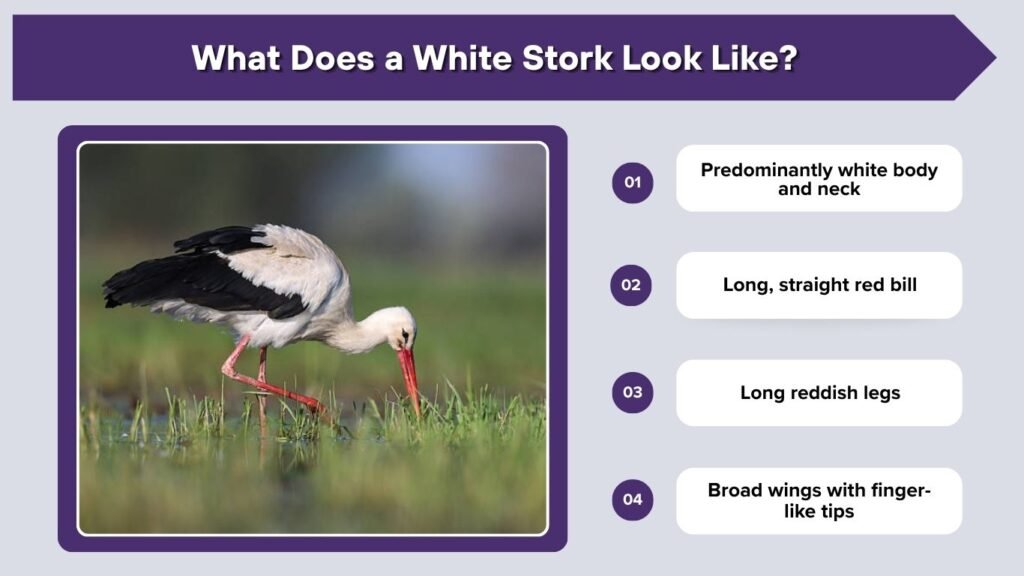
The combination of a white body, black wing feathers, red bill, and red legs separates the white stork from most other large waterbirds.
Main identification features
- Predominantly white body and neck
- Black primary and secondary flight feathers
- Long, straight red bill
- Long reddish legs
- Broad wings with finger-like tips
- Neck held straight while flying
- Slow, powerful wingbeats mixed with soaring
Flight and sound
White storks frequently soar on rising columns of warm air called thermals. They usually fly with their neck and legs fully extended, unlike herons, which commonly pull their necks into an S-shaped curve.
These birds are mostly quiet because their vocal muscles are poorly developed. Instead of calling loudly, they communicate by rapidly clattering their bills, particularly during courtship and greetings at the nest.
White Stork Habitat and Range
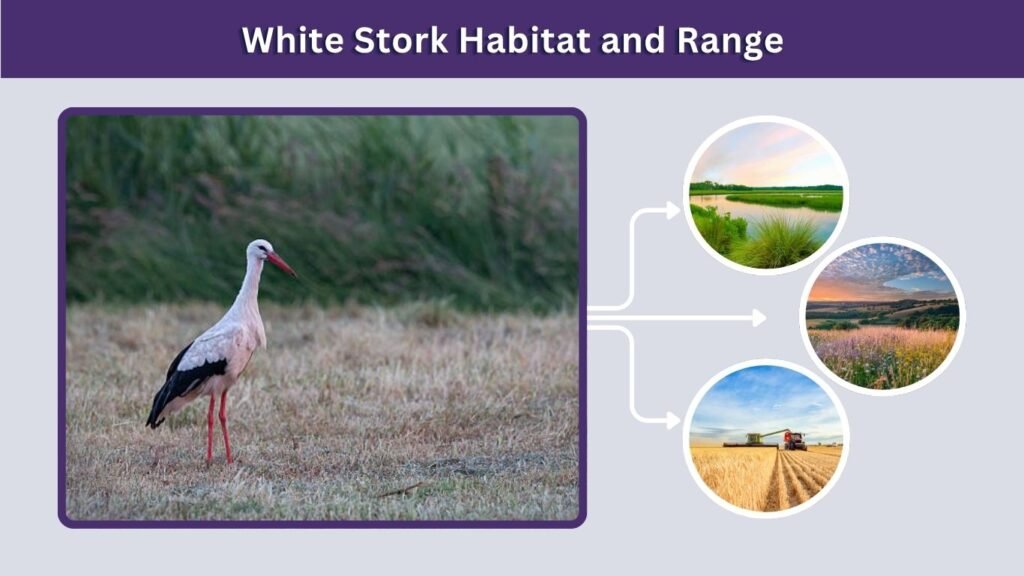
White storks need open feeding areas with abundant small animals. They usually avoid dense forests and extremely dry regions where prey is difficult to find.
Preferred habitat
White stork habitat includes freshwater wetlands, river valleys, marshes, meadows, pastures, savannas, and agricultural fields. Birds may forage near shallow ponds, irrigation channels, flooded farmland, and recently harvested fields.
They often live close to people when safe nesting structures and suitable feeding areas are available. Farm buildings, church towers, electrical poles, chimneys, and specially constructed platforms can all support their nests.
Where do white storks live?
White storks breed across parts of Europe, North Africa, the Middle East, and western and central Asia. Many European birds spend winter in sub-Saharan Africa, while some Asian populations migrate toward India and surrounding regions.
Their precise distribution changes seasonally because most populations migrate. A growing number of European birds now remain in southern Europe or North Africa during winter when enough food is available.
Is the White Stork a Migratory Bird?
Most white storks are migratory, although the distance travelled varies between populations. They use warm air currents to conserve energy and therefore prefer migration routes that minimize long flights over open water.
European migration routes
Western European birds commonly travel through Spain and cross into Africa near the Strait of Gibraltar. Eastern populations travel through Turkey, the Middle East, and eastern Africa.
Some individuals cover thousands of kilometres between breeding and wintering grounds. Large groups may gather along major migration corridors where favorable winds and thermals help them travel.
Changing migration behaviour
Warmer winters and access to food at landfills have caused some white storks to shorten their migration or remain in Europe year-round. However, this behaviour varies, and many birds continue their traditional journey to Africa.
What Do White Storks Eat?
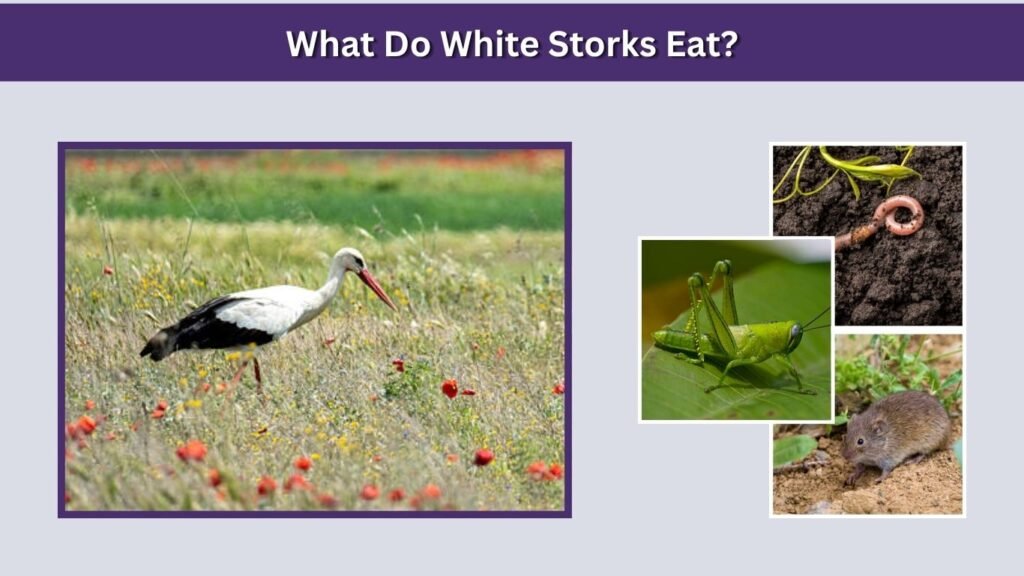
White storks are opportunistic carnivores. Their diet depends on the prey available in local wetlands, farmland, and grasslands.
Common foods
- Grasshoppers, beetles, crickets, and other insects
- Earthworms and spiders
- Frogs, tadpoles, and toads
- Small fish and crustaceans
- Lizards and snakes
- Mice, voles, and other small mammals
- Eggs or chicks of ground-nesting birds
Feeding behaviour
A white stork usually walks slowly through grass or shallow water while watching the ground. It catches prey with a fast downward thrust of its bill. Birds may also follow tractors and grazing animals because disturbed soil and vegetation expose insects, rodents, and other prey.
Nesting and Life Cycle
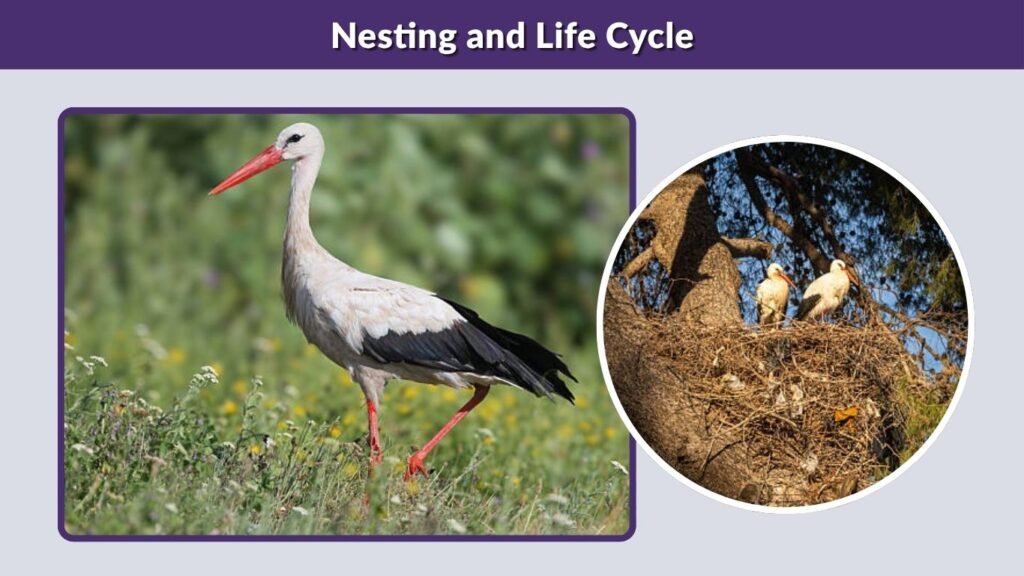
White storks frequently return to established nesting areas. A nest may be repaired and enlarged for many years, eventually becoming an enormous structure.
White stork nest
Nests are constructed from sticks and lined with grass, straw, leaves, cloth, or other soft materials. Large nests may reach approximately two metres across and several metres deep.
Common nesting locations include trees, rooftops, chimneys, towers, utility poles, and artificial nesting platforms. Sparrows, starlings, and other small birds sometimes build their own nests in spaces beneath the larger stork nest.
Eggs and chicks
A female typically lays three to six white eggs. Both parents incubate them for approximately 30–37 days. Because the eggs hatch at slightly different times, chicks within the same nest may vary in size.
Both adults feed the young by regurgitating food into the nest. Chicks normally begin flying at around eight or nine weeks and become independent soon afterward. White storks generally begin breeding when they are three to five years old.
White Stork-Like Birds
Several herons, ibises, cranes, spoonbills, and other storks can be mistaken for a white stork. Bill shape, leg colour, neck posture, and location provide the most useful clues.
Regional lookalikes
| Location | Likely lookalike | How it differs |
| Florida | Wood stork | Bald dark head and heavy, curved dark bill |
| Florida or Hawaii | Cattle egret | Much smaller, with a shorter yellow bill |
| Michigan or North Carolina | Great egret | Yellow bill, black legs, and entirely white wings |
| Australia | Black-necked stork | Glossy black head, neck, bill, and wing feathers |
| India | Painted stork | Pinkish rear feathers and patterned yellow bill |
| UK | Great egret or spoonbill | Different bill shape and no bright red legs |
Is there a white stork bird in Australia?
The true white stork is not a regular Australian bird. A large black-and-white stork seen in Australia is more likely a black-necked stork, also called a jabiru. Smaller white stork-looking birds may be Australian white ibises, great egrets, or royal spoonbills.
White stork-like birds in Florida
White storks are not native Florida residents. The most likely confusion is the wood stork, which has a white body and black flight feathers but possesses a bald, scaly head. Great egrets and white ibises are other common possibilities.
White Stork Symbolism and National Importance
The white stork has lived near human settlements for centuries, creating a strong connection with European and Asian traditions.
White stork spiritual meaning
In folklore, the white stork represents fertility, birth, renewal, loyalty, family, and good fortune. Its seasonal return to nesting sites became associated with spring and new life. The familiar story that storks deliver babies developed from these cultural associations rather than the bird’s natural behaviour.
White stork national bird
The white stork is widely recognized as the national bird of Lithuania. It is also an important cultural symbol in Poland, Belarus, Ukraine, Germany, and several other European countries. Poland supports one of the world’s largest breeding populations, although the bird’s cultural importance should not always be confused with official national-bird status.
Conservation Status and Threats
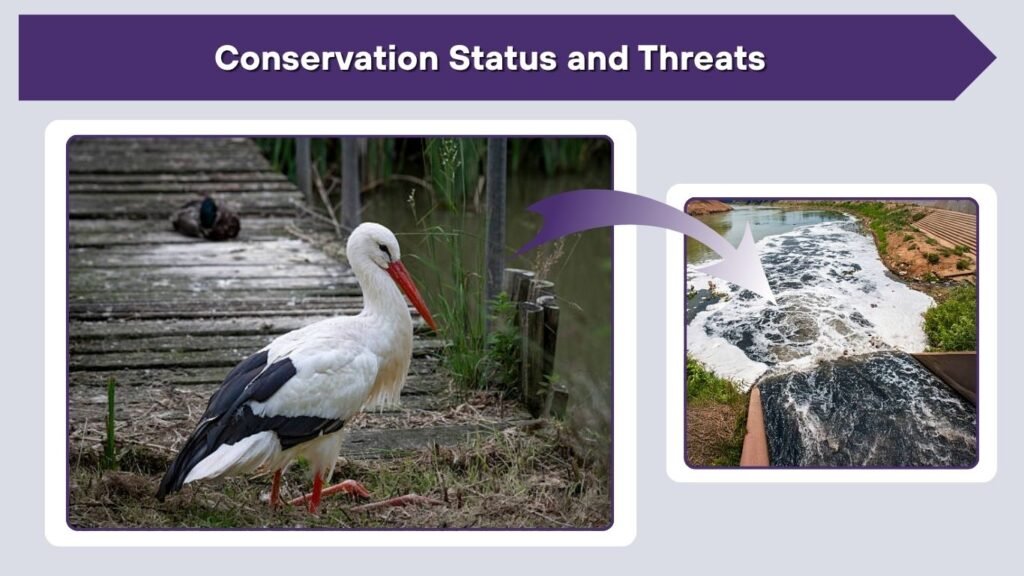
The global white stork population is currently classified as Least Concern by BirdLife International, but local populations still depend on healthy wetlands and safe migration routes. BirdLife International
Main threats
White storks may be affected by wetland drainage, intensive agriculture, pesticide use, drought, hunting, and collisions with electrical infrastructure. Power poles can be particularly dangerous when birds build nests close to exposed wires.
Conservation projects protect feeding areas, insulate power lines, and install secure nesting platforms. In southern England, the White Stork Project has also helped restore a breeding population after centuries of absence. White Stork Project
Frequently Asked Questions
The following answers address common questions about white stork identification, behaviour, and distribution.
Are white storks friendly?
White storks are generally not aggressive toward people, but they remain wild animals. Birds accustomed to nesting near houses may tolerate human activity from a distance. People should avoid approaching nests or attempting to touch and feed adults or chicks.
Is the white stork the national bird of Poland?
The white stork is strongly associated with Poland and plays a major role in Polish culture, folklore, and wildlife tourism. However, it is more clearly recognized as Lithuania’s national bird. Claims about official national-bird status can differ from broader cultural symbolism.
How long do white storks live?
White storks commonly live for approximately 20–25 years in the wild, although many young birds do not survive their first migration. Individuals protected from disease, collisions, hunting, and food shortages may live longer. The species generally begins reproducing at three to five years old.
How do white storks stay cool?
During hot weather, white storks may pant, hold their wings away from the body, and stand in shaded areas. They can also cool themselves through urohidrosis, releasing liquid waste onto their legs so that evaporation lowers their body temperature.
Are white storks endangered?
White storks are not considered globally endangered and are classified as Least Concern. Nevertheless, populations in particular regions may decline when wetlands disappear or migration becomes dangerous. Protecting feeding habitat, nests, and power lines remains essential for their long-term survival.