
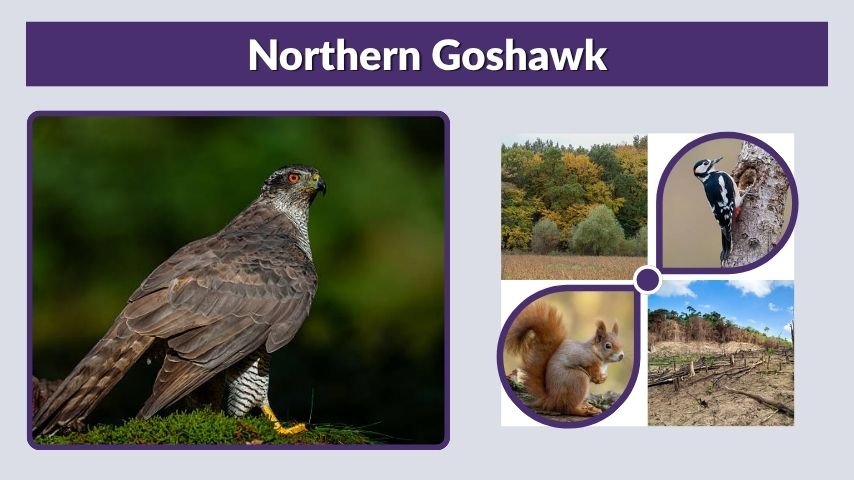
The northern goshawk is a powerful forest hawk known for speed, strength, red eyes, and bold hunting behavior. It is one of the largest accipiters, built with broad wings and a long tail that help it move quickly through dense woodland. This bird is often difficult to see, but its fierce nature, sharp call, and strong nesting defense make it unforgettable. In this article, you will learn about its size, habitat, diet, call, juvenile features, range, and facts.
What Is a Northern Goshawk?
The northern goshawk is a large bird of prey that lives mainly in forested areas. It belongs to the accipiter group of hawks, which are known for short, rounded wings and long tails. These features help them chase prey through trees. The goshawk is stronger and larger than Cooper’s Hawk and Sharp-shinned Hawk.
Scientific Name and Classification
The scientific name of the northern goshawk is Accipiter gentilis. It belongs to the family Accipitridae, which includes hawks, eagles, kites, and other raptors. In many older field guides, the name “Northern Goshawk” was used broadly for birds across North America, Europe, and Asia.
Today, some taxonomic authorities separate the North American bird as the American Goshawk. Because of this, readers may see both names used in bird guides, eBird lists, and wildlife articles. However, many people still search for and recognize the bird as the northern goshawk.
Why It Is Called a Forest Hawk
The northern goshawk is often called a forest hawk because it is closely connected to wooded habitats. Unlike open-country hawks that soar over fields, the goshawk usually hunts among trees. Its body is designed for quick turns, sudden attacks, and fast movement through branches.
Northern Goshawk Size and Appearance
The northern goshawk is a large, muscular hawk with a fierce look. It has a strong body, broad wings, a long tail, and powerful legs. Adults usually show gray upperparts, pale barred underparts, and a bold white eyebrow stripe. Its red or orange-red eyes give it an intense expression that birdwatchers often remember.
How Big Is a Northern Goshawk?
A northern goshawk is much larger than many backyard hawks. Females are usually bigger than males, which is common among birds of prey. The bird’s size helps it capture larger prey such as squirrels, rabbits, grouse, and other birds.
Key size features include:
- Length: about 20 to 25 inches
- Wingspan: about 40 to 46 inches
- Females larger and heavier than males
- Broad wings for power
- Long tail for steering
- Strong legs and feet
- Heavy body compared with Cooper’s Hawk
Male vs Female Northern Goshawk
Male and female northern goshawks look similar in color, but the female is noticeably larger. A female can appear heavier, broader, and more powerful, especially when perched or flying near the nest. The male is smaller and often more agile, but both sexes are skilled hunters.
In breeding season, the male often brings food to the female and chicks. The female usually spends more time near the nest, protecting eggs and young birds.
Adult Northern Goshawk Identification
Adult northern goshawks are usually gray above and pale below with fine horizontal barring. Their head often looks dark, with a strong white eyebrow stripe above the eye. This eyebrow marking gives the bird a serious, almost angry expression.
The adult’s eyes may be orange-red or deep red. The tail is long and banded, while the wings are broad and rounded. When seen in flight, the goshawk looks strong, direct, and controlled.
Juvenile Northern Goshawk Identification
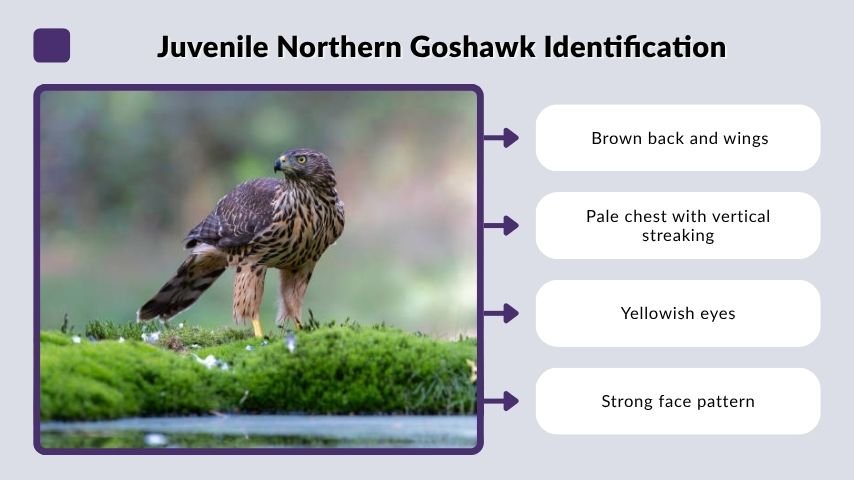
Juvenile northern goshawks can be harder to identify because they do not look exactly like adults. Instead of clean gray feathers and red eyes, young birds are usually brown above and streaked below. Their eyes are often yellowish. Many people confuse juvenile goshawks with juvenile Cooper’s Hawks, so size and shape are very important.
What Does a Juvenile Northern Goshawk Look Like?
A juvenile northern goshawk has brown upperparts and pale underparts with dark vertical streaks. Its face can still look bold, and it may show a strong eyebrow line. The body is usually bulky, with broad wings and a long tail.
Juvenile features include:
- Brown back and wings
- Pale chest with vertical streaking
- Yellowish eyes
- Strong face pattern
- Long banded tail
- Broad wings
- Heavy body shape
Immature Northern Goshawk vs Adult
The main difference between an immature and adult northern goshawk is color. Immature birds are brown and streaked, while adults are gray and barred. Young birds also tend to have yellow or pale eyes, while adults often develop orange or red eyes.
As the bird matures, its plumage becomes cleaner and more adult-like. The fierce expression becomes more obvious as the eye color deepens.
Juvenile Northern Goshawk vs Cooper’s Hawk
A juvenile northern goshawk is usually larger and bulkier than a juvenile Cooper’s Hawk. The goshawk has broader wings, a stronger head, and a heavier chest. Cooper’s Hawk usually looks slimmer, with a smaller body and a more delicate shape.
This comparison can be difficult in the field, especially when the bird is flying quickly through trees. Birders should look at overall size, wing width, head shape, tail pattern, and habitat.
Northern Goshawk Habitat and Range
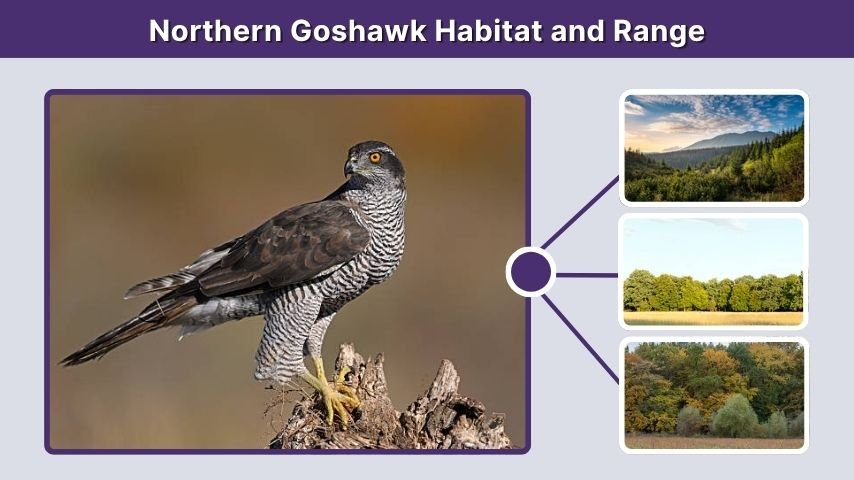
Northern goshawks are forest birds. They prefer large wooded areas where they can hunt, nest, and raise young with limited disturbance. They are often found in mature forests, mountain forests, conifer woods, and mixed woodland. Their range is broad, but local sightings depend on habitat, season, and regional bird populations.
Where Do Northern Goshawks Live?
Northern goshawks live across parts of the Northern Hemisphere. Historically, the name included birds from North America, Europe, and Asia. In North America, many birds once called northern goshawks may now be listed as American Goshawks in newer taxonomy.
They are usually found in areas with large trees and enough prey. They may live in remote forests, mountain regions, and colder northern habitats. In winter, some individuals may move to lower elevations or more open areas where food is easier to find.
Northern Goshawk Habitat
The best goshawk habitat includes mature woodland with space for nesting and hunting. These birds need trees for cover, nesting platforms, and hunting routes. They also need healthy prey populations.
Common habitats include:
- Mature conifer forests
- Mixed forests
- Mountain woodlands
- Boreal forests
- Forest edges
- Large wooded territories
- Areas with tall nesting trees
- Quiet breeding areas away from disturbance
Northern Goshawk Range by Region
Searches for northern goshawk in California, Colorado, Michigan, Massachusetts, Wisconsin, Ohio, Illinois, and British Columbia usually relate to local distribution. In some places, goshawks are rare or seasonal. In others, they may breed in suitable forests.
Because of the taxonomy split, North American readers should also check “American Goshawk” when looking for updated range maps or local records.
What Do Northern Goshawks Eat?
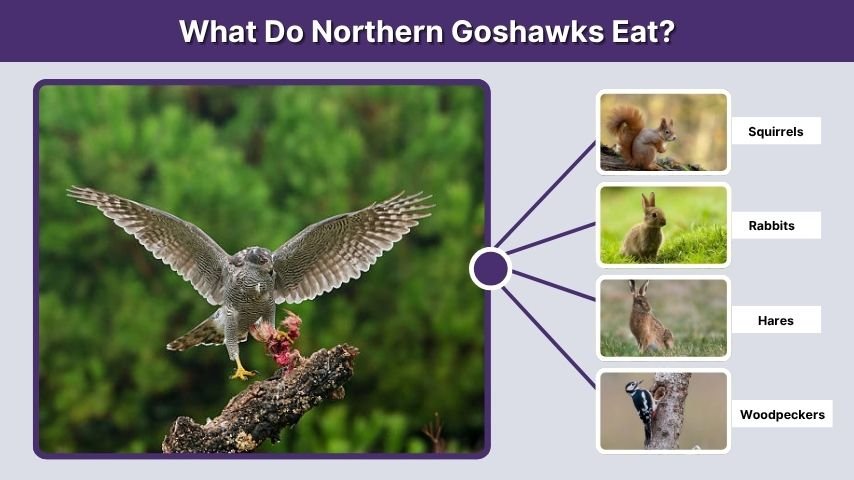
Northern goshawks are strong carnivores that hunt birds and mammals. They are not picky hunters, but their diet depends on what is available in their habitat. They often catch medium-sized prey in forests, using speed and surprise. Their powerful feet and sharp talons help them control active prey quickly.
Northern Goshawk Diet
The northern goshawk eats a wide variety of animals. It often hunts birds and mammals that live in forests or forest edges. Its diet changes by season and region.
Common prey includes:
- Squirrels
- Rabbits
- Hares
- Grouse
- Pigeons
- Jays
- Crows
- Woodpeckers
- Songbirds
- Small mammals
- Occasional reptiles
Northern Goshawk Hunting Style
The northern goshawk is a fast and aggressive hunter. It often hunts from cover, waiting for the right moment before launching a sudden attack. Its broad wings provide power, while its long tail helps it steer through trees.
Unlike hawks that circle high in the sky, goshawks often stay close to the forest. They may fly low, twist between trunks, and surprise prey before it has time to escape.
Northern Goshawk Speed and Flight
The goshawk’s flight is powerful, direct, and agile. It can move quickly through dense woodland, using short bursts of speed. Its long tail works like a rudder, allowing sharp turns during a chase.
In open flight, it may show a flap-and-glide pattern. However, it is most impressive inside forests, where it can follow prey through tight spaces.
Northern Goshawk Call and Sound
The northern goshawk is often hard to see in thick forest, but its call can reveal its presence. Its sounds are most noticeable during the breeding season, especially near the nest. Calls may be used for alarm, communication between mates, food exchange, or warning intruders away from the nesting area.
What Does a Northern Goshawk Sound Like?
A northern goshawk call is usually sharp, harsh, and repeated. People often describe it as a loud alarm call that carries through the forest. The exact sound can vary depending on the situation.
Near the nest, the call may become more intense. If a person or animal gets too close, the goshawk may call repeatedly and act aggressively.
Northern Goshawk Sounds Near the Nest
During breeding season, goshawks use calls to communicate with mates and chicks. The male may call during food delivery, while the female may call in defense or response. Young birds may also make begging calls when hungry.
Because goshawks are secretive, sound is an important clue for birders. However, a call alone should not be the only identification clue.
Why the Call Matters
The call matters because northern goshawks often remain hidden in forests. A sharp repeated call may help a birder locate the area where the bird is active. Still, other forest raptors can make similar sounds, so visual details such as size, shape, and markings should also be checked.
Northern Goshawk Nest and Breeding
Northern goshawks are known for strong nesting behavior. They usually build nests in large trees inside forested areas. During the breeding season, they can become very defensive. This fierce protection of eggs and chicks is one reason the bird has a reputation as a bold and fearless forest raptor.
Where Do Northern Goshawks Nest?
Northern goshawks usually nest in tall forest trees. They may choose a strong branch fork or a secure place near the trunk. The nest is often placed in mature woodland where the birds have cover and nearby hunting areas.
A pair may reuse the same nesting area in different years. Sometimes they build or maintain more than one nest within a territory.
Eggs and Chicks
The female usually lays a small clutch of eggs. She spends much time incubating and protecting them, while the male often provides food. After the chicks hatch, they depend completely on their parents.
Young goshawks grow quickly and need a steady supply of prey. After leaving the nest, they may remain nearby for a period while learning to fly and hunt.
Northern Goshawk Attack and Nest Defense
Northern goshawks are famous for defending their nests. If a person, owl, mammal, or other threat comes too close, the adults may call loudly, swoop, or dive toward the intruder. This behavior is not random aggression. It is a natural way to protect eggs and chicks.
Northern Goshawk vs Cooper’s Hawk
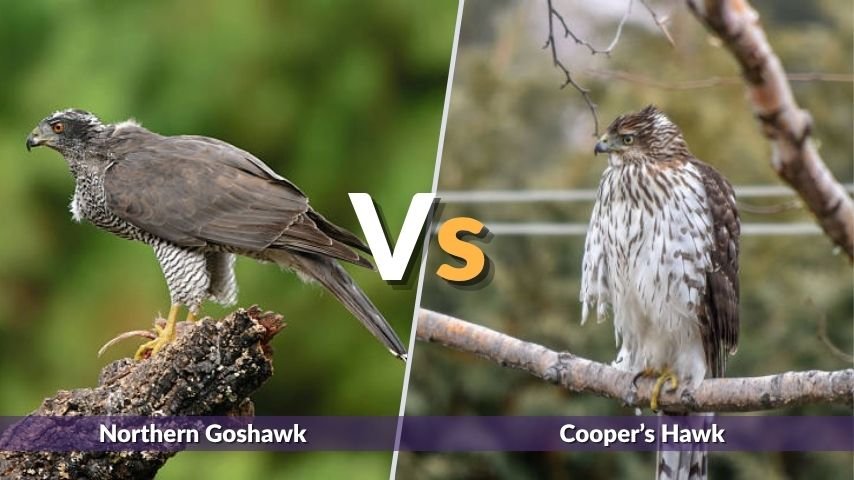
Northern Goshawk and Cooper’s Hawk are both accipiters, so they share some features. Both have rounded wings, long tails, and fast woodland flight. However, the northern goshawk is usually larger, heavier, and more powerful. Cooper’s Hawk is more common around suburbs, parks, and open woodland edges.
Main Differences
| Feature | Northern Goshawk | Cooper’s Hawk |
| Size | Larger and bulkier | Smaller and slimmer |
| Wings | Broader and stronger | Narrower |
| Face | Bold eyebrow stripe | Less intense face pattern |
| Eyes | Often orange-red or red in adults | Red in adults, but softer expression |
| Habitat | Mature forest | Woods, parks, suburbs |
| Flight | Heavy and powerful | Quick and agile |
Goshawk vs Cooper’s Hawk in Flight
In flight, a northern goshawk looks broader and stronger. Its wings appear wide, and its body looks heavy. Cooper’s Hawk usually appears slimmer and more lightweight. The goshawk’s tail may look long and rounded, helping it turn sharply through trees.
Juvenile Comparison
Juvenile birds are harder to separate. Both may be brown above and streaked below. The best clues are size, structure, and face pattern. A juvenile goshawk looks more powerful, with broader wings, a heavier body, and a stronger head than a juvenile Cooper’s Hawk.
Northern Goshawk Facts
The northern goshawk is one of the most impressive forest raptors. It is admired by birdwatchers, studied by researchers, and respected in falconry. Its secretive nature makes it difficult to observe, but its size, red eyes, hunting power, and nest defense make it one of the most memorable hawks.
Quick Facts About Northern Goshawks
Important facts include:
- The northern goshawk is a large accipiter.
- Adults often have red or orange-red eyes.
- Females are larger than males.
- Juveniles are brown and streaked below.
- It hunts birds and mammals.
- It prefers mature forest habitats.
- It is known for strong nest defense.
- It has broad wings and a long tail.
- North American birds may be called American Goshawks.
- It has a long history in falconry.
Northern Goshawk Pronunciation
Northern goshawk is pronounced as NOR-thurn GOS-hawk. The word “goshawk” comes from an old meaning connected with “goose hawk,” because large goshawks were historically known as powerful hunting birds capable of taking sizable prey.
Northern Goshawk in Falconry
The northern goshawk has long been respected in falconry because of its strength, speed, and courage. It is not usually a beginner’s bird. Falconers value it for its ability to chase prey through woodland and make fast, determined attacks.
Conservation and Predators
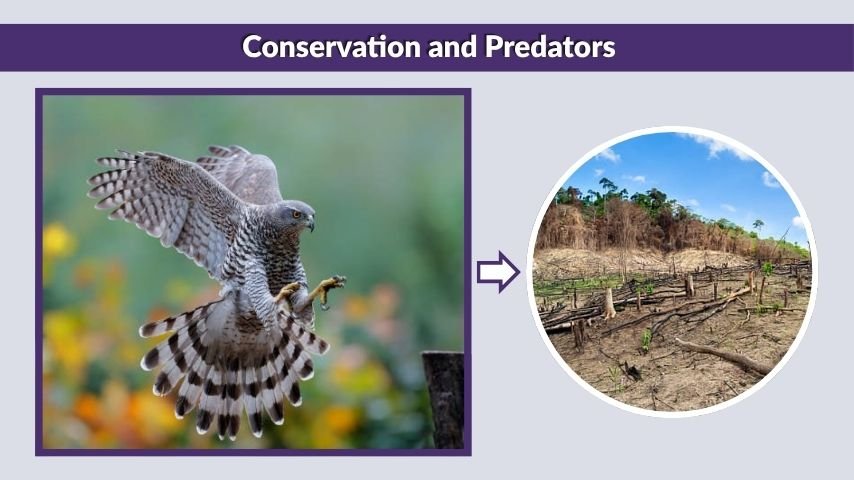
The northern goshawk is not globally endangered, but its status can vary by region. Because it depends on forests, it can be affected by habitat loss, logging, disturbance near nests, and changes in prey populations. Protecting large forest areas is important for keeping goshawk populations healthy.
Is the Northern Goshawk Endangered?
In many parts of its range, the northern goshawk is not considered endangered. However, local populations may still face pressure. Some areas monitor goshawks closely because they need mature forests and can be sensitive to disturbance during nesting season.
In North America, current information may appear under the name American Goshawk because of taxonomy changes.
Northern Goshawk Predators
Adult northern goshawks have few natural predators because they are strong birds of prey. However, eggs and chicks may be vulnerable to larger raptors, owls, mammals, or other nest predators. Bad weather and food shortage can also affect breeding success.
Main Threats
Threats to northern goshawks include forest loss, disturbance near nests, reduced prey, and habitat fragmentation. Human activity during breeding season can be especially harmful if it causes adults to abandon or reduce care for the nest. Healthy forests are the key to long-term goshawk survival.
FAQs
Is the northern goshawk the same as the American Goshawk?
Older sources often used “Northern Goshawk” for North American birds, but newer taxonomy may call the North American form the American Goshawk. Many people still use the older name, so both terms may appear in field guides, birding apps, and wildlife articles.
How big is a northern goshawk?
A northern goshawk is a large hawk, usually about 20 to 25 inches long, with a wingspan around 40 to 46 inches. Females are larger than males. Compared with Cooper’s Hawk, the goshawk looks bulkier, stronger, and broader-winged.
What do northern goshawks eat?
Northern goshawks eat birds and mammals. Their prey may include squirrels, rabbits, hares, grouse, pigeons, jays, crows, woodpeckers, and songbirds. They hunt with fast surprise attacks, often chasing prey through forests or along woodland edges.
How can you identify a juvenile northern goshawk?
A juvenile northern goshawk is usually brown above with pale underparts marked by dark vertical streaks. It often has yellowish eyes, broad wings, a long tail, and a heavy body. It can be confused with juvenile Cooper’s Hawk, but it is usually larger and stronger-looking.
What does a northern goshawk sound like?
A northern goshawk usually gives a sharp, harsh, repeated call. It is often heard near nesting areas, especially when the bird is alarmed or defending its territory. Because goshawks can hide in dense forest, their call may be the first sign that one is nearby.
