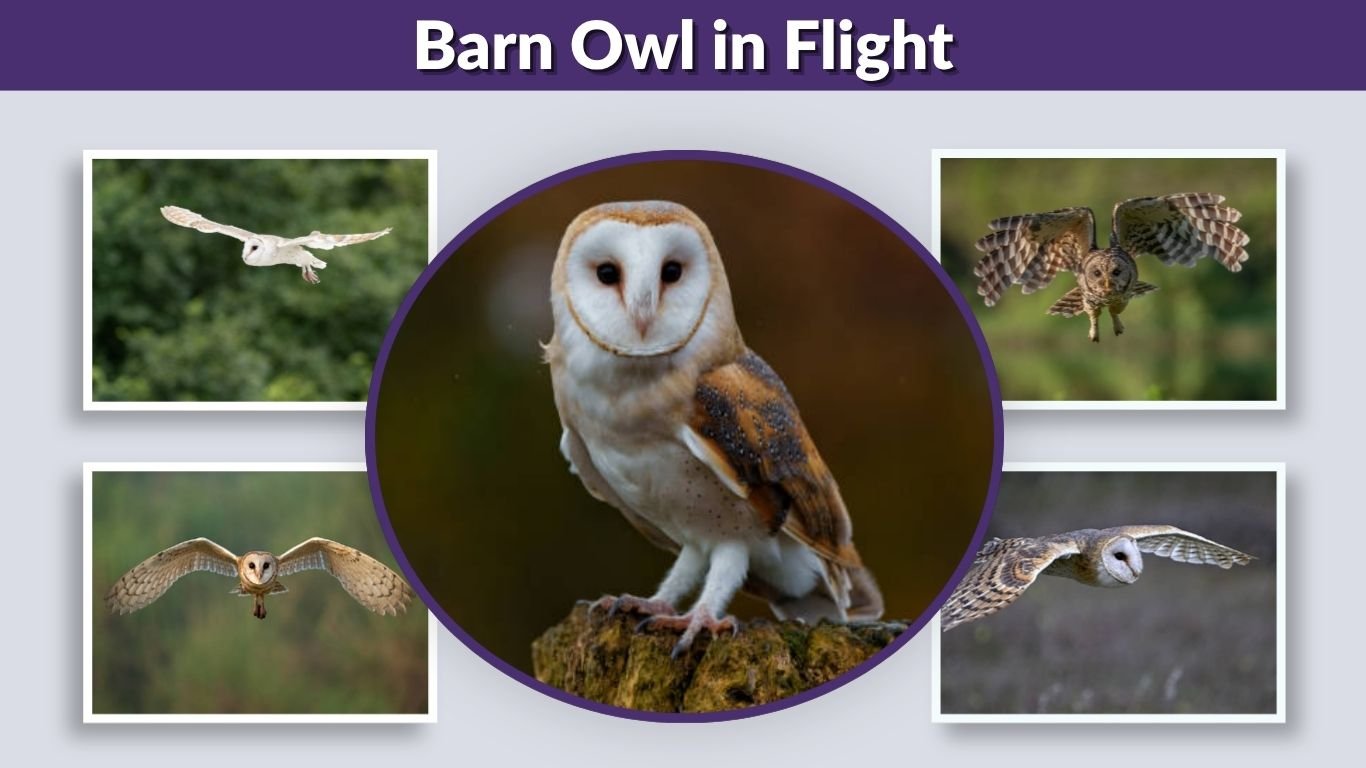
A barn owl in flight is one of the most beautiful sights in nature. With pale wings, a heart-shaped face, and silent movement, this owl looks almost ghost-like as it glides over fields at night. Barn owls usually hunt by flying low over open habitats while listening for small rodents below. This guide explains what a barn owl looks like in flight, why its flight is so quiet, and how to identify, photograph, or draw one.
What Does a Barn Owl Look Like in Flight?
A barn owl in flight has a pale body, broad wings, long legs, and a smooth floating movement. From below, it can look mostly white, especially at night or in moonlight. From above, the wings often show buff, gray, tan, and speckled markings.
Cornell Lab describes the American Barn Owl as pale overall, with dark eyes, buff and gray upperparts, and white to cinnamon underparts. It also notes that barn owls can appear almost all white when seen at night.
| Feature | Barn Owl in Flight |
| Wing shape | Broad, rounded, and pale |
| Face | Heart-shaped facial disc |
| Body color | White, buff, gray, or cinnamon |
| Flight style | Slow, floating, and quiet |
| Common height | Often low over grassland or fields |
| Best time to see | Dusk, night, or early morning |
| Main prey | Small rodents, especially mice and voles |
A white barn owl in flight is especially noticeable because the pale underwings reflect light. This is why many people describe flying barn owls as ghostly or silent white birds.
Why Barn Owls Fly So Silently
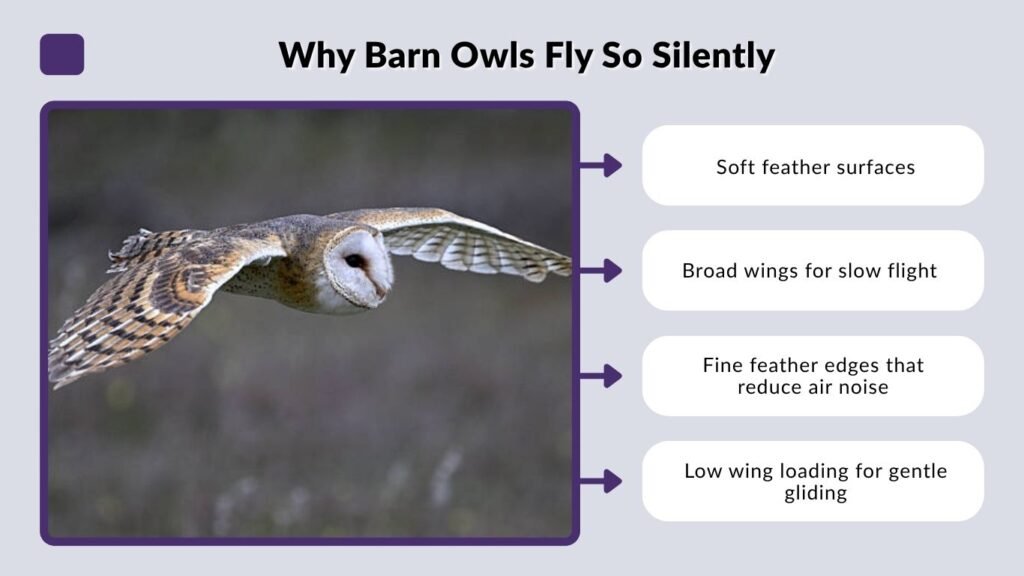
Barn owls are famous for silent flight. Their wings and feathers help reduce noise, allowing them to hear prey and approach without being detected. The Barn Owl Trust explains that silent flight helps barn owls hear tiny sounds made by small mammals and sneak up on prey. It also notes that their flight feathers have hair-like structures and tiny hooks that help smooth airflow and reduce sound.
Silent Flight Adaptations
Barn owls have several features that help them fly quietly:
- Soft feather surfaces
- Broad wings for slow flight
- Fine feather edges that reduce air noise
- Low wing loading for gentle gliding
- Lightweight body compared with wing size
- Large facial disc for sound detection
Scientific reviews of owl flight also explain that large wings and low wing loading help owls fly slowly and reduce noise.
Barn Owl in Flight at Night
A barn owl in flight at night may look like a pale shape drifting over fields, roadsides, marshes, or farmland. Unlike many birds that flap quickly, barn owls often glide and quarter back and forth over open ground.
Cornell notes that barn owls hunt at night by flying low over open habitats and searching for small rodents mainly by sound. This is why they are often seen near meadows, grasslands, hayfields, farms, marsh edges, and rough roadside fields.
Barn owls do not need bright light to hunt well. Their hearing is extremely important. The heart-shaped face helps direct sound toward the ears, allowing the owl to locate prey even in darkness.
Barn Owl Call in Flight
Many people expect owls to hoot, but barn owls are different. A barn owl call in flight is often a harsh scream or screech, not the classic “hoo-hoo” sound.
Cornell says American Barn Owls do not hoot like many owls. Instead, they make a long, harsh scream that lasts about two seconds, and males may call repeatedly from the air. The Woodland Trust also describes the barn owl call as a shrill screeching sound, which is why the species is sometimes called a “screech owl.
Common Barn Owl Sounds
Barn owls may make:
- Harsh screeches
- Hissing sounds near nests
- Purring or wavering calls
- Begging calls from young owls
- Repeated flight calls during breeding season
If you hear a scary scream over a field at night, it may be a barn owl flying nearby.
White Barn Owl in Flight
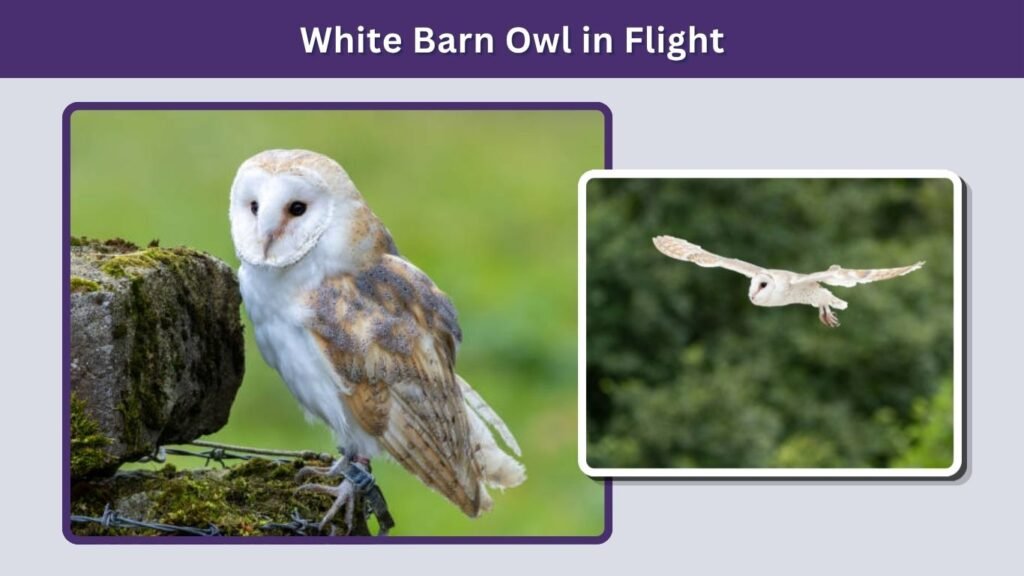
A white barn owl in flight is usually a normal barn owl seen from below. Barn owls often have pale faces, pale underwings, and white or light underparts. In low light, this can make them look completely white.
However, color can vary. Some barn owls are more buff or cinnamon underneath, while others are very pale. Females are often more heavily spotted than males, but this can vary by region and individual.
| View | What You May See |
| From below | White face, pale belly, pale underwings |
| From above | Buff, gray, tan, and speckled wings |
| At night | Ghostly white flying shape |
| In daylight | More detail, spots, and warm colors |
| In photos | Strong contrast between white face and darker wings |
This white appearance is one reason barn owl flight images are popular in wildlife photography, wallpapers, prints, tattoos, and drawings.
Barn Owl Flight Pattern
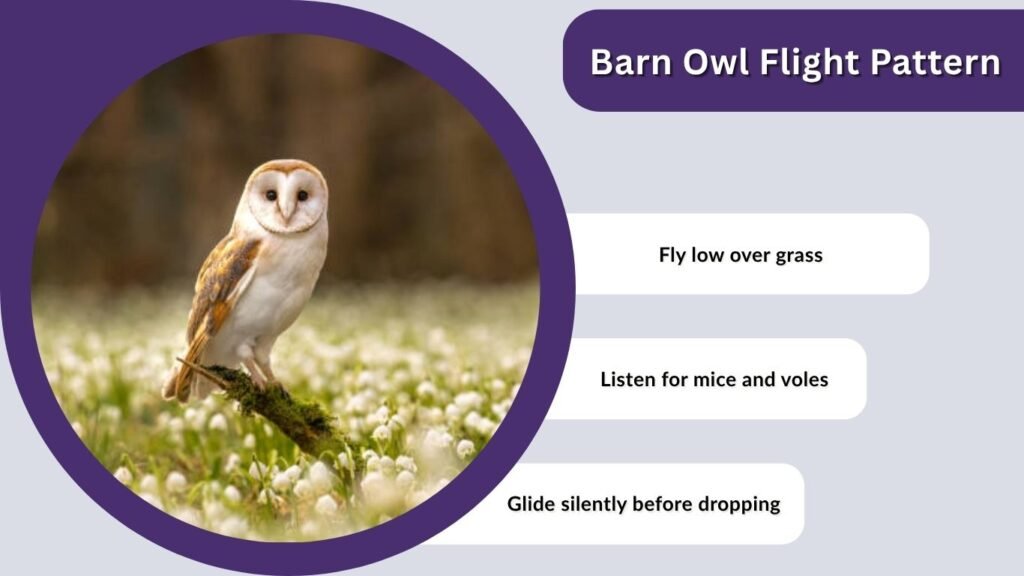
Barn owls usually fly with slow wingbeats and long glides. When hunting, they often fly low and methodically over open land. This search pattern is sometimes called quartering, where the owl moves back and forth across a hunting area.
How Barn Owls Hunt in Flight
A hunting barn owl may:
- Fly low over grass
- Listen for mice and voles
- Glide silently before dropping
- Hover briefly in wind
- Turn its face downward
- Drop feet-first onto prey
- Carry prey back to a perch or nest
Their flight is not only beautiful; it is practical. The owl is built to move quietly, listen carefully, and strike quickly.
Barn Owl in Flight From Behind
A barn owl in flight from behind shows the back and upperwings. This view is useful for identification because the upperparts usually show buff, gray, tan, and dark speckling. The tail may look short and pale compared with the broad wings.
From behind, a barn owl may look warmer and darker than it does from below. This can confuse people who expect barn owls to be fully white. The bird’s upperwing pattern is often much more detailed than the plain white underside.
Black or Melanistic Barn Owl in Flight
A black barn owl in flight is extremely rare and usually refers to a melanistic barn owl, not a separate species. Most barn owls are pale, buff, gray, cinnamon, or white. Some photos labeled “black barn owl in flight” may be edited, AI-generated, heavily shadowed, or a different owl species.
A true melanistic barn owl should still show a barn owl shape: heart-shaped face, dark eyes, smooth rounded head, long legs, and broad wings. If the bird has ear tufts or yellow eyes, it is likely not a barn owl.
Barn Owl in Flight vs Other Owls
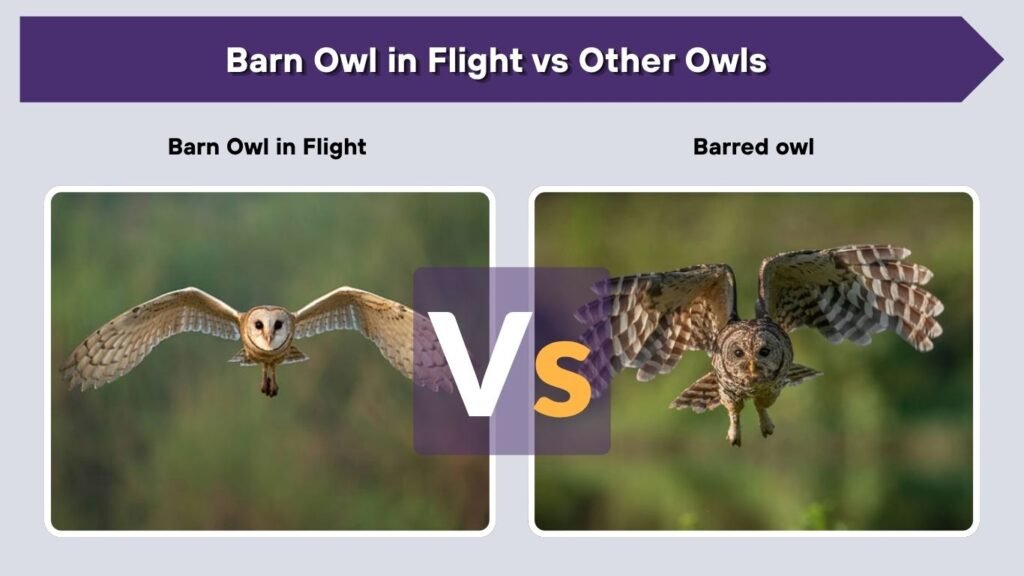
Barn owls are easy to separate from many owls because of their pale color and heart-shaped face. They do not have ear tufts like Great Horned Owls, and they do not have the round face pattern of many woodland owls.
| Owl Type | Flight ID Clue |
| Barn owl | Pale body, heart-shaped face, ghostly flight |
| Great horned owl | Large body, ear tufts, heavy wingbeats |
| Barred owl | Round head, brown barring, forest habitat |
| Short-eared owl | Open-country owl, yellow eyes, dark wrist patches |
| Snowy owl | Large white owl, heavier body, Arctic species |
If you see a pale owl flying low over fields at night, a barn owl is one of the strongest possibilities.
FAQs
What does a barn owl look like in flight?
A barn owl in flight looks pale, broad-winged, and ghostly. It has a heart-shaped face, long legs, rounded wings, and a slow, quiet flight style.
Do barn owls fly at night?
Yes, barn owls commonly fly and hunt at night. They often fly low over open fields and listen for small rodents below.
Why is barn owl flight silent?
Barn owl flight is silent because of special feather structures, soft feather surfaces, and broad wings that help reduce air noise. This helps them hear prey and approach quietly.
What sound does a barn owl make in flight?
A barn owl may make a harsh screech or scream in flight. It does not usually make the classic hooting sound people expect from owls.
Is a white barn owl in flight rare?
No, a white-looking barn owl in flight is not always rare. Many barn owls look very pale from below, especially at night, because their face, body, and underwings are light-colored.