
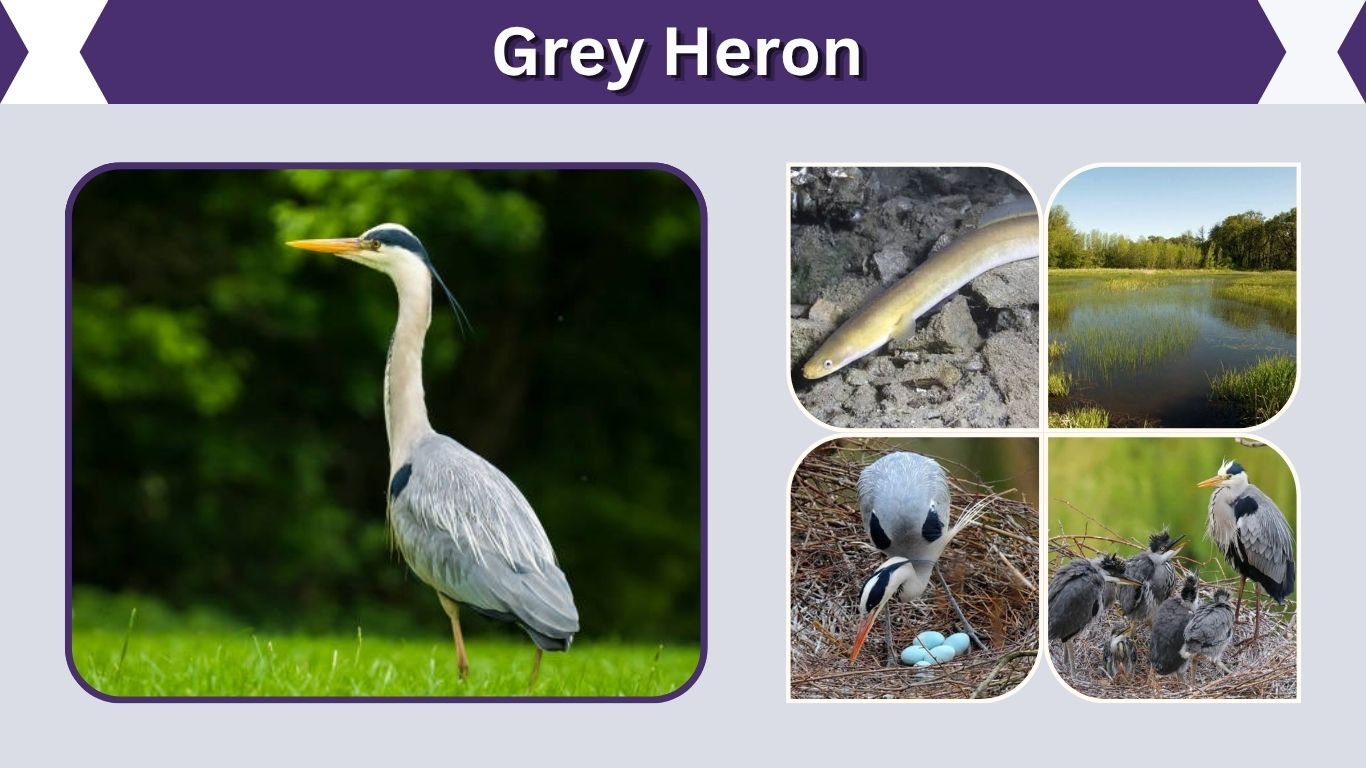
The Grey Heron is a large wading bird recognized by its long legs, pointed bill, and distinctive grey-and-white plumage. It lives near rivers, lakes, marshes, ponds, estuaries, and coastlines across Europe, Asia, and parts of Africa. Grey Herons are patient hunters that often stand motionless in shallow water before striking at fish. Although strongly associated with wetlands, they also visit farmland, city parks, garden ponds, and other places where food is available.
Grey Heron Scientific Name and Classification
The scientific name of the Grey Heron is Ardea cinerea. It belongs to the family Ardeidae, which includes herons, egrets, and bitterns.
| Feature | Information |
|---|---|
| Scientific name | Ardea cinerea |
| Family | Ardeidae |
| Length | Approximately 84–102 cm |
| Wingspan | Approximately 155–195 cm |
| Weight | About 1–2.1 kg |
| Diet | Fish, amphibians, insects, and small animals |
| Typical lifespan | Around 5 years in the wild |
| Maximum recorded age | More than 20 years |
| Conservation status | Least Concern |
Several subspecies occur across the bird’s extensive range, but all share the characteristic long-legged shape and primarily grey plumage.
Grey Heron Size
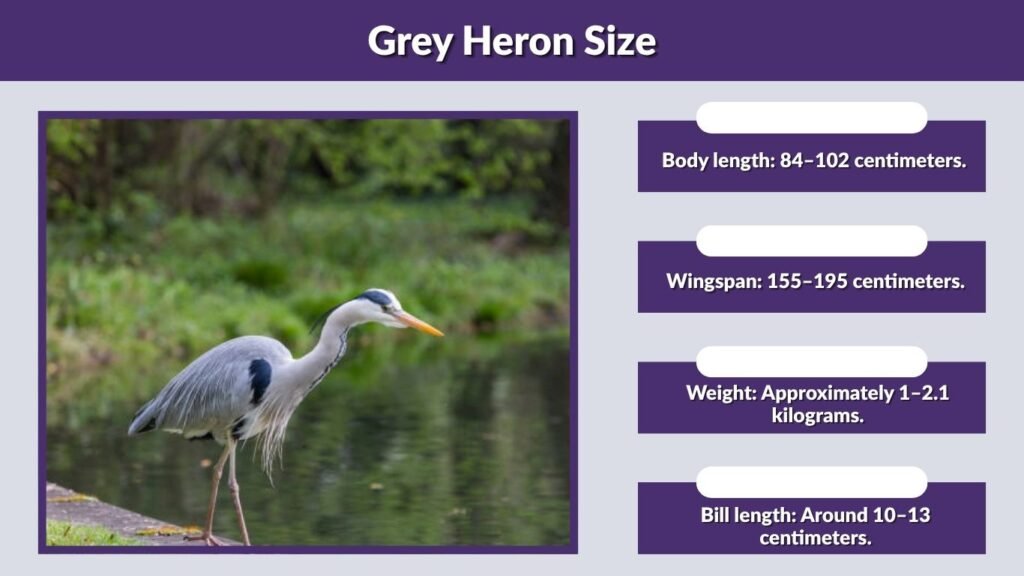
Grey Herons are among the largest and most noticeable wetland birds in their range. An adult can stand close to one meter tall when its neck is fully extended.
Body Measurements
Typical Grey Heron measurements include:
- Body length: 84–102 centimeters
- Wingspan: 155–195 centimeters
- Weight: Approximately 1–2.1 kilograms
- Bill length: Around 10–13 centimeters
- Standing height: Up to about one meter
Males are generally slightly larger and heavier than females, but the difference is difficult to notice without comparing two birds directly. Both sexes have the same long legs, dagger-shaped bill, broad wings, and flexible S-shaped neck.
A Grey Heron may look slim while standing, but it appears surprisingly large in flight. Its broad wings allow it to fly with slow, powerful wingbeats.
Grey Heron Color and Appearance
Adult Grey Herons have grey upperparts, pale underparts, and a mostly white head and neck. A bold black stripe extends from above each eye toward the back of the head, forming a narrow crest.
Adult Plumage
The main colors and features of an adult include:
- Blue-grey back and wings
- White head and neck
- Black eye stripe and crest
- Greyish-white underparts
- Black markings on the shoulders and flanks
- Long yellow, orange, or pinkish-yellow bill
- Brownish, yellow-brown, or reddish legs
- Yellow eyes
During the breeding season, the bill and legs may become brighter. Adults also develop long decorative feathers on the breast, shoulders, and back.
Juvenile Grey Heron
Juvenile birds are duller than adults. Their head and neck are mostly grey, and they lack the adult’s clean white crown and long black crest. Their back is usually browner, while the neck may have dark streaks.
Young birds gradually acquire adult plumage. However, it may take time for their head pattern and decorative feathers to become fully developed.
Grey Heron Habitat and Range
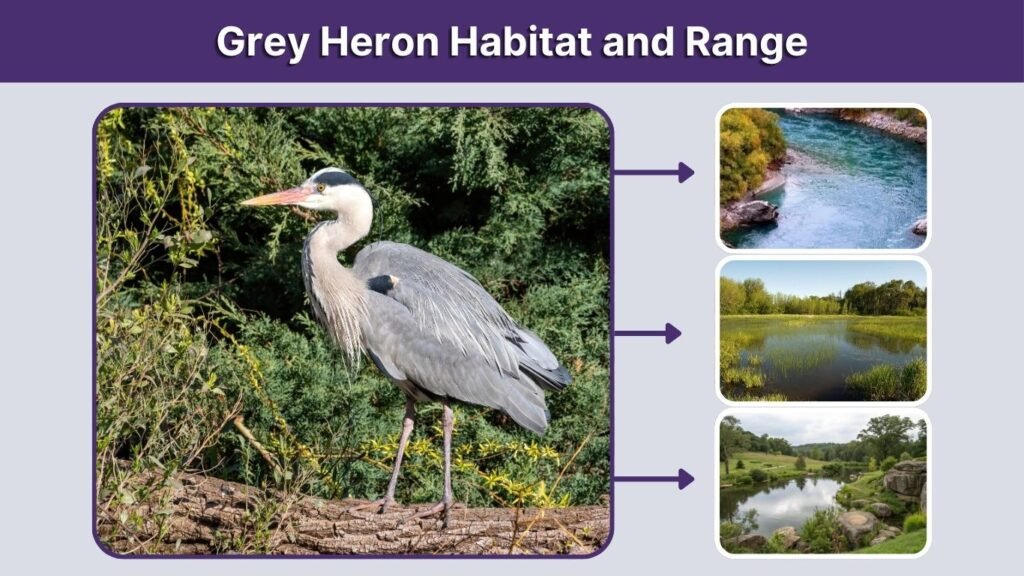
Grey Herons have an extensive distribution across Europe, Asia, and parts of Africa. They are permanent residents in many areas, but northern populations may migrate south when lakes and rivers freeze.
Preferred Habitat
Grey Herons can live around almost any freshwater, brackish, or coastal habitat that provides accessible prey. Common habitats include:
- Rivers and streams
- Lakes and reservoirs
- Marshes and swamps
- Farm ponds and garden ponds
- Flooded fields
- Drainage channels
- Estuaries and coastal lagoons
- Mudflats and rocky shorelines
- Mangroves and rice fields
The water must usually be shallow enough for the bird to stand or walk while hunting. However, Grey Herons sometimes feed away from water in fields and grasslands, where they catch rodents, insects, reptiles, and amphibians.
Urban Habitats
Grey Herons can adapt remarkably well to cities. They may visit public parks, canals, artificial lakes, fish farms, and private garden ponds.
Urban birds sometimes become accustomed to people, but they remain wild animals. Feeding them regularly may cause dependence or encourage them to approach unsafe areas.
What Do Grey Herons Eat?
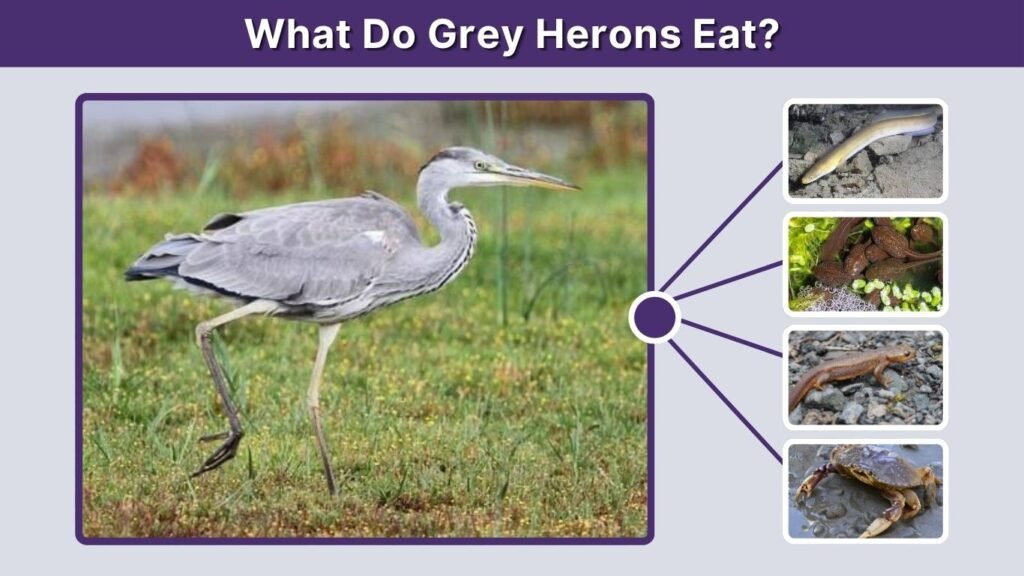
Grey Herons are opportunistic carnivores. Fish form the largest part of their diet in many habitats, but they consume almost any small animal they can catch and swallow.
Their diet may include:
- Fish and eels
- Frogs and tadpoles
- Newts and other amphibians
- Crabs and aquatic crustaceans
- Insects and insect larvae
- Snakes and lizards
- Mice, rats, voles, and young rabbits
- Small birds and ducklings
- Mollusks and worms
The exact diet varies according to location, season, and food availability. A heron living near a lake may eat mostly fish, while one hunting on farmland may take rodents, insects, and frogs.
Grey Herons usually swallow smaller prey whole. They manipulate larger fish with the bill so the prey enters headfirst, reducing the chance that fins or scales will become lodged in the throat.
How Does a Grey Heron Hunt?
The Grey Heron is best known for its patient hunting technique. It stands motionless in shallow water, with its neck partly folded and its eyes focused on the surface. When prey comes within range, the heron rapidly extends its neck and strikes with its pointed bill.
Hunting Techniques
Grey Herons use several methods to capture food:
- Standing motionless and waiting for prey
- Walking slowly through shallow water
- Stirring the bottom with one foot
- Striking fish with a rapid forward thrust
- Picking insects and rodents from fields
- Hunting from rocks, banks, or floating structures
The neck does not simply bend like a flexible tube. Specialized neck vertebrae allow it to form an S-shape and then extend forward with exceptional speed.
Grey Herons normally feed alone and may defend a profitable hunting area from other birds. They are most active around dawn and dusk but can hunt throughout the day or even at night.
Grey Heron Behavior and Flight
A Grey Heron often stands upright or rests on one leg. It may remain in the same location for long periods while watching for prey.
In flight, the bird pulls its neck back against its body and allows its long legs to trail behind. This separates it from cranes and storks, which usually fly with their necks extended.
Its wingbeats are slow and deliberate. Grey Herons can also glide and occasionally circle high on rising warm air. When disturbed, they often produce a loud, harsh call that sounds like a rough “fraank.”
Although Grey Herons commonly feed alone, they often gather to nest in colonies. They may also roost together in trees outside the breeding season.
Grey Heron Life Cycle
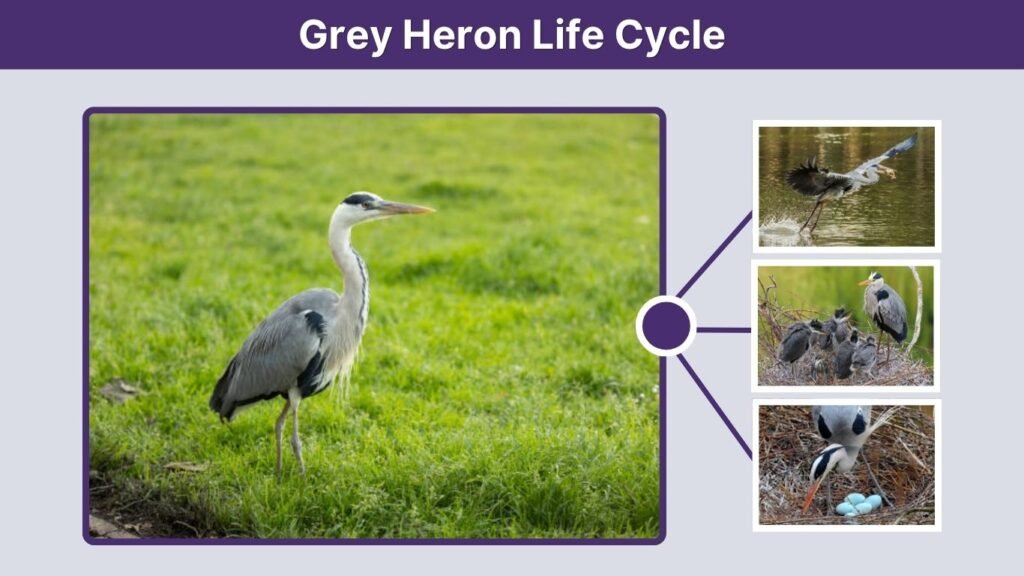
The Grey Heron’s life cycle begins with courtship and nesting, followed by egg laying, chick development, fledging, and eventual maturity.
Courtship and Nest Building
Breeding usually begins between late winter and spring, although timing varies by region. Grey Herons commonly nest in colonies called heronries. A heronry may contain a few pairs or hundreds of nests.
Nests are usually built high in mature trees near suitable feeding areas. Herons may also nest in bushes, reed beds, on cliffs, or occasionally on the ground where trees are unavailable.
The male generally collects sticks, while the female arranges them into a broad platform. A pair may reuse the same nest for several years, adding new material each season.
Eggs and Incubation
A female usually lays three to five pale blue-green eggs. The eggs are laid at intervals, so the chicks do not all hatch at exactly the same time.
Both parents incubate the eggs for approximately 25–26 days. They take turns protecting the nest while the other bird feeds.
Chicks and Parental Care
Newly hatched chicks are covered in pale down and are completely dependent on their parents. Both adults bring food to the nest and regurgitate it for the young.
As the chicks grow, competition for food can become intense. Older or stronger chicks may receive more food, particularly when prey is scarce.
Young herons begin climbing around the nest and nearby branches before they can fly well. They normally fledge at approximately seven to eight weeks old but may continue depending on their parents for a short period.
Maturity and Breeding
Juvenile Grey Herons leave the nesting area and begin learning to hunt independently. Catching fast-moving fish requires coordination, and inexperienced birds may initially have limited success.
They generally reach breeding maturity at around two years of age. Most pairs raise one brood per year, although replacement clutches or second attempts may occur if the first nest fails early.
Grey Heron Lifespan and Predators
The average wild lifespan is approximately five years, largely because many young birds die during their first winter. However, individuals that survive the difficult juvenile stage may live much longer. The oldest recorded Grey Herons have survived for more than 20 years.
Eggs and chicks may be taken by crows, ravens, birds of prey, and climbing mammals. Adult herons have fewer natural predators because of their large size and sharp bills. Severe weather, food shortages, habitat loss, fishing lines, pollution, and collisions present more significant dangers.
Grey Heron Conservation
The Grey Heron is not currently considered globally threatened. It remains widespread and can adapt to natural and human-modified environments.
However, local populations may be affected when wetlands are drained, nesting trees are removed, or feeding areas become polluted. Protecting shallow wetlands, mature nesting trees, riverbanks, and undisturbed breeding colonies helps support healthy populations.
FAQs
Are Grey Herons and Great Blue Herons the same?
No. The Grey Heron is an Old World species found mainly in Europe, Asia, and Africa. The Great Blue Heron lives primarily in North and Central America. They look similar, but the Great Blue Heron is generally larger and has more reddish coloring on its thighs and shoulders.
Do Grey Herons eat fish from garden ponds?
Yes. Grey Herons may visit garden ponds and eat small ornamental fish. Pond owners can protect fish by providing deep areas, floating cover, dense aquatic plants, or a properly installed pond net that does not trap wildlife.
Do Grey Herons mate for life?
Grey Herons are usually seasonally monogamous. A male and female form a pair and raise their chicks together during one breeding season. They may reunite in later years, but lifelong partnerships are not guaranteed.
Where do Grey Herons sleep?
Grey Herons sleep or rest in trees, reed beds, quiet shorelines, or other secure places. Some birds gather in communal roosts, particularly outside the breeding season. Elevated roosts offer protection from many ground predators.
Are Grey Herons dangerous to humans?
Grey Herons normally avoid close contact and are not considered dangerous. However, their long, pointed bills can cause injury if a bird is captured or cornered. An injured heron should only be handled by a trained wildlife professional.
