
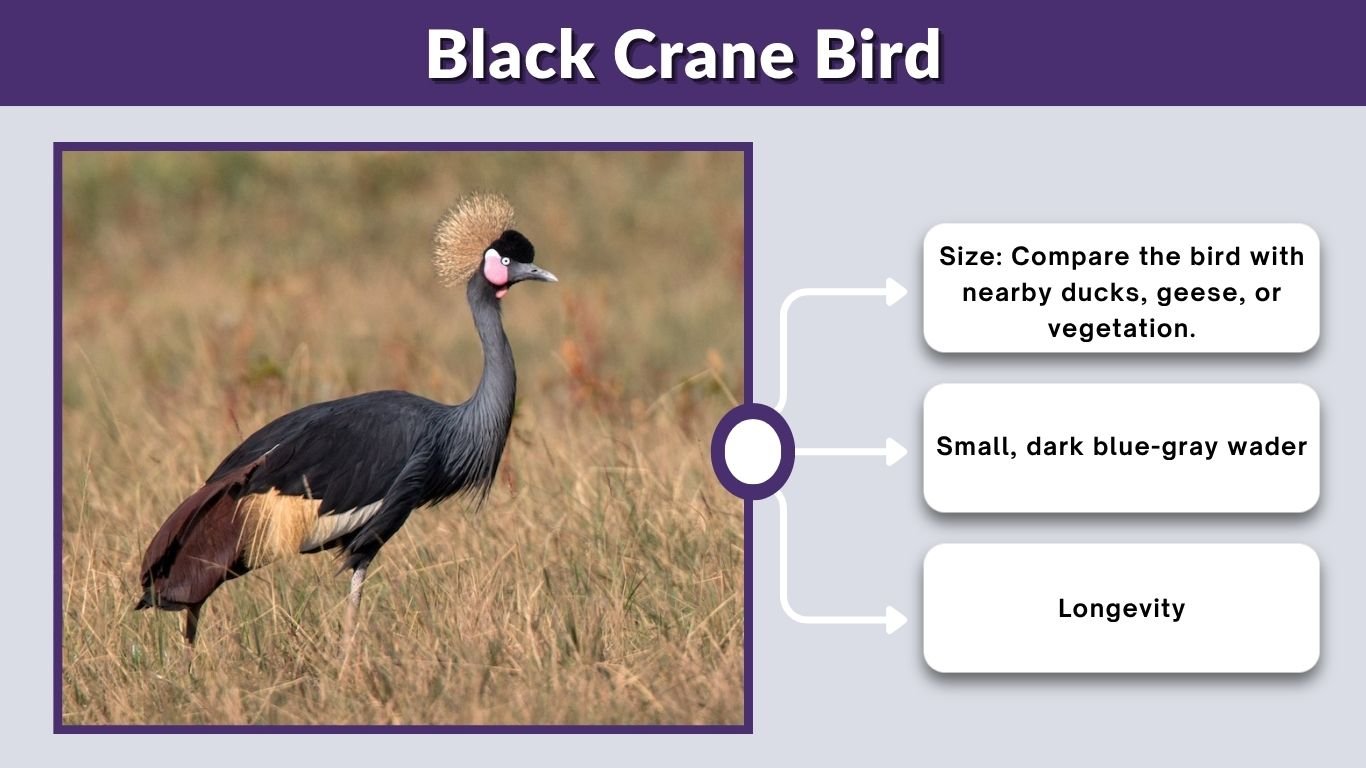
A tall, dark bird standing beside a lake or walking through a marsh is often described as a black crane bird. However, completely black cranes are exceptionally rare, and many birds given this name are actually herons, ibises, storks, cormorants, or rails. The Black-necked Crane is the species most closely associated with the name, although its entire body is not black. Location, body shape, bill style, leg position, and feeding behavior provide the best identification clues. This guide examines true dark-colored cranes and the black crane-like birds commonly seen in Florida, Texas, Utah, and other regions.
Is There an All-Black Crane Bird?
There is no widely recognized crane species with completely black adult plumage. Cranes belong to the family Gruidae, whose members are generally gray, white, blue-gray, or a mixture of black and white. Some have black necks, dark wing feathers, or black secondary plumage that becomes visible during flight.
A bird that appears entirely black may be affected by poor lighting, distance, wet feathers, or individual color variation. More often, the observer has encountered another type of long-legged wetland bird.
The Black-Necked Crane
The Black-necked Crane (Grus nigricollis) is the true crane most closely connected with the term “black crane.” It has a black head, upper neck, and tail area, but most of its body is pale gray or whitish.
Important identification features include:
- Pale gray or whitish body
- Completely black head and upper neck
- Bare red crown patch
- Dark tail and wing feathers
- Long black legs
- Straight, pointed bill
- Height of approximately 4–4½ feet
- Broad wings with black flight feathers
Black-necked Cranes inhabit high-altitude wetlands, river valleys, marshes, and agricultural areas across the Tibetan Plateau and surrounding parts of Asia. Bhutan is particularly famous for wintering populations. The species is not native to Florida, Texas, Utah, or other parts of North America.
Black Crowned Crane
The bird sometimes called a “black crowned crane” is usually the Black Crowned Crane (Balearica pavonina). It is a genuine African crane with predominantly dark gray or blackish plumage.
This species has a distinctive golden crown of stiff feathers, white wing patches, a red throat pouch, and a red-and-white facial pattern. It occupies wetlands and open grasslands across parts of western and central Africa.
The Black Crowned Crane is the national bird of Nigeria. Although its dark body can look black from a distance, its elaborate crown and colorful face make it easy to distinguish from North American wetland birds.
How to Identify a Black Crane-Like Bird
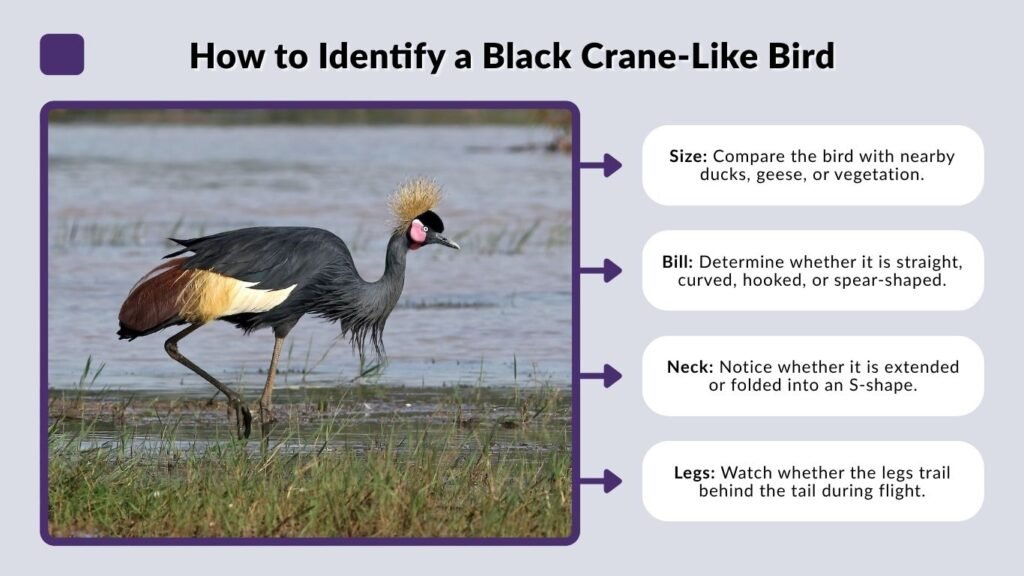
Identification should begin with body structure rather than color. Many unrelated wetland birds have dark feathers, long legs, and extended necks, but their bills, posture, and flight patterns differ.
Key Identification Features
When observing a dark crane-like bird, look for the following characteristics:
- Size: Compare the bird with nearby ducks, geese, or vegetation.
- Bill: Determine whether it is straight, curved, hooked, or spear-shaped.
- Neck: Notice whether it is extended or folded into an S-shape.
- Legs: Watch whether the legs trail behind the tail during flight.
- Feet: Check for long toes, webbed feet, or large crane-like feet.
- Flight: Observe wing speed and whether the neck remains straight.
- Habitat: Record whether it is in shallow water, deep water, grassland, or trees.
- Behavior: Look for wading, swimming, diving, stalking, or probing.
True cranes generally fly with their necks fully extended and their long legs trailing behind. Herons usually retract their necks into an S-shape during flight.
Crane, Heron or Ibis?
The following comparison can help separate these similar-looking birds:
| Feature | Crane | Heron or Egret | Ibis |
| Neck in flight | Extended straight | Folded backward | Extended straight |
| Bill | Straight and moderately long | Long and spear-shaped | Long and curved downward |
| Body posture | Upright | Often hunched or stretched | Forward-leaning while feeding |
| Feeding method | Walks and picks food | Stalks and strikes prey | Probes mud and shallow water |
| Common habitat | Wetlands and grasslands | Wetlands and shorelines | Marshes, mudflats and lawns |
| Legs in flight | Trail far behind body | Trail behind body | Trail behind body |
Common Black Birds That Look Like Cranes
Several dark-colored birds may be mistaken for cranes. The likely identification depends strongly on the location and habitat.
Black Heron
The Black Heron is a medium-sized African heron with dark plumage, long black legs, and yellow feet. It is famous for creating an umbrella with its wings while feeding. This canopy reduces glare and attracts or exposes fish beneath the water.
Because Black Herons are native to sub-Saharan Africa, a reported black crane in North America is unlikely to be this species.
Little Blue Heron
The Little Blue Heron is one of the most likely “small black crane” identifications in Florida and other parts of the southeastern United States. Adults have dark slate-blue bodies and purplish heads and necks, which can look black in shadows.
This heron has long greenish legs and a narrow bill with a dark tip. It usually hunts alone by walking slowly through shallow water. Juveniles are white and gradually develop patches of blue-gray feathers as they mature.
Tricolored Heron
The Tricolored Heron has a blue-gray back, dark wings, a purplish neck, and a white belly. From a distance, the darker upper body can create the appearance of a black-and-white crane bird.
It is relatively slender and active, often rushing, turning, or spreading its wings while chasing small fish. It is common in coastal wetlands across Florida and the Gulf Coast.
Black-Crowned Night Heron
Despite its name, the Black-crowned Night Heron is not entirely black. Adults have a black crown and back, pale gray wings, red eyes, and short yellow legs. Their stocky bodies and hunched posture distinguish them from true cranes.
These herons are most active from evening through early morning. Juveniles are brown with pale spots and may be mistaken for other young wading birds.
Glossy Ibis
A Glossy Ibis can appear nearly black from a distance. In good light, its feathers show glossy shades of bronze, chestnut, green, and purple. Its most distinctive feature is its long bill, which curves downward.
Glossy Ibises feed by probing muddy ground and shallow water. They are common in Florida and occur in scattered wetlands across other areas of the United States.
White-Faced Ibis
The White-faced Ibis is another dark wetland bird with iridescent plumage and a down-curved bill. Breeding adults develop reddish legs and a narrow border of white feathers around their reddish facial skin.
This species is particularly relevant to reports of black crane-like birds in Utah and western North America. Flocks frequently feed in shallow marshes, flooded fields, and muddy wetlands.
Double-Crested Cormorant
Cormorants are large, dark waterbirds with long necks and slightly hooked bills. They swim low in the water, dive for fish, and commonly stand with their wings spread to dry.
Their black plumage and upright stance can create a crane-like appearance when they stand on a dock, rock, or shoreline. However, their short legs and webbed feet are very different from the long legs of a crane.
Anhinga
The Anhinga is sometimes called the snakebird because it swims with only its narrow head and neck above the surface. Adults have dark bodies, long pointed bills, and long tails. Males are mostly black with silvery markings on their wings and back.
Anhingas are common in Florida and other warm regions of the southeastern United States. When standing with outstretched wings, they may look like unusually dark herons or small cranes.
Limpkin
A Limpkin is a long-legged marsh bird with brownish-black plumage covered in pale streaks. It has a long neck and a slightly curved bill adapted for feeding on apple snails.
Limpkins are common in Florida, where their tall shape frequently causes confusion with cranes and herons. Their loud, wailing calls are especially noticeable at night.
Black Crane Birds in Florida
A black crane-like bird in Florida is unlikely to be a true crane. Florida’s native cranes are the Sandhill Crane and the extremely rare Whooping Crane, neither of which is all black.
The most likely dark look-alikes are:
| Description | Likely Florida Bird |
| Small, dark blue-gray wader | Little Blue Heron |
| Dark bird with curved bill | Glossy Ibis |
| Black swimming bird drying its wings | Anhinga or cormorant |
| Brown-black bird with white streaks | Limpkin |
| Dark back, gray wings and red eyes | Black-crowned Night Heron |
| White body with black head and neck | Wood Stork or unusual plumage pattern |
| Gray bird with a red crown | Sandhill Crane |
A large black bird with a reddish head may be a Turkey Vulture rather than a crane. In flight, Turkey Vultures hold their wings in a shallow V and have relatively short legs.
Is a Dark Bird in Florida an Egret?
Egrets are members of the heron family and are typically white. However, the reddish egret has a dark color form with a slate-blue body and reddish neck. It occurs along coastal areas and hunts with energetic running, wing spreading, and sudden turns.
A dark-form Reddish Egret may therefore be described as a black egret or small dark crane, especially when seen from a distance.
Black Crane-Like Birds in Texas and Utah
In Texas, dark crane-like birds include Glossy Ibises, White-faced Ibises, Little Blue Herons, Tricolored Herons, Anhingas, and cormorants. Sandhill Cranes also travel through and winter in parts of the state, but they are primarily gray.
In Utah, the White-faced Ibis is one of the strongest possibilities. These dark, glossy birds gather in marshes and shallow wetlands, sometimes in large flocks. Great Blue Herons may also appear nearly black when viewed at dawn, dusk, or against bright water.
The actual Black-necked Crane is an Asian species. A report from North America would require careful documentation because it would be extraordinarily far outside its natural range.
Black and White Crane Birds
Several genuine cranes display mixtures of black and white. The Black-necked Crane has a pale body and black neck, while the Demoiselle Crane has a black neck and white feather plumes behind the eyes. The Red-crowned Crane has a white body, black neck and wing feathers, and a red crown.
Whooping Cranes are primarily white with black wing tips that become most visible during flight. They also have red facial skin and long black legs. However, a white bird with a black head and neck in Florida may be an American Wood Stork rather than a crane.
What Does a Black Crane Symbolize?
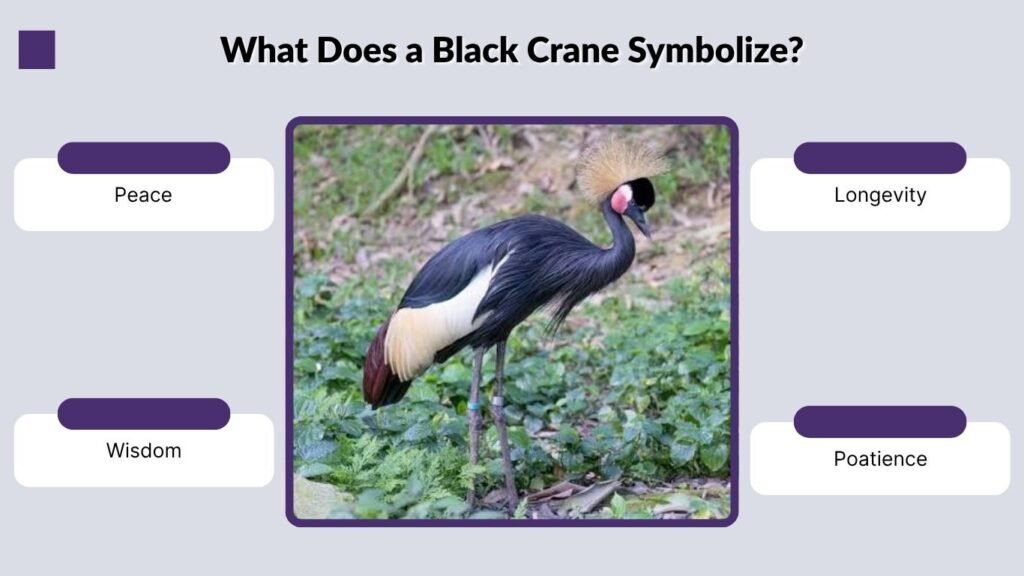
Crane symbolism varies among cultures, traditions, and artistic settings. Cranes generally represent longevity, patience, peace, wisdom, vigilance, good fortune, and spiritual transformation.
A black crane may be interpreted as a symbol of mystery, resilience, independence, protection, or change. However, there is no single universal meaning. In Bhutan, the Black-necked Crane carries strong cultural and spiritual importance and is associated with natural harmony, good fortune, and the protection of sacred landscapes.
Sounds and Behavior of Dark Crane-Like Birds
True cranes produce loud, resonant, trumpet-like calls that can travel over considerable distances. Pairs may perform coordinated calls while standing with their necks extended and bills raised.
Herons typically make rough croaks or squawks, while ibises often produce quieter grunts. Limpkins make loud, haunting screams. Cormorants and Anhingas are usually quieter but may grunt or croak around nesting colonies.
Watching behavior can also solve an identification. A bird diving underwater is probably a cormorant or Anhinga. One probing mud with a curved bill is likely an ibis. A bird standing motionless before striking a fish is generally a heron. A tall bird walking through a field with an upright body may be a true crane.
FAQs
What is the real name of a black crane bird?
The Black-necked Crane is the true crane most commonly associated with this name, although it has a pale body and black head and neck. The Black Crowned Crane is another dark species, but it is native to Africa.
Are black crane birds found in Florida?
No all-black crane species naturally occurs in Florida. A reported black crane is more likely a Little Blue Heron, Glossy Ibis, Anhinga, cormorant, Limpkin, Reddish Egret, or Black-crowned Night Heron.
What small black bird looks like a crane?
The Little Blue Heron is a common possibility, especially in the southeastern United States. Glossy and White-faced Ibises also have dark bodies and long legs, but their strongly curved bills distinguish them from cranes.
What crane has black-tipped wings?
The Whooping Crane has a mainly white body with black primary wing feathers. These black tips are mostly concealed when the wings are folded but become highly visible during flight. Its neck remains fully extended while flying.
How can I identify a distant black crane-like bird?
Photograph the bird and record its location, size, habitat, bill shape, leg color, and flight posture. A curved bill indicates an ibis, a folded neck suggests a heron, and a diving bird is probably an Anhinga or cormorant.
