
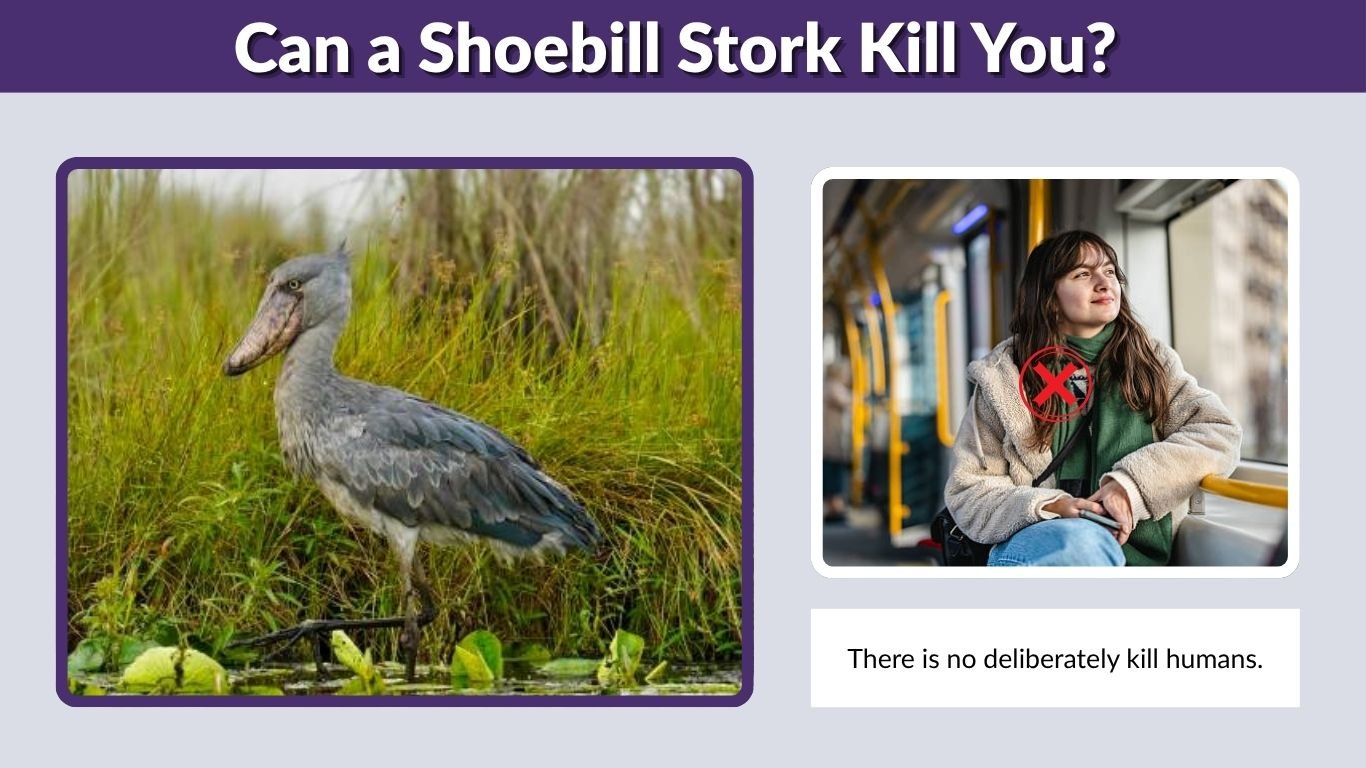
The shoebill stork looks intimidating enough to frighten almost anyone. It can stand nearly as tall as a person, has a powerful hooked bill, and produces a loud machine-gun-like clattering sound. However, its frightening appearance does not mean it normally attacks people.
A shoebill could potentially injure someone while defending itself, but humans are not its prey, and there are no known adverse effects of shoebills on people under ordinary circumstances. Shoebills can also fly, despite spending much of their time standing motionless in African wetlands.
Can a Shoebill Stork Kill You?
A shoebill is physically capable of causing a serious injury with its large, sharp-edged bill. However, there is no reliable evidence that shoebills hunt or deliberately kill humans.
Researchers studying nesting shoebills have reportedly approached within about six feet without being threatened. The birds usually remain still and stare rather than charging or attacking. Animal Diversity Web describes shoebills as docile around humans and reports no known harmful effects on people.
Why Do Shoebills Look So Dangerous?
Several physical features give the shoebill its frightening reputation:
- A bill more than seven inches long
- A sharp hook at the tip
- Cutting edges along the bill
- Forward-facing, intense-looking eyes
- A height of up to approximately five feet
- An almost motionless hunting posture
- Sudden and extremely powerful strikes
The bill is designed to catch slippery aquatic animals. Its hooked tip helps grip prey, while its sharp edges help separate fish from vegetation and control large meals.
Can a Shoebill Hurt a Human?
Yes, a defensive shoebill could potentially hurt someone. Any large wild bird may defend itself when cornered, restrained, injured, or protecting a nest.
That possibility is different from actively hunting humans. Shoebills feed mainly on fish, frogs, snakes, turtles, lizards, mollusks, and occasionally young crocodiles. A person is not part of their natural diet.
The safest approach is to:
- Keep a respectful distance from wild shoebills
- Avoid touching or feeding them
- Never approach an active nest
- Follow instructions from guides and zoo staff
- Avoid blocking the bird’s escape route
How Fast Can a Shoebill Kill You?
This question is based more on the bird’s appearance than its actual behavior. There is no verified measurement describing how quickly a shoebill could kill a human because such attacks are not a recognized pattern of shoebill behavior.
The bird can strike aquatic prey rapidly after remaining still for several minutes. During this hunting movement, called a “collapse,” it throws its head and neck forward, plunges its bill into the water, and collects prey along with plants and mud.
That fast hunting strike should not be interpreted as evidence that the bird attacks people. It is a specialized technique for capturing fish and other animals in shallow water.
Can Shoebills Fly?
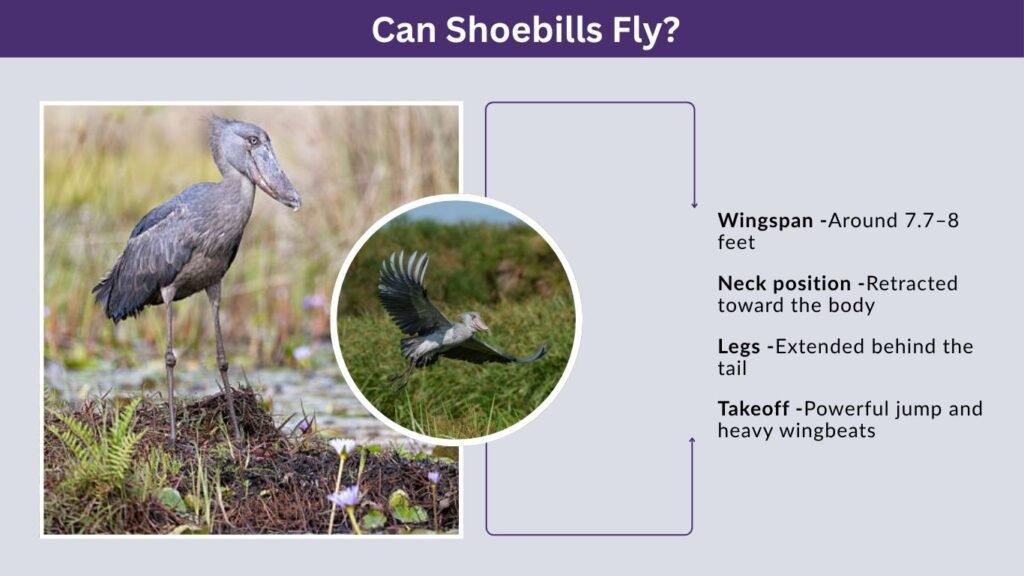
Yes, shoebills can fly. Their broad, powerful wings are well suited for soaring, and their wingspan can reach approximately 7.7 to 8 feet.
To take off, a shoebill makes a strong leap and follows it with several heavy wingbeats. Once airborne, it can use rising warm air, known as thermals, to soar over its wetland territory.
How Do Shoebills Look in Flight?
A flying shoebill holds its neck pulled backward instead of extending it straight ahead. Its long legs trail behind the body, while its large wings create slow, powerful wingbeats.
| Flight feature | Description |
| Wingspan | Around 7.7–8 feet |
| Neck position | Retracted toward the body |
| Legs | Extended behind the tail |
| Takeoff | Powerful jump and heavy wingbeats |
| Flight style | Flapping combined with soaring |
| Migration | Generally non-migratory |
Shoebills are generally sedentary when feeding conditions remain suitable, although they may make shorter seasonal movements between nesting and feeding areas.
Why Do Shoebills Rarely Appear to Fly?
Shoebills spend much of their day standing or walking slowly through marshes. Their hunting strategy requires patience, camouflage, and minimal movement, so they may remain almost perfectly still while waiting for fish to surface.
They normally fly when moving between feeding and nesting areas, crossing unsuitable habitat, escaping disturbance, or soaring over their territory.
How Fast Can a Shoebill Fly?
A dependable maximum flight speed has not been firmly established in the major official animal profiles. Although various websites publish estimated speeds, these figures are often presented without clear scientific measurements.
Reliable zoo and wildlife sources confirm that shoebills fly and soar on thermals but do not provide a verified top speed.
How Big Can a Shoebill Get?
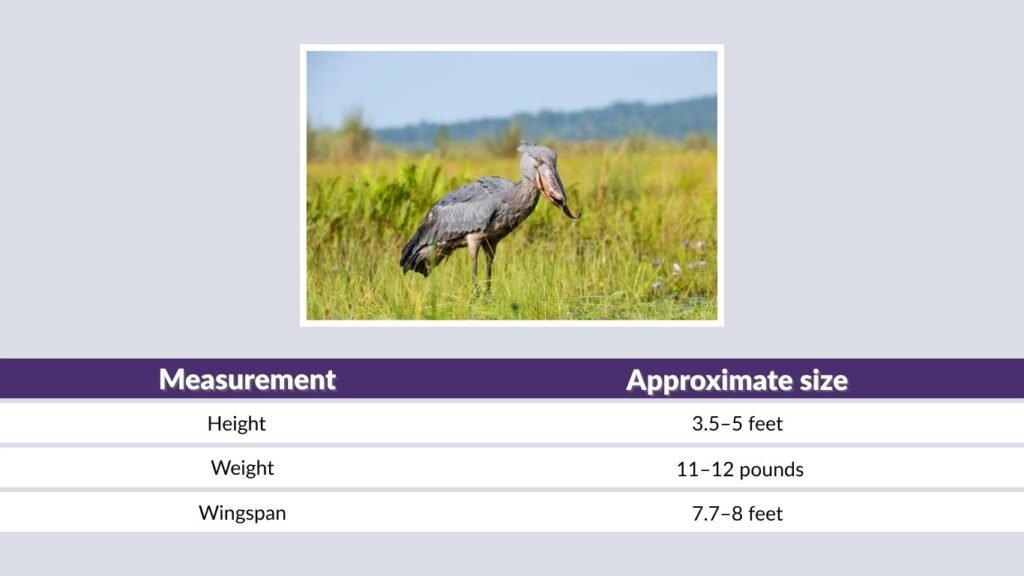
Shoebills are among Africa’s tallest wetland birds. Adults usually stand approximately 3.5 to 4.5 feet tall, while some sources report individuals approaching five feet.
Females commonly weigh around 11 pounds, and males may weigh approximately 12 pounds. Males also tend to possess slightly longer bills.
| Measurement | Approximate size |
| Height | 3.5–5 feet |
| Weight | 11–12 pounds |
| Wingspan | 7.7–8 feet |
| Bill length | More than 7 inches |
Shoebill Stork Compared to a Human
A large shoebill standing beside an adult may reach the person’s chest, shoulders, or head, depending on the heights of both. Its wingspan can also be wider than many people are tall.
Photographic perspective sometimes exaggerates its size, especially when the bird stands closer to the camera. Nevertheless, it is genuinely a very tall and broad-winged bird.
Can You Own a Shoebill Stork?
A shoebill is not an appropriate private pet. It requires an expansive wetland enclosure, large amounts of suitable animal food, specialized veterinary attention, and professional wildlife management.
The species is classified as Vulnerable, with an estimated 3,300–5,300 mature individuals remaining in the wild. Illegal capture and live-bird trafficking are among the threats contributing to its decline.
Ownership laws differ between countries and regions, but a person should never assume that buying, importing, or keeping a shoebill is legal. Responsible facilities obtain protected wildlife through regulated conservation and breeding programs rather than ordinary pet sales.
Can You Pet a Shoebill?
People should not attempt to pet a wild shoebill. Even a normally calm bird can react defensively when touched or crowded.
Some captive shoebills become accustomed to professional keepers, but this does not make them domesticated. Visitors should only interact with an animal when the facility permits it and trained staff provide direct instructions.
Where Can You See a Shoebill Stork?

The best places to see wild shoebills are freshwater swamps in central and eastern Africa. Their range extends from South Sudan to Zambia, with important viewing areas in Uganda and Zambia.
Seeing Shoebills in Zoos
Only a limited number of zoos keep shoebills. Current official facility pages include:
- Dallas World Aquarium, Texas: Its Borneo exhibit lists the shoebill stork.
- ZooTampa, Florida: Its official animal directory currently includes shoebills.
- Prague Zoo, Czech Republic: Visitors can observe shoebills in the Bird Wetlands complex.
- Ueno Zoo, Tokyo: Its current Shoebill Research Lab identifies four resident birds.
Zoo collections and exhibit access can change because of animal transfers, breeding, health concerns, or enclosure maintenance. Visitors should check the facility’s official animal list before arranging a long trip.
FAQs
Can a Shoebill Kill a Crocodile?
A shoebill can catch and kill a very young crocodile. It cannot defeat a healthy adult crocodile, which would be much larger and potentially dangerous to the bird. Young crocodiles are occasional prey rather than its primary food.
Can Shoebills Swim?
Shoebills are mainly wading birds. They use long legs and widely separated toes to move across shallow water and floating vegetation. They are not known as specialized swimming birds and usually travel by walking, wading, or flying.
Can Shoebills Live in Florida?
Shoebills could survive only in carefully managed conditions, such as a professional zoo enclosure. They are native to African wetlands and should never be released into Florida or any other location outside their natural range.
Are Shoebills Aggressive?
Shoebills can be territorial around nests and feeding areas, but they are not generally aggressive toward people. Their normal response to a nearby human is often to remain still, stare, or move away.
Can a Shoebill Eat a Monkey?
Monkeys are not a normal part of the shoebill’s diet. Shoebills primarily catch fish and other aquatic animals. Viral images or videos claiming that they regularly eat monkeys are usually exaggerated, mislabeled, or unsupported.
