
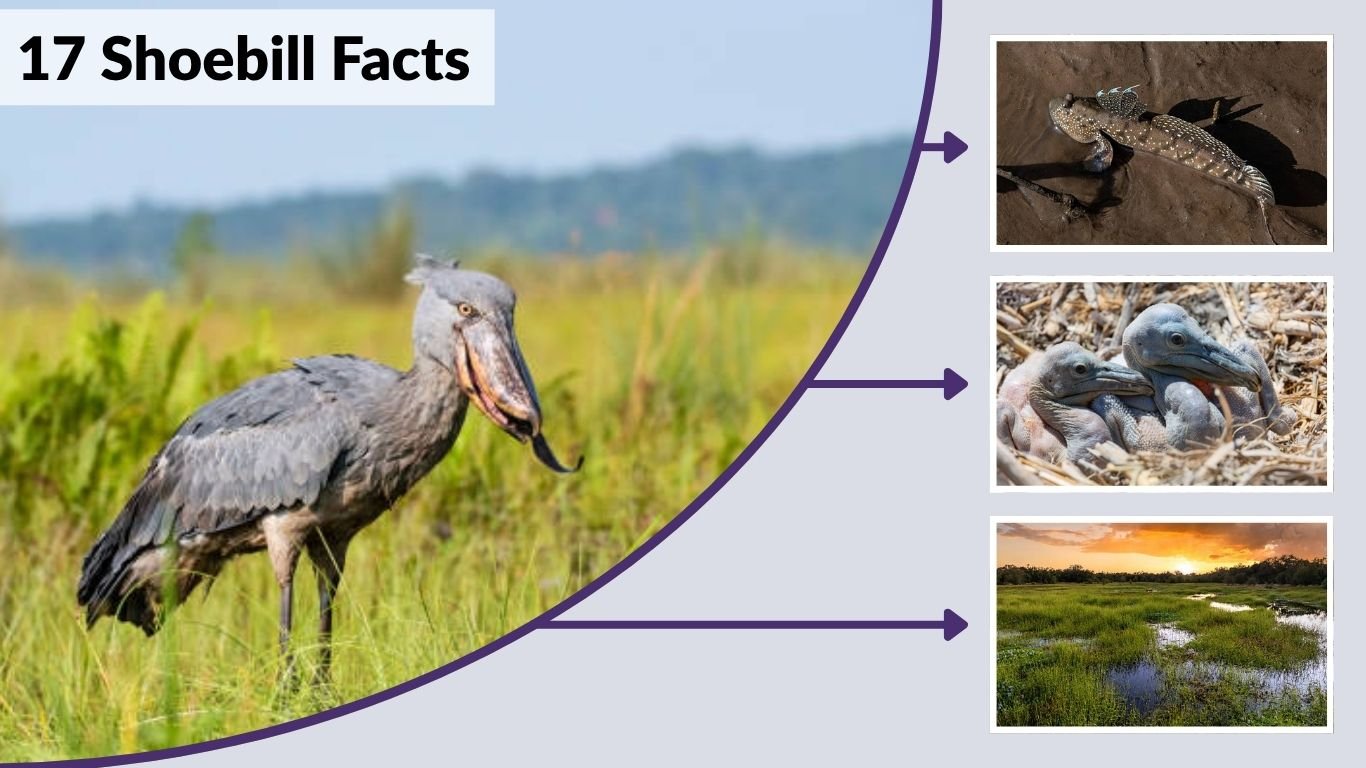
The shoebill is one of the most unusual birds in the world. Its enormous bill, piercing stare, gray feathers, and slow movements give it a prehistoric appearance. Commonly called the shoebill stork, this African wetland bird is famous for standing completely motionless before attacking prey with surprising speed.
Here are 17 interesting shoebill facts covering its appearance, habitat, diet, hunting behavior, chicks, lifespan, and conservation.
Quick Shoebill Facts
| Feature | Information |
| Scientific name | Balaeniceps rex |
| Family | Balaenicipitidae |
| Habitat | Freshwater swamps and marshes |
| Diet | Mainly fish and other aquatic animals |
| Height | Approximately 110–140 cm |
| Lifespan | Up to about 35 years |
| Conservation status | Vulnerable |
Shoebills inhabit freshwater wetlands from South Sudan to Zambia. BirdLife International estimates that only about 3,300–5,300 mature individuals remain in the wild.
1. The Shoebill Is Not a True Stork
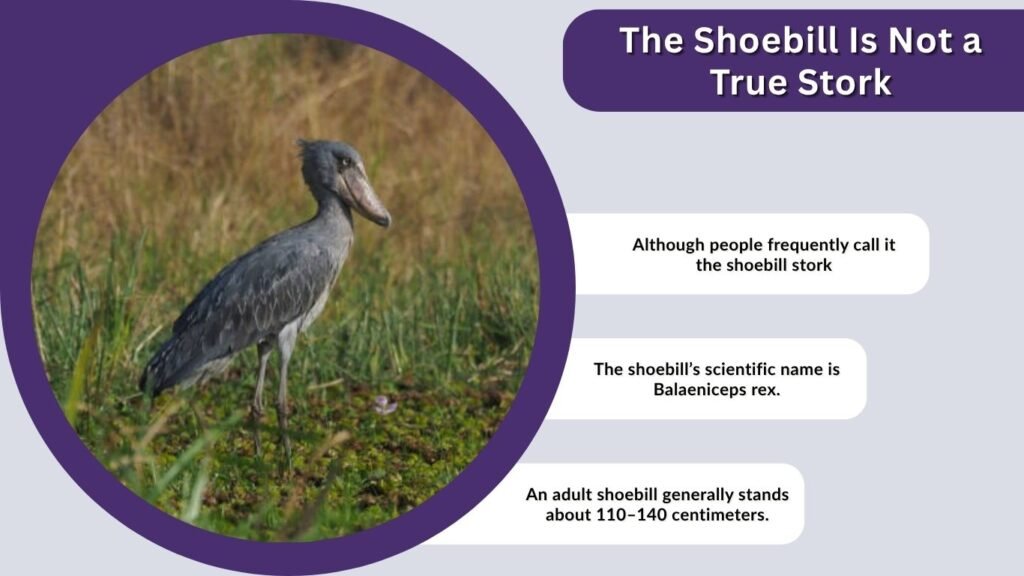
Although people frequently call it the shoebill stork, the shoebill is not classified as a true stork. It belongs to its own family, Balaenicipitidae, and is more closely related to pelicans.
Its stork-like name comes from its tall body, long legs, wetland lifestyle, and habit of clattering its bill. However, its scientific relationships place it among pelican-like waterbirds.
2. Its Scientific Name Means “Whale-Head King”
The shoebill’s scientific name is Balaeniceps rex. The name refers to the bird’s enormous head and bill.
“Balaeniceps” relates to a whale-like head, while “rex” means king. This makes “whale-head king” an appropriate name for a bird sometimes called the king of the marshes.
3. Its Bill Looks Like a Wooden Shoe
The shoebill gets its common name from its broad, deep bill, which resembles a traditional wooden shoe.
Bill Adaptations
- A strong hook at the tip
- Sharp edges for controlling prey
- A broad opening for scooping fish
- Enough capacity to carry water
- A mottled yellow, brown, and gray appearance
The bill helps the bird catch slippery fish, remove unwanted vegetation and manage relatively large prey.
4. Shoebills Can Stand Nearly Five Feet Tall
An adult shoebill generally stands about 110–140 centimeters, or 43–55 inches tall. BirdLife reports that exceptionally large individuals may reach about 152 centimeters.
Males are usually somewhat larger than females and may possess longer bills. A large shoebill standing beside a person can reach the person’s chest, shoulders or even close to eye level.
5. Their Wingspan Is Wider Than Many People Are Tall
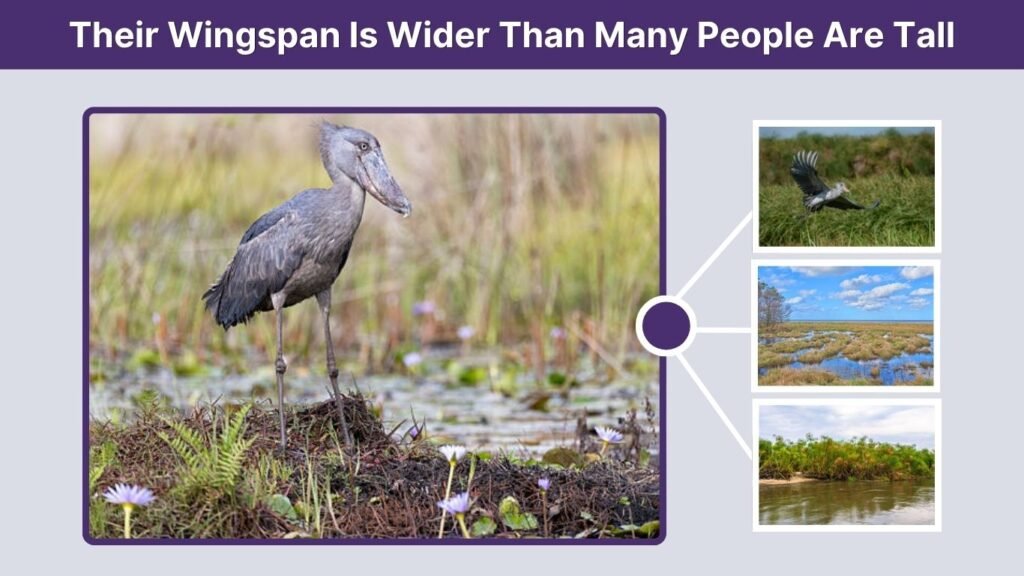
Despite their heavy appearance, shoebills possess broad wings that can span more than seven feet.
They use powerful wingbeats during takeoff and may soar on rising warm air. During flight, the shoebill pulls its neck backward while allowing its long legs to extend behind its body.
6. Shoebills Can Fly
Shoebills spend much of their day standing or walking slowly, which can make them appear unable to fly. However, they are capable fliers.
They fly between feeding and nesting locations, escape disturbances and soar over their territories. Shoebills are generally non-migratory when food and water remain available, although they may make local seasonal movements.
7. They Live Only in Africa
Wild shoebills inhabit tropical East and Central Africa. Important populations occur in South Sudan, Uganda, western Tanzania, eastern Democratic Republic of the Congo, Rwanda and northern Zambia.
Their distribution closely follows the presence of large freshwater wetlands, papyrus vegetation and fish such as lungfish.
8. Shoebills Are Swamp Specialists
Shoebills live in extensive freshwater marshes, papyrus swamps, floodplains, reed beds and areas covered by floating vegetation.
They often favor poorly oxygenated water. Fish living in such water must approach the surface more frequently to breathe, making them easier for the shoebill to detect and capture.
9. Fish Are Their Main Food
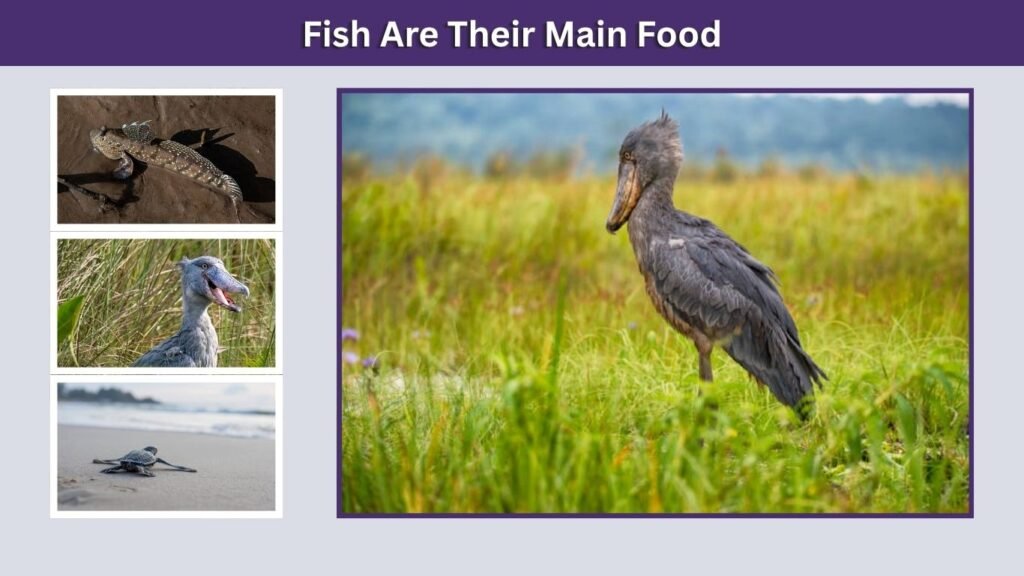
Shoebills are carnivores and specialized fish hunters. Lungfish are among their most important foods, but they also consume catfish, tilapia and other aquatic prey.
Their diet may include:
- Lungfish
- Catfish
- Tilapia
- Bichirs
- Frogs
- Water snakes
- Turtles
- Monitor lizards
- Mollusks
- Small waterbirds
- Occasionally very young crocodiles
Stories claiming that shoebills regularly hunt monkeys or adult crocodiles are exaggerated. Their feeding adaptations are designed primarily for catching aquatic animals.
10. They Hunt by Standing Completely Still
A hunting shoebill may remain motionless for a long time while watching the water. This behavior helps it avoid alerting fish and other prey.
When an animal moves within range, the shoebill suddenly throws its body forward and plunges its bill into the water. This rapid hunting movement is sometimes described as a collapse.
The bird may collect mud, water and plants along with the prey. It then swings its head to remove the vegetation while maintaining its grip on the captured animal.
11. Shoebills Sometimes Decapitate Their Prey
A shoebill may use its hooked bill to crush or decapitate a large fish before swallowing it. Smaller prey may be swallowed whole.
The shoebill usually positions a large fish headfirst. This allows fins, scales and other body parts to fold backward more easily as the bird swallows.
12. They Make a Machine-Gun-Like Sound
Shoebills are generally quiet, but they produce a startling sound by rapidly striking the two halves of their bill together.
This bill clattering resembles repeated wooden knocking or machine-gun fire. Adults use it when greeting a mate, communicating around the nest or performing breeding displays.
Adults can also produce whining or mooing noises, while hungry chicks make unusual hiccup-like calls.
13. Their Stare Helps Them Hunt
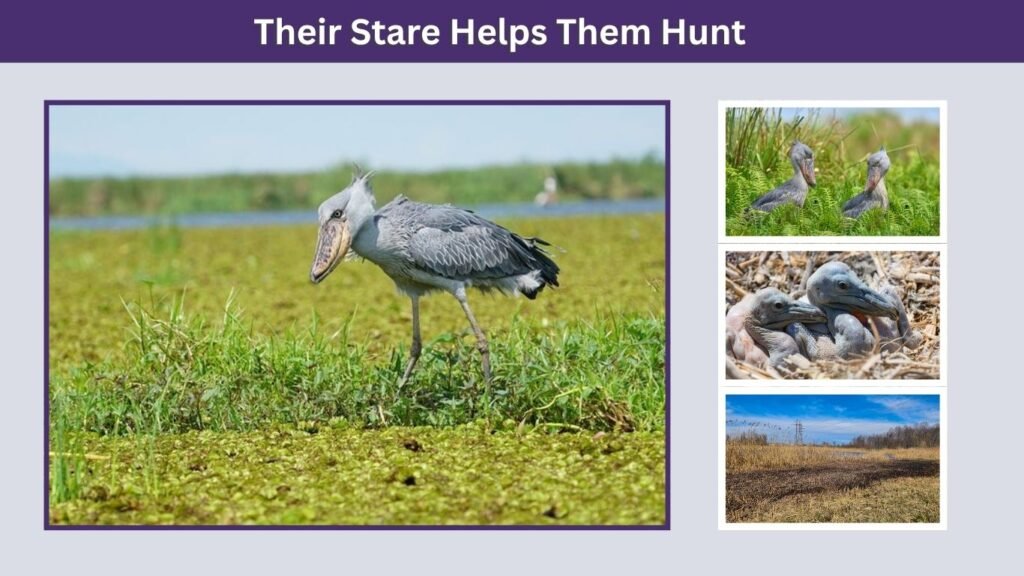
The shoebill’s intense stare is not simply a frightening expression. Its eyes help it focus on movements below the water.
Shoebills hold their heads and bills almost vertically while watching for prey. Their eye position supports binocular vision, helping them judge distance accurately before striking.
14. Shoebills Are Usually Solitary
Shoebills normally hunt and rest alone. Even a breeding male and female may search for food on opposite sides of their shared territory.
They are territorial and generally avoid gathering in large groups. Several birds may feed relatively close together when prey becomes concentrated, but shoebills are not naturally social flocking birds.
15. Both Parents Care for the Chicks
Shoebills usually build broad nests from grasses and aquatic vegetation. The nest may be placed on a floating plant platform or a small island within the swamp.
The female lays one to three eggs, and both parents help with nest building, incubation, protection and feeding. Adults may collect water in their bills and pour it over their eggs or chicks during hot weather.
The eggs hatch after approximately 30 days. Young birds generally fledge at around 95 days but may depend on their parents for food for several more weeks.
16. Usually Only One Chick Survives
Although two or more chicks may hatch, it is common for only one to survive. The older or stronger chick may attack its sibling and receive most of the food and parental attention.
This behavior improves the strongest chick’s chance of surviving when food is limited. However, it is one of the darker facts about shoebill family life.
The parents do not normally eat their chicks. The weaker chick usually dies because of injuries, starvation, exposure or reduced parental care.
17. Shoebills Are Vulnerable to Extinction
Shoebills are classified as Vulnerable, and their population is declining. Their main threats include wetland destruction, drought, nest disturbance, hunting and illegal capture for the live-bird trade.
Because shoebills reproduce slowly and commonly raise only one surviving chick, populations may take a long time to recover after losses. Protecting large freshwater swamps and working with nearby communities are essential for their survival.
FAQs
Are Shoebills Dangerous to Humans?
Shoebills are powerful wild birds, but they are not known for hunting people. They usually remain still, stare or move away when approached. A frightened or cornered bird could defend itself with its bill, so people should maintain a respectful distance.
How Long Do Shoebills Live?
Shoebills can live for approximately 35 years. Their lifespan depends on habitat quality, food availability, disease and protection from human threats. Eggs and chicks face greater dangers than healthy adult birds.
Do Shoebills Eat Crocodiles?
Shoebills may catch very young crocodiles, but they cannot overpower a healthy adult crocodile. Fish remain their primary food, while small reptiles are taken when suitable opportunities arise.
Why Do Shoebills Look Prehistoric?
Their enormous bill, gray plumage, tall body, intense eyes and slow movements create a dinosaur-like appearance. However, the shoebill is a modern bird specially adapted for hunting in African freshwater wetlands.
Are Shoebills Friendly?
Wild shoebills are generally calm and may tolerate people nearby, but they are not domesticated or naturally friendly pets. They should not be touched, crowded or fed. Captive individuals require professional care and specialized wetland enclosures.
