
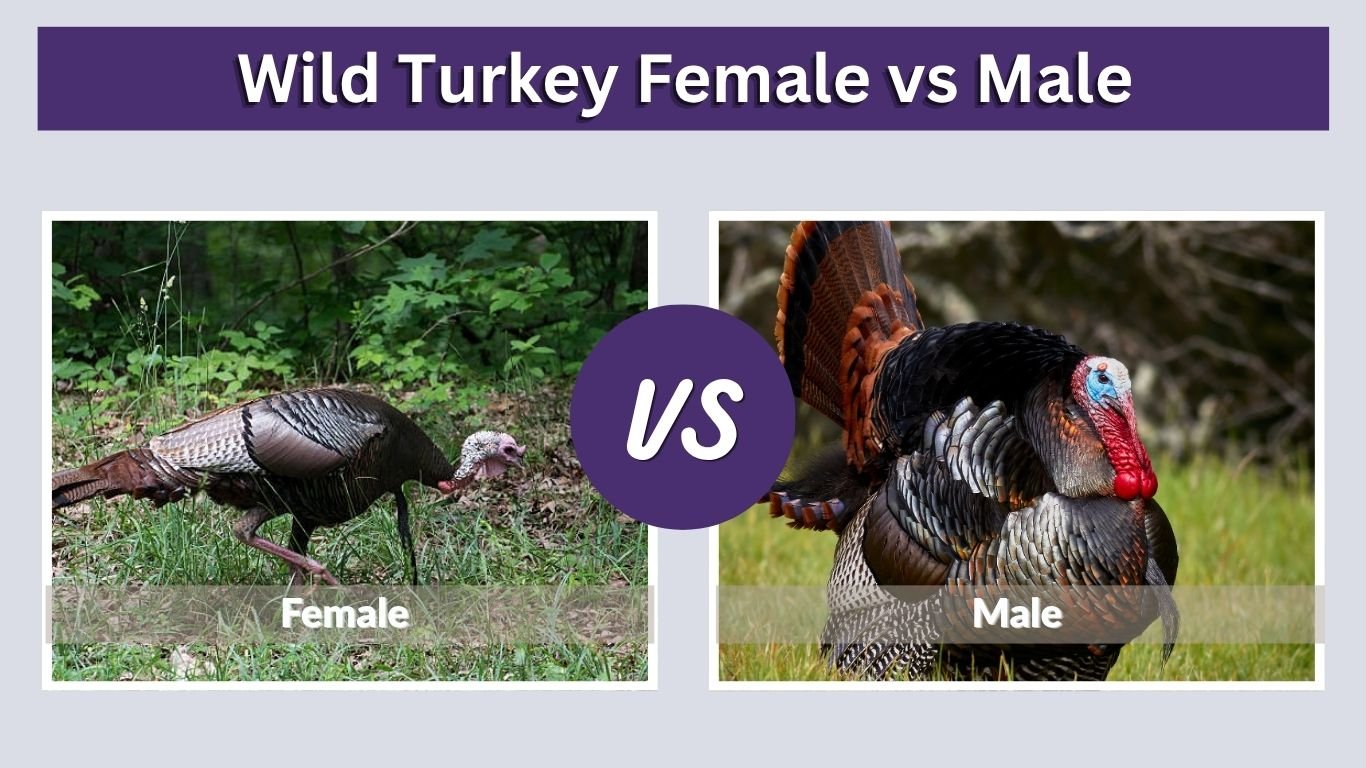
A female vs. male wild turkey can usually be identified by examining body size, feather color, head features, beard, spurs, and behavior. Male wild turkeys are larger, darker, and more colorful, especially during the breeding season. Females have duller brown plumage that helps them remain hidden while nesting. However, young males and bearded females can make identification more challenging.
Female vs. Male Wild Turkey: Quick Comparison
Male wild turkeys are called toms or gobblers, while females are called hens. Young males are known as jakes, and young females may be called jennies.
| Feature | Male Wild Turkey | Female Wild Turkey |
| Common name | Tom or gobbler | Hen |
| Average weight | About 10–25 pounds | About 8–12 pounds |
| Plumage | Dark and strongly iridescent | Dull brown and lightly iridescent |
| Head color | Bright red, white, or blue | Grayish-blue or pale pink |
| Beard | Usually long and noticeable | Usually absent or short |
| Spurs | Generally present | Usually absent |
| Strutting | Common during courtship | Rare |
| Gobbling | Loud and frequent in spring | Generally does not gobble |
| Nesting | Does not incubate eggs | Builds the nest and incubates eggs |
| Footprint | Often more than 4¼ inches | Usually smaller |
Adult toms can weigh more than twice as much as hens. Size varies with subspecies, age, habitat, and food availability, so it should not be the only identification feature.
12 Differences Between Male and Female Wild Turkeys
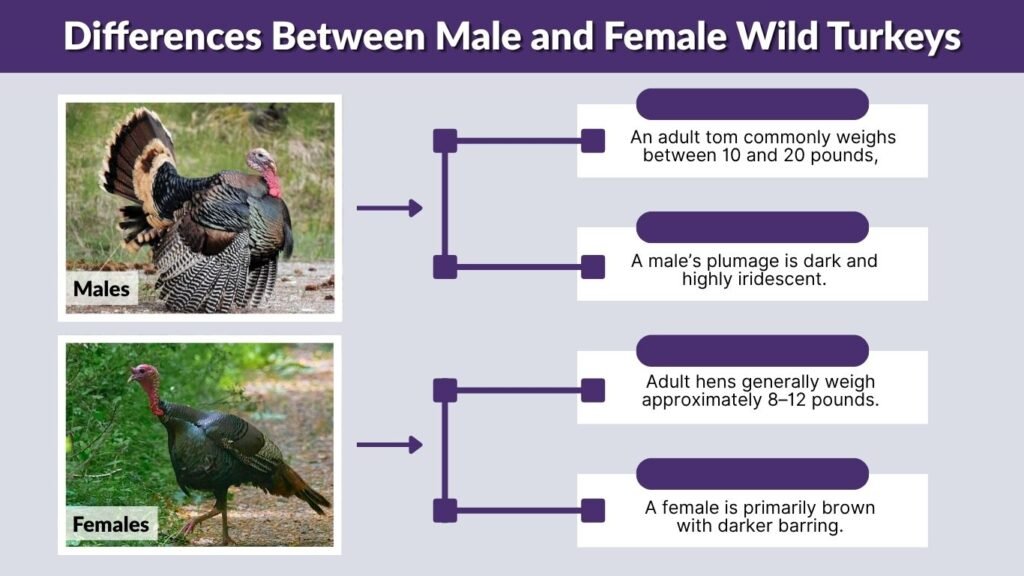
Although both sexes share the same general body shape, several physical and behavioral characteristics make them easy to distinguish when viewed clearly.
1. Body Size
Male wild turkeys are noticeably larger and heavier than females. An adult tom commonly weighs between 10 and 20 pounds, although large individuals may exceed 25 pounds. Adult hens generally weigh approximately 8–12 pounds.
Males also have longer legs, thicker bodies, broader chests, and larger feet. When males and females are standing together, size is one of the quickest ways to separate them.
2. Feather Color
A male’s plumage is dark and highly iridescent. Under direct sunlight, his feathers may reflect bronze, copper, green, blue, and purple shades.
A female is primarily brown with darker barring. Her feathers appear softer and less reflective. This dull coloration provides camouflage when she sits on a ground nest surrounded by leaves, grass, and brush.
3. Breast-Feather Tips
The tips of the breast feathers can provide reliable identification:
- Male: Breast feathers usually have black tips.
- Female: Breast feathers generally have brown or buff-colored tips.
This feature is particularly useful when head color, beard length, or body size cannot be seen clearly.
4. Head and Neck Color
Male wild turkeys have mostly bare heads covered with colorful skin. Their heads may change among red, blue, white, and purple depending on excitement, aggression, or courtship activity.
Females normally have bluish-gray heads with fine feathers extending along the back of the head and neck. Their colors are less intense and do not change as dramatically as those of males.
5. Snood and Wattles
The snood is the fleshy structure hanging above a turkey’s beak. The wattles are the fleshy folds under the chin and along the neck.
Adult males have prominent snoods and wattles. During courtship, a tom’s snood becomes longer, while his wattles enlarge and brighten. Females have much smaller and less noticeable fleshy structures.
6. Beard
A turkey’s beard is a bundle of coarse, hair-like feathers growing from the chest. Most adult males have a visible beard that may reach 8–12 inches.
Most hens do not have beards, but approximately 10% may develop one. A hen’s beard is generally thinner and shorter than that of an adult tom. Therefore, a beard strongly suggests a male but does not guarantee that the bird is male.
7. Leg Spurs
Male wild turkeys usually have pointed, bony spurs growing from the backs of their lower legs. They use these structures when fighting with rival males.
Young males have short, rounded spurs, while mature toms usually have longer and sharper ones. Females generally lack spurs, although rare hens can develop small ones.
8. Tail-Fan Shape
An adult male displays a broad, even tail fan while strutting. The feathers form a relatively smooth semicircle because they are similar in length.
A young male, or jake, often has longer central tail feathers and shorter outer feathers. This creates an uneven fan. Females can spread their tails, but they rarely perform the exaggerated courtship display associated with toms.
9. Strutting Behavior
Strutting is most strongly associated with male wild turkeys. A strutting tom:
- Fans his tail
- Puffs out his body feathers
- Lowers his wings
- Pulls his head backward
- Walks slowly around nearby hens
Males use this display to attract females and demonstrate dominance. Hens may occasionally show similar postures, but sustained strutting is much more characteristic of males.
10. Calls and Gobbling
Both sexes produce clucks, yelps, purrs, alarm calls, and other vocalizations. However, the familiar loud gobble is mainly produced by males.
Gobbling becomes especially common during the spring breeding season. It advertises the male’s presence to hens and warns competing males. Females primarily use yelps and softer calls to communicate with other turkeys.
11. Tracks and Footprints
Adult male tracks are usually larger because toms have longer toes and bigger feet. A male footprint may exceed 6 inches, while a hen’s track rarely exceeds approximately 4 inches.
Tracks are not always conclusive because a young male may leave a smaller print than a large adult hen. A track measuring more than about 4¼ inches is nevertheless more likely to belong to a male.
12. Nesting and Family Behavior
Female wild turkeys handle nearly all nesting and chick-rearing responsibilities. A hen creates a shallow nest on the ground, lays the eggs, incubates them, and protects the poults after hatching.
Males do not incubate eggs or help raise the young. Outside the breeding season, adult males commonly form male groups, while hens may gather in flocks with their poults.
Adult Tom vs. Jake vs. Hen
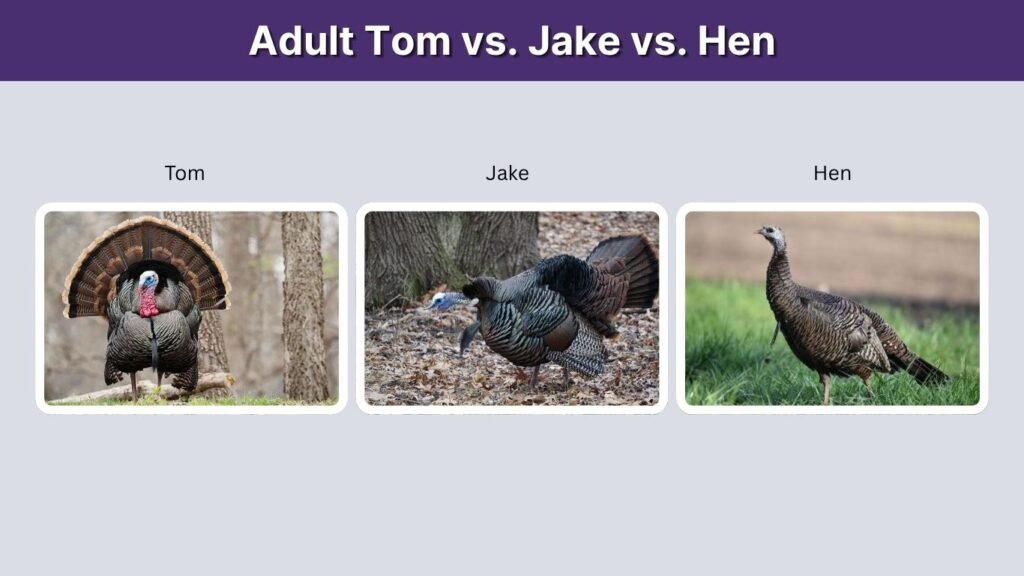
Young male turkeys can resemble hens from a distance. Looking at several features together makes identification more accurate.
| Feature | Adult Tom | Jake | Hen |
| Beard | Usually 8–12 inches | Often 2–6 inches | Usually absent or thin |
| Spurs | Long and pointed | Short and rounded | Usually absent |
| Tail fan | Even | Uneven | Generally not displayed |
| Head | Large and colorful | Colorful but smaller | Grayish and less colorful |
| Body | Large and heavy | Medium-sized | Smaller and slimmer |
A jake is typically around one year old. His most recognizable feature during a display is an uneven tail fan with central feathers extending above the outer feathers.
Wild Turkey vs. Turkey Vulture
Despite sharing the word “turkey,” these birds are unrelated and have very different appearances.
A wild turkey is a heavy, ground-dwelling game bird with long legs, a rounded body, and a broad tail. It spends much of its time walking through forests and open fields.
A turkey vulture is a soaring scavenger with long wings, a small red head, and dark feathers. In flight, it holds its wings in a shallow V and commonly circles while searching for carrion.
Wild Turkey vs. Domestic Turkey
Wild turkeys generally have slimmer bodies, longer legs, smaller heads, and stronger flight abilities than commercial domestic turkeys. Wild birds often have brown-tipped tail feathers and strongly iridescent plumage.
Many domestic meat turkeys are white, extremely heavy, and broad-breasted. However, domestic breeds can vary considerably, and some bronze-colored varieties closely resemble wild birds.
FAQs
Can a female wild turkey have a beard?
Yes. A small percentage of female wild turkeys develop beards, but their beards are usually shorter and thinner than those of adult males. Check the bird’s body size, breast-feather tips, head color, spurs, and behavior before deciding its sex.
Do female wild turkeys gobble?
Females primarily make yelps, clucks, purrs, and alarm calls. Gobbling is overwhelmingly associated with males, particularly during the breeding season. A gobbling turkey is therefore likely to be a tom or jake, although calls should be combined with visual identification.
What is a female wild turkey called?
An adult female wild turkey is called a hen. A young female may be called a jenny, while a young male is called a jake. Adult males are known as toms or gobblers.
How can you identify a male turkey from behind?
Look for a larger body, thick legs, visible spurs, and darker, more iridescent feathers. A strutting male may also display a wide tail fan. An adult tom’s fan is normally even, while a jake’s central tail feathers appear longer.
Are male wild turkeys more colorful than females?
Yes. Male wild turkeys have darker, more iridescent body feathers and brightly colored bare skin on the head and neck. Females are mostly dull brown, which helps them blend into vegetation while nesting and caring for poults.
