
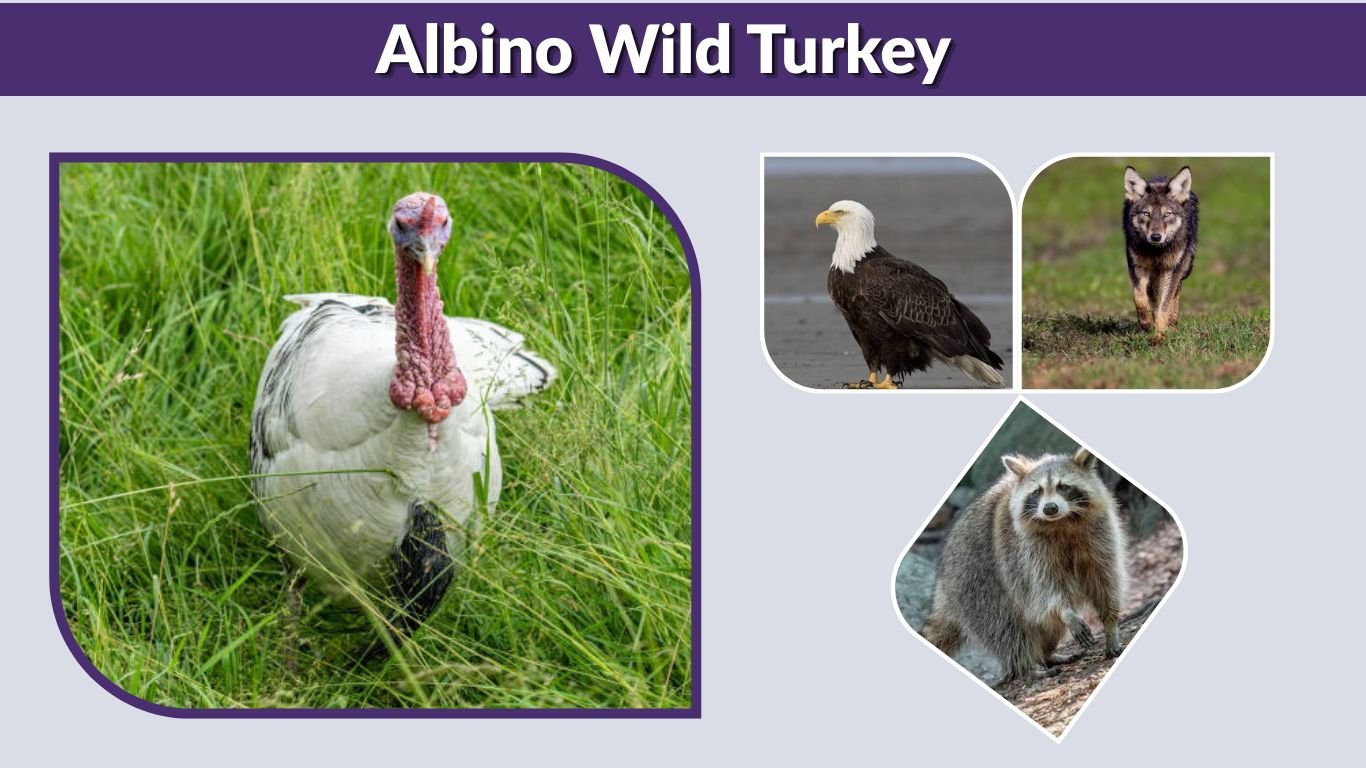
An albino wild turkey is an exceptionally rare bird that lacks melanin throughout its feathers, skin, and eyes. A true albino typically has completely white plumage, very pale skin, and pink or reddish eyes. However, most white wild turkeys described as albinos are actually leucistic. Leucistic turkeys may be entirely white or have scattered white patches, but they retain normally colored eyes and pigmentation in other body parts. These unusual birds belong to the same species as normally colored wild turkeys and generally display similar feeding, flocking, mating, and nesting behavior.
Can Wild Turkeys Be Albino?
Yes, genuine albinism can occur in wild turkeys, but it is extremely uncommon. Albinism results from an inherited condition that prevents the body from producing melanin, the pigment responsible for much of a bird’s dark coloration.
A true albino turkey lacks melanin throughout its body, including the eyes. Without dark eye pigment, blood vessels become visible, making the eyes appear pink or reddish. Most completely white wild turkeys still have dark eyes and are therefore leucistic rather than albino.
Scientific Classification
| Category | Classification |
| Kingdom | Animalia |
| Class | Aves |
| Order | Galliformes |
| Family | Phasianidae |
| Genus | Meleagris |
| Species | Meleagris gallopavo |
Albinism or leucism changes the bird’s coloration, not its species. A pale Eastern wild turkey remains an Eastern wild turkey, while a pale Merriam’s turkey remains part of the Merriam’s subspecies.
What Does an Albino Wild Turkey Look Like?
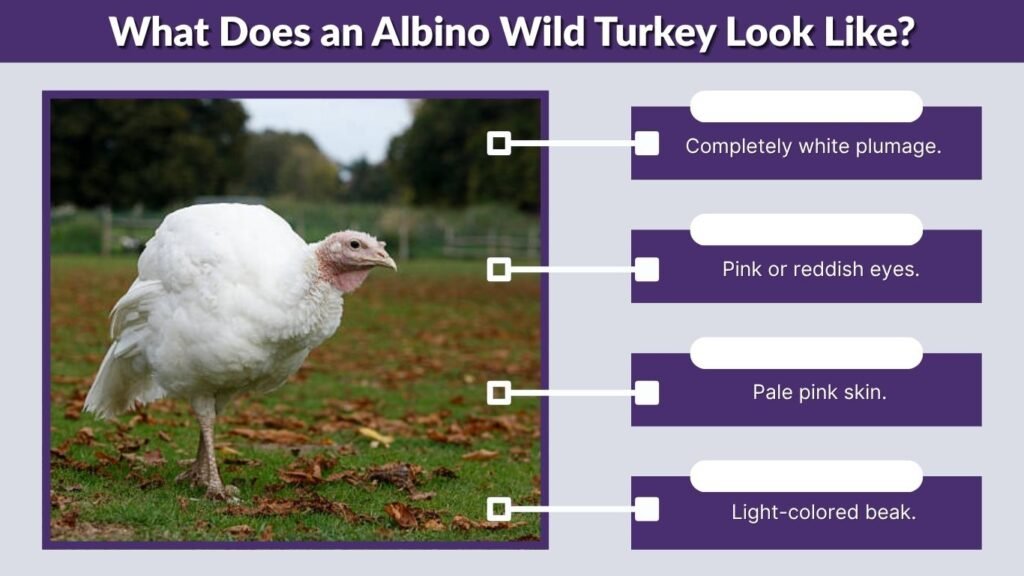
A true albino wild turkey has white feathers across its entire body. Its exposed skin, beak, legs, and claws may appear unusually pale. The most important identification feature is the eye color.
True Albino Turkey Identification
- Completely white plumage
- Pink or reddish eyes
- Pale pink skin
- Light-colored beak
- Pale legs and feet
- Little or no normal dark pigmentation
- White wing and tail feathers
- Reduced pigmentation throughout the body
The lack of pigment may make details such as wing barring, breast color, and tail bands difficult or impossible to see.
Albino vs. Leucistic Wild Turkey
White plumage alone does not prove that a wild turkey is albino. Leucism is far more commonly responsible for unusually pale or white feathers.
Leucism affects the placement or deposition of pigment in the feathers. It may produce one small white patch, a mixture of white and normal feathers, faded coloration, or an almost entirely white bird. The eyes remain normally colored because leucism does not remove pigment from every tissue.
| Feature | Albino wild turkey | Leucistic wild turkey |
| Feathers | Completely white | Partly or completely white |
| Eyes | Pink or reddish | Normally dark |
| Skin and legs | Usually very pale | May retain normal pigment |
| Beard | May appear pale | Often normally colored |
| Cause | Lack of melanin production | Abnormal pigment deposition |
| Frequency | Exceptionally rare | Rare, but more common |
Partial Leucism
A partially leucistic turkey may have white feathers on its wings, tail, back, neck, or head while the rest of its body remains normally colored. These birds are sometimes described as pied or piebald.
The white pattern may be symmetrical or irregular. Because some normal pigments remain, a partially leucistic turkey can still display bronze, brown, black, copper, or gray feathers elsewhere on its body.
Completely White Leucistic Turkey
A leucistic turkey can have an almost entirely white body while retaining dark eyes, normally colored facial skin, a dark beard, or pigmented legs. The presence of dark eyes is the strongest sign that the bird is not a true albino.
How Rare Is an Albino Wild Turkey?
True albino wild turkeys are exceptionally rare, but there is no reliable nationwide count showing exactly how often they occur. Many reported “albino” turkeys cannot be confirmed because photographs do not clearly show their eyes or other pigmentation.
Leucistic wild turkeys are also uncommon, although documented examples have been recorded in Eastern and Merriam’s turkey populations. The rarity of these birds makes them noticeable to wildlife photographers, hunters, birdwatchers, and local communities.
Reports claiming a precise rate such as one albino turkey in every several thousand birds should be treated cautiously unless supported by a documented population study.
Albino Turkey vs. White Domestic Turkey
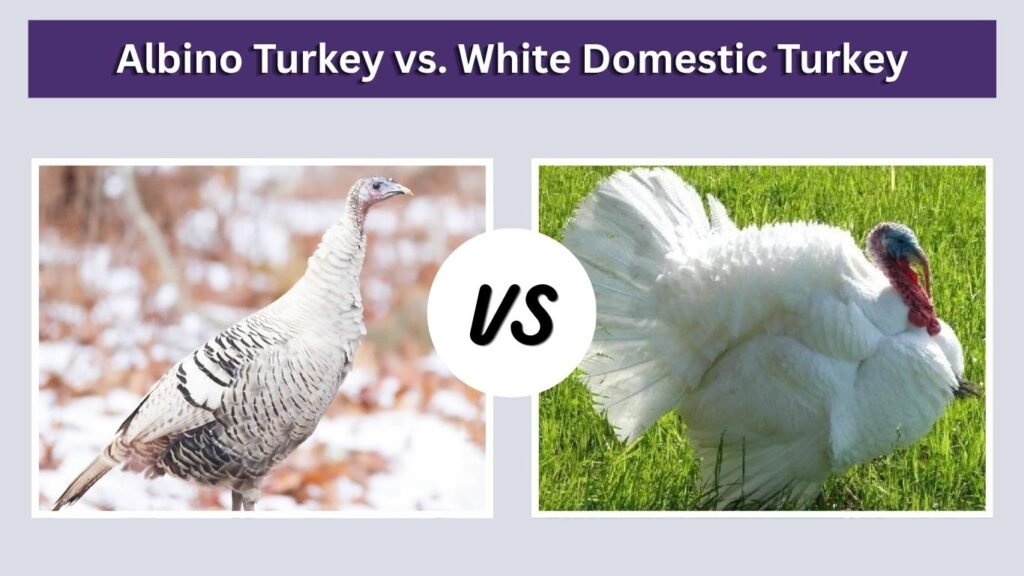
A white turkey seen near a farm, town, or residential area may not be a wild albino. Many domestic turkeys have been selectively bred for white plumage.
Modern commercial turkey strains commonly have white feathers and much heavier bodies than wild birds. They may also have broader breasts, shorter-looking legs, reduced flight ability, and less wary behavior.
How to Tell the Difference
A pale wild turkey generally has:
- A slimmer, more athletic body
- Long, strong legs
- A relatively small head
- Alert and cautious behavior
- Strong running and flying ability
- Associations with normal wild turkey flocks
- Natural woodland, grassland, or farmland habitat
A domestic turkey may remain close to buildings, livestock, roads, or people. Escaped domestic birds can sometimes join wild flocks, which makes identification more complicated.
Do Albino Wild Turkeys Behave Differently?
Albinism primarily affects pigmentation rather than the turkey’s basic instincts. Albino and leucistic wild turkeys can forage, walk, fly, roost, communicate, and breed like normally colored birds.
They may remain with ordinary turkey flocks and participate in the same seasonal behavior. Gobblers may strut and display, while hens may build ground nests, incubate eggs, and raise poults.
However, impaired eyesight can be associated with true albinism because melanin plays an important role in normal eye development. A true albino turkey may therefore have greater difficulty detecting food, navigating its habitat, or recognizing approaching danger than a leucistic bird with normally pigmented eyes.
Survival Challenges
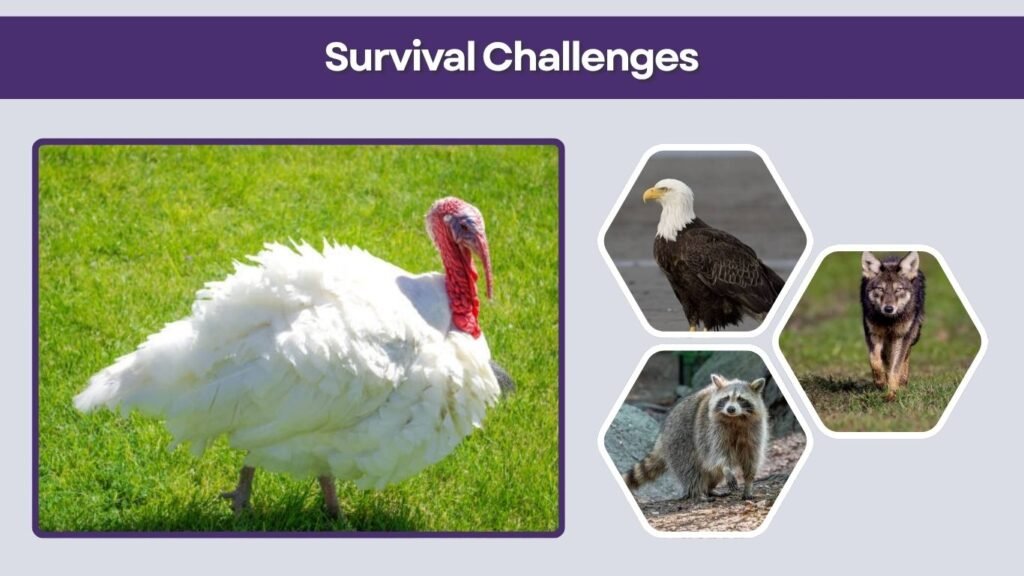
A normally colored wild turkey has dark, patterned plumage that helps it blend into forests, fields, leaves, brush, and shadows. A white turkey is much more visible in most habitats.
Greater Visibility to Predators
Bright white feathers may make an albino or leucistic turkey easier for coyotes, bobcats, foxes, eagles, and other predators to detect. This disadvantage can be especially serious for a hen incubating eggs on the ground.
The same coloring can attract unwanted attention from people, photographers, vehicles, or free-roaming pets. Leucistic birds can otherwise be healthy, but their visibility may increase their vulnerability.
Feather Durability
Melanin contributes strength to feathers. Feathers with little or no melanin may wear or break more easily than normally pigmented feathers.
Damaged flight feathers could reduce flight efficiency, although the severity depends on how much pigment is missing and which feathers are affected.
Sunlight and Vision
True albino animals may be more sensitive to strong sunlight because they lack protective pigment in the eyes. Poor vision can make it harder to detect predators or move safely through complex environments.
Leucistic turkeys usually have normally pigmented eyes, so they are less likely to experience the same vision problems.
Other Wild Turkey Color Variations
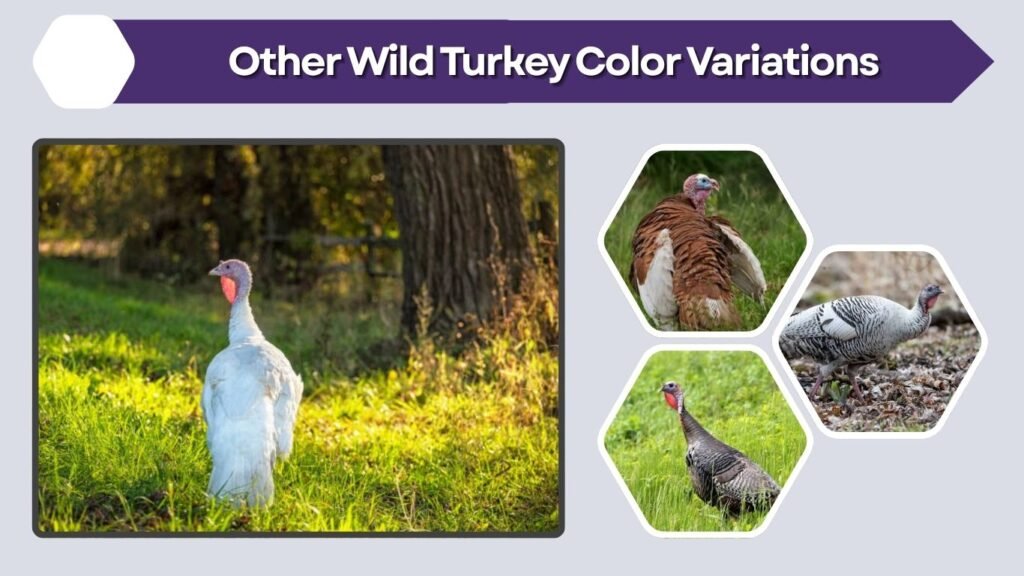
Not every unusually colored turkey is albino or leucistic. Wild turkeys can display several uncommon color phases caused by differences in feather pigmentation.
These may include:
- Smoke-gray plumage
- Reddish or erythritic coloration
- Melanistic or unusually dark plumage
- Partly white or pied feathers
- Almost completely white plumage
Smoke-phase birds may have a mixture of gray, white, brown, and black feathers while retaining normal eyes and skin. Dark melanistic birds produce an excess of dark pigmentation and may look almost black. Color-phase terminology is not always used consistently, so eye color and the distribution of pigment provide more reliable clues.
What to Do When You See a White Wild Turkey
Observe the turkey from a respectful distance and avoid chasing it for a closer photograph. Use binoculars or a zoom lens to examine the eyes, legs, head, wings, and any remaining colored feathers.
Record the date, location, habitat, flock size, and behavior. Clear photographs may help a wildlife biologist determine whether the bird is albino, leucistic, another color phase, or an escaped domestic turkey.
Do not attempt to capture, feed, or relocate it. Feeding wild turkeys can make them accustomed to people and may encourage them to gather near roads, homes, or other unsafe areas.
FAQs
Are there true albino wild turkeys?
Yes, true albinism can occur in wild turkeys, but confirmed cases are extremely rare. A true albino has white plumage, pale skin, and pink or reddish eyes caused by the complete absence of melanin.
How can you identify an albino wild turkey?
Look closely at the eyes. A true albino turkey has pink or red eyes. A completely white turkey with dark eyes is more likely leucistic or an escaped white domestic bird.
Can an albino wild turkey survive?
It can survive, but white plumage, possible vision problems, feather weakness, and greater visibility may reduce its chances. A leucistic turkey with normal eyesight may face fewer physical problems.
Can albino wild turkeys reproduce?
Albino turkeys can potentially mate and reproduce like other wild turkeys. Whether their offspring inherit the condition depends on the genes carried by both parents.
Is a white wild turkey always albino?
No. Most white wild turkeys are leucistic, another color variation, or domestic birds. Pink or reddish eyes are necessary for identifying true albinism, while leucistic birds retain normally colored eyes.
