
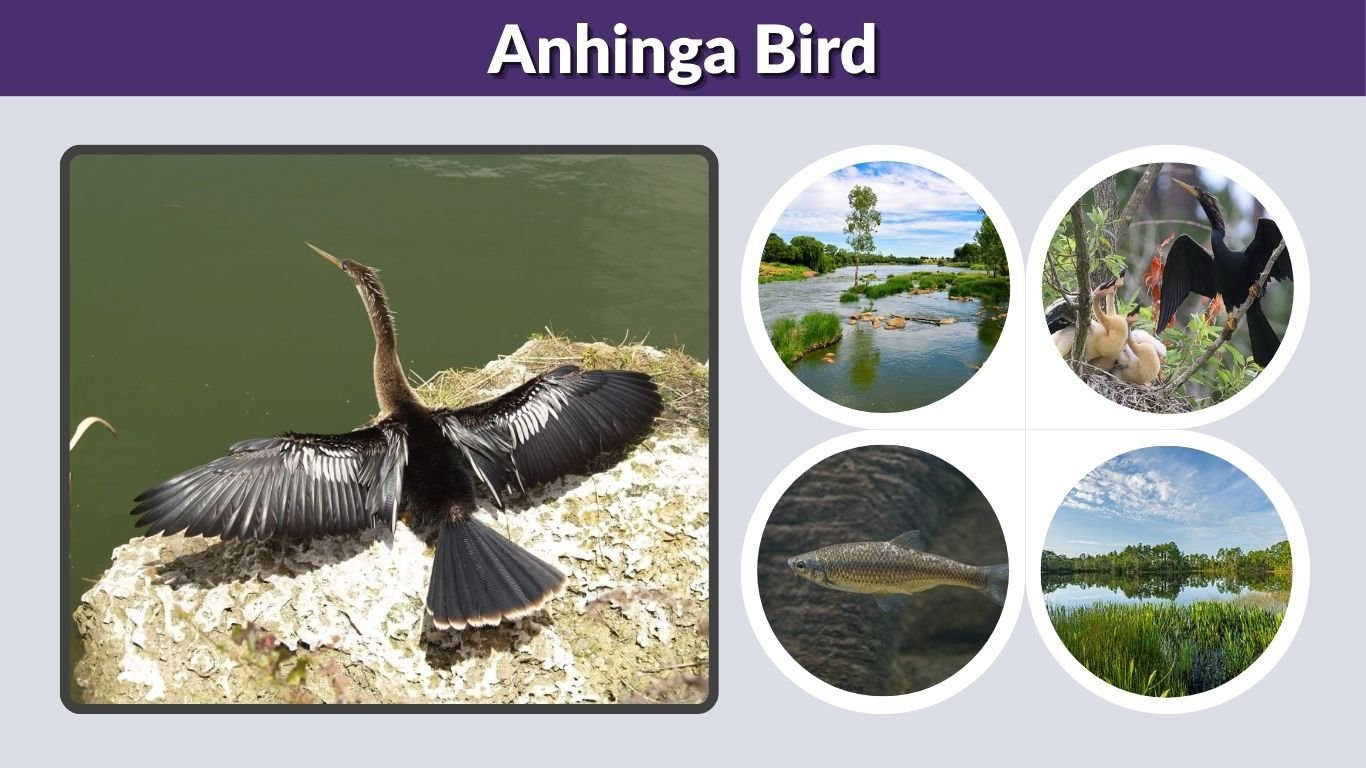
The anhinga bird is one of North America’s most distinctive waterbirds, famous for swimming with little more than its long, snake-like neck above the surface. Often called the snake bird or water turkey, the Anhinga is an expert underwater hunter that catches fish with its sharp, dagger-shaped bill. It is especially familiar in Florida wetlands, where it can often be seen drying its spread wings beside ponds and swamps. This guide covers identification, habitat, diet, behavior, calls, breeding, and differences from cormorants.
What Does an Anhinga Bird Look Like?
Anhingas are large, slender waterbirds with unusually long necks, pointed bills, broad wings, and long fan-shaped tails. Their combination of body shape and behavior makes them relatively easy to identify once you know what to look for. Adults measure about 29.5–37.4 inches long, with a wingspan of roughly 42.9 inches.
Anhinga Identification
Key characteristics include:
- Long, thin, S-shaped neck
- Straight, sharply pointed dagger-like bill
- Long, fan-shaped tail
- Broad wings with pale or silvery markings
- Yellowish-orange legs and feet
- Low swimming posture with much of the body underwater
- Frequent wing-spreading after swimming
When an Anhinga swims, its body may almost disappear beneath the water, leaving only its narrow neck and head visible.
Male and Female Anhinga Birds
Adult male Anhingas are mostly black, with silvery-white markings across their wings and upper back. Females look noticeably different, having a pale tan or buff-colored head, neck, and upper breast while retaining darker wings and lower body.
Immature Anhingas resemble females more closely than adult males. Their lighter coloration can sometimes make identification more difficult from a distance.
Why Is It Called a Snake Bird?
The nickname snake bird comes from the Anhinga’s swimming style. Because the bird can keep most of its body submerged, its long neck appears to move across the water like a snake.
Its long neck is not merely decorative. It allows the Anhinga to strike rapidly at underwater prey while swimming among submerged vegetation.
Anhinga Habitat and Range
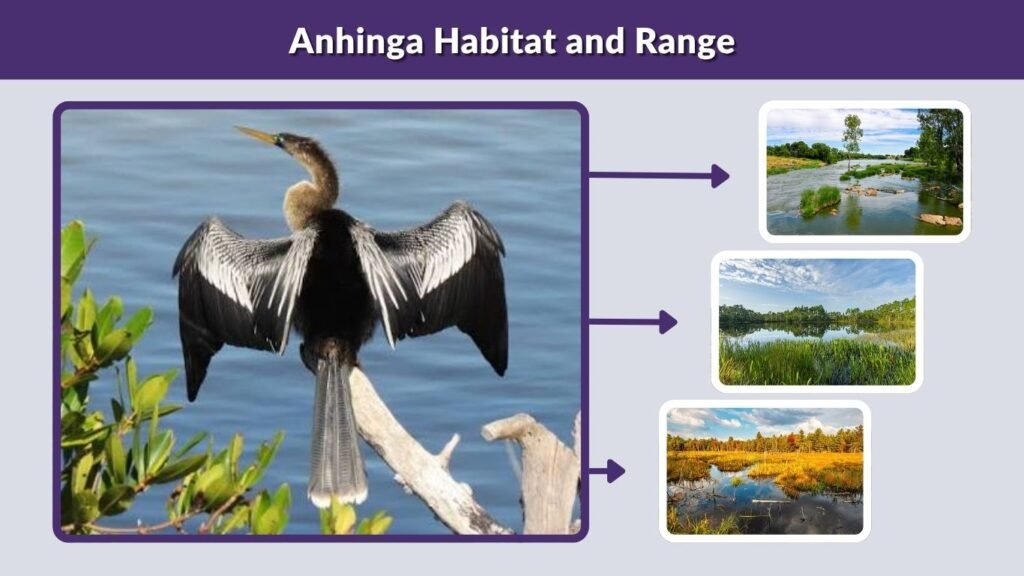
Anhingas are closely associated with quiet, shallow wetlands where fish are plentiful and trees, branches, or logs provide convenient places to rest and dry their feathers. They favor sheltered freshwater environments rather than large stretches of exposed open water. Coastal lagoons and brackish wetlands may also be used in some areas.
Anhinga Birds in Florida
Florida is one of the easiest places in the United States to observe Anhingas. They occur in swamps, marshes, canals, wooded ponds, lakes, and slow-moving waterways throughout much of the state.
Birdwatchers commonly see them sitting on exposed branches with their wings extended. They are also characteristic birds of Florida’s wetland landscapes, including cypress swamps and subtropical marshes.
Where Else Do Anhingas Live?
In the United States, Anhingas occur mainly across the Southeast and Gulf Coast. Their broader range extends south through Mexico, Central America, including Costa Rica, and into South America.
Northern populations may move south during winter, while birds in warmer regions can remain throughout the year. Cornell describes the species as a short-distance partial migrant.
Preferred Habitat
Typical Anhinga habitats include:
- Freshwater marshes
- Cypress swamps
- Slow-moving rivers
- Sheltered lakes and ponds
- Wooded wetlands
- Mangrove-lined lagoons
- Brackish coastal wetlands
Nearby trees or exposed branches are especially valuable because Anhingas regularly climb out of the water to rest and dry themselves.
What Do Anhinga Birds Eat?
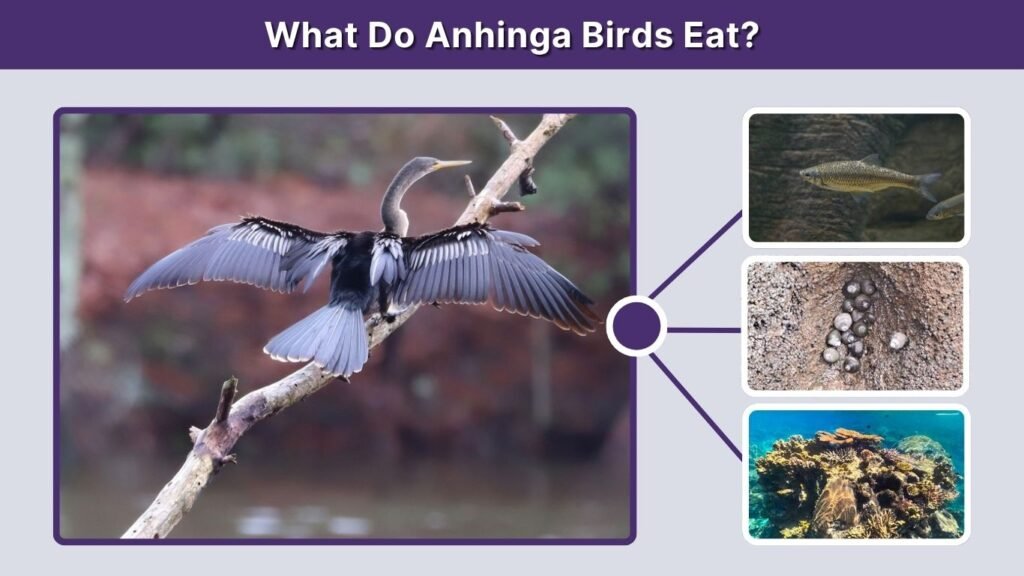
Anhingas are primarily fish-eating waterbirds. Rather than chasing prey continuously at high speed, they often swim slowly underwater and stalk fish around vegetation. Their sharp bills can be thrust quickly into prey, making them highly specialized aquatic hunters. Small crustaceans and other aquatic animals may occasionally supplement their diet.
Diet and Fishing Behavior
Anhingas commonly feed on:
- Small and medium-sized fish
- Aquatic crustaceans
- Other small aquatic invertebrates
The bird usually catches fish by striking them from the side with its partially opened bill. After surfacing, it often adjusts the fish and swallows it headfirst.
Anhinga Swimming Underwater
Anhingas are unusually well adapted to swimming low in the water. Their plumage is less waterproof than that of many waterbirds, allowing the feathers to become wet and reducing buoyancy.
Combined with relatively dense bones, this helps the bird submerge its body more easily while stalking fish. At times, only the neck, head, or even bill may remain above the surface.
Why Do Anhingas Dry Their Wings?
After swimming, an Anhinga frequently climbs onto a branch and holds its wings wide open. Because its feathers become waterlogged, spreading the wings helps them dry before the bird returns to sustained flight.
This dramatic posture is one of the easiest ways to recognize an Anhinga around a wetland and explains why photographs often show the bird with wings fully extended.
Anhinga Bird vs Cormorant
Anhingas and cormorants are often confused because both are dark aquatic birds that swim underwater, eat fish, and commonly perch with their wings spread. At close range, however, their bills, tails, body shapes, and swimming postures provide several useful identification clues. Their flight silhouettes also become quite different once you know what to notice.
Anhinga vs Cormorant Identification
The easiest differences include:
- Bill: Anhinga bills are straight and dagger-like; cormorant bills have a hooked tip.
- Neck: Anhingas have particularly thin, snake-like necks.
- Tail: Anhingas have longer, broader, fan-shaped tails.
- Swimming: Anhingas often swim with almost the entire body submerged.
- Flight: Anhingas frequently soar with wings extended and their long neck and tail creating a cross-like silhouette.
- Fishing style: Anhingas often spear or stab fish rather than primarily grasping them.
How Their Behavior Differs
Anhingas are often solitary while fishing but may gather together at communal roosts and breeding colonies. Cormorants are also social and may feed or rest in groups.
One especially noticeable difference appears overhead. Anhingas are accomplished soarers and regularly use rising thermals, sometimes circling high above wetlands with remarkably little wing movement.
Anhinga Calls, Breeding, and Interesting Facts
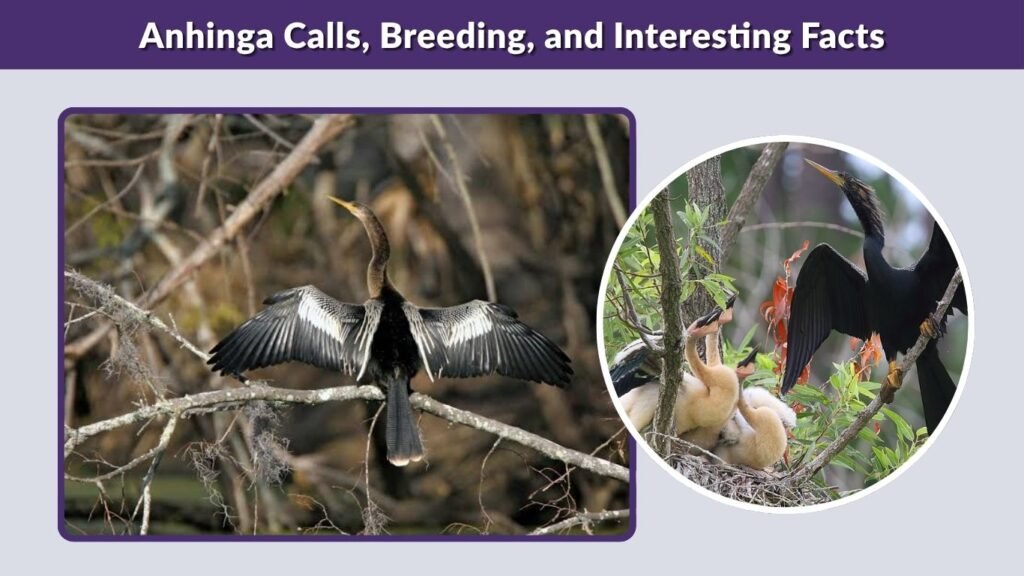
Although Anhingas are visually dramatic birds, they are not particularly musical. They spend much of their time quietly swimming, perching, or soaring. Vocal activity becomes more noticeable around nesting colonies. Their breeding behavior is also closely connected to wetlands, with nests usually constructed in trees or shrubs positioned near or directly over water.
What Does an Anhinga Bird Sound Like?
Anhingas are usually quiet away from breeding sites. Around colonies, however, they produce low grunts, croaks, rattling sounds, and clicking noises.
Their calls are much less elaborate than typical songbirds and are mainly associated with communication between birds around nests and communal areas.
Nesting and Life Cycle
Important breeding facts include:
- Nests are usually built in trees near or over water.
- Anhingas often nest in colonies with other waterbirds.
- Typical clutches contain 2–5 eggs.
- Incubation lasts about 26–30 days.
- Both sexes participate in nesting activities.
- The male gathers much of the nesting material before the female completes the nest.
Nests are bulky platforms made from sticks and often lined with fresh vegetation.
Why Is the Anhinga Called the Devil Bird?
The word Anhinga comes from a Tupi name from Brazil that has been interpreted as meaning “devil bird” or “evil spirit of the woods.” Its strange appearance while swimming—especially when only the twisting neck is visible—probably helps explain why the bird acquired such mysterious associations.
Despite the dramatic nickname, the Anhinga is simply a specialized fish-eating wetland bird and presents no unusual threat to people.
FAQs
The unusual appearance and behavior of Anhingas generate many questions, particularly when people encounter one swimming, drying its wings, or soaring above a Florida wetland. These quick answers cover some of the most common questions about identification, classification, habitat, and behavior.
1. What kind of bird is an Anhinga?
The Anhinga (Anhinga anhinga) is a large aquatic bird in the family Anhingidae. It belongs to the order Suliformes and is closely associated with freshwater wetlands.
2. Is an Anhinga a wading bird?
Anhingas are commonly grouped with wetland and waterbirds, but they are primarily diving and swimming birds rather than typical long-legged waders such as herons and egrets. They hunt fish underwater and spend considerable time swimming.
3. Can Anhinga birds fly well?
Yes. Anhingas are excellent flyers and surprisingly accomplished soarers. They often ride thermal air currents high above wetlands with their wings spread, long neck extended, and tail visible behind them.
4. Why do Anhingas swim with only their neck showing?
Their feathers become wet more easily than those of many waterbirds, which reduces buoyancy and helps them sink while hunting. As a result, much of the body can remain underwater while the long neck stays above the surface.
5. Are Anhingas and cormorants the same bird?
No. Although they look similar, Anhingas and cormorants are different birds. Anhingas have straighter dagger-shaped bills, longer fan-shaped tails, thinner necks, and typically swim lower in the water. Cormorants usually have heavier bodies and hooked bills.
