

The Arizona Woodpecker is one of the most distinctive woodpeckers of the American Southwest. Unlike the strongly black-and-white appearance of many North American woodpeckers, this species has a solid brown back, pale spotted underparts, and a brown-and-white face. It occurs mainly in southeastern Arizona, southwestern New Mexico, and Mexico, favoring mountain oak and pine-oak woodland. Arizona also supports several other woodpeckers, including Gila, Ladder-backed, Acorn, Hairy Woodpeckers, and Northern Flickers, making the state an excellent place to observe this diverse bird family.
What Does an Arizona Woodpecker Look Like?
The Arizona Woodpecker is unusual because it is the only U.S. woodpecker with a largely solid brown back. Its underparts are whitish or buff with dark spots and bars, while its face combines brown and white markings. Adults are roughly robin-sized, with a compact body and a fairly long, straight bill used for probing and excavating wood.
Arizona Woodpecker Identification
- Length: about 7.1–7.9 inches
- Wingspan: around 14 inches
- Weight: approximately 1.2–1.8 ounces
- Solid brown back
- White cheek patch
- Brown-and-white patterned face
- White or buff underparts with dark spotting
- Straight, chisel-like bill
- Male has a red patch on the rear crown
- Female lacks red on the head
The brown back is especially useful for separating this species from Hairy and Ladder-backed Woodpeckers.
Arizona Woodpecker Male vs Female
Male and female Arizona Woodpeckers are very similar in overall size and coloration.
The easiest difference is the head. An adult male has a small bright red patch toward the back of the crown, whereas an adult female has an entirely brown head without the red patch.
Males also average slightly larger and have somewhat longer bills. This difference influences feeding behavior: males excavate into wood more frequently, while females commonly remove or flake bark while searching for food.
Arizona Woodpecker Habitat and Range
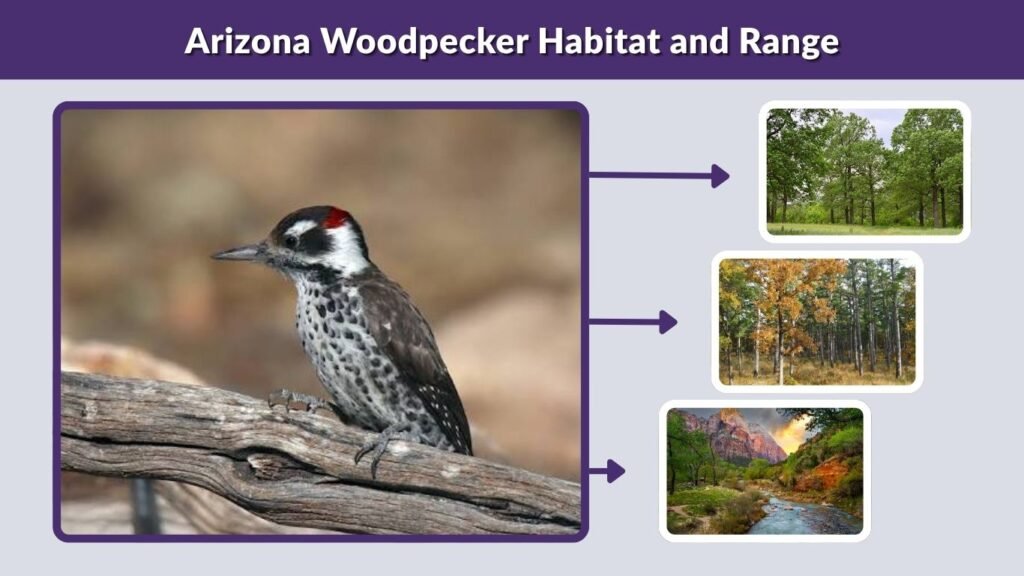
Despite its name, the Arizona Woodpecker is not found throughout every part of Arizona. In the United States, its distribution is concentrated primarily in southeastern Arizona and southwestern New Mexico. Most of its overall range lies farther south in Mexico. It is closely associated with the isolated mountain ecosystems sometimes called the Madrean Sky Islands.
Where Do Arizona Woodpeckers Live?
Important habitats include:
- Oak woodland
- Pine-oak forest
- Mountain canyons
- Sycamore-walnut woodland
- Oak-juniper woodland
- Riparian areas
- Mesquite thickets near lower elevations
In Arizona and New Mexico, they are most often found at roughly 5,000–5,600 feet, although observations can range from around 4,000 to 8,000 feet.
Do Arizona Woodpeckers Migrate?
Arizona Woodpeckers are generally nonmigratory.
Individuals typically remain within the same broad geographic region year-round, although some may move to lower elevations during cold winter weather.
What Do Arizona Woodpeckers Eat?

Arizona Woodpeckers are primarily insect eaters, but they have a varied diet. They spend considerable time climbing trunks and branches while probing cracks, removing loose bark, and excavating wood in search of hidden insects.
Common Foods
Their diet includes:
- Wood-boring beetle larvae
- Long-horned beetles
- Weevils
- Jewel beetles
- Other insects
- Berries
- Small fruits
- Acorns
They sometimes tap infested wood, apparently stimulating hidden larvae to move and making the prey easier to locate.
How Do They Find Food?
An Arizona Woodpecker may land near the base of a tree and progressively spiral upward while searching the bark.
After reaching higher branches, it often flies to the bottom of another tree and repeats the process.
This behavior can resemble the feeding pattern of a Brown Creeper.
Arizona Woodpecker Nest
Arizona Woodpeckers are cavity nesters. They excavate holes in dead trees, dead portions of living trees, and occasionally other suitable plant structures. Softer dead wood is especially useful because the birds can excavate it more easily than hard living wood.
Nesting Habits
A typical nest may be:
- Excavated in a dead tree or snag
- Roughly 9–50 feet above ground
- Located in walnut, oak, pine, sycamore, or another tree
- Occasionally placed in a large dead agave stalk
Arizona nests are frequently excavated in walnut trees because the wood can be easier to penetrate than oak.
Females generally lay about three or four white eggs. Both parents incubate, and both feed the nestlings after they hatch. Audubon reports an incubation period of approximately 14 days.
Arizona Woodpecker Call and Sounds
Woodpeckers communicate through both vocalizations and drumming. Drumming is the rapid hammering of the bill against a resonant surface and is used for communication rather than simply for finding food.
What Does an Arizona Woodpecker Sound Like?
Its calls include a sharp “peek” and rasping or rattling sequences.
Audubon describes one common call as a sharp “peek!” along with a rasping series.
Arizona Game and Fish notes that woodpecker drumming helps establish territory and communicate with potential mates.
Common Woodpecker Species in Arizona
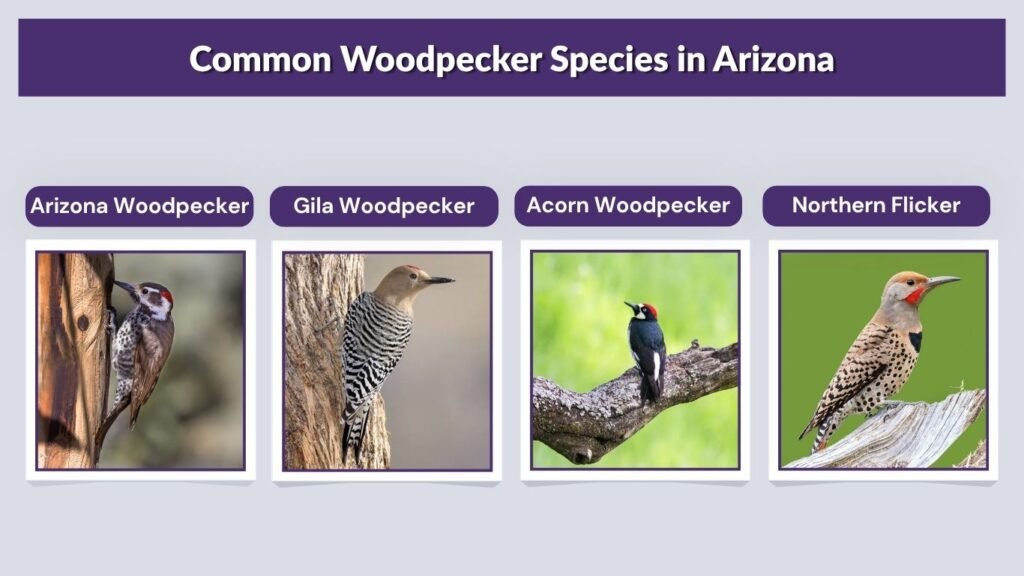
Arizona’s habitats range from Sonoran Desert cactus forests to high-elevation pine forests. As a result, different woodpecker species occupy very different parts of the state. Arizona Game and Fish notes that woodpeckers occur throughout Arizona and identifies the Northern Flicker as the state’s most widely distributed woodpecker.
1. Arizona Woodpecker
Best known for its brown back, this species is mainly associated with southeastern Arizona’s oak and pine-oak mountain woodlands.
2. Gila Woodpecker
The Gila Woodpecker is one of Arizona’s classic desert birds.
It has a tan head and belly with strongly barred black-and-white wings and back. Males have a red crown patch.
In Arizona, Gila Woodpeckers famously excavate nesting cavities inside giant saguaro cacti.
3. Ladder-backed Woodpecker
Ladder-backed Woodpeckers are well adapted to dry country.
Their backs have narrow black-and-white bars that resemble the rungs of a ladder. Males have a red crown, while females lack it.
In Arizona, they occupy desert vegetation containing mesquite, paloverde, acacia, yucca, catclaw, and various cacti.
4. Acorn Woodpecker
Acorn Woodpeckers favor oak-rich woodland and are famous for storing thousands of acorns in holes drilled into trees, utility poles, and other structures.
They can occur in Arizona’s mountain forests and oak woodlands rather than the hottest open desert.
5. Northern Flicker
Northern Flickers are among Arizona’s most widespread woodpeckers. They are larger than Arizona Woodpeckers and frequently forage on the ground for ants.
Arizona Game and Fish describes the Northern Flicker as the state’s most widely distributed woodpecker species.
6. Hairy Woodpecker
Hairy Woodpeckers are black-and-white forest birds that usually occur at higher elevations than Arizona Woodpeckers.
Their strongly contrasting back pattern makes them relatively easy to separate from the brown-backed Arizona Woodpecker.
Desert Woodpeckers in Arizona
The true Arizona Woodpecker is primarily a mountain woodland bird—not a typical open Sonoran Desert species. When people see woodpeckers among saguaros, mesquite, and desert neighborhoods, they are often seeing Gila or Ladder-backed Woodpeckers instead.
Gila vs Arizona Woodpecker
| Feature | Arizona Woodpecker | Gila Woodpecker |
| Back | Solid brown | Black-and-white barred |
| Head | Brown | Tan |
| Male red | Rear crown | Center/top of crown |
| Habitat | Mountain oak woodland | Low desert |
| Typical nest | Tree cavity | Often saguaro cavity |
| Arizona range | Mainly southeast | Southern desert regions |
The Gila Woodpecker is especially characteristic of saguaro-dominated desert habitat, often below about 3,300 feet.
Are Woodpeckers Protected in Arizona?
Yes. Arizona Game and Fish classifies woodpeckers as migratory nongame birds protected by state and federal laws. The federal Migratory Bird Treaty Act prohibits unauthorized killing, capturing, possession, transport, and other forms of “take” involving protected migratory birds.
Can You Kill a Woodpecker in Arizona?
Generally, you cannot legally shoot or kill a protected woodpecker simply because it is damaging a house.
Arizona Game and Fish states that a U.S. Fish and Wildlife Service permit is required for capturing, killing, or possessing protected migratory birds.
Active nests containing eggs or chicks also receive federal protection and should not be disturbed without appropriate authorization.
How to Stop Woodpecker Damage
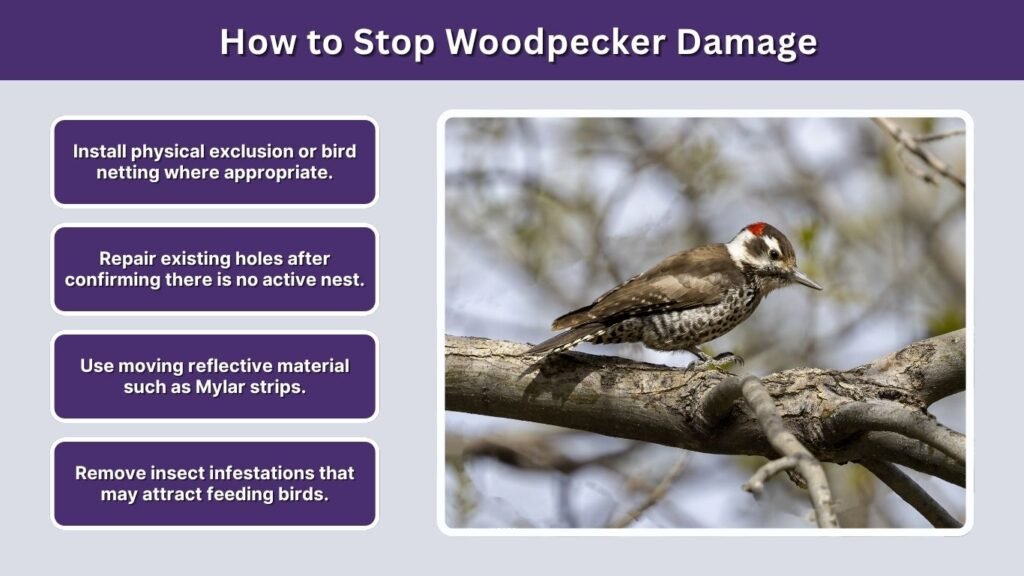
Woodpeckers sometimes drum on siding, roofs, chimneys, gutters, or stucco. The activity may be territorial communication, nest excavation, or feeding.
Nonlethal prevention should begin as soon as activity is noticed.
Safe Deterrent Methods
- Install physical exclusion or bird netting where appropriate.
- Repair existing holes after confirming there is no active nest.
- Use moving reflective material such as Mylar strips.
- Remove insect infestations that may attract feeding birds.
- Protect frequently targeted surfaces.
- Contact Arizona Game and Fish if persistent problems continue.
U.S. Fish and Wildlife Service describes physical exclusion as one of the most effective ways to reduce woodpecker damage. If a nest is already active, control measures that disturb it generally need to wait until the young have left.
FAQs
1. What does an Arizona Woodpecker look like?
It has a solid brown back, white cheek patch, spotted pale underparts, and a brown-and-white face. Males have a small red patch on the rear crown.
2. Where are Arizona Woodpeckers found?
In the United States, they occur mainly in southeastern Arizona and southwestern New Mexico, especially in mountain oak and pine-oak woodland. Most of their range extends into Mexico.
3. What do Arizona Woodpeckers eat?
They primarily eat insects and beetle larvae but also consume berries, fruits, and acorns.
4. Is a Gila Woodpecker the same as an Arizona Woodpecker?
No. The Gila Woodpecker is a black-and-white barred desert species that often nests in saguaros. The Arizona Woodpecker is brown-backed and primarily lives in mountain oak woodland.
5. Are Arizona Woodpeckers protected?
Yes. Woodpeckers in Arizona are protected as migratory nongame birds under state and federal law. Killing, capturing, or possessing them generally requires legal authorization.
