
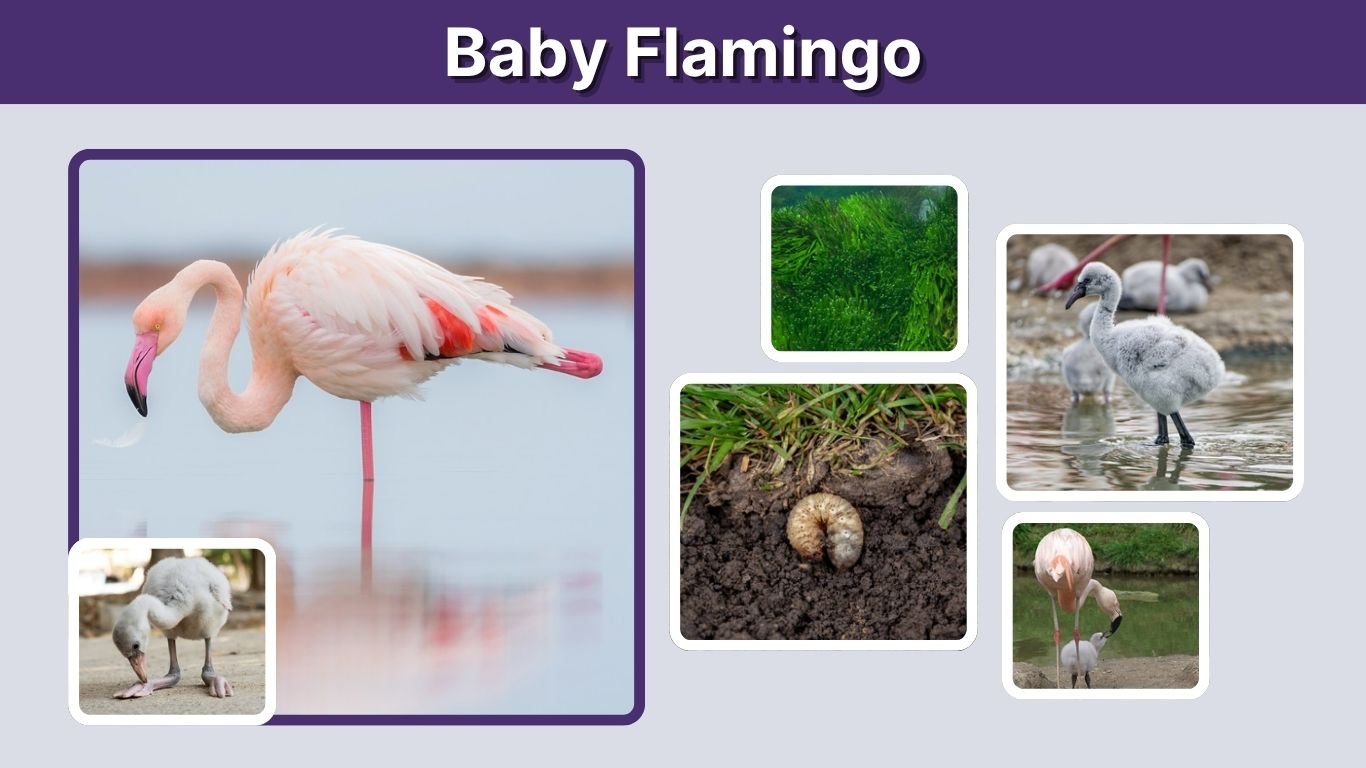
A baby flamingo looks surprisingly different from the tall, bright pink bird most people recognize. Flamingo babies hatch covered in soft white or gray down, have relatively short legs, and begin life with a mostly straight bill. They are called chicks and depend heavily on both parents during their early development. One of their most unusual characteristics is their diet: both male and female flamingos can produce a nutritious liquid called crop milk to feed their young. As chicks grow, they learn to walk, swim, filter-feed, and gradually develop their famous pink plumage.
What Is a Baby Flamingo Called?
A baby flamingo is officially called a chick, just like the young of many other bird species. Informal names such as “flaminglet” sometimes appear online, but chick is the standard biological term.
Flamingos typically produce only one egg during a breeding attempt. Both parents participate in nest building, incubation, feeding, and protection of their young.
After hatching, a chick remains closely associated with its parents until it becomes strong enough to move around the colony independently.
What Does a Baby Flamingo Look Like?
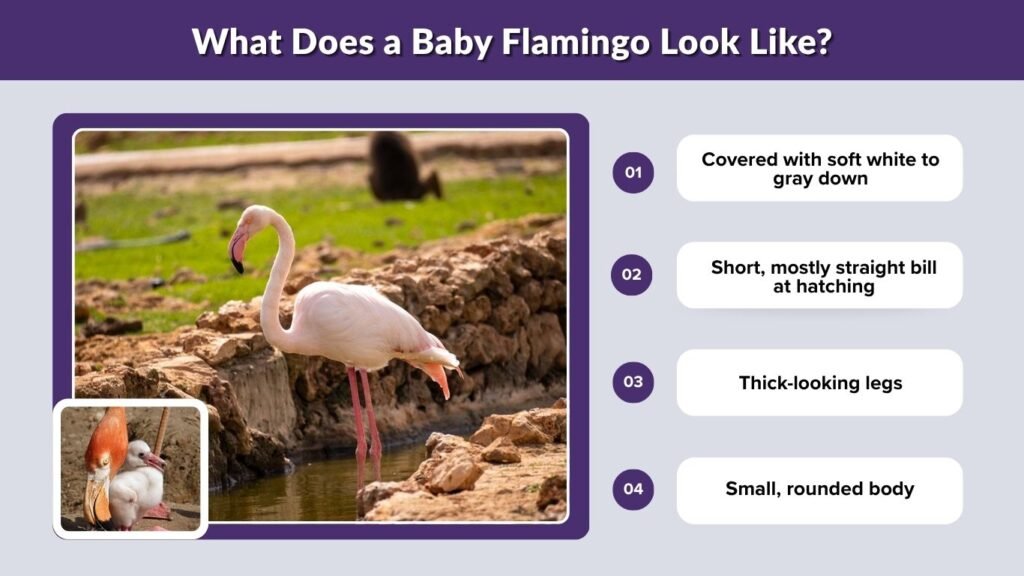
Newly hatched flamingos bear little resemblance to the elegant pink adults around them.
Baby Flamingo Identification
- Covered with soft white to gray down
- Short, mostly straight bill at hatching
- Dark eyes
- Thick-looking legs
- Webbed feet
- Small, rounded body
- Long neck that becomes more obvious with growth
- Plumage gradually changes from gray to pale pink
The characteristic downward-curving flamingo bill develops as the chick grows. Smithsonian sources note that chicks hatch with white-gray down and straight bills rather than the specialized curved bills of adults.
Why Aren’t Baby Flamingos Pink?
Flamingos are not born pink.
Their famous coloration develops from pigments called carotenoids obtained through their diet. Adult flamingos consume foods containing these pigments, and the compounds are eventually deposited in their feathers.
Young chicks initially have pale gray or white feathers because they have not yet accumulated enough pigment.
Some pink feathers may become noticeable during the first year, but developing the richer adult coloration takes considerably longer. Smithsonian observations indicate that chicks may show some pink by around six months, become light pink near their first birthday, and develop deeper coloration over the following years.
What Do Baby Flamingos Eat?
Very young flamingos do not immediately begin feeding like adults.
Instead, their parents produce a specialized liquid called crop milk.
What Is Flamingo Crop Milk?
Crop milk is a nutrient-rich secretion produced in the upper digestive tract. Unlike mammalian milk, it does not come from mammary glands.
It contains large amounts of fat and protein along with compounds that help support the rapidly growing chick. Remarkably, both male and female flamingos can produce it.
Parents feed crop milk directly from their bills into the chick’s mouth.
Is Flamingo Milk Red?
It can appear bright red or reddish because it contains pigments associated with the flamingos’ coloration.
A chick may therefore appear to have red liquid around its head or neck after feeding. This can look alarming, but it may simply be spilled crop milk rather than blood.
How Do Flamingo Parents Feed Their Babies?
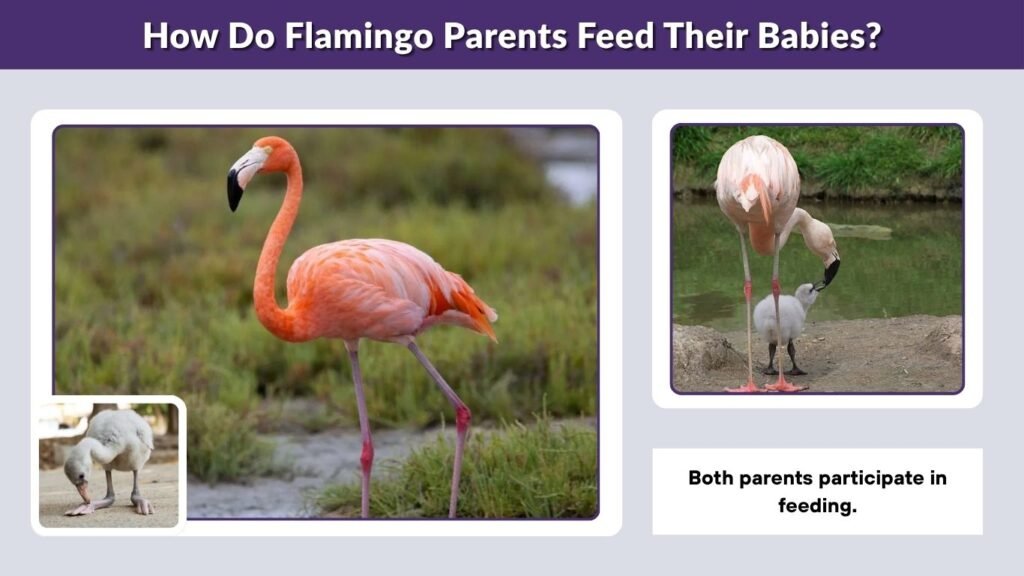
Both parents participate in feeding.
The chick places its bill against or inside the parent’s bill and receives crop milk. After feeding, the chick’s crop can become visibly enlarged as it fills with food.
Parent flamingos invest heavily in their chick because most breeding pairs raise only one young bird at a time.
Interestingly, chicks can continue begging for crop milk even after they have begun feeding themselves. Smithsonian keepers have observed some chicks continuing to receive parental feeding for more than six months.
Baby Flamingo Birth and Hatching
Flamingos typically construct mound-shaped nests from mud.
The nest resembles a small raised cone or miniature volcano. Its elevated shape helps protect the egg from shallow water and surrounding wet ground.
Flamingo Egg and Incubation
A female normally lays one egg.
Both parents take turns incubating it. In American flamingos, incubation lasts approximately 28 days.
When ready to hatch, the chick breaks through the eggshell. It emerges covered in soft down and is completely dependent on its parents.
The chick normally spends its earliest days around the nest before becoming increasingly adventurous.
When Do Baby Flamingos Start Walking?
Flamingo chicks develop mobility surprisingly quickly.
Within several days after hatching, they may begin exploring outside the nest. Their legs initially look somewhat awkward and their movements can be unsteady.
As the legs strengthen, chicks become capable walkers and swimmers.
San Diego Zoo Wildlife Alliance notes that a chick may begin walking, swimming, and exploring beyond the nest around five days after hatching.
This early mobility becomes important because flamingos nest in enormous colonies where young birds eventually gather together.
What Is a Group of Baby Flamingos Called?
Young flamingos form groups known as crèches.
A crèche can contain many chicks while adults remain nearby.
This behavior resembles a large communal nursery. Adults may watch over the group, but parents remain responsible for feeding their own offspring.
How Do Parents Find Their Baby?
A huge group of nearly identical gray chicks might appear impossible for a parent to navigate, but flamingos use vocal recognition.
Each chick develops a distinctive call.
Parents learn their chick’s voice and can recognize it among large numbers of other calling birds. Smithsonian observations describe chicks practicing their distinctive cheeping sounds from the time they hatch, helping strengthen parent-chick recognition.
How Does a Baby Flamingo’s Beak Change?
One of the most dramatic developmental changes occurs in the bill.
A newly hatched flamingo does not have the heavily downward-curved bill of an adult. The bill starts relatively straight.
As the young bird grows, it gradually bends downward and develops the structure required for filter feeding.
Adult flamingos use their specialized bills to strain tiny organisms and other food from water.
San Diego Zoo Wildlife Alliance notes that the bill remains straight during roughly the first couple of weeks before developing its specialized feeding shape.
What Do Older Flamingo Chicks Eat?
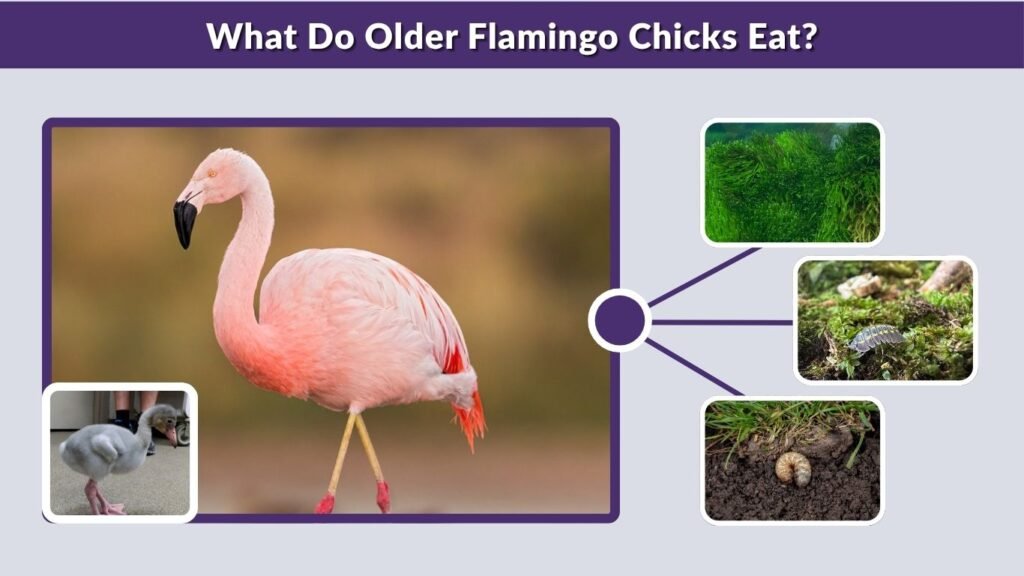
As chicks mature, they transition away from relying entirely on crop milk.
They begin learning the specialized filter-feeding technique used by adults.
Depending on the flamingo species and habitat, food can include algae, tiny crustaceans, aquatic invertebrates, insect larvae, and other small organisms.
Their changing diet is also important for color development because carotenoid-rich food contributes to the pink, orange, or reddish feathers seen in adults.
How Fast Do Baby Flamingos Grow?
Growth is rapid during the first several months.
Within days, chicks begin leaving the nest. As they grow stronger, they join other young flamingos in a crèche and gradually become capable of independent swimming and feeding.
By around three months, Smithsonian flamingo chicks can swim, feed themselves, and explore much more independently.
Physical maturation continues far beyond this point, however. Plumage color, bill shape, body size, and reproductive maturity all require additional time to reach the adult condition.
American Flamingo Babies
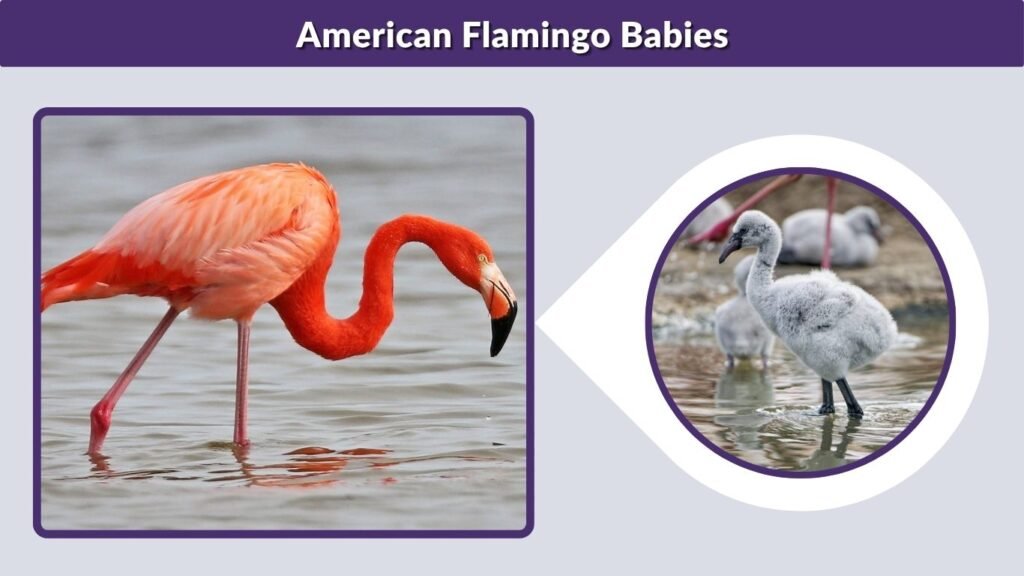
American flamingo chicks follow the same general developmental pattern.
They hatch pale rather than pink, receive crop milk from their parents, and gradually join groups of other chicks.
American flamingos are highly social birds, and colonies can become very large. Both parents help construct the nest, incubate their single egg, and provide care after hatching.
Young American flamingos eventually develop the striking pink-to-reddish-orange coloration for which the species is famous.
Interesting Baby Flamingo Facts
Baby flamingos provide some of the most unusual examples of parental care among birds. Both fathers and mothers can produce crop milk, and parents can locate their own chick among crowds largely through vocal recognition.
Chicks are gray instead of pink, and their bills initially lack the dramatic downward bend seen in adults.
They can also become surprisingly independent physically while continuing to ask their parents for food. A chick may already be swimming and feeding itself while still begging for crop milk.
Even adult parents can temporarily become paler during the chick-rearing period as pigment-rich resources are transferred into the crop milk used to nourish their young.
FAQs
What is a baby flamingo called?
A baby flamingo is called a chick. “Flaminglet” is sometimes used informally, but it is not the standard scientific name for a young flamingo.
Are baby flamingos born pink?
No. Flamingo chicks hatch with white or gray down. Their pink coloration develops gradually as pigments from their diet accumulate in their feathers.
Do baby flamingos drink milk?
They drink crop milk, a nutrient-rich secretion produced by both male and female parent flamingos. It is different from mammalian milk.
When does a baby flamingo turn pink?
Some pink coloration can begin appearing during the first year, but developing full adult coloration may take several years.
Can baby flamingos swim?
Yes. Flamingo chicks can begin walking and swimming within the early stages of life, sometimes only several days after leaving the nest.
