
A good monocular can make bird watching more convenient, especially when you want lightweight optics that are easy to carry on hikes, trips, or backyard observation sessions. The best bird watching monoculars combine clear magnification, bright lenses, comfortable focusing, and durable construction for dependable outdoor use. Some models also include smartphone adapters or tripods for capturing distant birds more easily. In this guide, we review 11 excellent bird watching monoculars suitable for beginners, casual nature lovers, travelers, and experienced birders looking for compact viewing equipment.
1. Pankoo 12×60 HD Monocular Telescope
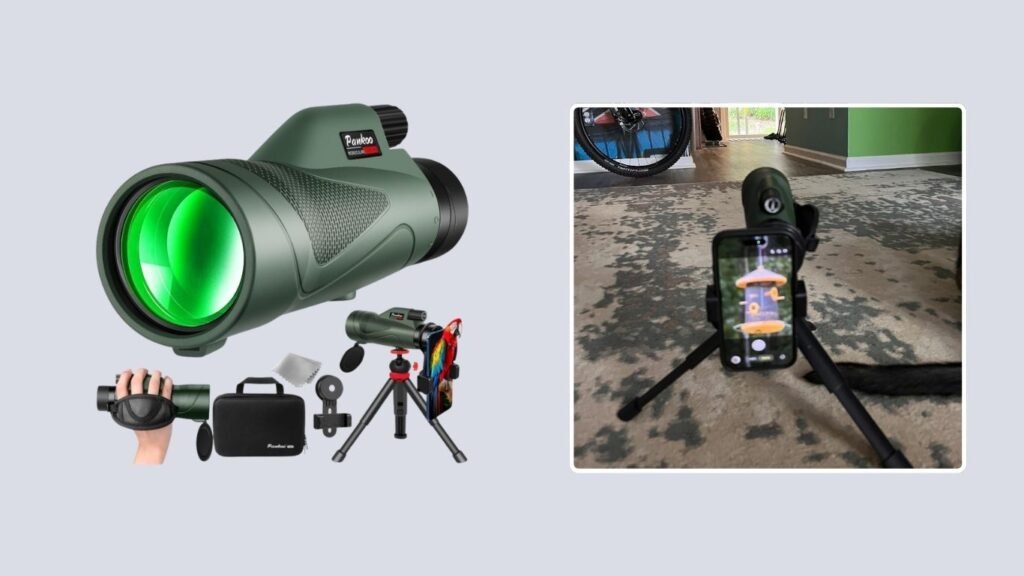
The Pankoo 12×60 HD Monocular Telescope is a practical option for bird watchers who want powerful magnification in a compact, one-handed viewing device. It combines 12x magnification with a large 60mm objective lens, giving users extra reach for observing birds across lakes, fields, forests, and open landscapes. A BAK-4 prism, fully multi-coated optics, smartphone adapter, tripod, and hand strap make the package especially versatile for birding, hiking, travel, and casual wildlife photography.
Key Features
- Powerful 12x magnification
- Large 60mm objective lens
- Approximately 325 ft field of view at 1,000 yards
- Premium BAK-4 prism
- Fully multi-coated optical surfaces
- Approximately 6.5° viewing angle
- Adjustable eyecup for comfortable viewing
- Includes smartphone adapter
- Tripod included for steadier observation
- Hand strap for easier outdoor handling
Why It’s a Strong Choice for Bird Watching
The 12x magnification is particularly useful when birds remain farther away than typical backyard viewing distances. It can help reveal plumage patterns, body shape, and other identification details on waterfowl, raptors, and birds perched high in trees. The 60mm objective lens also provides substantial light-gathering capability, making the monocular useful when observing birds in shaded areas or during softer daylight.
Optical Performance & Outdoor Handling
The combination of a BAK-4 prism and fully multi-coated lens system is designed to improve brightness, sharpness, and color reproduction. Since 12x magnification can make natural hand movement more noticeable, the included tripod becomes especially valuable for prolonged viewing. The rubberized exterior and hand strap also provide additional control when carrying or operating the monocular outdoors.
Versatility, Convenience & Overall Verdict
One of the strongest advantages of the Pankoo is how much functionality is included in a relatively compact setup. The smartphone adapter allows birders to experiment with capturing photos through the monocular, while the tripod provides stability for longer observation sessions. For recreational bird watchers who want more magnification than a small pocket monocular while still avoiding the bulk of a spotting scope, the Pankoo 12×60 HD Monocular offers an attractive combination of reach, accessories, optical capability, and everyday portability.
2. Gosky 12×55 HD Monocular Telescope

The Gosky 12×55 HD Monocular Telescope combines strong magnification with a large objective lens, making it particularly suitable for bird watchers who frequently observe birds at medium to long distances. Its 12x magnification and 55mm objective lens provide a useful balance of reach and brightness, while BAK-4 prism optics and fully multi-coated lenses are designed to deliver clearer, higher-contrast views. A smartphone adapter further adds versatility for birders interested in capturing photos of their sightings.
Key Features
- 12x magnification
- 55mm objective lens
- BAK-4 prism system
- Fully multi-coated optics
- Approximately 352 ft field of view at 1,000 yards
- IPX7 waterproof construction
- Nitrogen-filled for fog resistance
- Twist-up eyecup
- Smartphone mounting adapter
- Carrying case and hand strap included
Why It’s Excellent for Distant Bird Observation
Twelve-power magnification gives birders additional reach when watching waterfowl, raptors, shorebirds, and species positioned high in trees. The 55mm objective also collects more light than many compact monoculars, which can help provide a brighter image in shaded woodland or during early-morning viewing.
Optical Performance & Weather Protection
The BAK-4 prism and fully multi-coated lenses are intended to reduce reflections while improving light transmission, contrast, and image clarity. Its nitrogen-filled IPX7 construction also provides protection against water and internal fogging, making the monocular more suitable for unpredictable outdoor environments.
Convenience, Photography & Overall Verdict
The smartphone adapter expands its usefulness beyond simple observation, allowing users to experiment with capturing distant birds through the optic. A twist-up eyecup improves viewing comfort, including for many eyeglass wearers. For birders who prioritize stronger magnification, large optics, weather protection, and smartphone compatibility, the Gosky 12×55 HD provides an attractive all-in-one birding setup.
3. Vortex Optics Solo 10×36 Monocular

The Vortex Optics Solo 10×36 Monocular offers a compact alternative to full-size binoculars while maintaining enough magnification and lens size for serious outdoor observation. Its 10x magnification delivers useful reach, while the 36mm objective keeps the body relatively portable. Vortex equips this model with fully multi-coated lenses, rubber armor, nitrogen purging, and waterproof construction, creating a monocular well suited to bird watching, hiking, wildlife observation, and travel.
Key Features
- 10x magnification
- 36mm objective lens
- 325 ft field of view at 1,000 yards
- 15mm eye relief
- Fully multi-coated lenses
- Waterproof and fogproof design
- Nitrogen gas purged
- Durable rubber armor
- Integrated utility clip
- Approximately 9.3 oz weight
Why It’s Ideal for Mobile Bird Watchers
The Solo 10×36 is especially appealing when portability matters. It can provide noticeably more reach than lower-powered optics without requiring users to carry a larger binocular. Its utility clip also makes it convenient to attach to a backpack, belt, or other outdoor gear for quick access.
Optical Quality & Field Performance
Vortex uses fully multi-coated lenses to improve light transmission and clarity. The 10x magnification works particularly well for birds at moderate distances, while a 325-foot field of view gives users enough viewing area to scan open terrain or follow birds moving between perches.
Rugged Design & Overall Verdict
Rubber armor improves grip while providing added external protection. The nitrogen-purged and O-ring-sealed construction is designed to resist moisture and internal fogging in changing weather conditions. For bird watchers seeking a compact monocular from an established optics brand, the Vortex Solo 10×36 offers a strong combination of optical capability, durability, and portability.
4. OXK Optics 12×56 High-Power Monocular

The OXK Optics 12×56 High-Power Monocular is designed for users who want significant viewing reach combined with a large objective lens. Its 12x magnification makes distant birds easier to examine, while the 56mm objective provides substantial light-gathering capability. The package also includes a smartphone holder and tripod, making it suitable for stationary bird observation as well as casual digiscoping and outdoor photography.
Key Features
- 12x magnification
- 56mm objective lens
- 25mm eyepiece
- BAK-4 prism
- Fully multi-coated lens system
- Approximately 6.5° viewing angle
- Smartphone adapter included
- Adjustable tripod included
- Carrying case and accessories
- Manual focusing system
Why It’s Useful for Long-Range Birding
The combination of 12x magnification and a 56mm objective is particularly helpful when watching birds across wetlands, reservoirs, open fields, or coastal environments. Greater magnification can reveal plumage details and body characteristics that may be difficult to see through smaller pocket monoculars.
Image Quality & Stability
BAK-4 prism optics and fully multi-coated surfaces are designed to improve brightness, contrast, and color reproduction. Because 12x magnification can amplify natural hand movement, the included tripod is a particularly useful addition for prolonged observation or photography.
Accessories, Flexibility & Overall Verdict
A smartphone holder adds another dimension to the monocular, allowing users to attempt photos or video of distant birds. The travel case, strap, lens protection, and tripod make it a more complete package than a basic handheld optic. For bird watchers who prioritize greater magnification and accessory flexibility, the OXK Optics 12×56 is a compelling option for open-country and long-distance observation.
5. Vortex Optics Solo 10×25 Monocular

The Vortex Optics Solo 10×25 Monocular focuses heavily on portability. At just 4.4 inches long and approximately 5.6 ounces, it is compact enough to slip into a pocket or small section of a backpack. Despite its small size, it provides 10x magnification, fully multi-coated lenses, waterproof construction, and a protective rubber-armored body, making it a convenient companion for casual birding and travel.
Key Features
- 10x magnification
- 25mm objective lens
- 315 ft field of view at 1,000 yards
- 14.5mm eye relief
- Fully multi-coated lenses
- Waterproof and fogproof design
- Nitrogen gas purged
- Rubber-armored exterior
- Approximately 5.6 oz weight
- Neck lanyard and soft case included
Why It’s Best for Lightweight Birding
The compact dimensions are the main reason to consider this model. Birders hiking long trails, traveling, or carrying additional camera equipment may appreciate having a capable optic that adds very little bulk. The 10x magnification still offers enough reach for observing birds across moderate distances.
Clarity & Outdoor Performance
Fully multi-coated lenses increase light transmission and help provide cleaner, sharper images. The smaller 25mm objective will not gather as much light as larger 36mm or 55mm models, so it is best suited to normal daylight conditions. Waterproof and fogproof construction helps maintain reliability during changing weather.
Portability, Durability & Overall Verdict
The rubber-armored exterior provides a secure grip and additional protection against routine outdoor handling. Its extremely compact size means it can remain in a pocket or daypack until a bird appears. For travelers, hikers, and recreational birders who value minimal weight more than maximum low-light performance, the Vortex Solo 10×25 is an especially convenient choice.
6. High-Power Monocular with Tripod & Phone Adapter
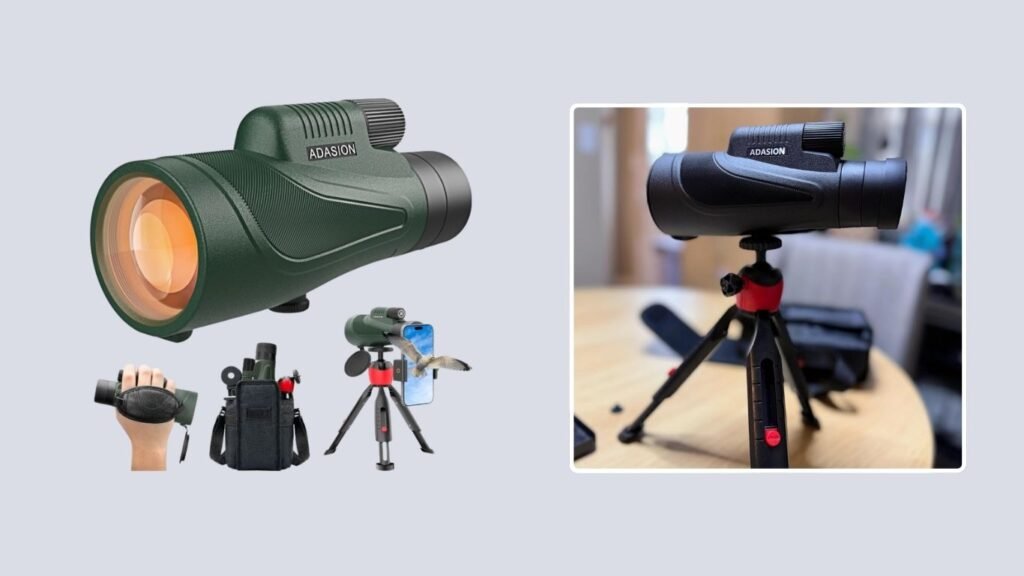
This High-Power Monocular with Tripod and Phone Adapter is aimed at bird watchers who want more versatility than a basic handheld monocular provides. Its package is designed around outdoor observation while also giving users the ability to stabilize the optic and connect a smartphone for photography. That combination can be useful for bird watching in parks, forests, wetlands, and open landscapes where longer viewing sessions benefit from additional support.
Key Features
- High-powered monocular design
- Suitable for bird and wildlife observation
- Smartphone adapter for capturing distant subjects
- Tripod adapter for more stable viewing
- Manual focusing for subject adjustment
- Portable single-eye optical design
- Suitable for hiking and travel
- Designed for handheld or supported observation
Why It’s Useful for Casual Bird Photography
A smartphone adapter can make this type of monocular especially attractive to recreational birders. Instead of simply watching a distant bird, users can align a compatible phone with the eyepiece and attempt to capture photographs or short video clips. This is convenient for documenting sightings without carrying a dedicated camera and long telephoto lens.
Viewing Stability & Field Performance
Higher-powered monoculars can show more distant detail, but stronger magnification also makes hand movement more noticeable. A tripod adapter helps address this issue by providing a steadier viewing platform. Stable positioning can be particularly useful when observing perched raptors, waterbirds, nests from a responsible distance, or birds across large open areas.
Practicality, Accessories & Overall Verdict
The biggest appeal of this model is its combination of portable viewing and accessory support. Birders can use it handheld for quick sightings, then switch to tripod-supported observation when more stability is needed. Smartphone compatibility also extends its usefulness for documenting wildlife. For beginners and casual bird watchers who want a flexible monocular package rather than a simple pocket optic, this High-Power Monocular with Tripod and Phone Adapter offers a practical setup for both viewing and basic bird photography.
7. PhysioPhyx 80×100 High-Power Monocular Telescope

The PhysioPhyx 80×100 High-Power Monocular Telescope is designed for outdoor users who want a portable viewing tool with strong advertised magnification and smartphone compatibility. Its compact single-eye design makes it easier to carry than full-size binoculars or spotting scopes, while the included phone adapter adds versatility for photographing distant subjects. The model is marketed for bird watching, wildlife viewing, hiking, camping, and travel, making it an appealing multipurpose choice for recreational outdoor observation.
Key Features
- Marketed as an 80×100 high-power monocular
- Smartphone adapter included
- Designed for distant wildlife observation
- Manual focusing system
- Portable handheld construction
- Suitable for bird watching and hiking
- Compact alternative to a spotting scope
- Protective exterior for outdoor handling
Why It Works for Long-Distance Bird Watching
The primary attraction of this monocular is its emphasis on distant viewing. Birders watching waterfowl across ponds, raptors perched far away, or birds high in trees may appreciate having a monocular that is easy to bring along. Its single-eye format also allows quick observation without carrying a full-size binocular setup.
Viewing Experience & Smartphone Compatibility
Smartphone compatibility gives this model additional usefulness for birders who enjoy documenting sightings. Aligning a phone camera with the eyepiece can make it possible to capture distant birds without carrying a dedicated telephoto camera. For the sharpest results, stabilizing the monocular against a solid surface or tripod-style support can be helpful.
Portability, Versatility & Overall Verdict
The PhysioPhyx model is aimed primarily at casual bird watchers who value magnification, portability, and phone photography in one package. Its compact form is convenient for day trips, nature walks, camping, or travel. Because extremely high magnification claims on compact monoculars should be interpreted cautiously, its strongest practical appeal is the combination of portable observation and smartphone adaptability rather than the marketing number alone.
8. Bushnell A3 10×32 Monocular

The Bushnell A3 10×32 Monocular offers a practical combination of 10x magnification and a compact 32mm objective lens. This configuration is well suited to bird watchers who want more reach than an 8x optic without carrying larger binoculars. Its streamlined design makes it convenient for hiking, backyard birding, wildlife observation, and travel, while the Bushnell name may appeal to users who prefer outdoor optics from an established manufacturer.
Key Features
- 10x magnification
- 32mm objective lens
- Compact handheld construction
- Multi-coated optical surfaces
- Designed for outdoor observation
- Water-resistant outdoor-focused build
- Easy manual focusing
- Portable size for hiking and travel
Why It’s Useful for Everyday Birding
Ten-power magnification provides enough reach for observing birds across open fields, wetlands, parks, and larger backyards. Compared with higher-powered monoculars, 10x also remains relatively manageable for handheld viewing. This makes the Bushnell A3 suitable for birders who want additional detail without moving to a much larger optical system.
Image Clarity & Field Performance
A 32mm objective offers a useful compromise between light gathering and portability. It keeps the monocular compact while providing enough lens area for normal daytime bird watching. The 10x magnification can help reveal feather markings, bill shape, and other identification features when birds remain beyond comfortable naked-eye viewing distance.
Compact Design & Overall Verdict
The Bushnell A3 10×32 is particularly attractive for people who prioritize convenience. It can fit easily into a daypack and can be brought out quickly when a bird appears. For hikers, travelers, and recreational bird watchers who want a recognizable optics brand and a practical 10x configuration without carrying full-size binoculars, this monocular offers a straightforward balance of portability and viewing power.
9. Vortex Optics Solo 8×36 Monocular

The Vortex Optics Solo 8×36 Monocular is a compact yet capable option for birders who value a wide viewing area, comfortable handling, and durable outdoor construction. It combines 8x magnification with a 36mm objective lens and provides a 393-foot field of view at 1,000 yards. Vortex also equips it with fully multi-coated optics, waterproof and fogproof construction, rubber armor, and a convenient utility clip.
Key Features
- 8x magnification
- 36mm objective lens
- 393 ft field of view at 1,000 yards
- Fully multi-coated lenses
- 18mm eye relief
- Waterproof and fogproof construction
- Rubber-armored exterior
- Integrated utility clip
- Approximately 9.7 oz weight
Why It’s Excellent for Tracking Moving Birds
Eight-power magnification is especially useful for active bird watching because it provides a steadier image and wider field of view than many higher-powered monoculars. The generous viewing area makes it easier to locate songbirds moving through branches or follow birds flying across open spaces.
Optical Performance & Outdoor Reliability
Fully multi-coated lenses are designed to improve light transmission and provide clearer views. Vortex also nitrogen-purges and O-ring seals the body for waterproof and fogproof performance. Rubber armor improves grip while providing additional protection against routine bumps and outdoor use.
Comfort, Durability & Overall Verdict
The Solo 8×36 weighs less than 10 ounces, making it easy to carry for long periods. Its utility clip can attach the monocular to a pack or belt for quick access. Bird watchers who prioritize wide viewing, dependable weather protection, and compact construction may find the Vortex Solo 8×36 one of the more balanced everyday choices in this list.
10. Nocs Provisions Zoom Tube 8×32 Monocular

The Nocs Provisions Zoom Tube 8×32 Monocular is designed around portability, simplicity, and quick outdoor observation. Its 8x magnification and 32mm objective lens provide a broad, steady view suitable for bird watching, hiking, and travel. Fully multi-coated optics, a BaK-4 roof prism, IPX4 water resistance, and a compact body make it particularly appealing to birders who want a monocular that can remain easily accessible in a pocket or backpack.
Key Features
- 8x magnification
- 32mm objective lens
- 384 ft field of view at 1,000 yards
- Fully multi-coated lenses
- BaK-4 roof prism
- 10 ft close-focus distance
- Twist-up eyecup
- IPX4 water resistance
- Tripod-compatible design
- Approximately 7.6 oz weight
Why It’s Great for Casual and Traveling Birders
Its 8x magnification provides a comfortable viewing experience with less visible hand shake than higher-powered options. A 384-foot field of view also makes scanning trees and following moving birds easier. The compact dimensions allow it to fit conveniently into a jacket pocket, backpack, or glove compartment.
Optical Quality & Easy Outdoor Use
Fully multi-coated optics and a BaK-4 roof prism are designed to provide better brightness, clarity, and natural-looking color. The twist-up eyecup helps accommodate different viewing preferences, while a 10-foot close focus can be useful for observing nearby birds, butterflies, or other small wildlife.
Lightweight Design & Overall Verdict
At roughly 7.6 ounces, the Zoom Tube adds very little weight to a birding kit. Its IPX4 rating provides protection against drizzle and splashes, although it is not intended for full submersion. For birders who prioritize portability, wide viewing, simple operation, and distinctive compact design, the Nocs Provisions Zoom Tube 8×32 is an attractive everyday monocular.
11. PhysioPhyx 80×100 HD High-Power Monocular
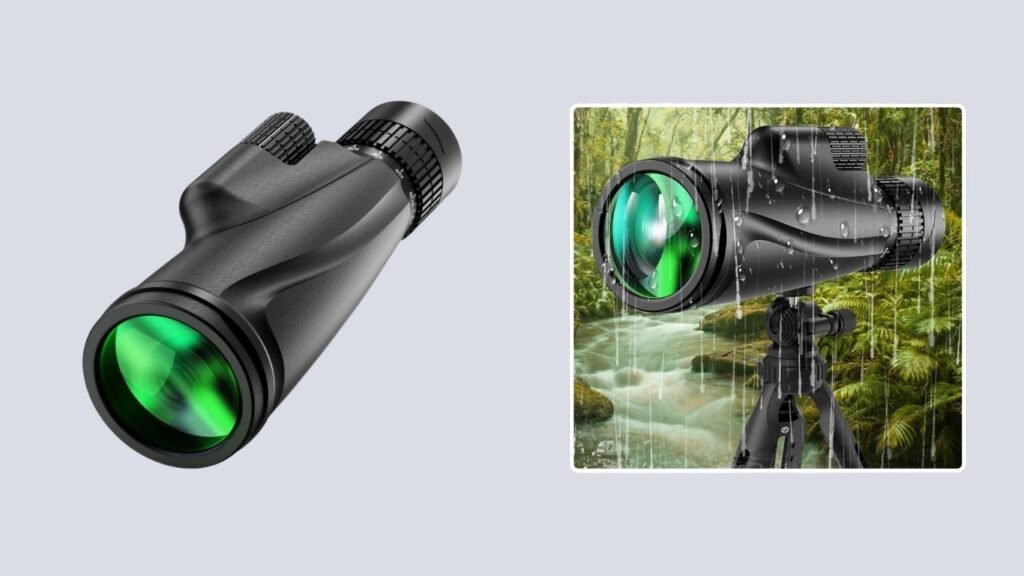
The PhysioPhyx 80×100 HD High-Power Monocular is another portable option aimed at users interested in distant wildlife observation and smartphone-assisted viewing. Its advertised high-power format targets activities such as bird watching, hiking, camping, and sightseeing. The handheld design provides an easier-to-carry alternative to a large spotting scope, while smartphone compatibility can help recreational birders document interesting sightings during outdoor trips.
Key Features
- Advertised high-power 80×100 configuration
- Designed for distant outdoor observation
- Smartphone-compatible setup
- Manual focus adjustment
- Compact single-eye design
- Suitable for wildlife and bird watching
- Portable construction for travel
- Useful for hiking, camping, and sightseeing
Why It Appeals to Recreational Bird Watchers
This model is best considered by users who want a simple monocular primarily for occasional long-distance viewing. It can be useful for scanning distant trees, open countryside, wetlands, or hillsides without bringing heavy optical equipment. Its handheld form also allows it to be carried easily during casual nature walks.
Observation & Phone Photography Performance
Smartphone compatibility adds versatility by allowing birders to align a phone camera with the monocular eyepiece. This can be useful for recording birds, sharing sightings, or creating simple wildlife photos. High magnification makes stability increasingly important, so resting the monocular against a stable surface can help produce a clearer view.
Portability, Practicality & Overall Verdict
For casual users, the main advantage is the combination of portable optics and smartphone functionality. It requires less carrying space than many spotting scopes while still providing greater viewing reach than the naked eye. As with other compact monoculars marketed with very high magnification numbers, buyers should focus on real-world clarity, stability, and handling rather than relying only on the advertised power. For recreational birding and travel, it remains a convenient multipurpose option.
FAQs
1. What magnification is best for a bird watching monocular?
For most bird watchers, 8x to 10x magnification provides a comfortable balance between detail, image stability, and field of view. Higher magnification can reveal more distant detail, but natural hand movement becomes increasingly noticeable and may make following moving birds more difficult.
2. Is an 8x or 10x monocular better for bird watching?
An 8x monocular is generally easier to hold steady and often provides a wider field of view, making it excellent for forests, gardens, and active songbirds. A 10x monocular provides greater reach and may be preferable for wetlands, open fields, distant waterfowl, or perched raptors.
3. Are monoculars good for bird watching?
Yes. Monoculars are particularly useful when portability matters. They are smaller and lighter than most binoculars and can often fit inside a pocket or compact backpack. They are excellent for quick bird identification, hiking, travel, and casual nature observation, although binoculars may feel more comfortable during extended viewing.
4. What objective lens size is good for a bird watching monocular?
Objective lenses between approximately 25mm and 42mm work well for many birding situations. Smaller lenses keep the monocular highly portable, while larger objectives generally collect more light and can produce brighter views. A 32mm or 36mm monocular provides a useful compromise between portability and brightness.
5. Can I take bird photos through a monocular?
Yes. Many modern monoculars can be paired with a smartphone adapter, allowing the phone camera to photograph or record the magnified image through the eyepiece. Keeping the monocular stable is important, especially at higher magnification. A tripod or stable support can substantially improve image sharpness and make aligning the smartphone easier.