
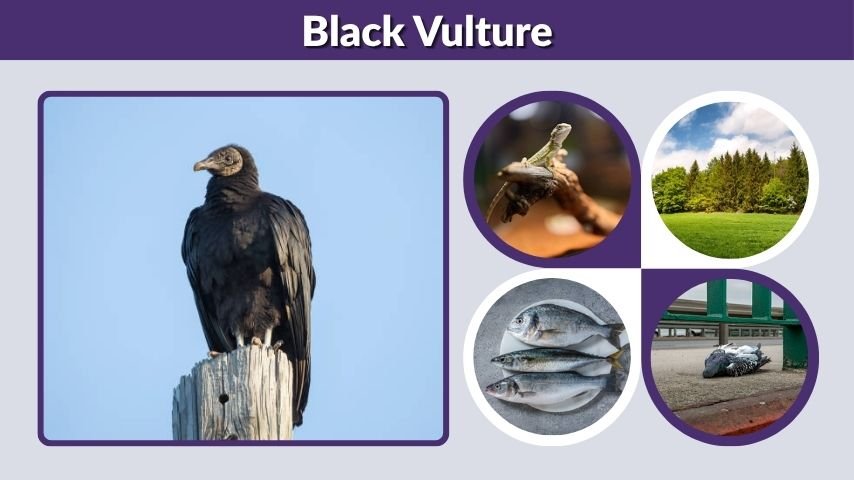
The black vulture is a bold, social scavenger often seen soaring over roadsides, farms, forests, fields, and towns. With its black body, bare dark head, short tail, and pale wingtip patches, this bird is easy to recognize once you know what to look for. Although many people confuse it with the turkey vulture, the black vulture has its own unique flight style, feeding behavior, and role in the ecosystem.
What Is a Black Vulture?
A black vulture is a large scavenging bird found in the Americas. Its scientific name is Coragyps atratus. It belongs to the New World vulture family, which also includes turkey vultures and condors.
Black vultures are best known for eating carrion, or dead animals. They clean up roadkill, carcasses, and other animal remains, helping recycle nutrients back into the environment. Although they may look intimidating, they are not birds of prey in the same way hawks and eagles are. They are mainly scavengers, not active hunters.
In the United States, black vultures are especially common in the Southeast, but their range has expanded northward in many areas. They are now seen in places such as Texas, Florida, Georgia, Kentucky, Missouri, Ohio, New Jersey, Pennsylvania, Maryland, and parts of the Midwest and Northeast.
Black Vulture Identification
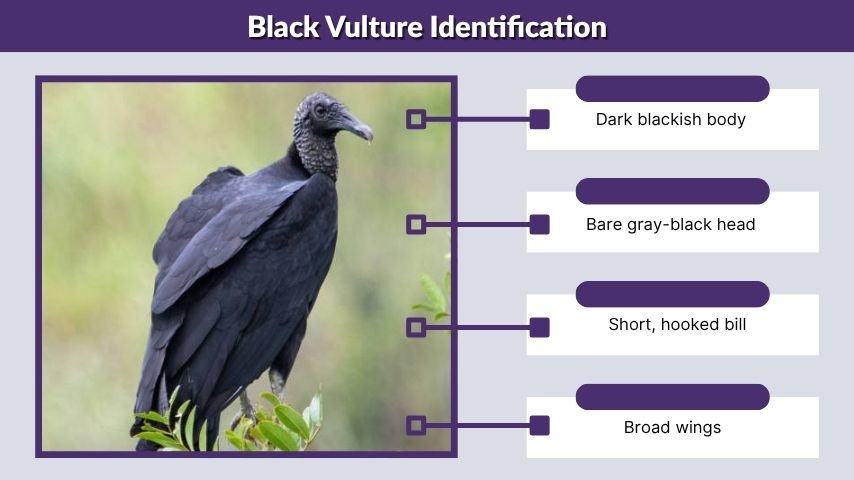
The black vulture has an all-dark appearance, but it is not completely featureless. Adult birds have a blackish body, a bare gray-black head, broad wings, and a short squared tail. In flight, the most important field mark is the pale or whitish patch near each wingtip.
Cornell’s All About Birds describes black vultures as compact vultures with broad wings, short tails, and strong wingbeats, contrasting them with the lankier turkey vulture’s teetering flight.
What Does a Black Vulture Look Like?
A black vulture usually shows these features:
- Dark blackish body
- Bare gray-black head
- Short, hooked bill
- Broad wings
- Short tail
- Pale patches near the wing tips
- Compact shape in flight
- Powerful flapping followed by short glides
Juvenile black vultures look similar to adults. Unlike turkey vultures, they do not develop a bright red head. This makes them easy to confuse with young turkey vultures, which also have darker heads before adulthood.
Black Vulture Size and Wingspan
Black vultures are large birds, but they are smaller and more compact than turkey vultures. Their wings are broad, and their tail is noticeably short. This gives them a stockier appearance in the air.
| Feature | Black Vulture Description |
| Scientific name | Coragyps atratus |
| Bird family | New World vultures |
| Average length | About 23–27 inches |
| Wingspan | Around 4.5–5 feet |
| Head color | Gray-black and bare |
| Body color | Blackish |
| Main food | Carrion, roadkill, scraps, and some small animals |
| Flight mark | Pale patches near wingtips |
| Common confusion | Turkey vulture |
When people search for “black vulture size,” “black vulture wingspan,” or “black vulture size comparison to human,” they are usually trying to understand how large this bird looks in real life. A black vulture can appear very big when perched on a roof or fence, but compared with turkey vultures and condors, it is more compact.
Black Vulture Flight
Black vulture flight is one of the best ways to identify the species. Unlike turkey vultures, which often soar with their wings raised in a shallow V and rock from side to side, black vultures fly with stronger, quicker wingbeats.
A typical black vulture flight pattern includes several rapid flaps followed by a short glide. The bird often looks more controlled and less wobbly than a turkey vulture. From below, the pale patches near the wing tips stand out against the dark wings.
How to Identify a Black Vulture in Flight
Look for these signs:
- Short tail
- Broad wings
- White or pale wingtip patches
- Quick flapping
- Short gliding
- More stable flight than turkey vultures
- Compact shape
A black vulture soaring overhead may look like a dark cross with silver-white tips on the wings. If the bird is rocking unsteadily with long wings and a long tail, it is more likely a turkey vulture.
What Do Black Vultures Eat?
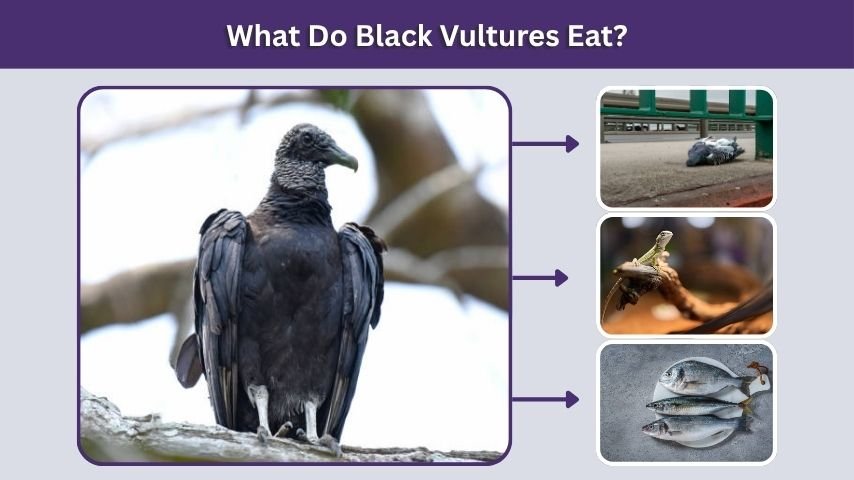
Black vultures mainly eat carrion. Their diet includes dead mammals, roadkill, dead birds, fish, reptiles, and discarded animal remains. They often gather at carcasses in groups, and they may feed aggressively when competing with other scavengers.
Audubon lists black vulture habitats such as fields, grasslands, forests, landfills, savannas, and shrublands, which reflects how adaptable the species is when searching for food.
Do Black Vultures Eat Live Animals?
Black vultures usually eat dead animals, but they are more likely than turkey vultures to attack vulnerable live animals. In some areas, they may target newborn livestock, weak animals, eggs, nestlings, or small helpless animals.
This behavior is one reason black vultures can cause conflict with farmers and ranchers. Still, most of their diet is carrion, and their ecological role as cleanup birds is very important.
Black Vulture Habitat
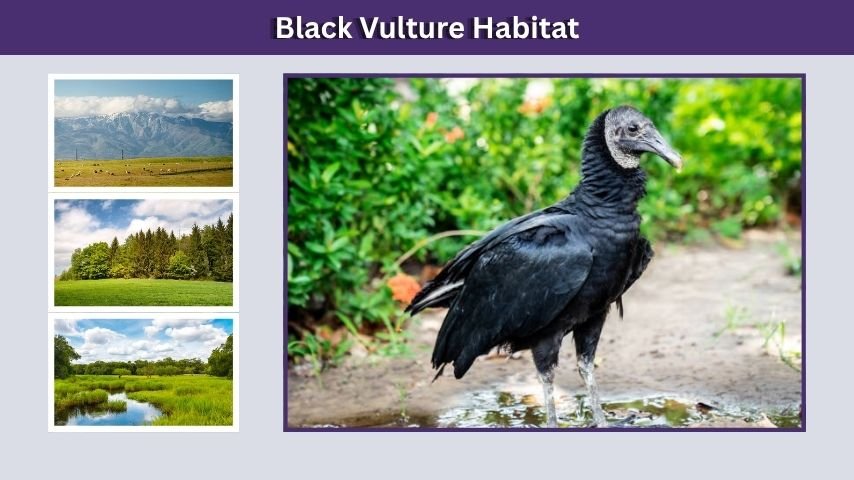
Black vultures are highly adaptable. They can live in open country, forest edges, wetlands, farmland, towns, suburbs, and areas near landfills or roads. They need access to food, safe roosting places, and sheltered nesting sites.
They are often found near people because human landscapes provide roadkill, garbage, livestock areas, and tall structures for roosting. Large groups may gather on communication towers, rooftops, barns, trees, and power structures.
Common Black Vulture Habitats
Black vultures may be seen in:
- Open fields
- Farms and ranches
- Roadsides
- Forest edges
- Wooded river corridors
- Wetlands
- Landfills
- Towns and suburbs
- Pastures
- Southern and eastern states
Their ability to live near human activity has helped them expand in many areas.
Black Vulture Range
The black vulture is found from the southeastern United States through Mexico, Central America, and much of South America. In the U.S., it is especially common in the Southeast and parts of the South, but sightings have increased farther north in recent decades.
Cornell’s range information notes the species’ association with black plumage, bare head, pale wingtip patches, and its comparison with turkey vultures, which are often seen in the same areas.
Where Do Black Vultures Live?
In the United States, black vultures are often associated with states such as:
- Florida
- Texas
- Georgia
- South Carolina
- North Carolina
- Tennessee
- Kentucky
- Missouri
- Ohio
- Maryland
- New Jersey
- Pennsylvania
They may appear farther north, especially where winter conditions are mild or where food and roosting sites are available.
Black Vulture Nesting
Black vultures do not build neat stick nests like many hawks or crows. Instead, they lay eggs in sheltered places. A nest site may be in a hollow tree, cave, abandoned building, brush pile, rock crevice, stump, or dense vegetation.
The eggs are usually laid directly on the surface of the chosen site. Both parents help care for the young. Black vulture chicks are pale and downy when they hatch, then gradually grow dark feathers as they mature.
Black Vulture Eggs and Chicks
Black vulture breeding often includes:
- One to three eggs
- Sheltered nesting location
- Little or no nest material
- Both parents feeding young
- Chicks staying in the nest site for weeks
- Young birds joining family groups after fledging
Young black vultures may remain near adults for some time. Family bonds are strong, and black vultures are known for being social birds.
Black Vulture Sounds
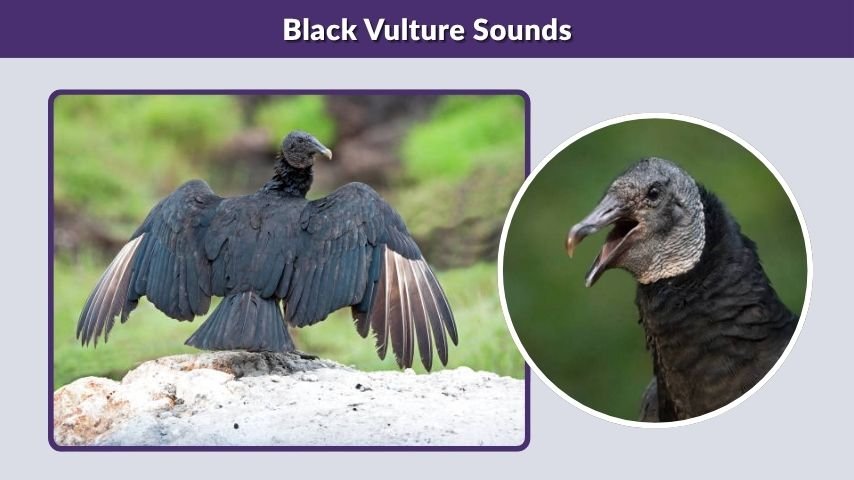
Black vultures are usually quiet because they do not have a strong songbird-like voice. They may hiss, grunt, or make harsh breathing sounds, especially when disturbed, threatened, or near a nesting site.
What Does a Black Vulture Sound Like?
Common black vulture sounds include:
- Hissing
- Grunting
- Low rasping noises
- Harsh defensive sounds
People searching for “black vulture call” or “black vulture sounds” may expect a loud bird call, but black vultures are not very vocal. Their body language, group behavior, and flight style are usually more noticeable than their sounds.
Are Black Vultures Dangerous?
Black vultures are not usually dangerous to humans. They do not hunt people, and they generally avoid direct contact. However, they can cause problems when large groups roost around homes, farms, towers, or buildings.
They may damage rubber, roofing materials, vehicle parts, caulking, and other soft materials. Their droppings can also create mess and sanitation concerns. In agricultural areas, they may sometimes harm newborn livestock, which makes them a serious concern for some farmers.
Will Black Vultures Attack Dogs or People?
Black vultures are very unlikely to attack people. They are also unlikely to attack healthy adult dogs. However, small, weak, newborn, or helpless animals can be vulnerable in rare situations, especially when many vultures gather around livestock or birthing areas.
If black vultures are causing a problem, property owners should use legal, humane control methods and contact wildlife professionals when needed.
Are Black Vultures Protected?
Yes. In the United States, black vultures are protected under the Migratory Bird Treaty Act. The U.S. Fish & Wildlife Service explains that the MBTA is intended to ensure the sustainability of protected migratory bird species.
USDA APHIS also notes that vultures are migratory birds protected under the MBTA, while recognizing that black vultures and turkey vultures can sometimes create agricultural, property, or safety conflicts.
This means people generally cannot kill, trap, harm, possess, or disturb black vultures, their eggs, or their nests without proper permits. If there is a serious livestock or property issue, the correct step is to contact local wildlife officials or USDA Wildlife Services.
Black Vulture vs Turkey Vulture
“Black vulture vs turkey vulture” is one of the most common comparison searches. These birds often occur in the same areas and may feed together, but they are easy to separate once you know the differences.
A turkey vulture has a red head as an adult, longer wings, a longer tail, and a rocking flight style. A black vulture has a dark head, shorter tail, broader wings, and pale patches near the wingtips.
Turkey vultures have a better sense of smell and often locate hidden carrion first. Black vultures may follow turkey vultures to food, then compete aggressively at the carcass.
Key Differences
- Black vulture: dark head, short tail, white wingtip patches
- Turkey vulture: red head, long tail, pale trailing wing feathers
- Black vulture: quick flaps and short glides
- Turkey vulture: wobbly soaring with wings held in a V
- Black vulture: more social and aggressive at carcasses
- Turkey vulture: better at finding carrion by smell
Black Vulture vs Turkey Buzzard
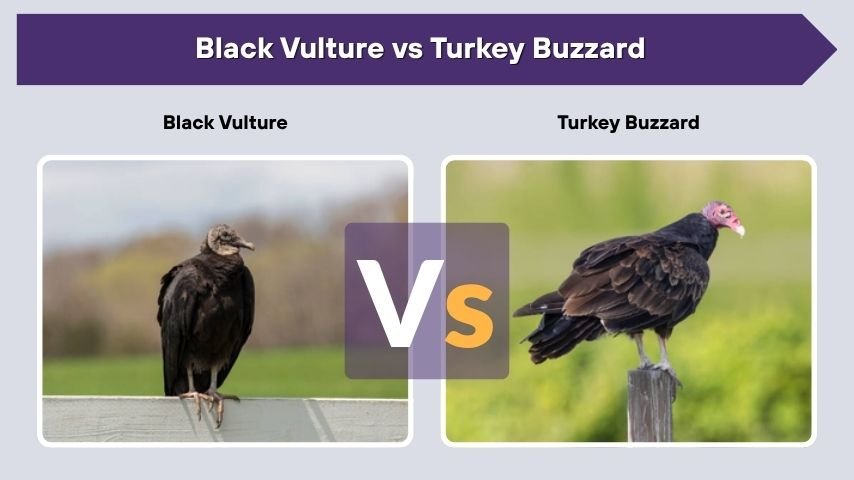
In North America, many people use “buzzard” to mean vulture. So when someone says “black vulture vs turkey buzzard,” they are usually comparing black vultures with turkey vultures.
Technically, “buzzard” can mean different birds depending on the country. In Europe, a buzzard is usually a type of hawk. In the United States, “turkey buzzard” usually means turkey vulture.
Black Vulture Spiritual Meaning
The black vulture often symbolizes cleansing, transformation, survival, patience, and renewal. Because it feeds on dead animals, it may seem connected with death, but its deeper meaning is often about removing waste and turning endings into new beginnings.
A black vulture can also represent resourcefulness. It survives by using what others leave behind. Spiritually, some people see the black vulture as a reminder to release what is no longer useful and trust the natural cycle of change.
Spiritual meaning depends on culture, personal belief, and context. In nature, the black vulture’s role is practical and valuable: it cleans the environment and helps recycle organic matter.
Black Vulture Feathers
Black vulture feathers are dark, but the underside of the wings shows pale patches near the tips. These pale areas are important for identification in flight.
In the United States, feathers from protected birds generally should not be collected without permission. Even if a feather is found naturally on the ground, it may still be covered by wildlife laws. It is safest to leave wild bird feathers where they are.
How to Get Rid of Black Vultures Safely
If black vultures are gathering around a home, farm, roof, or barn, the first step is to remove attractants. Do not leave carcasses, exposed garbage, pet food, or livestock afterbirth where vultures can feed.
Safe management may include:
- Removing food sources
- Securing trash
- Protecting newborn livestock
- Using approved visual deterrents
- Blocking access to roosting spots
- Contacting USDA Wildlife Services or local wildlife agencies
- Following permit rules before any direct control
Because black vultures are protected, do not shoot, poison, trap, or destroy nests without proper authorization.
FAQs
What is the scientific name of the black vulture?
The scientific name of the black vulture is Coragyps atratus. It is a New World vulture found across parts of North America, Central America, and South America. In the United States, it is especially common in the Southeast and South.
What do black vultures eat?
Black vultures mainly eat carrion, including roadkill and dead animals. They may also eat scraps, eggs, young birds, weak newborn animals, or small helpless animals in some situations. Most of their diet comes from scavenging rather than hunting.
What is the difference between a black vulture and a turkey vulture?
A black vulture has a dark head, short tail, broad wings, and pale wingtip patches. A turkey vulture has a red head as an adult, longer tail, longer wings, and a wobbly V-shaped flight. Turkey vultures are also better at finding carrion by smell.
Are black vultures dangerous?
Black vultures are not usually dangerous to people. They may cause problems around farms, rooftops, vehicles, and livestock areas, especially in large groups. They can damage property and may sometimes threaten newborn livestock, but they normally avoid humans.
Are black vultures protected?
Yes, black vultures are protected in the United States under the Migratory Bird Treaty Act. This means they cannot usually be killed, captured, harmed, or disturbed without proper permits. For serious nuisance issues, contact wildlife officials instead of handling the birds illegally.
