
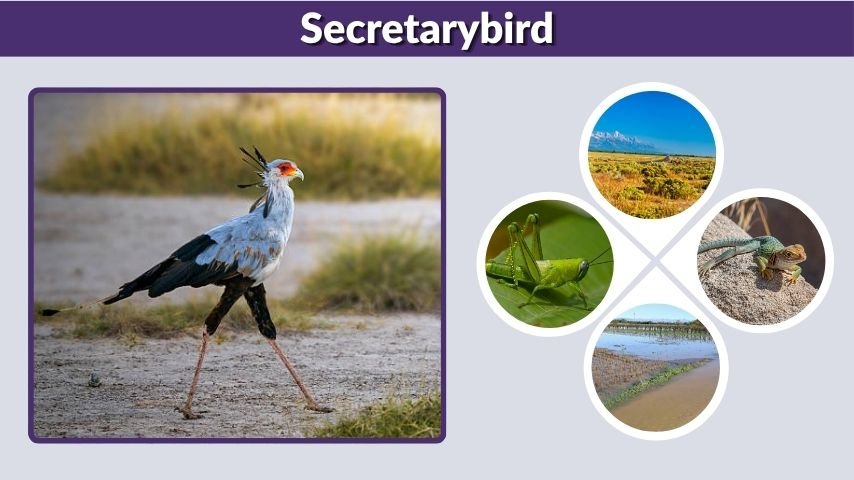
The secretarybird is one of Africa’s most unusual birds of prey. With long crane-like legs, an eagle-like body, a hooked beak, and a dramatic crest of black feathers, it looks unlike almost any other raptor. While many birds of prey hunt from the sky, the secretarybird spends much of its time walking across grasslands, searching for snakes, insects, reptiles, and small mammals.
What Is a Secretarybird?
The secretarybird, also written as secretary bird, is a large terrestrial bird of prey found in sub-Saharan Africa. Its scientific name is Sagittarius serpentarius. It belongs to the order Accipitriformes, the same broad group that includes hawks, eagles, kites, harriers, and vultures. However, the secretarybird is so distinctive that it is placed in its own family, Sagittariidae.
Unlike many raptors that spend most of their hunting time flying, the secretarybird is mostly ground-dwelling. It walks through open savannas and grasslands on long legs, using sharp vision to spot prey. Its body is built for both walking and striking. The bird has strong legs, a hooked beak, and a unique hunting style that involves stamping or kicking prey on the ground.
The name “secretarybird” is often linked to the long black crest feathers on the back of its head. These feathers look a little like old-fashioned quill pens tucked behind a clerk’s ear, which may explain the bird’s common name.
Secretarybird Size
The secretarybird is a tall, elegant raptor. Its long legs make it look more like a crane or stork at first glance, but its hooked beak and hunting behavior clearly show that it is a bird of prey. Adults can reach impressive heights, making “secretarybird size” one of the most searched topics about this species.
A full-grown secretarybird can stand over 4 feet tall. Its long legs help it move through tall grass, while its wings allow it to fly, roost, and perform courtship displays. Although it can fly well, it usually hunts by walking.
| Feature | Approximate Details |
|---|---|
| Scientific name | Sagittarius serpentarius |
| Bird type | Terrestrial bird of prey |
| Height | Up to about 4 feet or more |
| Wingspan | Around 6 feet or more |
| Main range | Sub-Saharan Africa |
| Habitat | Grassland, savanna, steppe, open woodland |
| Diet | Insects, reptiles, snakes, small mammals, birds, eggs |
| Conservation status | Endangered |
The secretarybird’s height gives it an advantage in open landscapes. It can look over grass, scan the ground for movement, and strike quickly when prey is found.
What Does a Secretarybird Look Like?
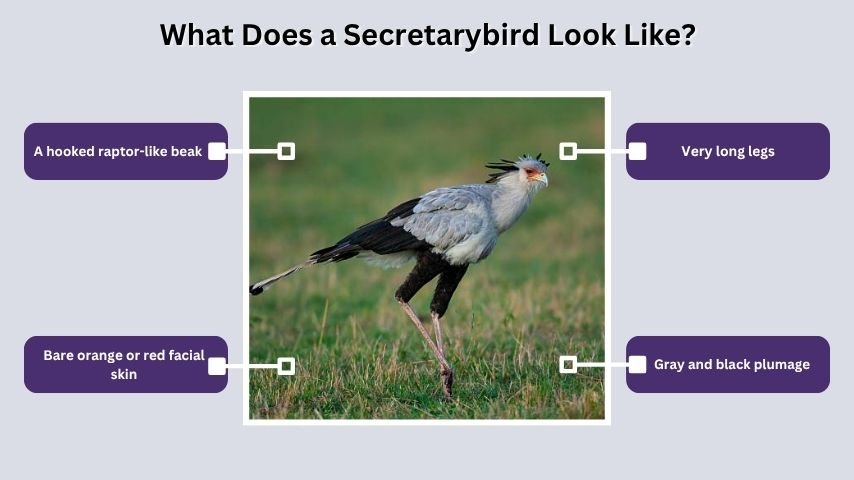
The secretarybird has one of the most recognizable appearances of any African bird. Its body is mostly pale gray, with black flight feathers, black thighs, and a long tail. The face often has bare orange or reddish skin, giving the bird a sharp, alert expression.
Its most famous feature is the crest of long black feathers behind the head. These feathers can stick up or trail backward, giving the bird a dramatic look. Combined with its long legs, the crest makes the secretarybird appear both graceful and powerful.
Key Appearance Features
A secretarybird is easy to identify because it has:
- Very long legs
- Gray and black plumage
- A hooked raptor-like beak
- Bare orange or red facial skin
- Long black crest feathers
- A long tail with central streamers
- A walking hunting style
From a distance, it may look like a strange mix of eagle, crane, and roadrunner. Up close, it is clearly a specialized raptor adapted for life on the ground.
Where Do Secretarybirds Live?
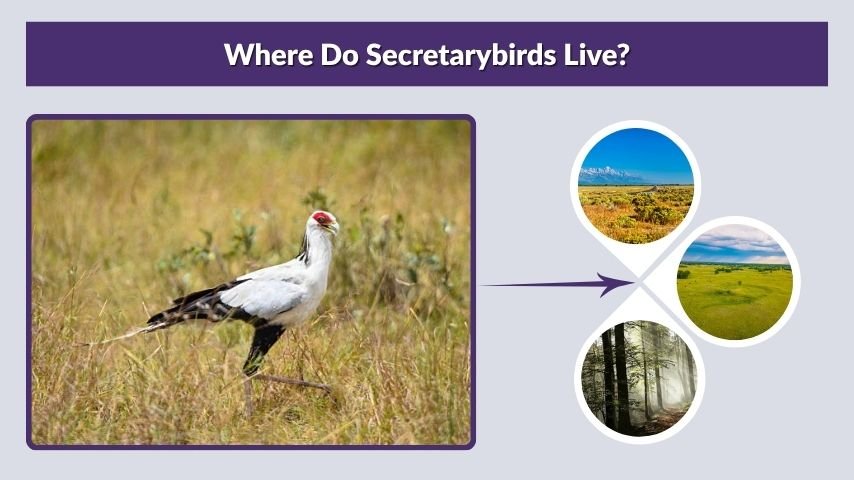
Secretarybirds live across large parts of sub-Saharan Africa. They are associated with open habitats, especially grasslands and savannas. Their range extends through parts of West, East, Central, and Southern Africa, though they are absent from some dense forest regions such as much of the Congo Basin.
They prefer open areas where they can walk, hunt, and see prey easily. Dense forests are not suitable because the bird relies on visibility and movement across the ground. Open woodland, steppe, and lightly wooded savanna can also support secretarybirds if prey is available.
Common Secretarybird Habitat
Secretarybirds are usually found in:
- Open savannas
- Grasslands
- Steppe habitats
- Light woodland
- Semi-arid plains
- Protected reserves and national parks
- Open farmland or grazing areas in some regions
Because the bird needs large open spaces, habitat loss is a serious problem. When grasslands are converted to farms, plantations, roads, or urban areas, secretarybirds lose hunting and breeding space.
Secretarybird in Africa
The secretarybird is strongly associated with African savannas. It is especially well known from wildlife areas in countries such as Kenya, Tanzania, South Africa, Botswana, Namibia, and other parts of sub-Saharan Africa. It may be seen walking through grasslands in places like the Serengeti, Maasai Mara, and other open landscapes.
Although the secretarybird has a wide range, it does not occur evenly everywhere. It can be uncommon or declining in many areas. The bird needs suitable habitat, safe nesting sites, enough prey, and low levels of disturbance.
In African ecosystems, the secretarybird plays an important role as a predator. It helps control populations of insects, reptiles, rodents, and other small animals. Its habit of hunting snakes has made it especially famous.
What Do Secretarybirds Eat?
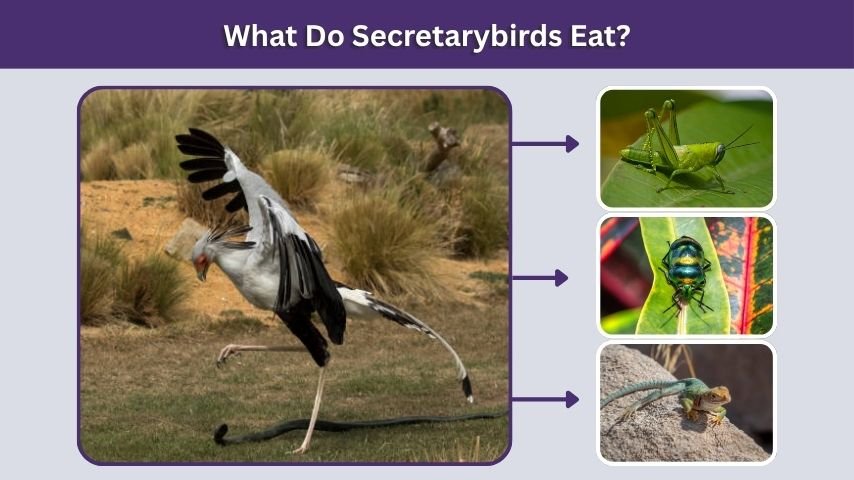
The secretarybird is a carnivore. Its diet includes insects, small mammals, reptiles, birds, eggs, amphibians, and sometimes carrion. It is especially famous for eating snakes, but snakes are not its only food. Its diet can vary depending on location, season, and prey availability.
Secretarybirds hunt mainly on foot during the day. They walk through grasslands and flush prey from vegetation. When they see movement, they may chase, kick, stomp, or strike with the beak.
Common Secretarybird Food
A secretarybird may eat:
- Grasshoppers and locusts
- Beetles and other large insects
- Lizards
- Snakes
- Small birds
- Bird eggs
- Rodents
- Hares and small mammals
- Tortoises and other small reptiles
San Diego Zoo notes that the secretarybird’s feet are adapted more for walking than grasping. Instead of carrying prey in its feet like many raptors, it usually eats food immediately or carries it in the beak.
Secretarybird and Snakes
The secretarybird is famous as a snake hunter. Many people search for “secretarybird snake,” “secretarybird black mamba,” or “secretarybird snake defense behavior” because the bird has a dramatic way of dealing with dangerous prey.
When hunting snakes, the secretarybird may use powerful downward kicks and stomps to stun or kill the snake. Its long legs help keep its body away from the snake’s head, while the scaly lower legs provide some protection. The bird may also use its wings for balance and distraction.
How Secretarybirds Hunt Snakes
A secretarybird may hunt snakes by:
- Walking through grass to flush prey
- Watching for movement on the ground
- Striking with fast kicks
- Stomping prey repeatedly
- Using the beak once prey is weakened
- Keeping distance with long legs
Although it is famous for killing snakes, the secretarybird is not immune to danger. Venomous snakes can still be risky. The bird’s success comes from speed, accuracy, leg length, and repeated powerful strikes.
Secretarybird Kick and Stomp
The secretarybird’s kick is one of its most fascinating behaviors. Instead of relying mainly on talons to grab prey, it uses fast, forceful strikes from its legs. This is why “secretarybird kick” and “secretarybird stomp” are common search topics.
Researchers studying a trained secretarybird found that its kicking strikes were extremely quick and forceful, with contact lasting only a fraction of a second. The strikes averaged about five times the bird’s body weight in force.
This explains how a secretarybird can attack dangerous prey such as snakes. A quick, accurate kick can stun or injure prey before it has time to strike back.
Can Secretarybirds Fly?
Yes, secretarybirds can fly. However, they are more famous for walking than flying. Much of their hunting is done on the ground, and they may walk long distances while searching for prey.
They fly to move between areas, escape threats, reach nests, and perform courtship displays. During courtship, pairs may soar together in wide circles and perform aerial movements.
Their wings are broad and strong, but their long legs make them look unusual when taking off or landing. Like many large birds, they often prefer open space for easier movement.
Secretarybird Nesting and Breeding
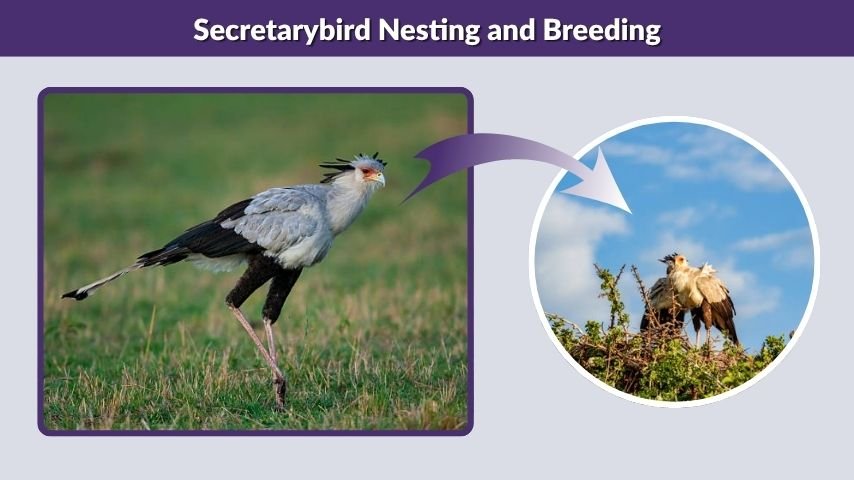
Secretarybirds build large nests, usually in trees such as thorn trees or acacias. The nest is often placed high enough to provide safety and a wide view of the surroundings. Breeding may happen at different times depending on food availability and local conditions.
The female usually lays one to three eggs. Both parents may help care for the young. In good food years, more chicks may survive, but in difficult years, survival can be lower.
Breeding Features
Secretarybird breeding usually involves:
- Large stick nests in trees
- One to three eggs
- Parental care from both adults
- Slow chick development
- Dependence on food availability
- Nesting in open or lightly wooded habitats
Because secretarybirds reproduce slowly compared with many smaller birds, population recovery can be difficult when adult birds are lost.
Secretarybird Lifespan
The secretarybird can live for many years, especially in protected environments. Like many large birds of prey, it has a slower life history than small birds. It takes time to mature, reproduce, and raise young.
This long lifespan helps stable populations survive under good conditions. However, it also means that conservation problems can become serious when adult survival drops. If many adults are killed, displaced, or unable to breed, the population may decline faster than it can recover.
Are Secretarybirds Endangered?
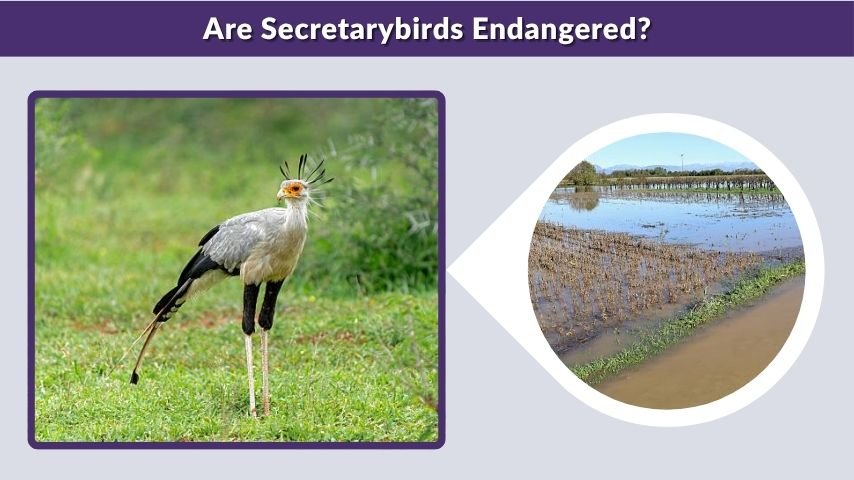
Yes, the secretarybird is currently classified as Endangered. BirdLife International reports that the species has declined severely across its range, likely because of habitat degradation, disturbance, hunting, and capture for trade. The estimated number of mature individuals is broad, around 6,700 to 67,000, and the population trend is decreasing.
BirdLife South Africa notes that the secretarybird was uplisted from Near Threatened to Vulnerable in 2011 and then to Endangered in 2020. This reflects growing concern about declines in parts of its range.
Main Threats to Secretarybirds
Secretarybirds face several threats, including:
- Grassland loss
- Agricultural expansion
- Overgrazing
- Habitat degradation
- Disturbance near nests
- Hunting or capture
- Collisions with fences and power lines
- Poisoning in some areas
Because the secretarybird depends on large open habitats, protecting grasslands and savannas is essential for its future.
Secretarybird Facts
The secretarybird is full of unusual features. It is one of the few raptors that hunts mostly on foot, and it has a body plan that looks very different from most birds of prey.
Here are some quick secretarybird facts:
- The secretarybird is native to Africa.
- Its scientific name is Sagittarius serpentarius.
- It is a bird of prey, not a crane or stork.
- It spends much of its time walking.
- It is famous for hunting snakes.
- It can kill prey with powerful kicks.
- It lives mostly in grasslands and savannas.
- It builds large nests in trees.
- It has long black crest feathers.
- It is currently listed as Endangered.
FAQs
What is a secretarybird?
A secretarybird is a large terrestrial bird of prey found in sub-Saharan Africa. It has long legs, a hooked beak, gray and black feathers, and a dramatic crest. Unlike most raptors, it hunts mainly by walking across grasslands and striking prey on the ground.
How big is a secretarybird?
A secretarybird can stand over 4 feet tall, making it one of the tallest birds of prey. Its long legs give it a crane-like appearance, while its hooked beak and hunting behavior show that it is a raptor. Its wingspan can reach around 6 feet or more.
Where do secretarybirds live?
Secretarybirds live in sub-Saharan Africa, especially in open savannas, grasslands, steppe, and lightly wooded areas. They avoid dense forests because they need open ground for walking and hunting. They are often seen in protected reserves and open plains.
Do secretarybirds eat snakes?
Yes, secretarybirds are famous for eating snakes, but snakes are only part of their diet. They also eat insects, lizards, rodents, small birds, eggs, and other small animals. They often kill prey by kicking or stomping it on the ground.
Are secretarybirds endangered?
Yes, the secretarybird is classified as Endangered. Its population is declining because of habitat loss, grassland degradation, disturbance, hunting, capture, and other human-related threats. Conservation depends on protecting large open habitats and reducing risks around nesting and hunting areas.