
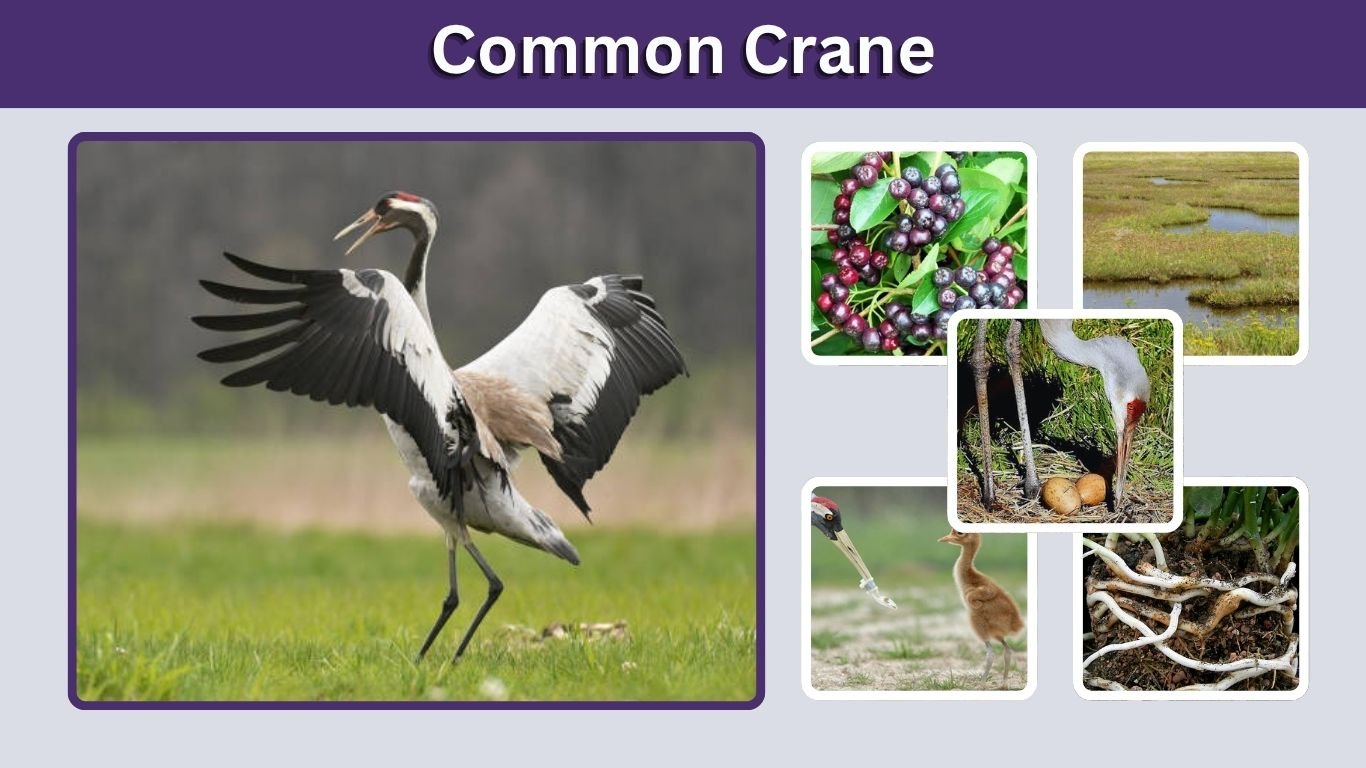
The Common Crane is a tall, elegant bird known for its trumpeting call, energetic courtship dance, and impressive long-distance migrations. Adults have grey plumage, long black legs, a white neck stripe, and a small red crown. They breed in quiet wetlands across Europe and northern Asia before many populations migrate south for winter. Common Cranes are omnivorous and feed on everything from grains and roots to insects, amphibians, and small mammals. Outside the breeding season, they may form enormous flocks at traditional feeding and roosting sites.
Common Crane Scientific Name and Classification
The scientific name of the Common Crane is Grus grus. It is also called the Eurasian Crane in some regions. It belongs to the family Gruidae, which includes the world’s true cranes.
| Feature | Information |
|---|---|
| Scientific name | Grus grus |
| Family | Gruidae |
| Length | Approximately 100–130 cm |
| Wingspan | Approximately 180–240 cm |
| Weight | Around 3–6.1 kg |
| Diet | Plants, grains, insects, and small animals |
| Clutch size | Usually 2 eggs |
| Incubation | Approximately 28–31 days |
| Conservation status | Least Concern |
Two commonly recognized subspecies occupy different portions of the species’ extensive European and Asian range.
Common Crane Size
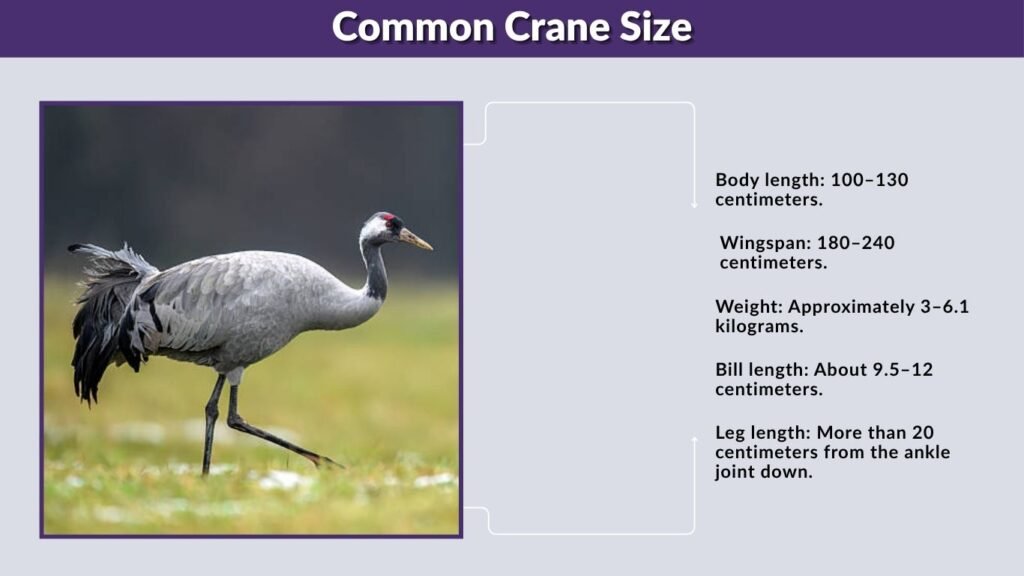
The Common Crane is a large bird with a long neck, long legs, and broad wings. When standing upright, an adult may be more than one meter tall.
Common Crane Measurements
Typical measurements include:
- Body length: 100–130 centimeters
- Wingspan: 180–240 centimeters
- Weight: Approximately 3–6.1 kilograms
- Bill length: About 9.5–12 centimeters
- Leg length: More than 20 centimeters from the ankle joint down
Males are generally larger and heavier than females, but both sexes have almost identical plumage. Their long legs allow them to walk through shallow wetlands, while their broad wings support migration across thousands of kilometers.
Young birds reach nearly adult size before their first migration. However, they can still be recognized by their brownish plumage and less contrasting head patterns.
e similar in appearance, although their average size and coloration can vary slightly.
an it appears. Its hollow bones and powerful flight muscles help it travel long distances during migration.
Common Crane Color and Appearance
Adult Common Cranes are primarily slate grey. The head and upper neck have a striking combination of black, white, and red that makes the species relatively easy to recognize.
Adult Plumage
The main identification features include:
- Slate-grey body and wings
- Black forehead, face, and front of the neck
- White stripe extending from behind the eyes down the neck
- Bare red patch on the crown
- Long, pointed, greyish or yellowish bill
- Dark legs
- Black flight feathers
- Long, drooping feathers over the rear of the body
The feathers hanging over the tail may resemble a bushy tail, but they are actually elongated inner wing feathers. The bird’s true tail is relatively short.
The red crown is bare skin rather than red feathers. Its brightness may change with excitement, aggression, courtship, or other social interactions.
Juvenile Common Crane
Juveniles are mostly grey-brown or yellowish brown. They lack the adult’s bold black-and-white neck pattern and bare red crown. Their head is fully feathered, helping distinguish them from mature birds.
Young cranes gradually acquire adult plumage over the next few years. A family group seen during migration may include two grey adults accompanied by one or two browner juveniles.
Common Crane Habitat
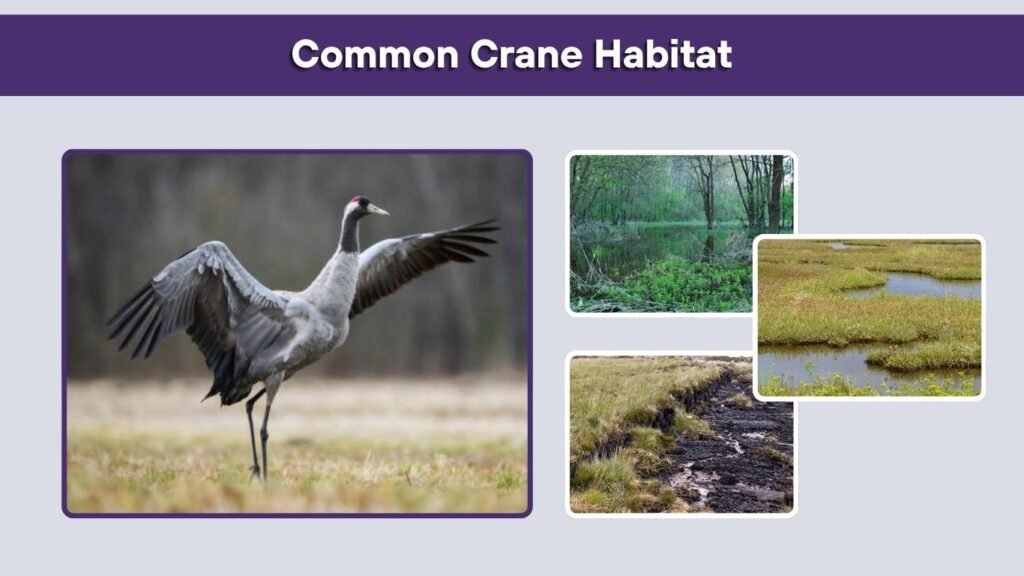
Common Cranes use different habitats during breeding, migration, and winter. They need quiet wetlands for nesting but frequently forage in much drier environments.
Breeding Habitat
During the breeding season, cranes prefer secluded areas with shallow water and dense vegetation. Suitable habitats include:
- Forested swamps
- Peat bogs
- Marshes
- Wet meadows
- Shallow lakes
- Reed beds
- Moorland pools
- Flooded woodland
- Wet areas surrounded by boreal forest
Shallow water helps protect nests from many land predators. Dense reeds, sedges, and other vegetation also conceal the adults, eggs, and chicks.
Winter Habitat
During winter, Common Cranes often live in open countryside. They feed in farmland, pastures, grasslands, harvested fields, shallow wetlands, and savanna-like areas.
Large flocks may gather at communal roosts in shallow water. These wet roosting sites provide protection because approaching predators create movement and noise in the water.
Common Crane Range and Migration
The Common Crane has a broad range extending from Europe across northern and central Asia. Important breeding populations occur in Scandinavia, the Baltic region, Germany, Poland, Finland, Russia, and parts of northern Asia.
Many Common Cranes are migratory. European populations may travel to France, Spain, Portugal, the Mediterranean region, and northern Africa for winter. Other populations migrate toward northeastern Africa, the Middle East, India, Pakistan, or eastern China.
Migration Behavior
Common Cranes migrate in family groups and larger flocks. They frequently fly in V-shaped formations, which may reduce air resistance and help conserve energy.
Their loud trumpeting calls allow flock members to maintain contact during flight. Migrating cranes can fly at considerable heights and cover hundreds of kilometers when weather conditions are favorable.
Autumn migration generally occurs from late summer through early winter. Spring migration begins when birds leave their wintering grounds and return north to breed. Exact timing depends on the population, weather, food availability, and geographic location.
Some cranes now remain farther north during mild winters when wetlands do not freeze and sufficient food remains available.
What Do Common Cranes Eat?
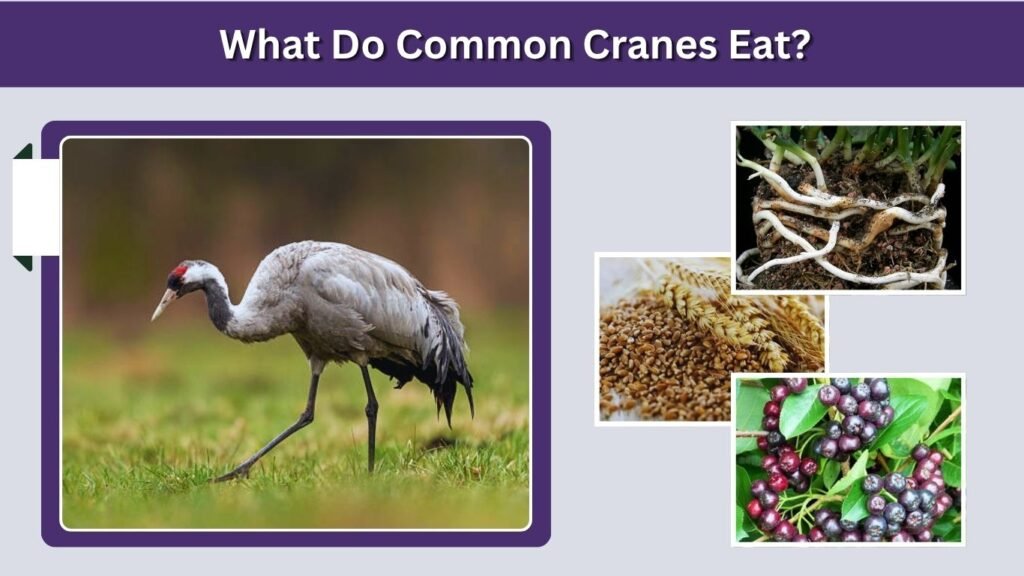
Common Cranes are omnivores with a highly adaptable diet. Plant material is particularly important during migration and winter, while animal prey becomes more common during spring and summer.
Plant Foods
Common Cranes eat:
- Seeds and grains
- Wheat, barley, corn, and rice
- Acorns
- Berries
- Roots and rhizomes
- Tubers
- Young shoots
- Leaves
- Aquatic plants
Harvested agricultural fields provide valuable feeding areas during migration. Cranes search for spilled grain, seeds, and crop remains left after harvesting.
Animal Foods
Their animal prey includes:
- Insects and insect larvae
- Earthworms
- Snails and other mollusks
- Frogs and tadpoles
- Small fish
- Lizards and snakes
- Rodents
- Small birds and eggs
- Crustaceans
The diet changes according to what is seasonally abundant. Parents depend heavily on protein-rich insects and other small animals when feeding growing chicks.
Feeding Behavior
Common Cranes usually forage while walking slowly across open ground. They pick food from the surface or use their bills to probe into soil, mud, and vegetation.
In farmland, a flock may spread across a field while searching for grain and invertebrates. One or more birds frequently stop feeding and raise their heads to watch for danger.
Cranes can cause localized crop damage when large numbers feed on newly planted seeds or developing crops. However, they also consume many insects and small animals that may otherwise become agricultural pests.
Calls, Dancing, and Social Behavior

The Common Crane has a loud, resonant trumpeting call that can be heard from a considerable distance. Its long, coiled windpipe helps produce this powerful sound.
Pairs often perform a coordinated unison call. The male and female stand close together, stretch their necks upward, and call in a repeated pattern. This behavior helps strengthen the pair bond and advertise their territory.
Crane Dancing
Common Cranes are famous for dancing. A display may include:
- Jumping into the air
- Bowing
- Running with open wings
- Turning and pirouetting
- Tossing grass or sticks
- Flapping and calling
Dancing is strongly associated with courtship, but it is not limited to breeding adults. Juveniles and nonbreeding cranes also dance, suggesting that the behavior supports social bonding, coordination, and physical development.
Outside the breeding season, Common Cranes are highly social. Hundreds or even thousands may gather at important feeding, staging, and roosting locations.
Common Crane Life Cycle
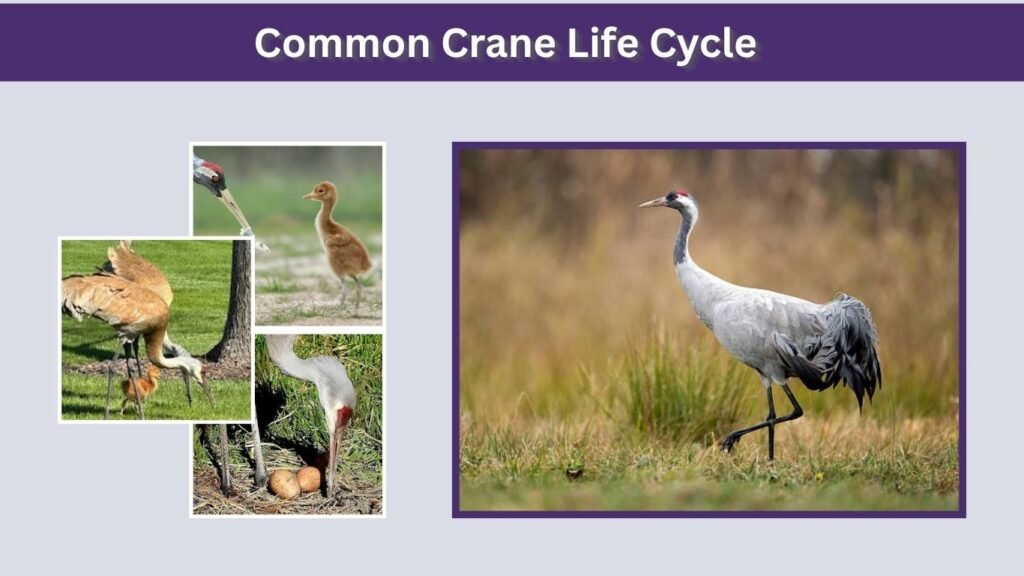
Common Cranes usually form long-lasting pair bonds. A pair may remain together for many years, although a bird can find another mate if its partner dies.
Courtship and Nest Building
Courtship becomes particularly noticeable in spring. Paired birds dance, call, bow, and walk together before establishing a breeding territory.
The nest is built on the ground in or near shallow water. Both adults collect reeds, grasses, sedges, moss, and other plant material to create a low mound. Some pairs reuse or repair the same general nesting area in later years.
Breeding pairs become territorial and generally avoid nesting close to other cranes. They can react aggressively toward foxes, wild boar, dogs, and other animals approaching the nest.
Eggs and Incubation
The female usually lays two large eggs, although a nest occasionally contains only one. The eggs are typically olive, brownish, or buff with darker spots and blotches that provide camouflage.
Incubation lasts approximately 28–31 days. The female performs most incubation duties, but the male may take a turn while she feeds. The male also remains nearby to watch for threats.
Chicks and Parental Care
Common Crane chicks are precocial. They hatch covered in brownish down, with open eyes and strong enough legs to leave the nest soon afterward. Within about a day, they can follow their parents and begin exploring the surrounding wetland.
Both parents protect and feed the chicks. The young pick up some food themselves but also receive insects, worms, and other small prey from the adults.
The family moves through marshes and meadows instead of remaining at the nest. Their brown coloration helps the chicks hide among dead vegetation.
Fledging and Independence
Young Common Cranes begin making short flights at approximately nine or ten weeks old. They continue traveling with their parents after fledging and normally complete their first migration as a family.
Juveniles often remain with their parents throughout winter. The family separates before the next breeding season, when the adults return to their nesting territory.
Young cranes generally join groups of other nonbreeding birds. They usually begin breeding between three and six years of age.
Common Crane Lifespan and Predators
Common Cranes can live for many years. Their average lifespan may be around 12–15 years, although some wild individuals survive for more than 30 years.
Eggs and young chicks are vulnerable to crows, ravens, foxes, wild boar, and other predators. Large birds of prey may attack juveniles or weakened adults. Adult cranes can defend themselves with their pointed bills, strong legs, and powerful wings.
Other threats include wetland drainage, disturbance around nests, collisions with power lines, poisoning, illegal hunting, and changes to traditional feeding areas.
Conservation Status
The Common Crane is classified as Least Concern globally. Its population has recovered in several European countries because of wetland protection, reduced persecution, and habitat restoration.
However, breeding success still depends on quiet, healthy wetlands. Protecting nesting marshes, migration stopovers, traditional roosts, and winter feeding areas is essential for its continued recovery.
FAQs
Is the Common Crane the same as the Sandhill Crane?
No. The Common Crane is native mainly to Europe and Asia, while the Sandhill Crane is primarily a North American species. Common Cranes have a bold black-and-white neck pattern, whereas Sandhill Cranes have more uniformly grey necks.
Do Common Cranes mate for life?
Common Cranes generally form long-lasting monogamous pair bonds. A pair may remain together for many breeding seasons. However, if one partner dies or disappears, the surviving bird may eventually form a new pair.
Why do Common Cranes fly in a V formation?
A V formation helps cranes use rising air created by the birds flying ahead, which can reduce the energy required for long-distance travel. The formation also helps flock members maintain visual contact and coordinate their direction.
Where do Common Cranes build their nests?
Common Cranes build low vegetation mounds on the ground, usually in shallow water. Common nesting sites include marshes, bogs, forest swamps, reed beds, and wet meadows with limited human disturbance.
Are Common Cranes dangerous?
Common Cranes generally avoid people and are not considered dangerous. However, breeding adults can aggressively defend their eggs and chicks. Their strong bills and legs can cause injury, so people should keep a safe distance from nesting families.
