
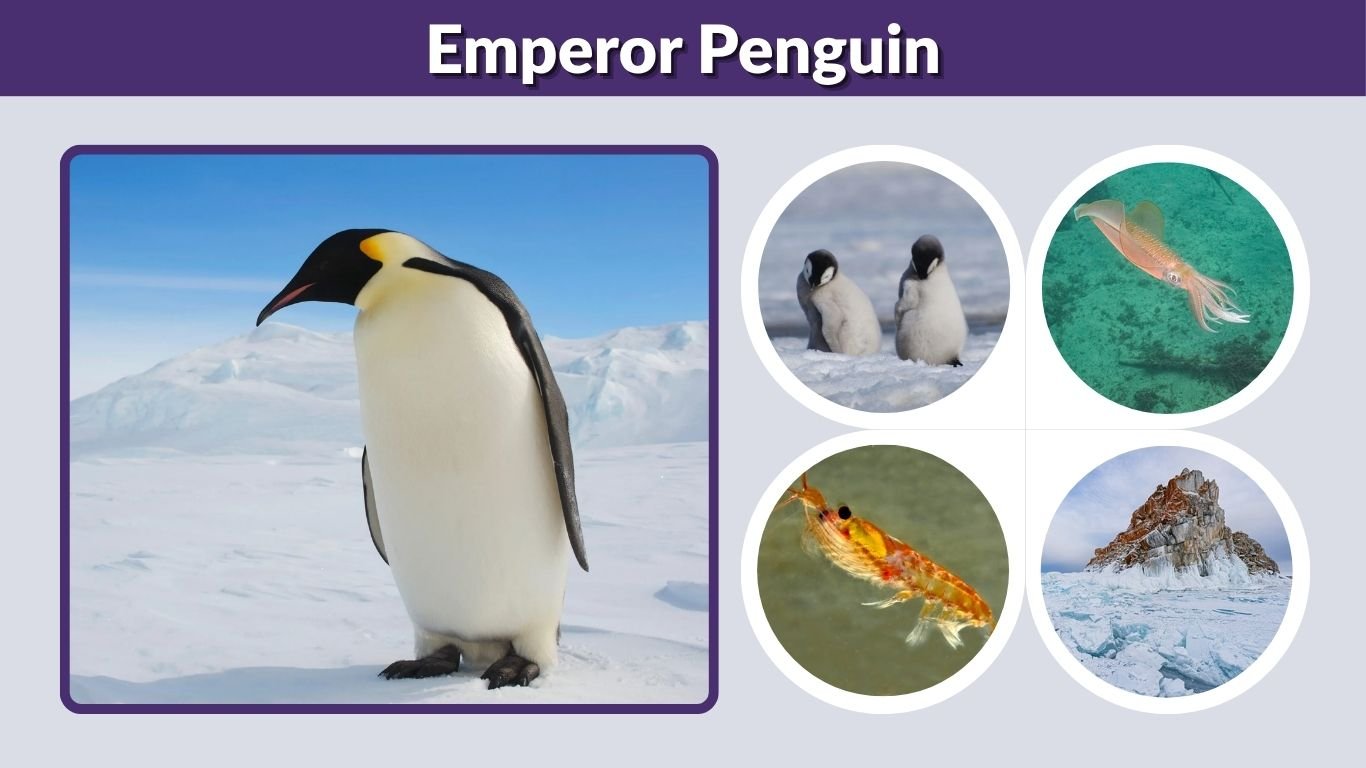
The emperor penguin is the largest living penguin species and one of Antarctica’s most remarkable birds. Known scientifically as Aptenodytes forsteri, it survives extreme cold, breeds during the Antarctic winter, and can dive hundreds of meters beneath the ocean surface for food. Adult emperors stand over a meter tall, while their fluffy gray chicks look dramatically different from their parents. From their extraordinary breeding cycle to their specialized cold-weather adaptations, emperor penguins have developed an exceptional way of life on Antarctic sea ice.
Emperor Penguin Facts and Scientific Classification
Emperor penguins belong to the genus Aptenodytes and are closely related to king penguins. They are flightless seabirds built for swimming rather than flying. Unlike many other penguins, emperors spend their lives closely associated with Antarctica and its surrounding ocean. Their enormous size, distinctive yellow-orange neck patches, and winter breeding behavior make them easy to distinguish from most other penguin species.
Quick Emperor Penguin Facts
- Scientific name: Aptenodytes forsteri
- Class: Aves
- Order: Sphenisciformes
- Family: Spheniscidae
- Genus: Aptenodytes
- Habitat: Antarctica and surrounding Southern Ocean
- Diet: Mainly fish, krill, and squid
- Status: Endangered
- Eggs: Usually one per breeding attempt
- Special ability: Exceptional swimming and deep diving
The emperor penguin is the largest of the 18 recognized living penguin species. It is also unusual because it breeds during the Antarctic winter, when conditions can include extreme cold, darkness, and powerful winds.
Emperor Penguin Height, Size and Weight
Size is one of the emperor penguin’s most recognizable characteristics and a major reason it looks so impressive next to other penguins. Adults can reach approximately 115 cm in height, although individuals vary. Weight also changes through the year because adults accumulate fat before breeding and may lose substantial weight while fasting during incubation.
How Tall Is an Emperor Penguin?
An adult emperor penguin stands roughly 115 cm, or about 3.8 feet, tall. This makes it significantly taller than most other living penguin species.
An emperor penguin next to a human would generally reach somewhere around the upper thigh or waist of an average adult, depending on the heights of both individuals.
Adults can weigh around 40 kg, with some reported at approximately 45 kg during heavier periods. Their weight fluctuates because breeding adults may spend long periods fasting.
What Does an Emperor Penguin Look Like?
Emperor penguins have a streamlined body designed for efficient movement through water.
Their head and back are mainly black, while the belly is white. Yellow to orange coloration appears around the neck and upper chest. Their flippers are relatively small compared with their body size, which helps reduce heat loss.
Males and females look very similar, although males may be somewhat heavier at particular stages of the breeding cycle.
Emperor Penguin Habitat and Adaptations
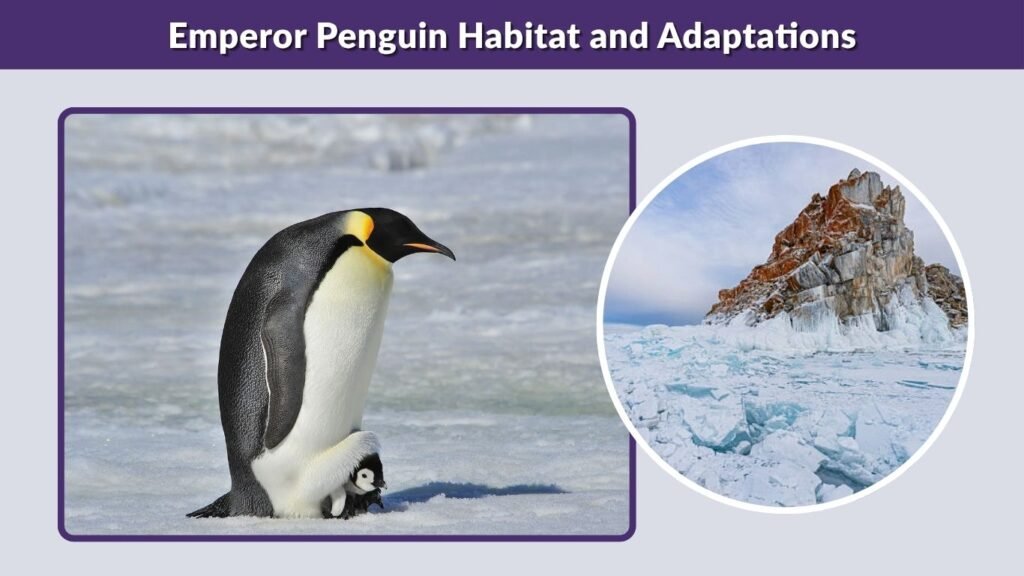
The emperor penguin habitat is one of the harshest environments occupied by any bird. These penguins live around Antarctica and breed mainly on stable fast ice connected to islands, icebergs, or the Antarctic coastline. Surviving such conditions requires more than thick feathers; emperors combine specialized anatomy, stored body fat, heat-conserving circulation, and remarkable social behavior.
Adaptations of an Emperor Penguin
Important adaptations include:
- Several layers of dense, scale-like feathers
- Thick reserves of insulating body fat
- Relatively small bills and flippers that limit heat loss
- Heat-exchange systems in the limbs
- Specialized feet that tolerate icy conditions
- Strong claws for gripping ice
- Group huddling during severe cold
- Streamlined bodies for efficient swimming
- Excellent diving ability
One of their best-known behaviors is huddling. Penguins pack closely together during severe weather and gradually change positions, allowing individuals to spend time in warmer inner areas rather than remaining permanently exposed along the outside.
What Does an Emperor Penguin Eat?
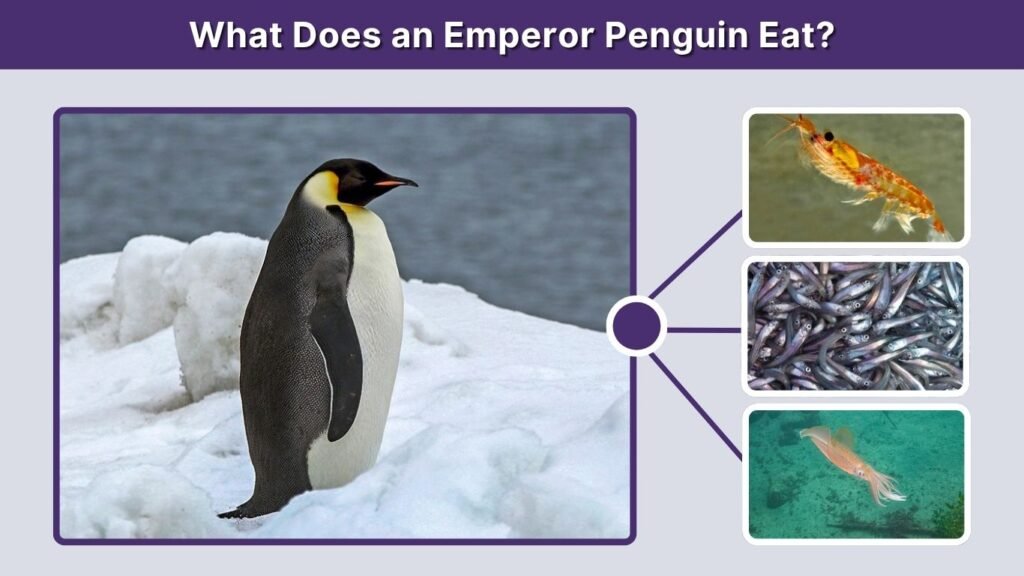
The emperor penguin diet consists entirely of marine prey. They leave their breeding colonies and travel to feeding areas where they hunt underwater. Powerful flippers propel them through the ocean, while their bodies are adapted to conserve oxygen during dives. Feeding conditions change seasonally, so the proportions of fish, krill, and squid in the diet can vary.
Main Foods of Emperor Penguins
Their diet commonly includes:
- Antarctic silverfish
- Other small fish
- Antarctic krill
- Squid
- Other small marine prey
Australian Antarctic Program information indicates that adults normally consume roughly 2–3 kg of food per day but may eat considerably more while building body reserves before breeding or moulting.
Emperor Penguin Diving and Predators
Emperor penguins commonly forage at depths around 150–250 meters, although much deeper dives have been recorded. The Australian Antarctic Program reports a maximum recorded dive of about 565 meters, with the longest recorded dive lasting about 22 minutes.
In the ocean, emperor penguins face predators such as leopard seals and killer whales. Eggs and young chicks may also face threats from Antarctic seabirds.
Baby Emperor Penguin and Life Cycle
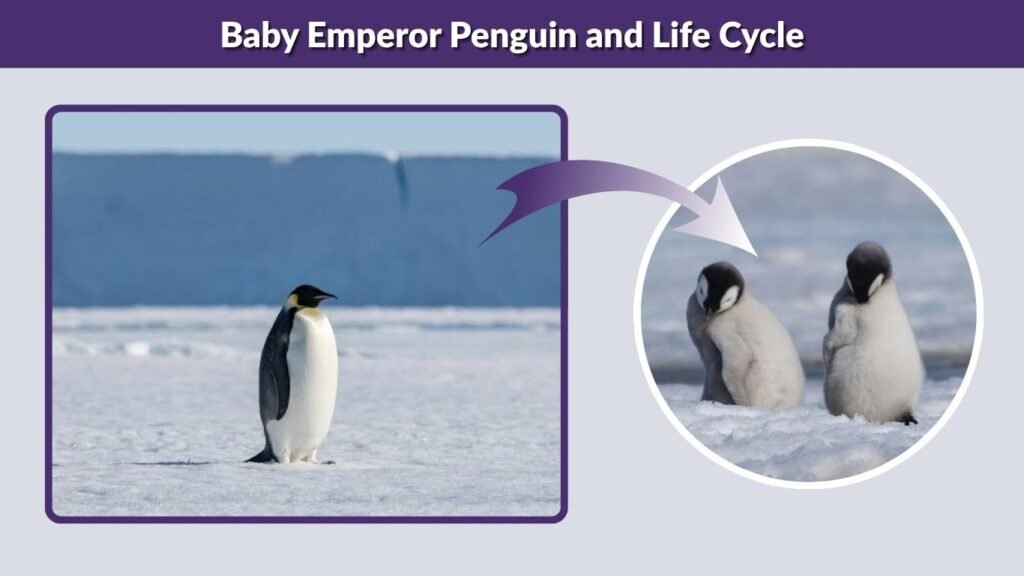
A baby emperor penguin, usually called a chick, begins life under extraordinary conditions. Emperor penguins breed during the Antarctic winter instead of the relatively mild summer. A female lays a single egg and transfers it to the male, who balances it on his feet beneath a warm brood pouch while the female returns to sea to feed.
From Emperor Penguin Egg to Chick
The breeding process generally follows this pattern:
- Adults gather at breeding colonies during the Antarctic autumn.
- The female lays one egg.
- She carefully transfers the egg to the male.
- The male incubates it on his feet beneath his brood pouch.
- Males huddle together and fast during incubation.
- The female returns around the time the chick hatches.
- Parents take turns feeding and protecting the chick.
- Older chicks eventually gather together in groups.
- Young penguins replace their fluffy down before entering the sea.
Male emperor penguins can fast for weeks while incubating. British Antarctic Survey information describes males losing a substantial proportion of their body weight during this period.
What Does a Baby Emperor Penguin Look Like?
Young chicks are covered with soft gray down rather than the sleek black-and-white plumage of adults. They usually have a black head with contrasting white facial markings.
Down provides insulation but is not suitable for swimming. Before becoming independent, chicks must develop waterproof juvenile feathers that allow them to enter the cold Southern Ocean.
Emperor Penguin Lifespan and Survival
Emperor penguins are relatively long-lived birds, but lifespan estimates vary because following individual wild penguins over decades is difficult. The Australian Antarctic Program notes that some emperors survive beyond 40 years, although most do not live that long in nature. Their survival depends heavily on food availability, sea-ice conditions, predation, and breeding success.
Are Emperor Penguins Endangered?
Emperor penguins now face serious conservation concerns because their reproductive cycle depends heavily on stable Antarctic sea ice.
A 2026 IUCN assessment classified the emperor penguin as Endangered and cited observed population declines together with projected future losses associated with changes in sea-ice habitat. The assessment projected substantial population decline risks over coming generations, although conditions and outcomes vary among Antarctic regions.
Loss of breeding ice at the wrong time can be particularly destructive because chicks may enter the ocean before developing waterproof feathers.
King Penguin vs Emperor Penguin
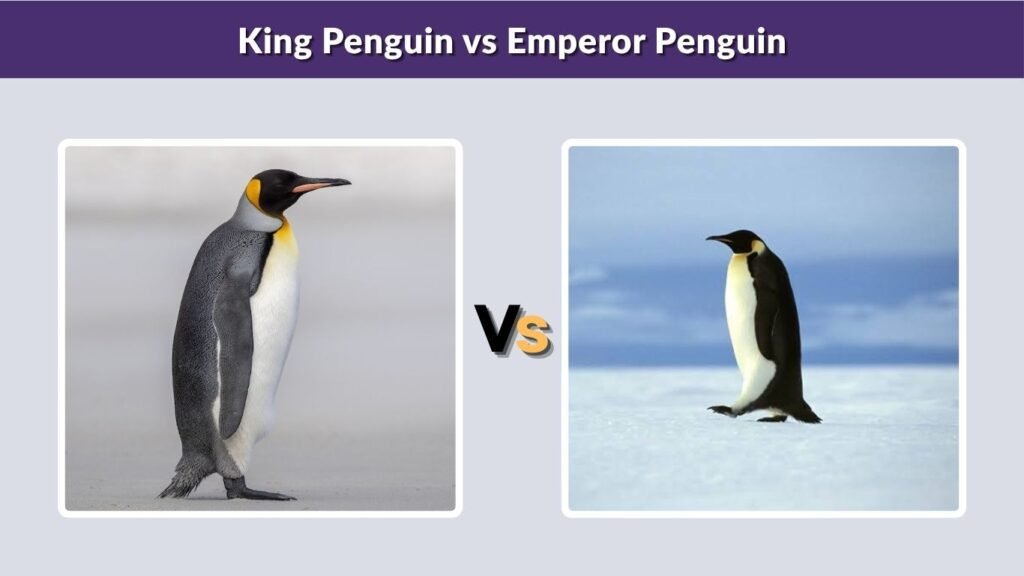
Emperor and king penguins are close relatives and can look similar because both have tall bodies, black heads, and yellow-orange coloring. However, they occupy different environments and differ considerably in size and breeding biology. Emperor penguins are larger and strongly associated with Antarctic sea ice, whereas king penguins breed mainly on subantarctic islands.
Main Differences Between King and Emperor Penguins
| Feature | Emperor Penguin | King Penguin |
| Scientific name | Aptenodytes forsteri | Aptenodytes patagonicus |
| Approx. height | Around 115 cm | About 85–95 cm |
| Maximum typical mass | Around 40 kg or more seasonally | Roughly 10–15 kg during courtship |
| Main breeding area | Antarctic sea ice | Subantarctic islands |
| Relative size | Largest living penguin | Second-largest living penguin |
King penguins were once believed to be the world’s largest penguins until emperor penguins were scientifically distinguished from them in the 19th century.
FAQs
1. How tall is an emperor penguin?
An adult emperor penguin is approximately 115 cm (3.8 feet) tall, making it the tallest living penguin species.
2. How much does an emperor penguin weigh?
Adults can weigh around 40 kg, and some individuals may reach approximately 45 kg during heavier seasonal periods. Weight changes considerably during breeding and fasting.
3. What does an emperor penguin eat?
Emperor penguins eat fish, Antarctic krill, squid, and other marine prey. Antarctic silverfish are an especially important food source in some areas.
4. Where do emperor penguins live?
Emperor penguins live around Antarctica and the Southern Ocean. Most breeding colonies occur on Antarctic fast ice that remains relatively stable through the breeding season.
5. How long can an emperor penguin live?
Some emperor penguins can survive for more than 40 years, although most wild individuals do not reach that age. Survival varies with food, predators, environmental conditions, and sea-ice stability.
