
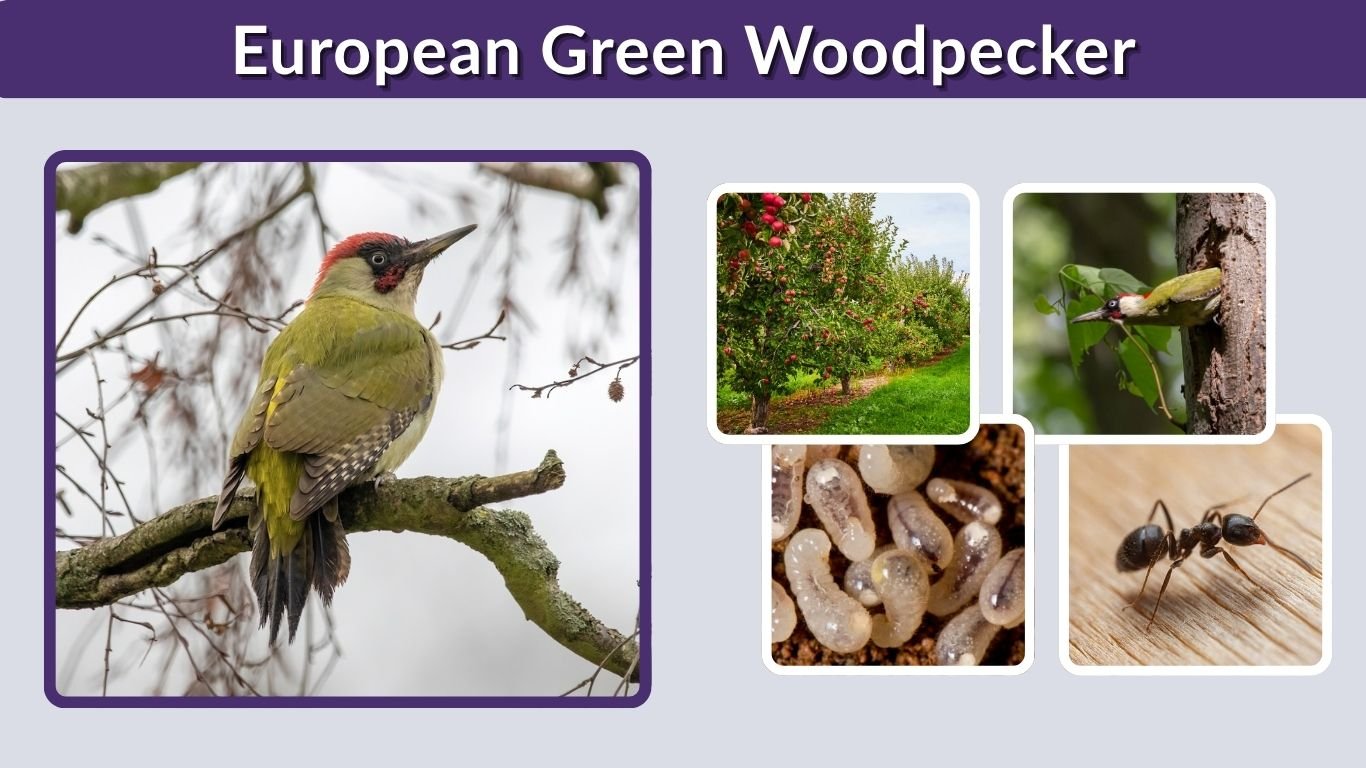
The European Green Woodpecker (Picus viridis) is a large, colorful woodpecker recognized by its olive-green body, bright yellow rump, red crown, and distinctive laughing call. Unlike many woodpeckers that spend most of their feeding time drilling into trees, this species frequently searches lawns and grassland for ants. Its exceptionally long, sticky tongue allows it to reach deep into ant nests. European Green Woodpeckers inhabit woodland edges, parks, farmland, and gardens across much of Europe and are resident year-round in Britain.
What Does a European Green Woodpecker Look Like?
The European Green Woodpecker is the largest woodpecker breeding in Britain. Adults have green upperparts, pale gray-green underparts, a brilliant yellow rump, and red across the crown. Their strong bill is relatively long, while the stiff tail and specialized feet help them cling to tree trunks even though much of their actual feeding occurs on the ground.
Identification
- Scientific name: Picus viridis
- Family: Picidae
- Length: about 30–34 cm
- Wingspan: approximately 40–42 cm
- Weight: roughly 180–220 g
- Olive-green back and wings
- Bright yellow rump
- Pale belly
- Red crown
- Black facial or “moustache” markings
- Strong, pointed bill
- Bouncing, undulating flight
The yellow rump can be particularly conspicuous when the bird flies away.
European Green Woodpecker in Flight
Green Woodpeckers have a characteristic undulating flight.
They flap strongly for several beats, then briefly close their wings and glide, creating a rising-and-falling flight path. The bright yellow rump and green wings are especially noticeable during flight.
Their flight pattern is one useful way to identify them at a distance.
Male vs Female European Green Woodpecker
Male and female European Green Woodpeckers look extremely similar. Both have the same green body, red crown, yellow rump, and black facial markings. The most reliable difference is found in the moustache-like stripe beneath the eye and alongside the bill.
Male and Female Differences
Male: The black moustache stripe contains a noticeable red center.
Female: The moustache stripe is entirely black.
Apart from this feature, size and general plumage are very similar. Young males may develop less extensive red in the moustache than fully mature adults.
What Does a Young Green Woodpecker Look Like?
Juveniles look much more heavily patterned than adults.
Young birds have pale greenish plumage covered with dark spots, bars, and streaks, particularly across the face and underparts. Their red crown is present but may appear less cleanly defined.
As juveniles molt into adult plumage, the heavily spotted appearance disappears.
What Do European Green Woodpeckers Eat?
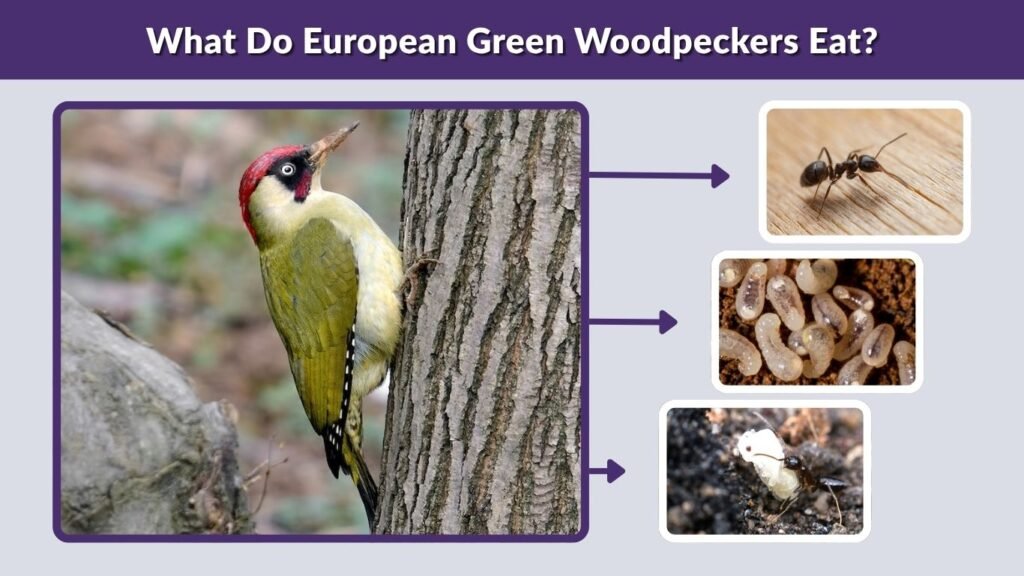
Ants dominate the European Green Woodpecker’s diet. Instead of constantly hammering into tree trunks for beetle larvae, it often spends long periods walking across lawns, woodland rides, pastures, and other short grass. It detects ant colonies, uses its powerful bill to open access points, and then collects ants with an extraordinarily specialized tongue.
Common Foods
Their diet includes:
- Adult ants
- Ant larvae
- Ant pupae
- Other small invertebrates
Ants are so important that suitable feeding habitat often includes short grass with abundant ant nests.
Research cited by BTO found that Green Woodpeckers particularly favored short, species-rich grassland where ants were plentiful.
Why Do They Feed on Lawns?
Garden lawns can provide excellent Green Woodpecker feeding habitat because ant colonies often occur beneath short turf.
A bird may spend considerable time probing several holes around an ant nest.
Small holes appearing in a lawn are therefore sometimes the first evidence that a Green Woodpecker has been visiting.
European Green Woodpecker Tongue
The tongue is one of the bird’s most extraordinary adaptations. Green Woodpeckers need to reach ants hidden deep inside tunnels that their bills cannot easily access. Their long tongue can be extended into the nest and used to collect insects before being retracted back into the mouth.
How Long Is the Tongue?
The tongue is so long that its supporting structures extend around the rear of the skull when retracted.
Woodland Trust describes it as a long, sticky tongue specialized for collecting ants and notes that it effectively coils behind the skull to fit inside the bird’s head.
This adaptation allows the bird to exploit food that many other insect-eating birds cannot reach.
Does the Tongue Protect the Brain?
Claims online sometimes suggest that a woodpecker’s tongue simply “wraps around its brain” as a shock absorber.
That is an oversimplification. The elongated tongue-supporting apparatus extends around parts of the skull, but its primary biological function is helping the bird extend and retract its tongue for feeding.
For Green Woodpeckers, this system is especially important for ant hunting.
European Green Woodpecker Call and Sound
You may hear a Green Woodpecker before seeing one. Its famous call sounds like loud, descending laughter and can carry considerable distance through woodland and open countryside. The sound has led to one of the species’ best-known British folk names: “yaffle.”
What Does the Call Sound Like?
The typical call consists of a rapid series of laughing notes, often rendered approximately as:
“yaff-yaff-yaff-yaff”
BTO describes the song as a liquid, laughing yaffle, while RSPB characterizes it as a loud, laughing, descending call.
Do Green Woodpeckers Drum?
Yes, but they drum much less frequently than Great Spotted or Lesser Spotted Woodpeckers.
Their laughing vocalization is a far more prominent form of territorial communication. When Green Woodpeckers do drum, it tends to be softer and longer than the drumming of Britain’s spotted woodpeckers.
European Green Woodpecker Habitat
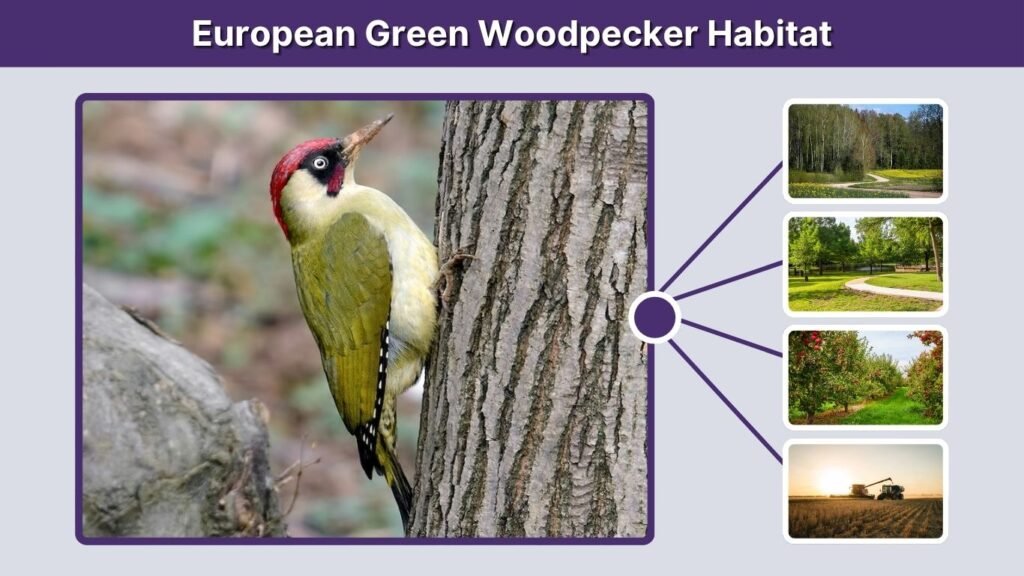
Green Woodpeckers need a combination of trees for nesting and open ground for feeding. Pure dense forest without grassy feeding areas is therefore less suitable than woodland edges, parkland, orchards, and mixed landscapes containing both mature trees and short grass.
Typical Habitat
European Green Woodpeckers occur in:
- Deciduous woodland
- Woodland edges
- Parks
- Gardens
- Orchards
- Farmland
- Grassland
- Heathland
- Large lawns and playing fields
In Britain, deciduous woodland is particularly important during the breeding season, while adjacent grassland provides valuable ant-feeding habitat.
European Green Woodpecker in the UK
The species occurs widely across England and Wales and reaches parts of Scotland.
It becomes less common toward northwestern Scotland and is absent from Ireland, the Isle of Man, and the Channel Islands according to current BTO distribution information. It is a resident rather than a regular long-distance migrant, so birds can be seen throughout the year.
European Green Woodpecker Nesting and Breeding
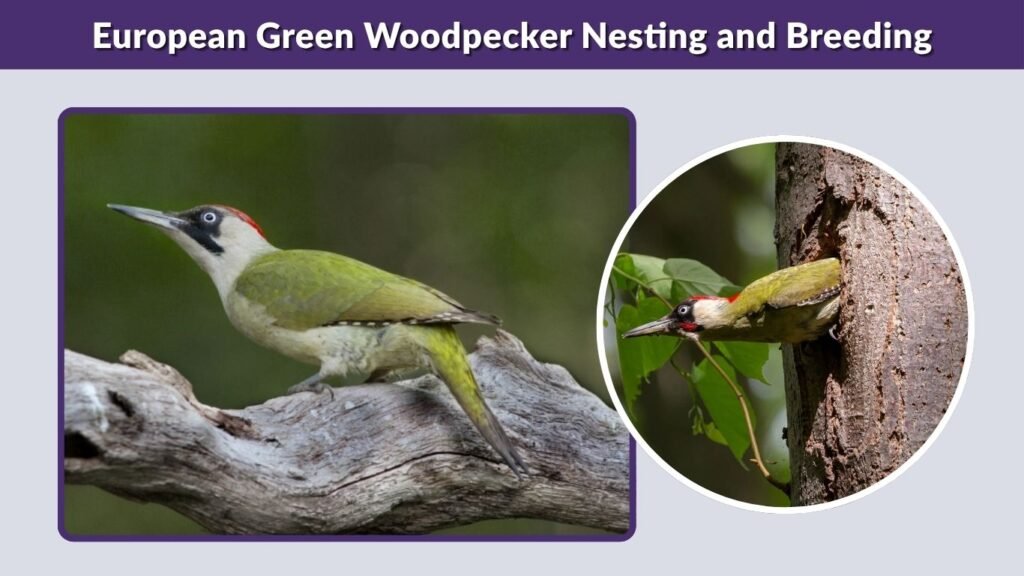
European Green Woodpeckers are cavity nesters. A breeding pair excavates a hole in a suitable tree, often using softened or decaying wood. Unlike songbirds that construct nests from grass and twigs, woodpeckers rely primarily on the protected cavity itself.
Breeding Facts
- Usually one brood per year
- Typical clutch: 4–6 eggs
- Both parents incubate
- Incubation: about 18–20 days
- Chicks hatch naked and helpless
- Young remain in the nest roughly 20–24 days
Both parents participate in caring for the brood.
Where Do They Nest?
Green Woodpeckers excavate holes in trees using their bills.
Trees with softer or partly decayed wood can make excavation easier. Creating a nest cavity may take several weeks.
Older woodland with mature trees and standing dead or decaying wood therefore provides particularly useful nesting opportunities.
Are European Green Woodpeckers Rare?
They are not currently considered rare in Britain. BTO lists the species as common and on the UK Green List of Birds of Conservation Concern.
However, population trends deserve attention. BTO currently estimates around 46,000 breeding pairs and records a 13% decline between 1995 and 2024. RSPB reports a sharper decline over the more recent 2013–2023 period.
Main Challenges
Availability of ant-rich grassland is especially important.
Extremely cold winters may also affect survival because frozen ground makes ants harder to access. Changes in woodland, grassland management, and suitable feeding habitat can therefore influence local populations.
Other Names for the European Green Woodpecker
The standard English name is European Green Woodpecker, although in Britain it is normally shortened simply to Green Woodpecker.
Traditional British names include:
- Yaffle
- Pick-a-Tree
- Rainfowl
“Yaffle” comes from the bird’s distinctive laughing voice.
FAQs
1. What is the scientific name of the European Green Woodpecker?
Its scientific name is Picus viridis, and it belongs to the woodpecker family Picidae.
2. What does a European Green Woodpecker eat?
Its diet consists primarily of ants, including adults and immature stages. It occasionally takes other invertebrates.
3. How can you tell a male from a female Green Woodpecker?
Males have a red center within the black moustache stripe. Females have an entirely black moustache stripe.
4. Why does the European Green Woodpecker have such a long tongue?
Its long, sticky tongue allows it to reach deep inside ant nests and extract ants that would otherwise be inaccessible.
5. What sound does a European Green Woodpecker make?
Its best-known sound is a loud series of laughing, descending notes. This characteristic call gave rise to the British nickname “yaffle.