
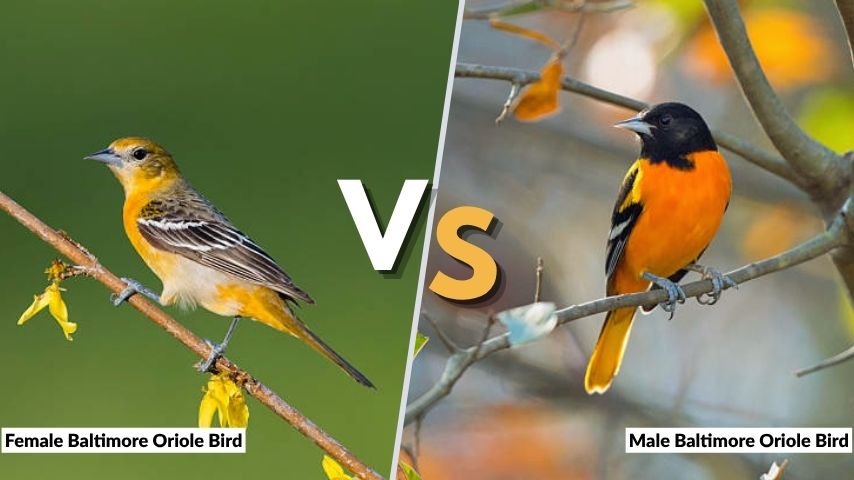
The female Baltimore oriole bird is beautiful, but she is often overlooked because the male has brighter orange and black feathers. Female Baltimore orioles usually show softer yellow-orange, olive, gray, and brown tones, which help them blend into trees while nesting. Learning the difference between male and female Baltimore orioles makes identification easier, especially during spring and summer when these birds return to gardens, parks, orchards, and wooded neighborhoods.
What Does a Female Baltimore Oriole Look Like?
A female Baltimore oriole has a warm yellow-orange or golden-orange underside, with grayish, olive-brown, or brownish upperparts. Her wings are darker than the body and usually show pale wing bars. She does not usually have the bold black head and back of an adult male.
Her appearance can vary. Some females look mostly yellow-orange, while others appear more brownish or olive. Older females may show deeper orange coloring and more contrast, which can sometimes make them look similar to young males.
Main Identification Features
The female Baltimore oriole usually has:
- Yellow-orange or golden underside
- Grayish or olive-brown head and back
- Dark wings with pale wing bars
- Slender body
- Long tail
- Pointed bill
- Softer coloring than the male
- Active movement high in trees
The pointed bill is an important clue. Orioles use their sharp bills to eat insects, fruit, and nectar. Even when the color looks confusing, the bill shape can help separate orioles from warblers, tanagers, and finches.
Female vs Male Baltimore Oriole
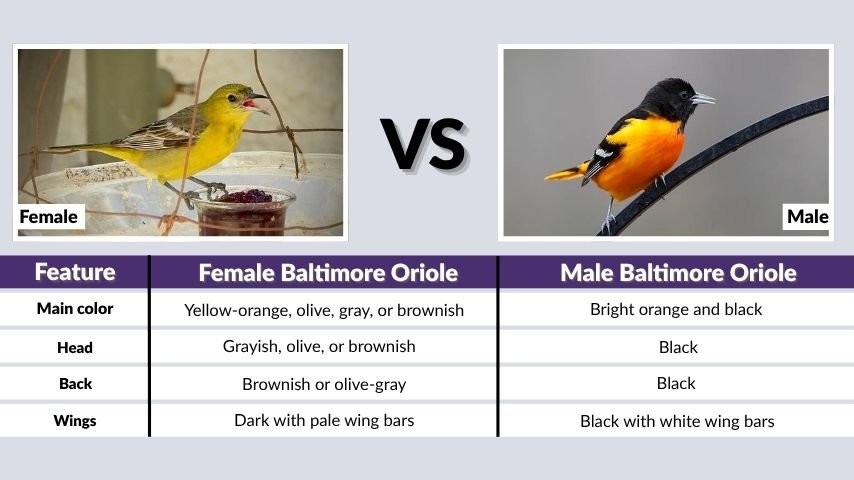
The easiest difference between a female and male Baltimore oriole is color. The adult male is bright orange and black, while the female is softer and more blended. However, young males may look similar to females, so identification is not always instant.
| Feature | Female Baltimore Oriole | Male Baltimore Oriole |
|---|---|---|
| Main color | Yellow-orange, olive, gray, or brownish | Bright orange and black |
| Head | Grayish, olive, or brownish | Black |
| Back | Brownish or olive-gray | Black |
| Wings | Dark with pale wing bars | Black with white wing bars |
| Overall look | Softer and more camouflaged | Bold and high contrast |
| Nest role | Builds nest and incubates eggs | Defends territory and sings often |
| Song | Can sing, but less noticed | Loud, clear, and frequent |
Male Baltimore orioles are usually easier to identify because their colors are bold. Females require closer observation because their tones are more subtle.
Why Female Baltimore Orioles Are Less Bright
Female Baltimore orioles are less bright for a practical reason. Their softer colors help them stay hidden while nesting. Since females build the hanging nest and incubate eggs, camouflage is useful. A bright black-and-orange bird sitting near a nest would be easier for predators to notice.
The male’s bright coloring helps with attracting mates and defending territory. His song and appearance make him stand out during breeding season. The female’s quieter colors help protect the nesting area.
Camouflage During Nesting
Female orioles often move through leafy branches where yellow, green, brown, and orange shades blend well with sunlight and leaves. When she is near a nest, her softer plumage makes her harder to detect.
This is why many birdwatchers first notice the male but later realize a female is nearby, quietly moving among leaves or visiting feeders.
Female Baltimore Oriole Bird Picture: What to Look For
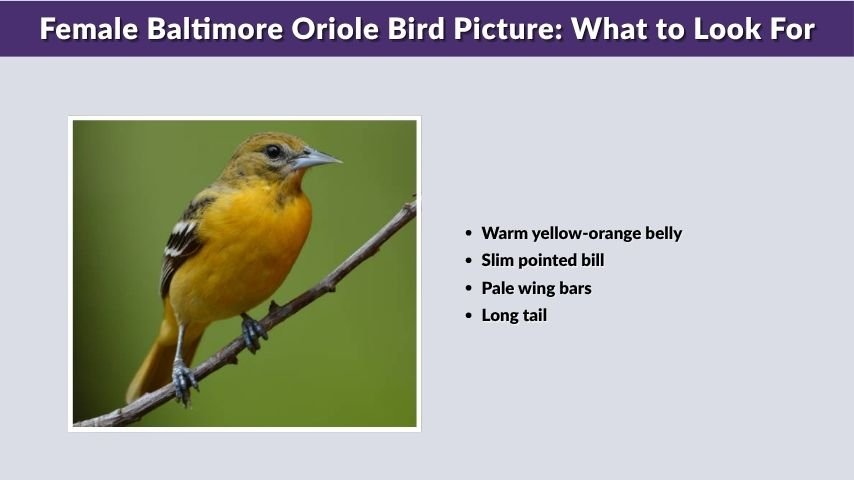
When looking at a picture of a female Baltimore oriole bird, focus on the overall pattern rather than expecting the same bold colors as the male. A female may look pale yellow, orange-yellow, or warm tan depending on age, lighting, and season.
Photos can be misleading because sunlight can make her appear brighter or duller. A female in strong sunlight may look very golden, while one in shade may seem grayish or brown.
Photo Identification Tips
When checking a female Baltimore oriole image, look for:
- Warm yellow-orange belly
- Slim pointed bill
- Pale wing bars
- Long tail
- Grayish or olive upperparts
- Tree-canopy posture
- Oriole-like body shape
If the bird has a fully black head and bright orange body, it is probably an adult male. If it is yellow-orange with softer markings, it is more likely a female or young male.
Female Baltimore Oriole vs Young Male
One of the hardest identification challenges is telling a female Baltimore oriole from an immature male. Young males may not yet have the full black head and back of adult males. They may look yellow-orange, patchy, or duller.
Over time, young males develop stronger black and orange coloring. During this transition, they can look very similar to females.
| Feature | Female Baltimore Oriole | Immature Male Baltimore Oriole |
|---|---|---|
| Color pattern | Softer and more even | May look patchy or uneven |
| Black markings | Usually limited or weak | May develop black patches |
| Orange color | Yellow-orange to golden | Often brighter with age |
| Head color | Grayish or olive-brown | May show darkening areas |
| Identification difficulty | Moderate | Often confusing |
| Best clue | Softer, balanced pattern | Patchy developing male plumage |
If you are unsure, watch behavior, season, and markings over time. A bird that gradually develops a black head and stronger orange body is likely a young male.
Female Baltimore Oriole Song
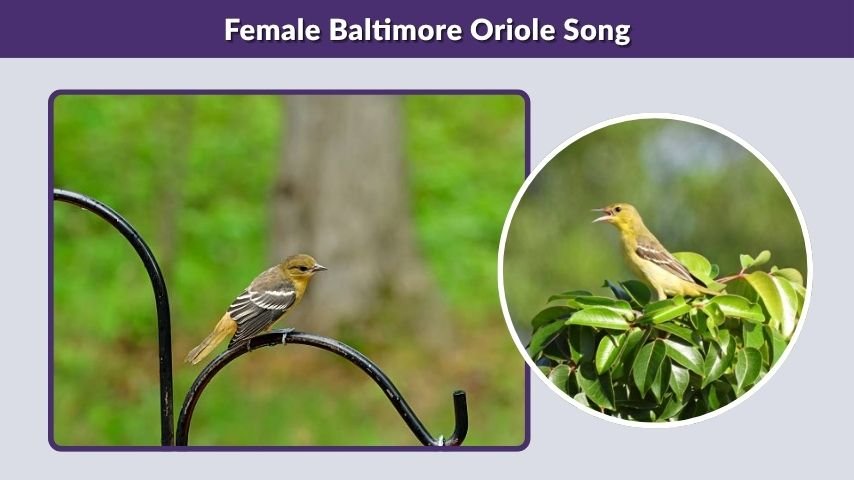
Female Baltimore orioles can sing, although male songs are more commonly noticed. The male usually sings more often to defend territory and attract a mate, but females may also produce songs and calls.
Their sounds are clear, whistled, and musical. Orioles also make chatter-like calls, short notes, and alarm sounds. During nesting season, both males and females may call near the nest or when disturbed.
What the Song Sounds Like
Baltimore oriole song often sounds like a series of rich, flute-like whistles. Each bird may have slight variation. The sound is usually clear and ringing, especially when heard from treetops in spring.
Learning the song is helpful because orioles often stay high in leafy trees where they are difficult to see.
Female Baltimore Oriole Nesting Behavior
The female Baltimore oriole is famous for building one of the most impressive nests among North American songbirds. She weaves a hanging pouch-like nest near the end of a thin branch. This nest may hang several feet below the branch and sway in the wind.
The nest is made from plant fibers, grasses, bark strips, hair, and other flexible materials. The female does most of the weaving. The male may stay nearby and guard the territory, but the female is the main builder.
Does the Female Incubate the Eggs?
Yes, the female Baltimore oriole incubates the eggs. After laying, she sits on the eggs to keep them warm until they hatch. The male may help feed her or defend the area, but incubation is mainly the female’s job.
After the chicks hatch, both parents may help feed them. They bring insects, especially caterpillars and other soft-bodied prey, which provide protein for growing young.
Female Baltimore Oriole Diet
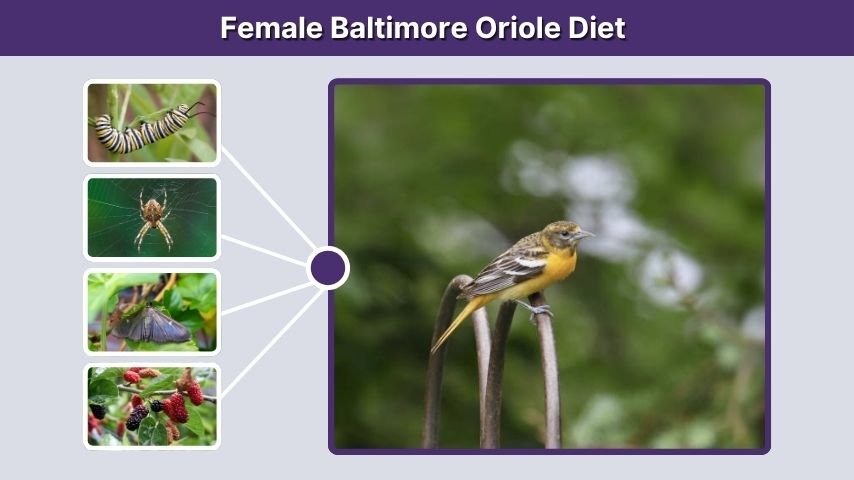
Female Baltimore orioles eat insects, fruit, and nectar. During nesting season, insects are especially important because they support egg production and chick growth. Caterpillars, beetles, moths, spiders, and other small invertebrates are common foods.
They also eat sweet fruits and may visit backyard feeders for oranges, grape jelly, or nectar. However, natural foods should remain the main part of their diet.
Foods Females May Eat
Female Baltimore orioles may feed on:
- Caterpillars
- Beetles
- Moths
- Spiders
- Berries
- Mulberries
- Orange halves
- Grape jelly
- Nectar
- Mealworms
If you feed orioles, offer small amounts and keep feeders clean. Spoiled jelly or fermented nectar can be harmful.
How to Attract Female Baltimore Orioles
Female Baltimore orioles visit the same types of feeders as males, but they may be more cautious, especially near nesting time. A yard with tall trees, fruiting shrubs, insects, and clean feeders is more attractive.
Backyard Attraction Tips
To attract female orioles:
- Put out orange halves in spring
- Offer small amounts of grape jelly
- Use clean oriole nectar feeders
- Plant native berry shrubs
- Avoid heavy insecticide use
- Provide tall deciduous trees
- Keep cats indoors
- Offer clean water
Do not rely only on jelly. Orioles need protein-rich insects during breeding season. A healthy yard with native plants helps support the insects they need.
Where Female Baltimore Orioles Live
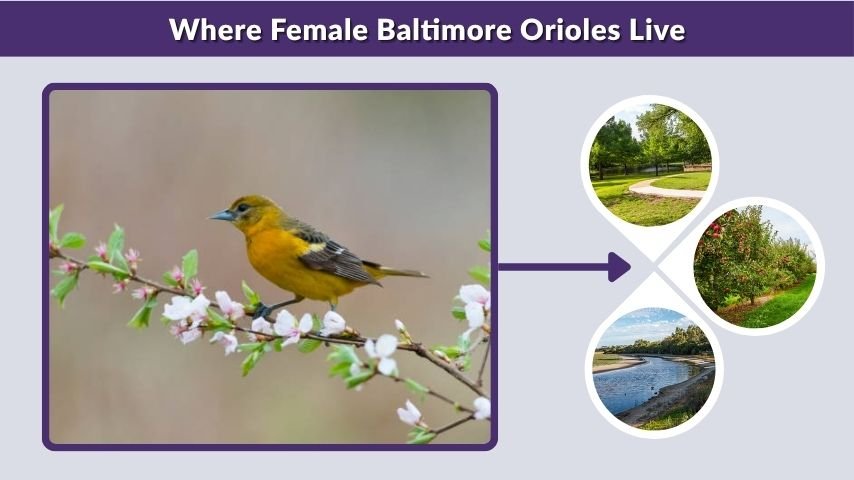
Female Baltimore orioles live in open woodlands, forest edges, orchards, parks, riverbanks, and neighborhoods with mature trees. They prefer tall deciduous trees where they can nest safely near the ends of branches.
They breed across much of eastern and central North America. In winter, they migrate to warmer areas such as Mexico, Central America, the Caribbean, and parts of northern South America.
Best Places to See Them
You may see female Baltimore orioles in:
- Backyard shade trees
- Parks
- Orchards
- Woodland edges
- River corridors
- Suburban neighborhoods
- Flowering trees
- Fruiting shrubs
They are often easier to see in spring before trees fully leaf out. Once foliage becomes dense, listening for calls and watching feeders can help.
Female Baltimore Oriole vs Similar Birds
Female Baltimore orioles can be confused with female orchard orioles, young male orioles, tanagers, and some warblers. The best clues are size, bill shape, wing bars, and warm orange-yellow coloring.
Female orchard orioles are usually smaller and more yellow-green. Scarlet tanager females are yellowish-green and lack the same oriole shape. Warblers are much smaller and usually have thinner bills.
Quick Identification Advice
Look for a medium-sized songbird with a pointed bill, long tail, warm orange-yellow underside, and pale wing bars. If the bird is feeding on orange halves or grape jelly in eastern North America, a female Baltimore oriole is a strong possibility.
FAQs
What color is a female Baltimore oriole?
A female Baltimore oriole is usually yellow-orange or golden below, with grayish, olive-brown, or brownish upperparts. Her wings are darker with pale wing bars. She is not as bright as the adult male, but older females may show richer orange tones and stronger contrast.
How do you tell a male from a female Baltimore oriole?
The adult male has a black head, black back, and bright orange body. The female has softer yellow-orange, gray, olive, and brown tones. Young males may look similar to females, so look for patchy black markings, brighter orange, and developing male plumage.
Does the female Baltimore oriole sing?
Yes, female Baltimore orioles can sing, although males are heard more often. Their song may include clear, whistled notes, and they also make calls near the nest or while communicating. Males usually sing more frequently during breeding season to defend territory and attract mates.
Does the female Baltimore oriole build the nest?
Yes, the female Baltimore oriole does most of the nest building. She weaves a hanging pouch-like nest near the end of a tree branch using plant fibers, grasses, bark strips, and other flexible materials. She also incubates the eggs after laying them.
What does a female Baltimore oriole eat?
A female Baltimore oriole eats insects, fruit, and nectar. During nesting season, insects are especially important for protein. She may also visit feeders for oranges, grape jelly, nectar, and mealworms. Clean feeders and native plants can help attract her safely.