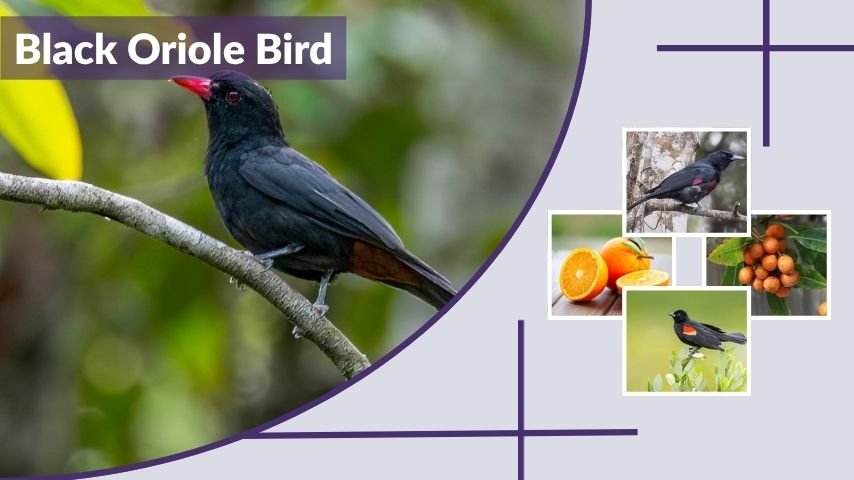
A black oriole bird is usually not an all-black bird. Most “black orioles” people notice are orioles with black mixed with orange, yellow, or white. The name may refer to a Baltimore Oriole, Hooded Oriole, Black-headed Oriole, Black-hooded Oriole, or Black-naped Oriole. This guide explains how to identify them, where they live, and which similar birds cause confusion.
What Is a Black Oriole Bird?
A “black oriole bird” is a broad phrase, not always one exact species. Birdwatchers often use it when they see a bird with a black head, black wings, black back, or black markings combined with bright orange or yellow plumage.
In North America, the bird is often a male Baltimore Oriole or Hooded Oriole. In Asia, it may be a Black-naped Oriole or Black-hooded Oriole. In Africa, people may mean the Black-headed Oriole. These birds are not identical, but they share the same general impression: a slim, colorful bird with strong black markings.
Most orioles are medium-sized songbirds with pointed bills, longish tails, and a graceful shape. They often stay high in trees, where their colors flash between leaves. Some visit fruit, nectar, and jelly feeders, especially during migration or breeding season.
When identifying a black oriole, look at the full pattern. Is the head fully black? Are the wings black and white? Is the body orange, yellow, or chestnut? The answer will help separate one oriole from another.
Common Black Oriole Types
Several birds match the “black oriole” description. Some have black heads, some have black hoods, and others show black wings or backs. Their location is one of the easiest ways to narrow the ID.
| Bird Name | Main Colors | Common Region | Key ID Feature |
| Baltimore Oriole | Orange and black | Eastern and central North America | Male has a black head and bright orange body |
| Hooded Oriole | Yellow-orange and black | Southwestern U.S. and Mexico | Male has black throat and bright yellow-orange body |
| Black-headed Oriole | Yellow and black | Parts of Africa | Bright yellow body with black head |
| Black-hooded Oriole | Yellow and black | South Asia | Yellow body with black hood |
| Black-naped Oriole | Yellow and black | Parts of Asia | Yellow bird with black eye-to-nape band |
These birds may look similar in photos, but their ranges are very different. A yellow-and-black oriole in Singapore is not likely to be a Baltimore Oriole. A black-and-orange bird in Maryland is not likely to be a Black-naped Oriole. Location matters as much as color.
Baltimore Oriole: The Orange and Black Oriole Bird
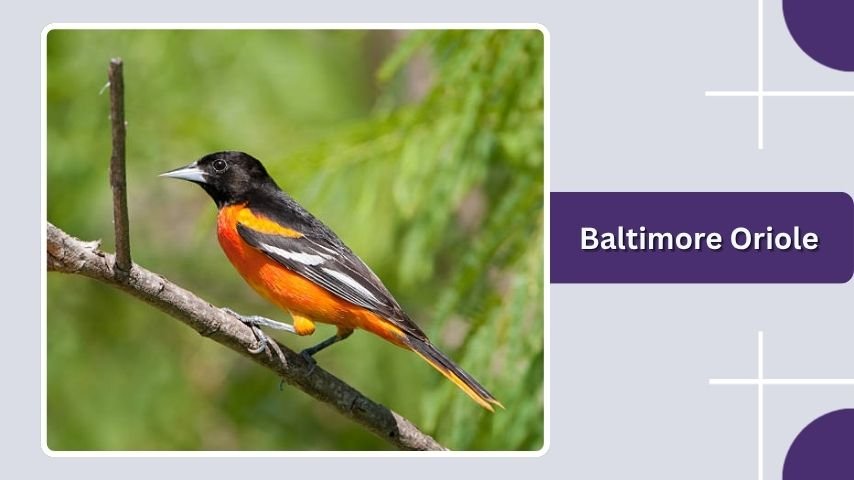
The Baltimore Oriole is one of the most recognized black-and-orange orioles. Adult males have a black head, black upper back, black wings, white wing bars, and a vivid orange body. Their oranges can look almost flame-like in sunlight.
This is the bird many people mean when they search for an “orange and black oriole bird” or an “oriole orange-breasted bird with black head.” The black head is a major clue. The orange body is usually rich and bold, especially on adult males.
Females look different. They are usually yellow-orange below with grayish, olive, or brownish upperparts. They do not have the same deep black head as adult males. Young males may look duller at first and gradually develop stronger black and orange plumage as they mature.
Baltimore Orioles are often seen in tall deciduous trees, parks, orchards, wooded edges, and backyards. They may visit orange halves, nectar feeders, or grape jelly, but they also eat many insects.
Hooded Oriole: A Yellow-Orange Bird With Black Markings
The Hooded Oriole is another bird people may describe as a black oriole, especially in California and the Southwest. Adult males are bright yellow-orange with black on the throat, face, wings, and tail. Their bill is slender and slightly curved.
This bird often appears in searches like “oriole yellow and black bird California” or “yellow bird with black throat oriole.” The male’s black throat can create a hooded look, although the exact pattern varies by region.
Female Hooded Orioles are much paler. They are usually yellowish or yellow-green with less black. Juveniles also look softer and less dramatic than adult males.
Hooded Orioles are often linked with palm trees because they may attach their hanging nests to palm fronds. They also visit nectar feeders and can sometimes be seen bending or hanging awkwardly while feeding.
Black-Headed Oriole: A Yellow Bird With a Black Head
The Black-headed Oriole is a striking yellow-and-black bird found in parts of Africa. It has a bright yellow body, dark wings, and a strongly contrasting black head. The bill may appear pale, pinkish, or flesh-colored depending on light and individual appearance.
This species is different from the Baltimore Oriole, even though both can have a black head and bright body color. The Black-headed Oriole is generally yellow rather than orange, and its natural range is outside North America.
People searching for “black headed oriole bird” may also be looking for photos, plush patterns, artwork, or crochet designs. For real bird identification, the most important clues are:
- Bright yellow body
- Clearly black head
- Dark wings
- Pale or pinkish-looking bill
- African range
- Tree-loving behavior
If you are in Africa and see a bold yellow bird with a black head, this species may be a strong possibility. If you are in the eastern United States, a Baltimore Oriole is usually more likely.
Black-Hooded Oriole: A South Asian Yellow and Black Bird
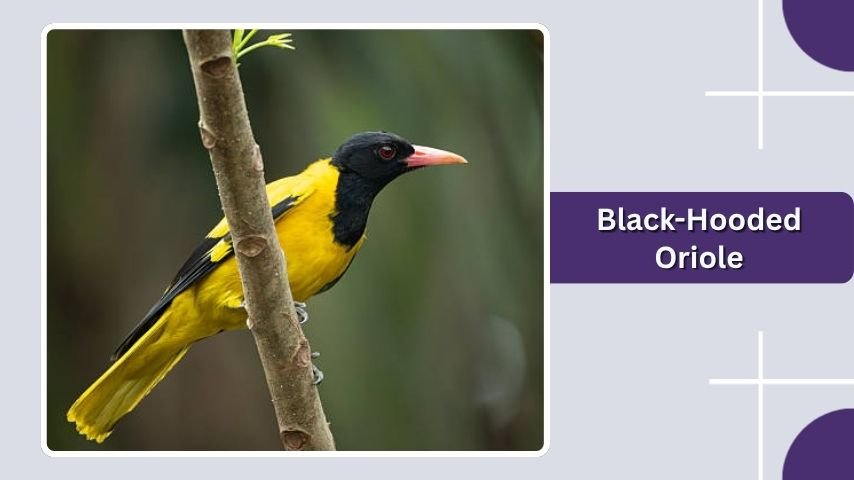
The Black-hooded Oriole is another yellow-and-black oriole. As its name suggests, it has a dark hood-like head pattern with a bright yellow body. It is found in parts of South Asia and is known for its bold color contrast.
This bird may be confused with the Black-headed Oriole because both have yellow bodies and dark heads. However, they live in different regions. The Black-hooded Oriole is associated with South Asian habitats, while the Black-headed Oriole is African.
Its bright yellow body makes it stand out in trees, but like many orioles, it may be easier to hear than to see clearly. Its black hood helps separate it from other yellow birds that only have small black patches.
For identification, focus on range first, then color pattern. A yellow bird with a dark hood in India or nearby regions may fit Black-hooded Oriole better than Baltimore Oriole or Hooded Oriole.
Black-Naped Oriole: A Yellow Bird With a Black Eye Band
The Black-naped Oriole is a medium-sized yellow-and-black oriole found in many parts of Asia. It is especially familiar in places such as Singapore, where it is one of the more noticeable yellow birds.
This bird has bright yellow plumage, black on the wings and tail, and a distinctive black band that runs through the eye toward the nape. That black band gives the species its name. It also often has a reddish or pinkish bill, which helps with identification.
Searches like “black naped oriole bird Singapore” or “black-naped oriole Singapore birds” usually refer to this species. It is not black overall. Instead, it is mostly yellow with strong black markings.
If you see a bright yellow bird in Singapore with a dark eye stripe extending backward, the Black-naped Oriole is a likely match. Its bold yellow color and loud calls often make it easier to notice in urban greenery, parks, gardens, and wooded areas.
Are There All-Black Oriole Birds?
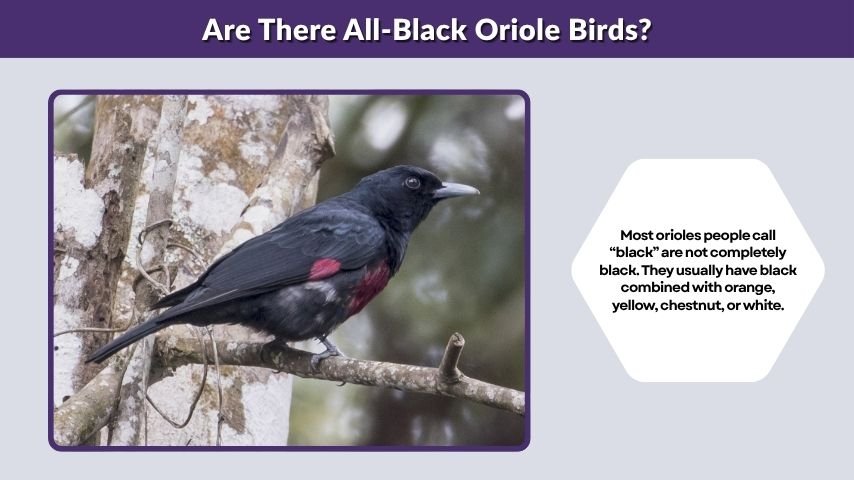
Most orioles people call “black” are not completely black. They usually have black combined with orange, yellow, chestnut, or white. A bird that looks all black may be a blackbird, grackle, starling, crow, or another species rather than an oriole.
Lighting can also make orioles look darker than they are. A male Baltimore Oriole sitting in shade may appear mostly black until it turns and shows its orange body. Similarly, a bird seen from below may show mostly dark wings or shadowed plumage.
If a bird seems almost all black, check these features:
- Does it have any orange, yellow, or white patches?
- Is the bill slender and pointed?
- Is the tail medium-long and narrow?
- Is the bird feeding in trees, fruit, or nectar?
- Does it sing rich whistles or make harsh blackbird-like calls?
- Is it alone or moving in a flock?
A true oriole usually has some visible color pattern. An all-black bird at a feeder may be a grackle, blackbird, or starling stealing food from an oriole feeder.
Black and White Birds That Look Like Orioles
Some searches mention a “black and white oriole bird” or a bird that looks like an oriole but has black-and-white markings. In many cases, this may not be an oriole at all.
Orioles can show white wing bars, especially Baltimore Orioles. When the orange or yellow body is hidden by leaves or poor lighting, the black wings and white bars may stand out more than the body color. This can make the bird appear black and white for a moment.
However, several other birds may also cause confusion. Woodpeckers, mockingbirds, grosbeaks, and some blackbirds may show black-and-white patterns. If the bird has no orange or yellow at all, it may not be an oriole.
A black-and-white bird in Florida, for example, could be something entirely different depending on size, bill shape, and behavior. Always use more than color when identifying birds.
Red-Winged Blackbird vs Baltimore Oriole
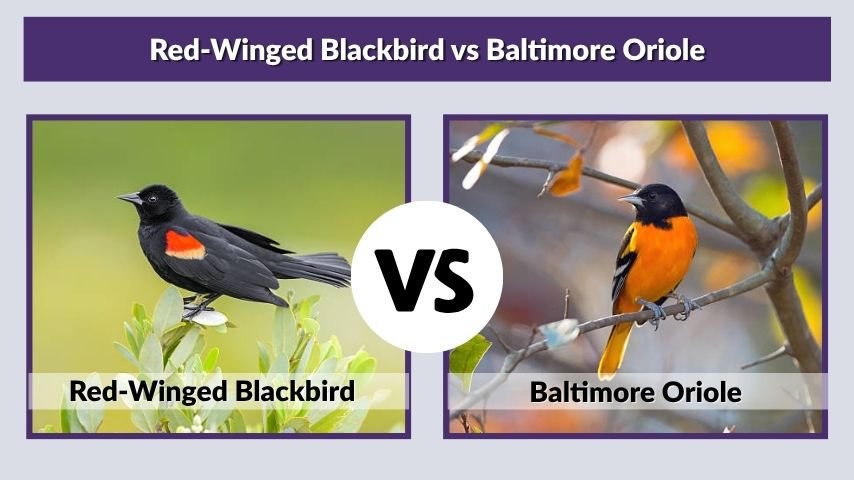
A Red-winged Blackbird and a Baltimore Oriole can both show black with bright warm colors, but they are easy to separate with a careful look. A male Red-winged Blackbird is mostly black with red and yellow shoulder patches. A male Baltimore Oriole has a black head and wings but a bright orange body.
Red-winged Blackbirds are often found around marshes, wetlands, fields, and roadside vegetation. Baltimore Orioles are more often seen in trees, parks, orchards, and wooded neighborhoods.
Their body shapes also differ. Red-winged Blackbirds look stockier and more blackbird-like. Orioles look slimmer, longer-tailed, and more graceful. The oriole’s pointed bill is useful for fruit, nectar, and insects, while the blackbird has a more seed-and-insect feeding style.
At a jelly or fruit feeder, blackbirds may sometimes compete with orioles. If a mostly black bird is pushing orioles away from jelly, it is likely not an oriole. It may be a grackle, starling, or blackbird.
Baltimore Oriole vs Black-Headed Grosbeak
The Baltimore Oriole and Black-headed Grosbeak can both show orange, black, and pale markings, which causes confusion. However, their shapes are different. A grosbeak has a much thicker, heavier bill. An oriole has a slimmer, sharper bill.
Black-headed Grosbeaks are mostly western birds, while Baltimore Orioles are mainly eastern and central. Range helps a lot. If you are in the western United States and see an orange-and-black bird with a large thick bill, consider Black-headed Grosbeak or Bullock’s Oriole before Baltimore Oriole.
The grosbeak also looks heavier-bodied. Orioles tend to look sleeker and more elegant. Their movements through branches often seem more slender and agile.
When in doubt, focus on the bill. A thick, seed-cracking bill suggests grosbeak. A narrow, pointed bill suggests oriole.
What Do Black and Yellow Orioles Eat?
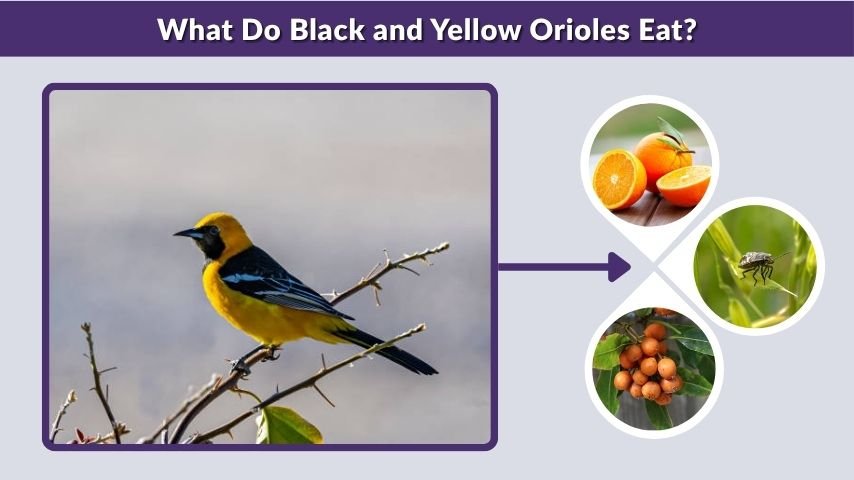
Black and yellow orioles eat a mix of fruit, nectar, and insects. Their diet changes with season and food availability. During nesting season, insects are especially important because young birds need protein to grow.
Backyard foods can attract some orioles, especially in North America. However, feeders should be clean and used carefully. Spoiled fruit, moldy jelly, or dirty nectar can harm birds.
Good oriole-friendly foods include:
- Orange halves
- Small amounts of grape jelly
- Nectar in clean oriole feeders
- Native berries
- Flower nectar
- Caterpillars and other insects
- Fruiting trees and shrubs
Avoid large bowls of jelly. Small portions are safer and easier to keep fresh. Native plants are even better because they support insects, fruit, shelter, and nesting habitat.
How to Identify a Black Oriole Quickly
A quick identification starts with color, but it should not end there. Many birds share black, yellow, orange, or white markings. The best ID comes from combining plumage, location, size, bill shape, and behavior.
Use this simple process:
- Check location: North America, Africa, South Asia, or Southeast Asia?
- Check body color: Orange, yellow, chestnut, black, or white?
- Check the head: Fully black, hooded, black throat, or black eye band?
- Check the bill: Slim and pointed or thick and heavy?
- Check habitat: Treetops, palms, parks, wetlands, fields, or feeders?
- Check behavior: Feeding on fruit, nectar, insects, or seeds?
A black-headed orange bird in the eastern United States may be a Baltimore Oriole. A yellow bird with a black eye band in Singapore may be a Black-naped Oriole. A yellow bird with a black hood in South Asia may be a Black-hooded Oriole.
FAQs
Is there a black oriole bird?
Yes, but most “black orioles” are not completely black. The phrase usually refers to orioles with black heads, wings, throats, backs, or eye bands. Examples include the Baltimore Oriole, Hooded Oriole, Black-headed Oriole, Black-hooded Oriole, and Black-naped Oriole, depending on location.
What is an orange and black oriole bird?
An orange and black oriole bird in eastern or central North America is often a male Baltimore Oriole. It has a black head, black wings, white wing bars, and a bright orange body. In the western United States, a similar bird may be a Bullock’s Oriole or Hooded Oriole.
What yellow and black bird looks like an oriole?
Several yellow and black birds may look like orioles. In California, it could be a Hooded Oriole. In Singapore or parts of Asia, it may be a Black-naped Oriole. In South Asia, it could be a Black-hooded Oriole. Location is the fastest clue.
Is a Red-winged Blackbird a type of oriole?
No, a Red-winged Blackbird is not an oriole. It belongs to the same broader blackbird family as New World orioles, but it is a different bird. Male Red-winged Blackbirds are mostly black with red shoulder patches, while male Baltimore Orioles are orange and black.
Why does an oriole look black in shade?
An oriole can look black in shade because its bright orange or yellow body may be hidden by leaves, angle, or poor lighting. Male Baltimore Orioles have black heads and wings, so a quick view may show mostly dark plumage before the bird turns and reveals its color.