
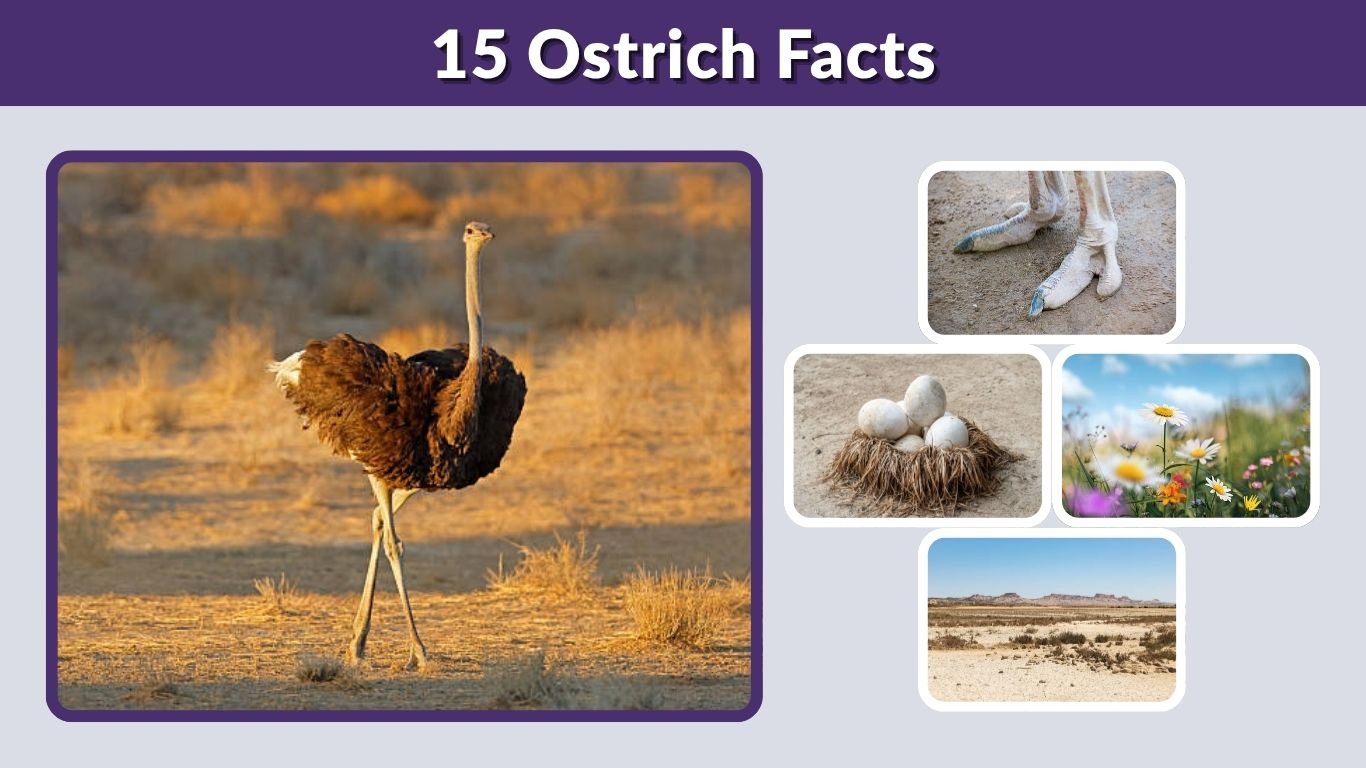
Ostriches are extraordinary birds known for their enormous size, powerful legs, impressive speed, and unusually large eggs. Native to Africa, these flightless birds have evolved to survive in open grasslands, savannas, and semi-arid environments where running is often their best defense. They also have remarkable eyes, unique two-toed feet, specialized feathers, and fascinating breeding behavior. From their ability to run faster than many animals to the surprising truth about whether they bury their heads, here are 15 ostrich facts that reveal just how unusual these birds really are.
1. Ostriches Are the Largest Living Birds
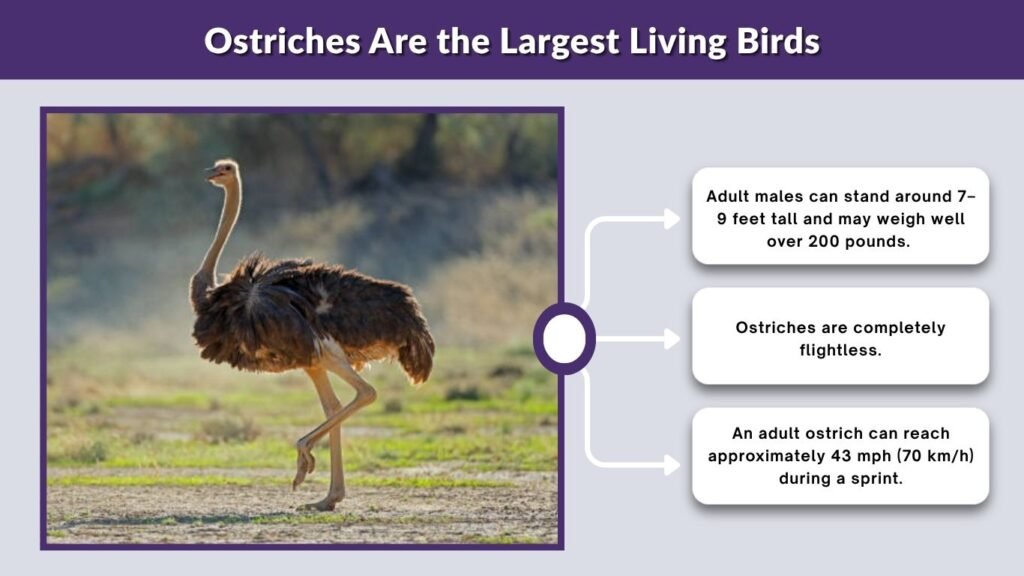
The common ostrich (Struthio camelus) is the largest living bird in the world.
Adult males can stand around 7–9 feet tall and may weigh well over 200 pounds. Females are generally somewhat smaller, although they are still enormous compared with most other birds.
Their height comes largely from their exceptionally long legs and neck.
Despite their impressive size, ostriches have relatively small heads, giving them their unmistakable appearance.
2. Ostriches Cannot Fly
Ostriches are completely flightless.
Unlike flying birds, they have evolved large, muscular legs rather than bodies specialized for airborne movement. Their wings are too small to lift such a heavy bird into the air.
The wings are not useless, however. Ostriches use them for balance while running, courtship displays, communication, and protecting chicks.
Their loose feathers also differ from the tightly interlocking flight feathers found on many flying birds.
3. Ostriches Can Run About 43 MPH
One of the most impressive ostrich facts is their incredible speed.
An adult ostrich can reach approximately 43 mph (70 km/h) during a sprint.
Their powerful legs allow them to cover considerable ground with each stride. At high speed, an ostrich’s stride may extend several meters.
This makes running the bird’s primary defense against predators such as lions, cheetahs, and hyenas.
4. Ostriches Have Only Two Toes
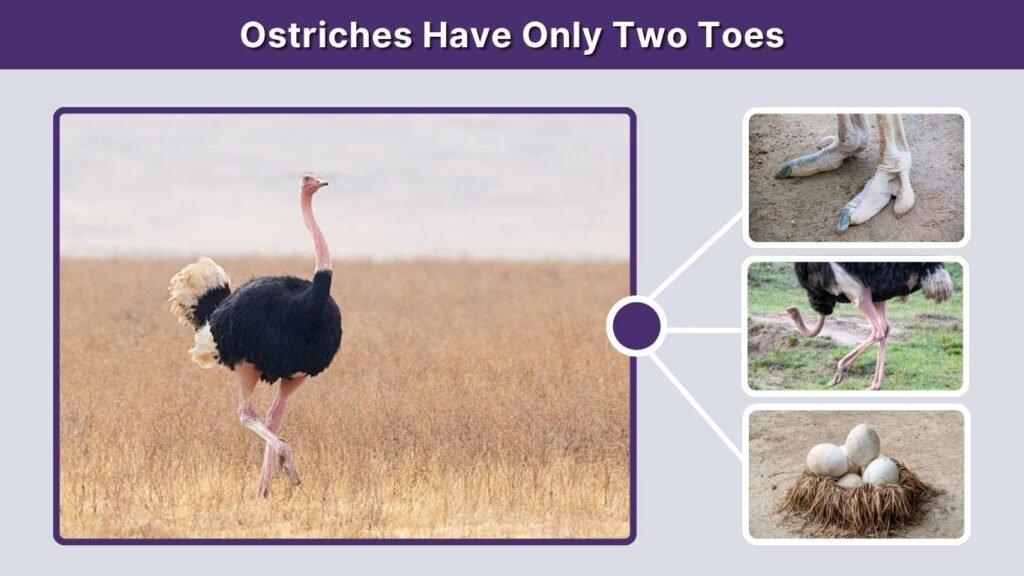
Most birds have three or four toes, but ostriches have only two toes on each foot.
The larger inner toe is especially important for supporting the bird’s weight and helping it run efficiently.
Two-toed feet may reduce unnecessary weight at the end of the leg and contribute to efficient high-speed movement.
One toe also carries a large, strong nail that can become important during defensive kicks.
5. An Ostrich Kick Can Be Dangerous
Ostriches generally prefer escaping from danger rather than fighting, but a cornered bird can defend itself powerfully.
Its muscular legs can deliver forceful kicks capable of seriously injuring predators or humans.
The large claw on the main toe makes the kick even more dangerous.
For this reason, wild ostriches should always be given plenty of space, and captive birds should be handled only by people experienced with large animals.
6. Ostriches Lay the World’s Largest Bird Eggs
Ostrich eggs are the largest eggs produced by any living bird.
A single egg may weigh roughly 3 pounds or more, equivalent in volume to many chicken eggs.
The shell is thick and strong, helping protect the developing chick inside.
Despite being the largest bird egg today, an ostrich egg is actually relatively small compared with the mother’s body size when compared proportionally with eggs produced by many smaller birds.
7. Ostrich Eyes Are Extremely Large
Ostriches have some of the largest eyes of any land vertebrate.
Each eye is roughly 2 inches across and can actually be larger than the bird’s brain.
Large eyes provide excellent vision across open landscapes, allowing ostriches to notice approaching predators from far away.
Their long eyelashes help protect their eyes from dust, sand, and harsh sunlight in dry environments.
8. Ostriches Have Small Brains
Although an ostrich has enormous eyes, its brain is surprisingly small.
The bird does not rely on complex problem-solving in the way some highly intelligent birds such as crows or parrots do.
Instead, survival depends heavily on excellent senses, instinctive behavior, speed, and awareness of the surrounding landscape.
The saying that ostriches are especially “stupid” is exaggerated, however. They possess behaviors well adapted to their natural environment.
9. Ostriches Do Not Bury Their Heads in Sand
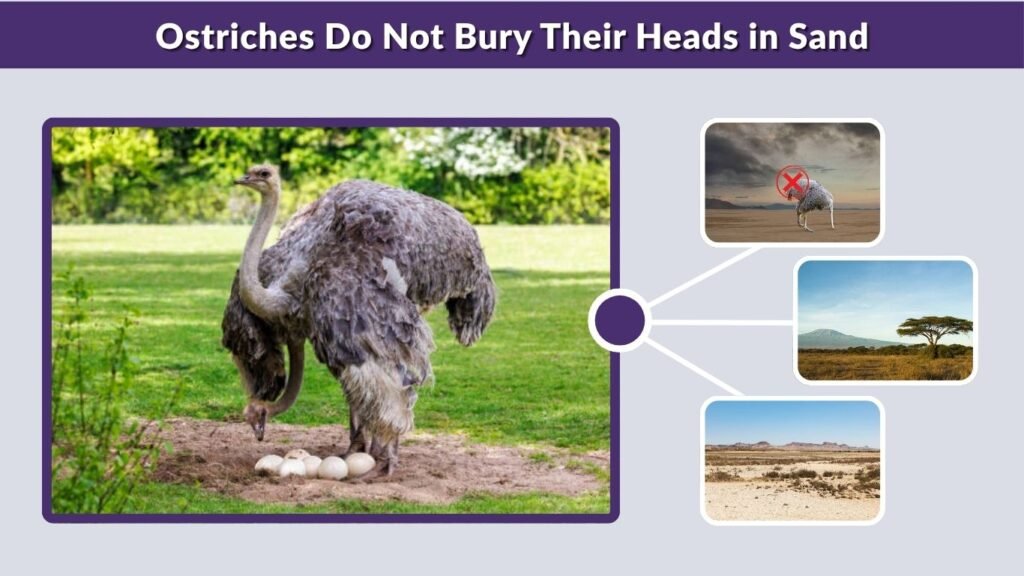
One of the most famous ostrich myths is that frightened birds bury their heads in the sand.
They do not actually do this.
An ostrich may lower its long neck close to the ground when checking eggs, tending a nest, or attempting to remain less noticeable.
Viewed from a distance, especially in uneven terrain, the bird’s pale head can seem to disappear, perhaps creating the myth that it has buried its head.
10. Ostriches Are Native to Africa
Wild ostriches naturally occur in Africa.
They inhabit regions of eastern and southern Africa and some areas farther north, depending on the population.
Typical ostrich habitats include:
- Savannas
- Grasslands
- Semi-deserts
- Open shrublands
- Dry plains
These open habitats provide enough visibility for ostriches to spot danger and enough space to use their exceptional running ability.
11. Ostriches Eat Both Plants and Animals

Ostriches are primarily plant eaters but have an opportunistic diet.
Common foods include:
- Grasses
- Seeds
- Leaves
- Flowers
- Fruits
- Roots
- Insects
- Small animals occasionally
Their flexible diet helps them survive seasonal changes in food availability.
Because they do not have teeth, ostriches swallow small stones and grit that remain inside the digestive system and help grind tough food.
12. Ostriches Can Survive in Dry Environments
Ostriches are well adapted to hot, relatively dry regions.
They drink water when it is readily available, but they can obtain significant moisture from the plants they eat.
Their bodies are also capable of tolerating heat efficiently.
During extremely hot conditions, an ostrich can open its mouth and use other behaviors to help release excess heat.
This ability allows the birds to live in habitats where permanent water sources may be widely separated.
13. Male and Female Ostriches Look Different
Adult male and female ostriches can usually be distinguished by their plumage.
Mature males commonly have:
- Mostly black body feathers
- White wing feathers
- White tail feathers
Females and immature birds are generally grayish or brownish.
The female’s muted coloration provides camouflage when she is near a nest during daylight, while the darker male plumage can be less conspicuous when he incubates during nighttime hours.
14. Male Ostriches Help Incubate the Eggs
Ostrich parenting involves both sexes.
Several females may lay eggs in a communal nest, usually a shallow depression scraped into the ground.
The dominant female typically contributes several eggs and helps incubate them.
Males also play an important role and often sit on the nest at night.
After the chicks hatch, adults protect and guide them while the young birds learn to move and forage in their environment.
15. Baby Ostriches Grow Very Quickly

Ostrich chicks are relatively well developed when they hatch and can walk soon afterward.
Their early coloration is quite different from an adult’s, providing camouflage among grasses and dry vegetation.
Young ostriches grow rapidly during their first months and may gain substantial height in a relatively short period.
Although chicks can move quickly, they remain vulnerable to predators, so adults closely guard groups of young birds.
More Interesting Ostrich Facts
Ostriches have many other unusual adaptations beyond their size and running ability. Their biology reflects millions of years of evolution toward life on the ground rather than in the air.
Fun Facts About Ostriches
Here are a few additional facts:
- Ostriches belong to a group of flightless birds called ratites.
- Their wings are used during courtship displays.
- Males can produce deep booming calls.
- Ostriches may live for several decades.
- Their necks allow them to scan over tall grasses.
- Feathers help provide shade to chicks.
- Groups of ostriches may graze alongside mammals such as zebras and antelope.
- Their excellent eyesight can also help nearby grazing animals detect predators.
Ostrich Facts for Kids
Ostriches are particularly fascinating to children because many of their features break the usual rules people associate with birds.
Easy Ostrich Facts to Remember
- Ostriches are birds, but they cannot fly.
- They are the largest birds alive today.
- They have only two toes on each foot.
- Ostriches can run faster than most humans.
- Their eggs are enormous.
- They have very large eyes.
- Ostriches come from Africa.
- They do not bury their heads in the sand.
- Baby ostriches are called chicks.
- They use powerful legs to escape danger.
Ostrich Egg Facts
Ostrich eggs attract particular attention because of their enormous size and remarkably strong shells.
Interesting Facts About Ostrich Eggs
One female can lay several eggs during a breeding period, and multiple females may contribute eggs to a communal nest.
The eggs are usually creamy white and have a hard shell.
An ostrich chick develops inside the egg for roughly six weeks before hatching.
Breaking out is difficult because of the thick shell, so the chick must gradually crack through it using movements of its beak and body.
FAQs
1. What is the most interesting fact about an ostrich?
One of the most impressive facts is that an ostrich can run at approximately 43 mph despite being the world’s largest living bird. Powerful legs, long strides, and specialized two-toed feet allow it to escape predators across open African landscapes.
2. Can an ostrich really kill a lion?
An ostrich’s kick can be extremely powerful and could seriously injure a large predator. However, ostriches normally try to run away rather than fight lions. Defensive kicks are generally used when escape is impossible or when adults are protecting themselves or their young.
3. Do ostriches really bury their heads in sand?
No. Ostriches do not bury their heads in sand when frightened. They sometimes lower their heads and necks close to the ground while tending nests or attempting to avoid detection. From a distance, this behavior probably helped create the famous myth.
4. How fast can an ostrich run?
An ostrich can reach approximately 43 mph, or around 70 km/h, during high-speed running. Its long legs produce enormous strides, while its two-toed feet and powerful muscles help make the ostrich one of the fastest-running birds and land animals.
5. How big is an ostrich egg?
An ostrich egg commonly weighs around 3 pounds, though size varies. It is the largest egg produced by any living bird and contains the equivalent of many chicken eggs. The shell is exceptionally thick and protects the developing chick during incubation.
