
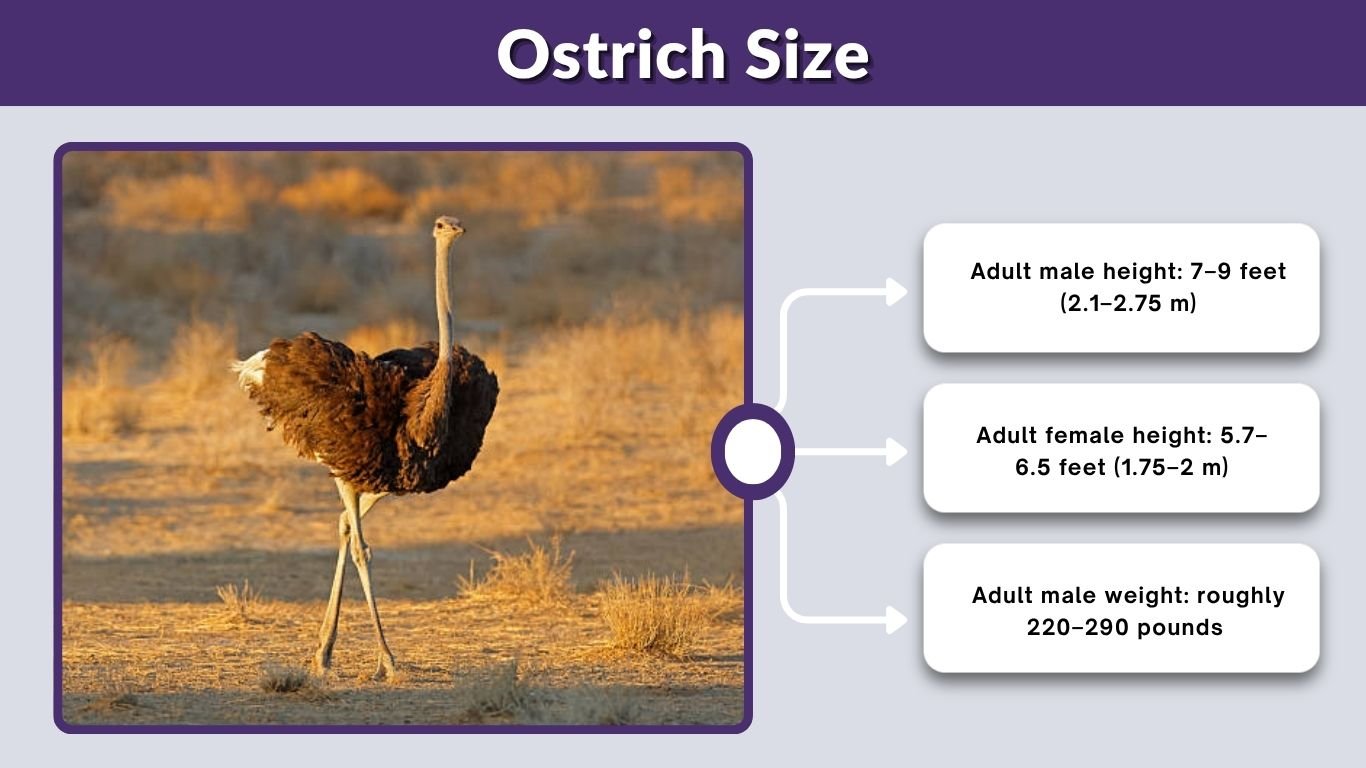
Ostriches are the largest living birds, with adult males capable of standing nearly 9 feet tall and weighing more than 300 pounds in exceptional cases. Their remarkable size comes mostly from extremely long legs and a tall neck, while their rounded body holds powerful muscles built for running. Ostriches are also famous for producing the largest eggs of any living bird. From their giant eyes to their surprisingly small brains, understanding ostrich size becomes even more interesting when compared with humans, emus, rheas, cassowaries, and ordinary chicken eggs.
How Big Is an Ostrich?
Adult ostrich size varies according to sex, subspecies, nutrition, and individual development. Males are generally taller and heavier than females. Even an average adult ostrich towers over most people, making it easy to understand why the species holds the title of world’s largest living bird.
Average Ostrich Height and Weight
Typical adult measurements are approximately:
- Adult male height: 7–9 feet (2.1–2.75 m)
- Adult female height: 5.7–6.5 feet (1.75–2 m)
- Adult male weight: roughly 220–290 pounds (100–130 kg)
- Large males: may exceed 300 pounds (136 kg)
- Adult female weight: often around 200–240 pounds (90–110 kg)
Much of an ostrich’s height comes from its long neck and exceptionally long legs.
Despite its enormous size, an ostrich is built for speed rather than slow, heavy movement.
Why Are Ostriches So Large?
Ostriches evolved as ground-dwelling birds in open African environments.
Because they do not fly, they do not face the same body-weight limitations as flying birds. Instead, evolutionary pressure favored powerful legs, speed, and height.
Being tall also gives an ostrich an excellent view across grasslands and savannas. It can detect predators from considerable distances and escape by running rather than flying.
Ostrich Size Compared to a Human
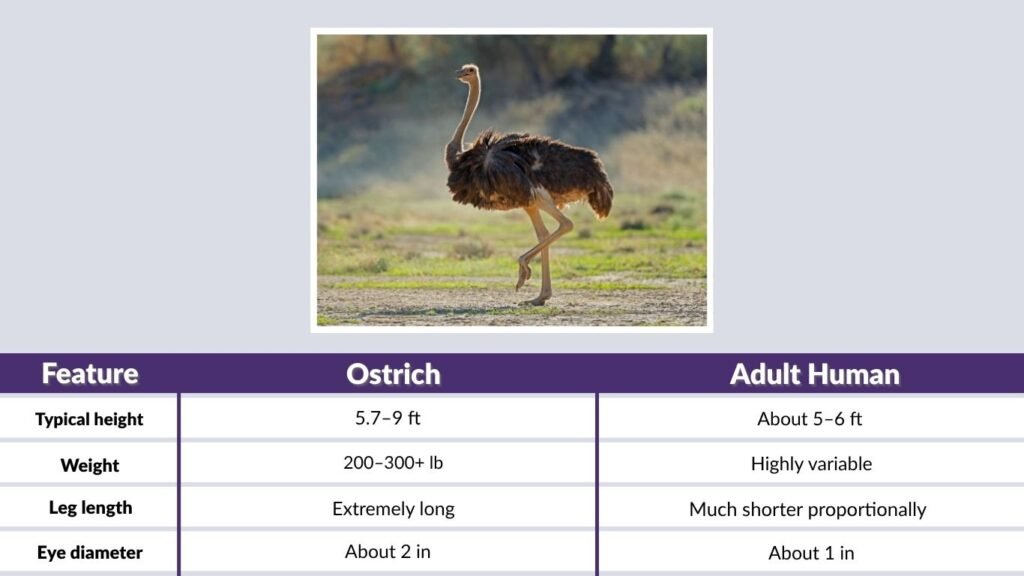
Standing next to a full-grown male ostrich can be surprising. A typical adult human is around 5–6 feet tall, while a large male ostrich can approach 9 feet.
Ostrich vs Human Size
A basic comparison looks like this:
| Feature | Ostrich | Adult Human |
| Typical height | 5.7–9 ft | About 5–6 ft |
| Weight | 200–300+ lb | Highly variable |
| Leg length | Extremely long | Much shorter proportionally |
| Eye diameter | About 2 in | About 1 in |
| Running speed | Up to ~43 mph | Much slower |
An ostrich’s body itself is not 9 feet tall. Its long neck and legs account for a large proportion of the total height.
Can an Ostrich Be Taller Than a Person?
Yes. Adult males are usually taller than the average person.
Even many females can look remarkably large when standing upright. A tall male can stand several feet above a person’s head.
This height also makes adult ostriches potentially dangerous at close range because their powerful legs are positioned high enough to deliver forceful defensive kicks.
Ostrich Egg Size
The ostrich lays the largest egg of any living bird. A single egg is enormous compared with a chicken egg, although it is surprisingly small relative to the size of the adult female.
Average Ostrich Egg Size and Weight
An average ostrich egg measures roughly:
- Length: about 15 cm (6 inches)
- Width: around 12–13 cm (5 inches)
- Weight: approximately 1.2–1.8 kg (2.6–4 pounds)
- Shell: thick, hard, and cream-colored
Exact dimensions vary among individual birds.
The hard shell protects the developing chick while the egg sits in a shallow ground nest.
Ostrich Egg vs Chicken Egg Size
One ostrich egg can contain roughly the same volume as 20–24 chicken eggs, depending on the sizes being compared.
An ostrich egg is dramatically larger in:
- Overall volume
- Yolk size
- Egg white quantity
- Shell thickness
- Total weight
Despite being enormous, ostrich eggs are not the largest eggs known from bird history. Some extinct giant birds produced significantly larger eggs.
Ostrich vs Emu Size
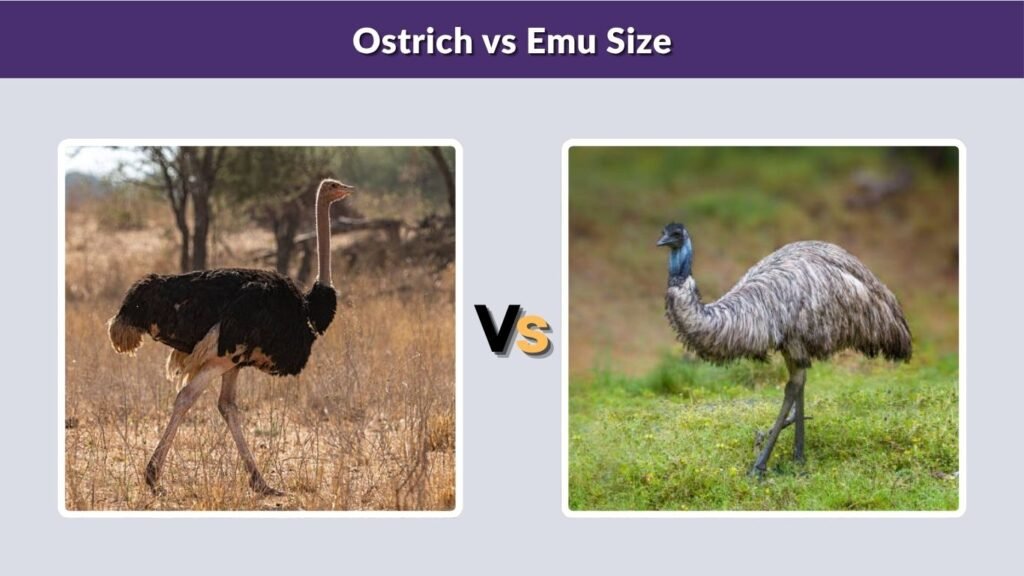
The emu is another large flightless bird, making comparisons with ostriches common. Both have long legs and necks, but the ostrich is substantially larger.
Emu vs Ostrich Height
An adult emu commonly stands around 5–6 feet tall, while a male ostrich can reach approximately 7–9 feet.
Ostriches are also much heavier.
Typical comparisons include:
- Ostrich: about 200–300+ pounds
- Emu: roughly 65–120 pounds
A large ostrich may therefore weigh more than twice as much as an adult emu.
Ostrich Egg vs Emu Egg
Ostrich eggs are also considerably larger.
Emu eggs are famous for their dark green coloration, but they typically weigh far less than an ostrich egg.
The ostrich egg’s pale shell and much greater size make the two easy to distinguish even without seeing the parent birds.
Rhea vs Ostrich Size
Rheas are sometimes called South American ostriches because they look similar, but they are different birds and significantly smaller.
How Much Bigger Is an Ostrich Than a Rhea?
Greater rheas commonly reach about 4–5 feet in height and weigh around 45–90 pounds.
By comparison, an adult ostrich may approach 9 feet and exceed 250 pounds.
The size difference is substantial:
- Ostriches are taller.
- Ostriches are much heavier.
- Ostriches have longer, more powerful legs.
- Ostrich eggs are larger.
- Ostriches can generally run faster.
Rheas have three toes on each foot, whereas ostriches have only two.
Cassowary vs Ostrich Size

Cassowaries are powerful flightless birds from Australia, New Guinea, and nearby islands. They have heavy bodies and strong legs, but they are still smaller than ostriches.
Ostrich vs Cassowary
Cassowaries commonly stand around 5–6 feet tall, although particularly large females can be taller.
Ostriches can reach close to 9 feet.
Cassowaries have stockier bodies relative to their height, while ostriches have much longer necks and legs.
Both species possess powerful legs, but their appearance is very different. Cassowaries have colorful neck skin and a prominent casque on the head, while ostriches have long bare necks and relatively small heads.
Ostrich Brain Size
The ostrich’s brain receives attention because it is surprisingly small relative to the bird’s enormous body. Its eyes are particularly large compared with its brain.
Is an Ostrich Eye Bigger Than Its Brain?
An ostrich eye can measure approximately 5 cm (2 inches) across, making it among the largest eyes of any land vertebrate.
Its brain is smaller than might be expected for an animal of this size.
The huge eyes provide excellent long-distance vision, an important survival adaptation in open habitats where spotting predators early can mean the difference between escaping and being caught.
A small brain does not mean ostriches lack useful behaviors; they are well adapted to their ecological needs.
Ostrich Feet and Claw Size
The bird’s enormous body is supported by two highly specialized feet. Unlike most birds, an ostrich has only two toes on each foot.
Why Ostrich Feet Are Unique
Important characteristics include:
- Two toes instead of three or four
- One much larger main toe
- Strong nail or claw
- Thick pads underneath the toes
- Legs designed for long strides
- Powerful muscles supporting rapid running
The foot structure helps reduce weight at the end of the leg and contributes to efficient high-speed movement.
Ostriches can reach approximately 43 mph (70 km/h) over short distances.
Ostrich Chick Size and Growth
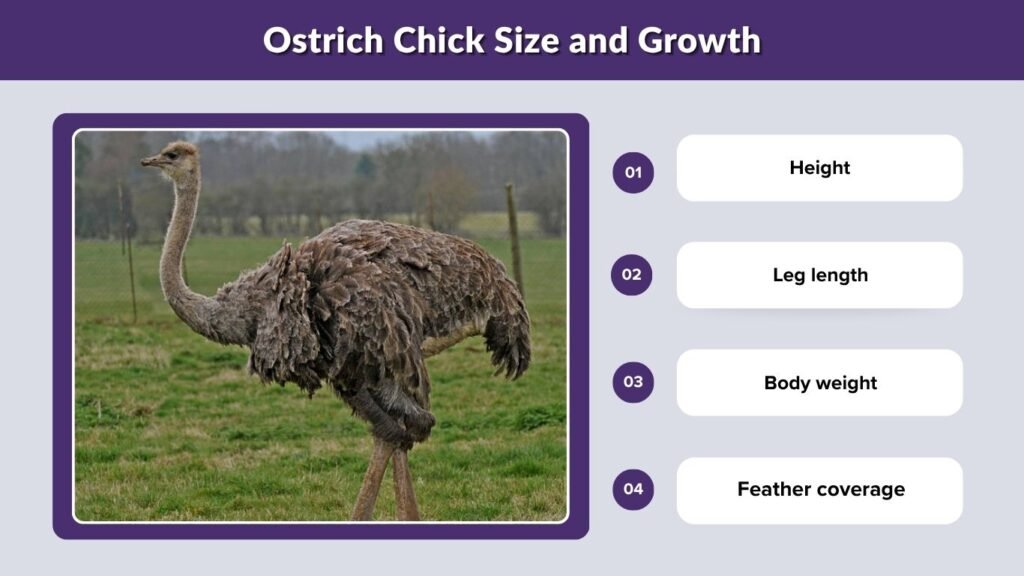
An ostrich chick looks tiny beside an adult, but it is still large compared with the chicks of most birds. Newly hatched chicks are well developed and capable of walking shortly after leaving the egg.
How Fast Do Ostrich Chicks Grow?
Ostrich chicks grow remarkably quickly.
During their first months they rapidly gain:
- Height
- Leg length
- Body weight
- Feather coverage
- Muscle development
Young birds initially have brownish, striped, or mottled plumage that provides camouflage.
As they mature, males gradually develop the characteristic black-and-white adult plumage, while females retain more subdued gray-brown coloring.
Common Ostrich Size Comparison
Looking at several flightless birds together demonstrates just how exceptional the ostrich is.
Flightless Bird Size Comparison
Approximate adult heights are:
- Ostrich: up to about 9 feet
- Emu: around 5–6 feet
- Cassowary: around 5–6 feet
- Greater rhea: around 4–5 feet
- Kiwi: usually under 2 feet
The ostrich is clearly the giant of modern flightless birds.
Its combination of extraordinary height, substantial body weight, long legs, and rapid running speed makes it unlike any other living bird.
FAQs
How tall is a full-grown ostrich?
A full-grown male ostrich commonly stands around 7–9 feet tall, while females are generally about 5.7–6.5 feet. Individual size varies according to sex, subspecies, nutrition, and genetics. Large males can tower several feet above an average adult human.
How much does an ostrich weigh?
Adult males commonly weigh roughly 220–290 pounds, although exceptionally large individuals may exceed 300 pounds. Females are generally lighter and often weigh around 200–240 pounds. Ostriches are both the tallest and heaviest living birds.
How big is an ostrich egg?
An ostrich egg is approximately 6 inches long and around 5 inches wide, although dimensions vary. It generally weighs about 2.6–4 pounds. Ostrich eggs are the largest eggs produced by any living bird.
Is an ostrich bigger than an emu?
Yes. An ostrich can reach almost 9 feet in height and weigh more than 250 pounds, while an emu generally stands around 5–6 feet and weighs considerably less. Ostriches are the largest living birds, while emus are the second tallest.
Is an ostrich eye really bigger than its brain?
Yes. An ostrich eye can measure about 2 inches across and is larger than its brain. These unusually large eyes give ostriches excellent vision, allowing them to detect predators at long distances across the open African landscapes where they naturally live.
