
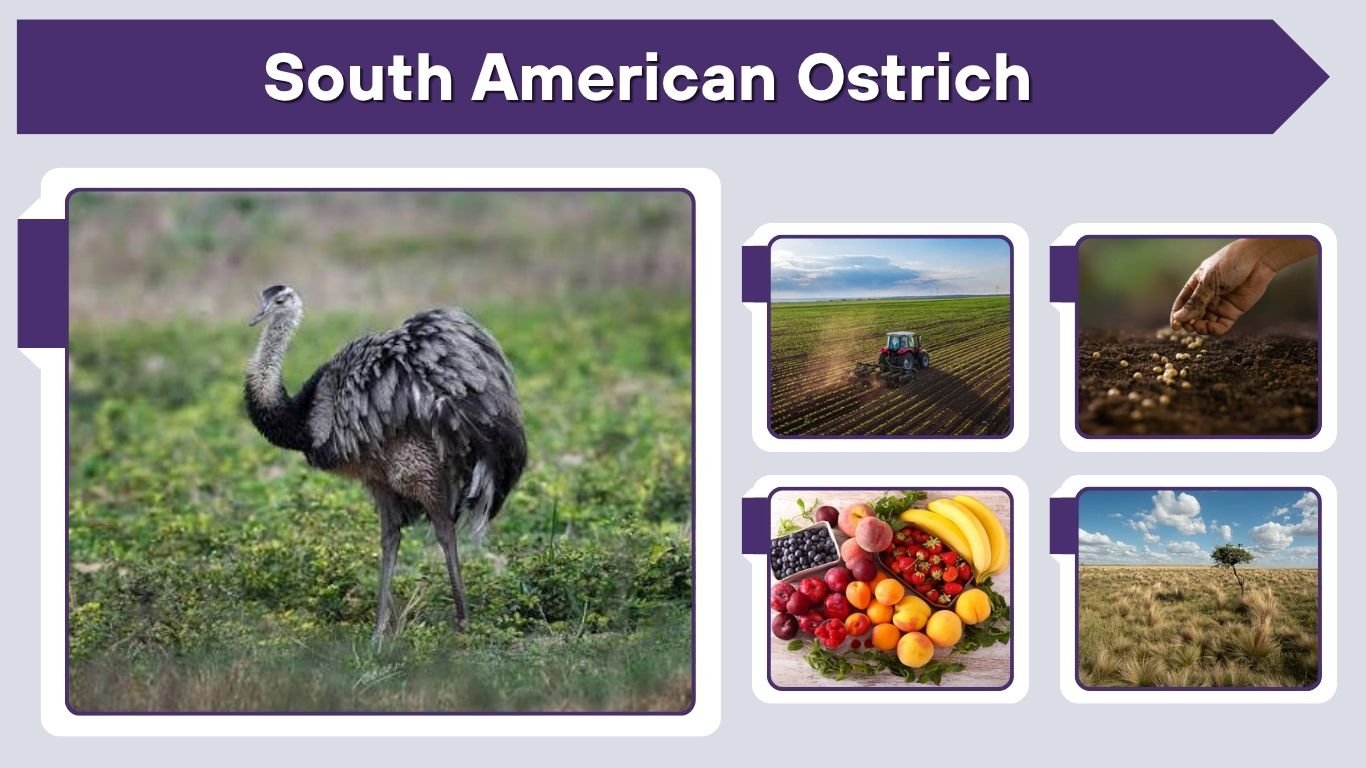
The term South American ostrich usually refers to the rhea, a large flightless bird native to South America. Rheas resemble African ostriches because they have long legs, long necks, and bodies adapted for running, but they are different birds. The greater rhea is the largest bird native to South America and occurs in grasslands and open country across countries such as Argentina, Brazil, Paraguay, Bolivia, and Uruguay. Rheas are omnivorous, fast-moving, social birds with unusual breeding behavior in which males incubate eggs and care for chicks.
What Is a South American Ostrich?
There is no naturally occurring true ostrich species native to South America. The name “South American ostrich” is an informal name used for rheas, which are large flightless birds that superficially resemble ostriches. The bird most commonly associated with the name is the greater rhea, Rhea americana.
South American Ostrich Name
The South American ostrich-like bird is called a rhea. In parts of South America it is also known as ñandú.
Important identification features include:
- Long neck and long legs
- Gray or brown plumage
- Flightless body structure
- Large wings despite being unable to fly
- Three toes on each foot
- Long feathers covering much of the body
- Adult height of roughly 3–5 feet
- Weight commonly around 33–66 pounds
Rheas use their unusually large wings for balance and maneuvering while running.
Is a Rhea Really an Ostrich?
No. A rhea is not a true ostrich.
True ostriches belong to the genus Struthio and are native to Africa. Rheas belong to the family Rheidae and are native to South America. Both are large flightless running birds, which explains their similar appearance and the informal name “South American ostrich.”
Are There Ostriches in South America?
Wild native ostriches do not naturally occur in South America. True ostriches are African birds. However, captive ostriches can be kept on farms or private properties in South American countries. The large wild birds people commonly mistake for ostriches are usually rheas.
Rhea vs Ostrich
Although they look similar, several features separate them.
Rheas:
- Native to South America
- Usually smaller
- Have three toes on each foot
- Mostly gray or brown
- Have relatively large wings
- Use wings for balance while running
Ostriches:
- Native to Africa
- Much larger and heavier
- Have two toes on each foot
- Adult males commonly show black-and-white plumage
- Can reach about 43 mph in short bursts
- Are the world’s largest living birds
The number of toes is one of the easiest physical differences: rheas have three, while ostriches have two.
Where Do South American Ostriches Live?
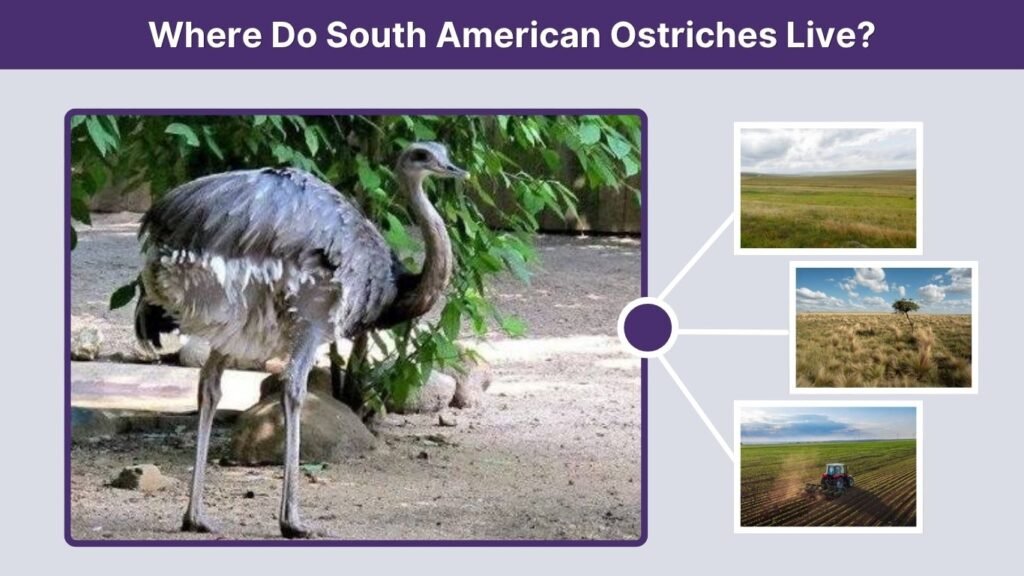
Greater rheas inhabit open environments where running provides an effective way to escape danger. Their range includes substantial portions of southeastern South America, particularly Argentina, Brazil, Uruguay, Paraguay, and Bolivia.
South American Rhea Habitat
Typical habitats include:
- Open grasslands
- Pampas
- Semiarid scrub
- Agricultural landscapes
- Open plains
- Areas near wetlands during breeding periods
Greater rheas can occupy both upland and lowland open habitats. During the breeding season, they may remain closer to rivers, lakes, or marshes.
Why Rheas Prefer Open Land
Their body structure is designed for terrestrial movement rather than flight.
Long legs allow them to cover open ground quickly, while good visibility makes it easier to notice approaching danger. Their wings also contribute to balance and rapid changes in direction.
Dense forest would make these adaptations less useful, which helps explain their close association with grasslands and open scrub habitats.
What Do South American Ostriches Eat?
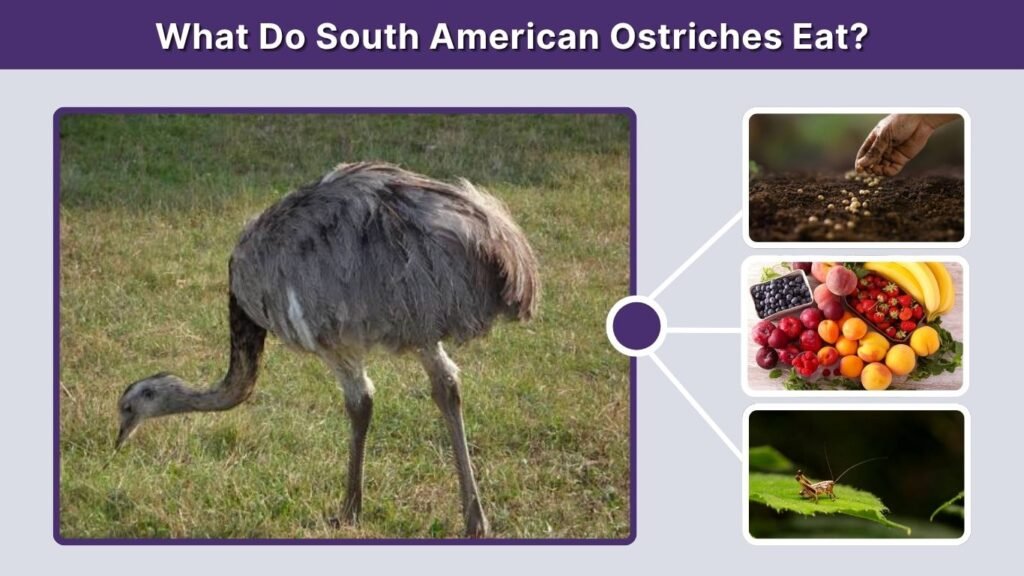
Rheas are omnivores, so their diet includes both plant and animal material. They spend considerable time moving through their habitat while searching for food. Broad-leaved plants and clover can form an important part of the greater rhea’s diet, but these adaptable birds consume many other foods as well.
Common Rhea Foods
A South American rhea may eat:
- Broad-leaved plants
- Clover
- Seeds
- Roots
- Fruits
- Insects
- Small lizards
- Frogs
- Small birds
- Small snakes
Plant material makes up much of the diet, but animal prey can provide additional protein when available.
Do Rheas Eat Crops?
Rheas may enter agricultural areas and consume cultivated plants. Because of their broad diet, they can feed on crops when farmland overlaps with their habitat.
This adaptability allows rheas to find food in changing environments, but it can also create conflicts between the birds and farmers.
How Do South American Ostriches Run?
Rheas cannot fly, but they are well adapted for running. Their long legs allow rapid movement across grassland, while their relatively large wings help them balance and change direction when avoiding danger.
Wings Used for Running
A rhea’s wings are unusually large for a flightless bird.
Instead of producing powered flight, the wings can act somewhat like rudders. While running, the bird extends or adjusts them to maintain balance and make quick turns.
This gives rheas impressive agility in open landscapes, especially when attempting to escape predators.
Why Can’t Rheas Fly?
Rheas belong to a group of large flightless birds often referred to as ratites. Instead of relying on flight, these birds evolved bodies suited to terrestrial life.
Other well-known flightless running birds include:
- African ostriches
- Australian emus
- Cassowaries
- New Zealand kiwis
The rhea represents the South American member of this familiar group of flightless birds.
South American Ostrich Eggs and Breeding
Rhea reproduction is unusual because males take responsibility for building the nest, incubating the eggs, and caring for the young. A male may mate with several females, and multiple females can contribute eggs to the same nest.
Rhea Eggs
A male greater rhea makes a shallow nest depression on the ground. After courtship and mating, females place eggs in the male’s nest.
Several females may contribute, potentially creating a very large collection of eggs.
The eggs are relatively large and often have a yellowish or golden coloration. Once egg laying is complete, the male takes over incubation.
Male Rheas Raise the Chicks
Male rheas incubate the eggs for roughly six weeks and subsequently care for the chicks.
A male protecting eggs or young can become highly defensive. He may charge animals—or even people—that approach too closely.
This paternal care is one of the most fascinating aspects of rhea behavior because the father performs most of the direct nest and chick care.
South American Ostrich Behavior
Rheas are generally social birds and may form groups outside the breeding season. Their behavior changes when reproduction begins, particularly among males that establish breeding areas and care for nests.
Living in Groups
Rheas often travel and feed together.
Group living can provide advantages in open habitat because several birds can watch for potential danger while others feed.
During breeding periods, males become more solitary and territorial as they court females, establish nests, and later defend eggs and chicks.
Courtship Behavior
Male rheas use both sound and visual displays to attract females.
During the breeding season, the male may develop a darker collar near the base of his neck. He produces booming calls and displays his large wings while courting females.
After mating, the male prepares the ground nest where females deposit their eggs.
South American Ostrich Facts
The rhea has many characteristics that make it one of South America’s most distinctive birds.
Interesting Rhea Facts
- Rheas are native to South America.
- The greater rhea is South America’s largest bird.
- Rheas cannot fly.
- They have three toes on each foot.
- Ostriches have only two toes.
- Their long wings help with balance while running.
- Greater rheas can stand up to about 5 feet tall.
- They eat both plants and small animals.
- Males build ground nests.
- Several females may lay eggs in one male’s nest.
- Males incubate the eggs.
- Male rheas also protect and raise young chicks.
- They commonly inhabit grasslands and open scrub.
- They are sometimes called South American ostriches.
- Despite the nickname, rheas are not true ostriches.
FAQs
Are there ostriches in South America?
There are no native wild true ostriches in South America. Ostriches are native to Africa. The large flightless birds naturally found in South America are rheas, which resemble ostriches and are consequently sometimes called South American ostriches. Captive ostriches may occur on farms.
What is the South American ostrich called?
The bird commonly called the South American ostrich is the rhea, particularly the greater rhea (Rhea americana). Rheas are large, flightless South American birds with long legs and necks, but they belong to a different family from true African ostriches.
What is the difference between a rhea and an ostrich?
Ostriches are African and much larger, while rheas are South American and smaller. Ostriches have two toes on each foot, whereas rheas have three. Rheas also have comparatively large wings that they use for balance and steering while running.
What does a South American rhea eat?
Greater rheas are omnivores. They eat broad-leaved plants, clover, fruits, seeds, roots, and other vegetation, along with insects and small vertebrates such as lizards, frogs, small birds, and snakes when suitable opportunities arise.
Who takes care of rhea eggs?
Male rheas perform most of the parental care. A male prepares a shallow ground nest where several females may deposit eggs. He then incubates the eggs for approximately six weeks and protects the chicks after they hatch.
