
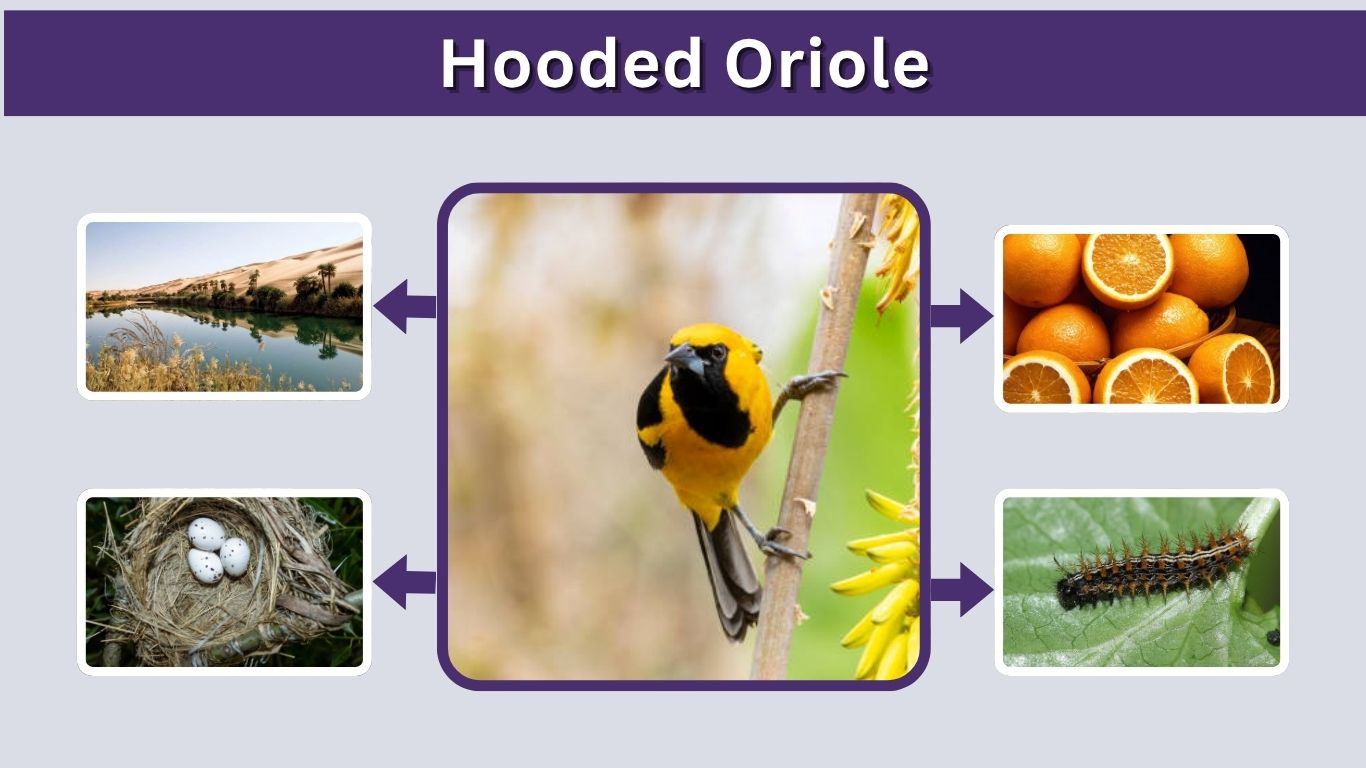
The Hooded Oriole is a bright, elegant songbird best known for its yellow-orange color, slim body, curved bill, and love of palms, flowers, and backyard feeders. Found mostly in the southwestern United States and Mexico, this oriole often appears in warm neighborhoods, gardens, parks, and open areas with tall trees. Its color, chatter, and unique hanging nest make it one of the most interesting orioles to watch.
What Is a Hooded Oriole?
The Hooded Oriole is a medium-sized songbird in the blackbird and oriole family. Its scientific name is Icterus cucullatus. It is sometimes called the “palm-leaf oriole” because it often builds hanging nests under palm fronds, especially in California and other warm areas where palms are common.
This bird is slim, active, and often easier to hear than see. Hooded Orioles may move through trees, flowers, and shrubs while feeding on insects, nectar, and fruit. They are also known for visiting hummingbird feeders, where they may awkwardly bend or hang to drink sugar water.
Although the male is bright and easy to notice, the female and juvenile birds are softer in color. Because of this, people often search for female Hooded Oriole identification, juvenile Hooded Oriole appearance, and male vs female differences.
Hooded Oriole Identification
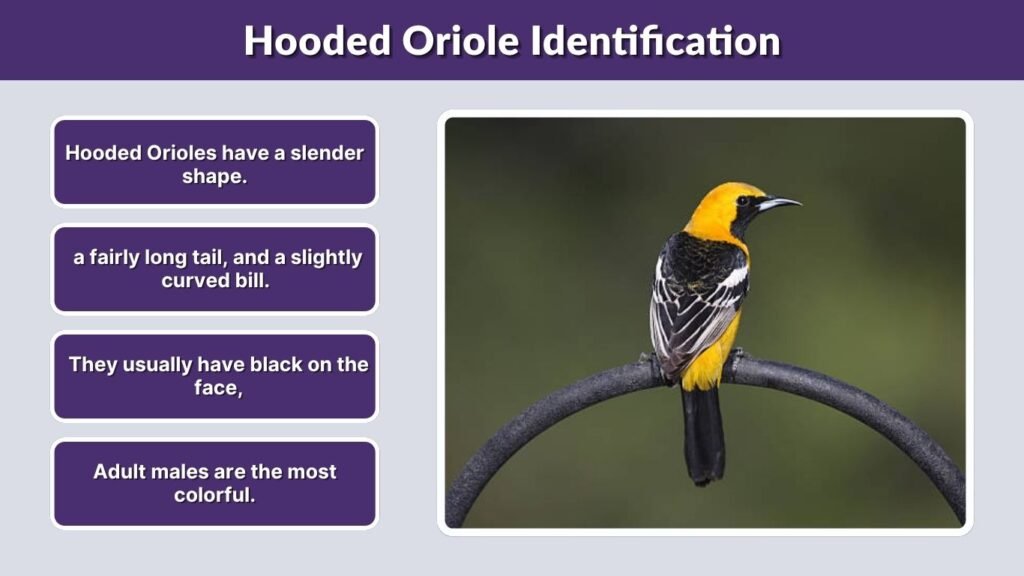
Hooded Orioles have a slender shape, a fairly long tail, and a slightly curved bill. The bill helps them feed on nectar, fruit, and insects. Their flight can look direct and quick, and their bright color may flash through trees when they move.
Adult males are the most colorful. Depending on the region, males may look bright yellow, golden yellow, or orange-yellow. They usually have black on the face, throat, wings, back, and tail. The contrast between the dark throat and bright body gives the bird its “hooded” look.
Female Hooded Orioles are more subtle. They are usually yellowish below and olive-yellow or grayish above. Their wings are darker with pale wing bars, but they do not have the bold black hood of the adult male.
Juvenile Hooded Orioles often look similar to females. Young males may gradually develop stronger yellow-orange color and darker markings as they mature.
Male vs Female Hooded Oriole
Male and female Hooded Orioles can look very different, especially during the breeding season. This difference is important for birdwatchers because many people only recognize the bright male and may overlook the female.
| Feature | Male Hooded Oriole | Female Hooded Oriole |
|---|---|---|
| Color | Bright yellow to orange-yellow | Pale yellow, olive-yellow, or grayish-yellow |
| Face and throat | Black hood or bib | No bold black hood |
| Wings | Black with white wing bars | Darker wings with lighter wing bars |
| Overall look | Bold, bright, high contrast | Softer, plainer, more camouflaged |
| Common confusion | Bullock’s Oriole or Altamira Oriole | Female Bullock’s Oriole or juvenile orioles |
The male is easier to identify because of his bright color and black throat. The female requires more attention to shape, bill, wing bars, and location. If you see a slim yellowish bird with a curved bill visiting palm trees or nectar feeders in the Southwest, it may be a female Hooded Oriole.
Hooded Oriole Range and Habitat
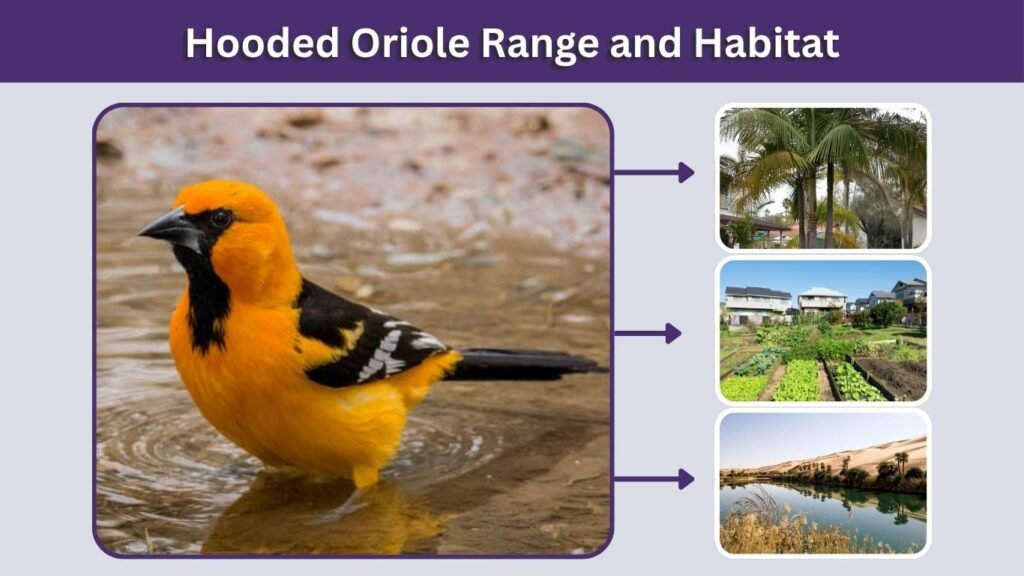
Hooded Orioles are most associated with the southwestern United States, Mexico, and parts of Central America. In the United States, they are often seen in California, Arizona, Texas, New Mexico, and nearby areas. They are especially familiar in Southern California neighborhoods where palms are common.
These birds like warm, open habitats with scattered trees. They are often found in streamside woods, desert oases, parks, suburbs, gardens, and palm-lined streets. They do not need deep forests. In fact, many people see them around homes when flowers, palms, and feeders are available.
Common Places to Find Hooded Orioles
You may find Hooded Orioles in:
- Palm trees and ornamental trees
- Suburban yards and gardens
- Parks and golf courses
- Desert washes and oases
- Streamside woodland edges
- Flowering shrubs and fruiting trees
- Areas with hummingbird feeders
In California, palm trees are especially important because Hooded Orioles often use palm fronds for nesting. In Arizona and Texas, they may use other trees and riparian habitats where food and nesting sites are available.
What Do Hooded Orioles Eat?
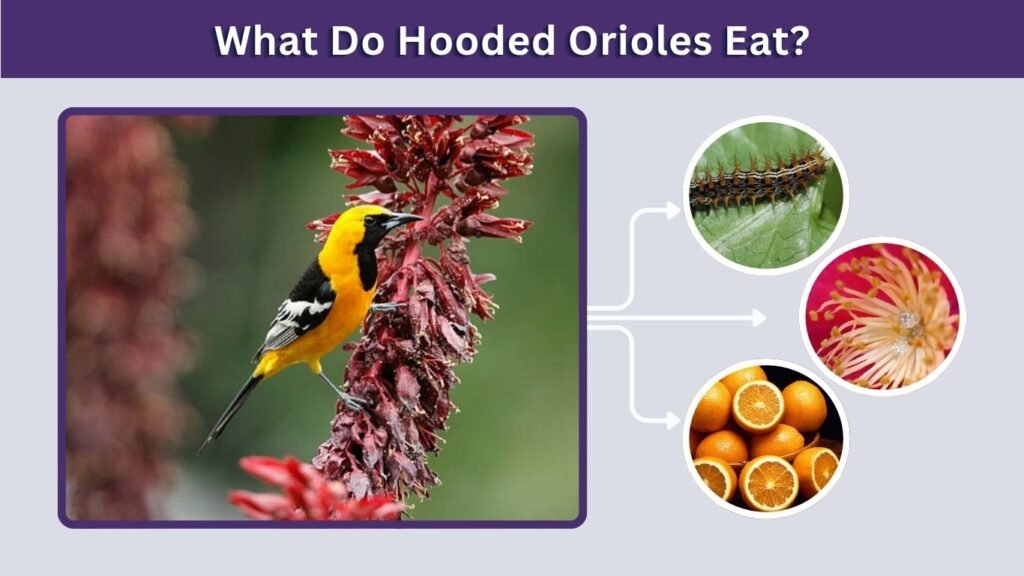
Hooded Orioles eat a varied diet. They feed on insects, nectar, fruit, and sometimes sugar water from feeders. Their diet changes depending on season, location, and food availability.
Insects are especially important during nesting season because growing chicks need protein. Orioles may search leaves, flowers, and branches for caterpillars, beetles, wasps, ants, and other small invertebrates. They also visit flowers for nectar and may pierce the base of flowers to reach the nectar directly.
Foods Hooded Orioles May Eat
Their diet may include:
- Caterpillars and other insects
- Nectar from flowers
- Fruit and berries
- Orange halves or grape jelly at feeders
- Sugar water from nectar feeders
- Small spiders and other arthropods
If you want to attract Hooded Orioles, offering nectar and fruit can help. However, natural landscaping is also important. Flowering plants, native trees, and insect-friendly gardens give them more reasons to visit.
Hooded Oriole Feeders
Hooded Orioles often visit hummingbird feeders, but they may have trouble using feeders designed only for tiny hummingbirds. Orioles are larger and need better perching space. An oriole feeder with larger ports, a perch, and bright orange features may work better.
A simple nectar mixture can be made with plain white sugar and water. Do not use honey, artificial sweeteners, food dye, or brown sugar. Keep feeders clean because sugar water can spoil quickly in warm weather.
How to Attract Hooded Orioles
To make your yard more attractive:
- Offer clean nectar in an oriole-friendly feeder
- Put out fresh orange halves during migration or breeding season
- Plant nectar-rich flowers
- Grow native plants that support insects
- Avoid spraying pesticides
- Keep feeders clean and shaded when possible
- Provide tall trees or palms nearby
A yard with flowers, insects, fruit, and safe nesting trees is more attractive than a yard with feeders alone.
Hooded Oriole Nest and Eggs
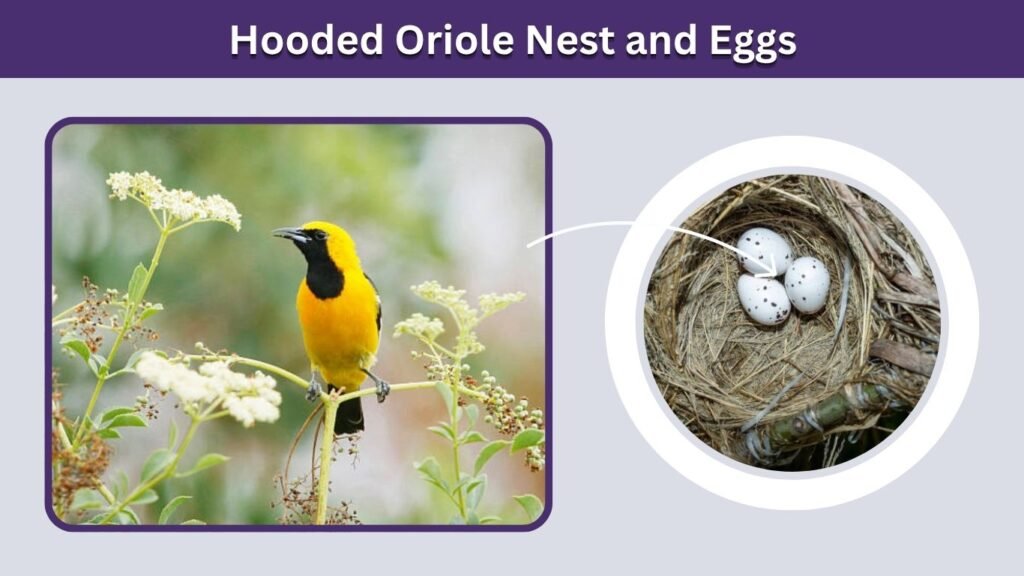
The Hooded Oriole is famous for its hanging nest. The female usually builds the nest, often attaching it to the underside of a palm frond or suspending it from leaves or branches. The nest is shaped like a pouch or basket and is woven from plant fibers, grasses, and other flexible materials.
In palm trees, the female may push fibers through the palm leaf and sew the nest into place. This behavior is one reason the bird is called a palm-leaf oriole. The nest may hang safely below the leaf, helping protect it from some predators and weather.
Hooded Oriole eggs are usually pale with darker markings. The female does most of the nest-building and incubation, while both parents may help feed the young after hatching.
Hooded Oriole Song and Call
Hooded Orioles are often heard before they are seen. Their sounds include chatter, whistles, harsh notes, and short musical phrases. The song may sound jumbled or varied rather than smooth and simple.
They can also mimic sounds from nearby birds. This means Hooded Oriole songs may vary by location. A bird in Arizona may include different copied notes than one in California.
People searching for Hooded Oriole call or Hooded Oriole song usually want to know what to listen for in the field. The best clue is a mix of chatter and bright notes coming from palms, flowering trees, or leafy cover.
Hooded Oriole Migration
Many Hooded Orioles migrate. In much of the United States, they are mainly spring and summer birds. They arrive for breeding and then move south after the season. Some may remain in warmer areas or near reliable feeders, but many leave their northern breeding range when conditions change.
In Southern California and other warm regions, people often notice them in spring when males begin appearing around palms and feeders. Later in the year, activity may decrease as birds move south.
Migration timing can vary by region, food supply, and weather. If Hooded Orioles disappear from a yard after summer, it is usually part of their normal seasonal movement.
Hooded Oriole vs Similar Orioles
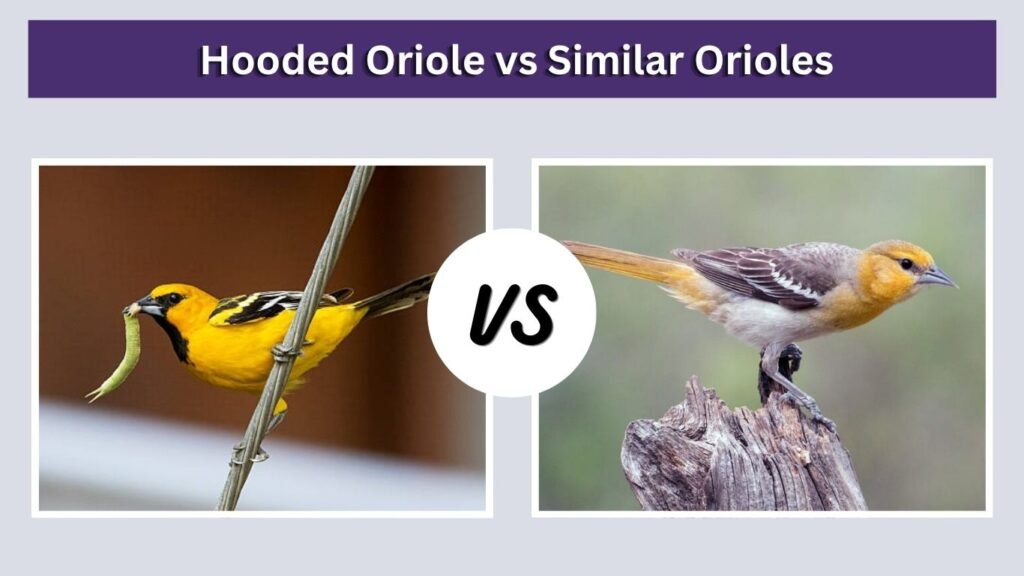
Hooded Orioles can be confused with other yellow or orange orioles, especially Bullock’s Orioles, Altamira Orioles, Orchard Orioles, and Baltimore Orioles. Location is one of the best clues. Hooded Orioles are mostly a southwestern species in the United States, while Baltimore Orioles are more common in the East.
Bullock’s Orioles overlap with Hooded Orioles in parts of the West. Male Bullock’s Orioles often show more orange on the face with a different head pattern, while Hooded Orioles have a stronger black throat and hooded look. Female orioles can be harder to separate, so shape, bill, wing bars, range, and behavior all matter.
Are Hooded Orioles Rare?
Hooded Orioles are not usually considered rare in the right habitat. In parts of California, Arizona, Texas, and Mexico, they can be fairly common during the right season. However, they may seem rare to people outside their normal range or to those who do not have palms, flowering plants, or feeders nearby.
They can also be easy to miss. Females and juveniles are less colorful, and even bright males may stay partly hidden while feeding in trees. Learning their chatter and preferred habitat can make them much easier to find.
FAQs
What does a Hooded Oriole look like?
A male Hooded Oriole is bright yellow to orange-yellow with black on the face, throat, wings, back, and tail. A female is softer yellow or olive-yellow with darker wings and pale wing bars. Both have a slender body, long tail, and slightly curved bill that helps them feed on nectar and insects.
Where do Hooded Orioles live?
Hooded Orioles live mainly in the southwestern United States, Mexico, and nearby regions. In the U.S., they are often seen in California, Arizona, Texas, and surrounding areas. They prefer warm places with palms, scattered trees, gardens, streamside woods, parks, and suburban neighborhoods with flowers or feeders.
What do Hooded Orioles eat?
Hooded Orioles eat insects, nectar, fruit, and sometimes sugar water from feeders. During nesting season, insects are especially important because young birds need protein. Adults may also visit flowers, orange halves, grape jelly, and hummingbird-style nectar feeders, especially when natural food is easy to reach nearby.
How can I attract Hooded Orioles?
You can attract Hooded Orioles by offering clean nectar in an oriole feeder, providing orange halves, planting nectar-rich flowers, and avoiding pesticides. Native plants are helpful because they support insects, which orioles need for feeding young. Tall trees or palms nearby can also make your yard more appealing.
Do Hooded Orioles migrate?
Yes, many Hooded Orioles migrate. In much of the southwestern United States, they are mainly spring and summer breeding birds. After nesting season, many move south toward Mexico or warmer regions. In some mild areas, a few may remain longer, especially if food sources or feeders are available.
